
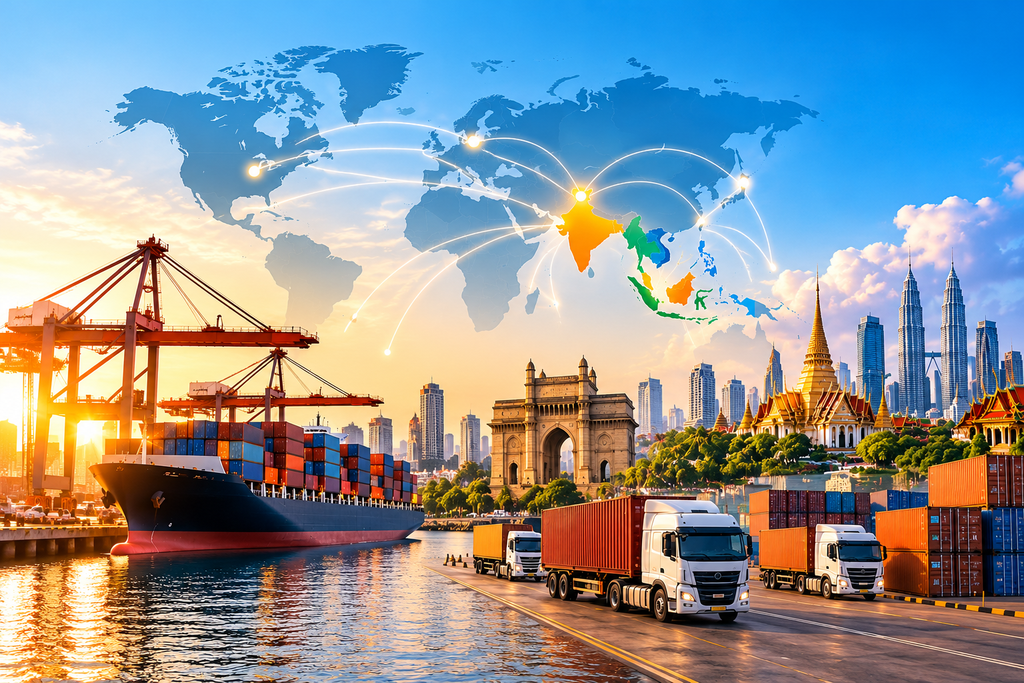
In short: Global companies are spreading manufacturing beyond China to reduce risk. India, Vietnam, Indonesia, Thailand and Malaysia are the main winners, each for different reasons: India for scale and talent, Vietnam for export readiness, Indonesia for raw materials, Thailand for automotive depth and Malaysia for semiconductors. The shift is gradual, not a sudden exit, and it is reshaping trade flows, investment and jobs across Asia.
For three decades, the formula for global manufacturing was simple: design in the West, build in China, sell everywhere. That model delivered low costs and huge scale. But a series of shocks exposed its weakness. Pandemic factory shutdowns, shipping bottlenecks, trade tariffs, export controls and rising geopolitical tension all showed how risky it is to depend on a single country for critical goods.
The response has not been a dramatic exodus. Instead, companies are diversifying. Many now follow a “China plus one” or “China plus many” strategy, keeping capacity in China while building alternatives elsewhere. India and Southeast Asia are capturing much of this new investment. This article explains why, compares the leading destinations, and looks at what the shift means for businesses of every size.
The Five Forces Driving the Shift
1. Resilience over pure cost
Boards and investors now ask how a company would cope if one country, port or supplier became unavailable. Concentration risk has become a board-level issue, and spreading production across several countries is the most direct answer.
2. Trade policy and tariffs
Tariffs and export controls between major economies have raised the cost and uncertainty of routing certain goods through China. Producing in a third country can reduce exposure to these measures, although rules of origin mean simple re-labelling does not work.
3. Rising costs in China
Wages in China’s coastal manufacturing hubs have risen steadily, and the country is moving up the value chain toward advanced manufacturing. Labour-intensive assembly is increasingly competitive elsewhere.
4. Government incentives
Destination countries are competing hard. India’s production-linked incentive (PLI) schemes reward output in sectors such as electronics, pharmaceuticals and solar modules. Southeast Asian governments offer tax holidays, industrial parks and fast-track approvals.
5. Growing regional demand
Asia’s own middle class is expanding rapidly. Producing close to these consumers cuts shipping time and lets companies serve both export and domestic markets from the same factory.
Country Snapshot: Who Is Winning and Why
India
Strengths: huge domestic market, young workforce, engineering and software talent, PLI incentives, improving highways, ports and power.
Key sectors: smartphones and electronics, pharmaceuticals, auto components, textiles, chemicals, renewable equipment.
Watch out for: land acquisition, state-level regulatory differences, logistics costs in some regions.
Vietnam
Strengths: proven export ecosystem, many free trade agreements, competitive labour, proximity to Chinese suppliers.
Key sectors: consumer electronics, apparel, footwear, furniture.
Watch out for: power supply strain, rising wages, a smaller labour pool than India.
Indonesia
Strengths: large population, rich natural resources including nickel, growing domestic consumption.
Key sectors: battery materials, electric vehicle supply chains, food processing, consumer goods.
Watch out for: export restrictions on raw materials, island logistics, bureaucracy.
Thailand
Strengths: deep automotive cluster, skilled technicians, strong infrastructure.
Key sectors: vehicles and EVs, auto parts, electronics, food exports.
Watch out for: ageing workforce and slower labour force growth.
Malaysia
Strengths: decades of semiconductor assembly and testing experience, English-speaking workforce, stable business environment.
Key sectors: semiconductors, electrical and electronics, medical devices.
Watch out for: skilled labour shortages in advanced segments.
Philippines
Strengths: large English-speaking workforce, strong services and electronics base.
Key sectors: electronics components, business process services, shipbuilding.
Watch out for: infrastructure gaps and higher power costs.
Side-by-Side Comparison
The table below gives a qualitative view of how the leading destinations compare on the factors companies weigh most heavily when choosing a new production base.
| Factor | India | Vietnam | Indonesia | Thailand | Malaysia |
|---|---|---|---|---|---|
| Labour pool size | Very large | Medium | Large | Medium | Small |
| Domestic market | Very large | Medium | Large | Medium | Small |
| Supplier ecosystem | Growing fast | Mature for electronics | Developing | Mature for auto | Mature for chips |
| Engineering talent | Very strong | Moderate | Moderate | Good | Good |
| Speed of setup | Moderate | Fast | Moderate | Fast | Fast |
| Best fit | Scale + local sales | Export assembly | Resources + EV | Automotive | Semiconductors |
What the Shift Looks Like in Practice
The movement of supply chains is happening in layers. First come final assembly lines, which are easiest to relocate. Electronics brands, for example, have expanded smartphone and laptop assembly in India and Vietnam. Next come component suppliers, who follow their customers to stay competitive. Finally, raw materials and specialised inputs begin to be produced locally, which is the slowest and hardest stage.
This layered process explains why many “new” factories still import a large share of their components from China in the early years. Building a full local ecosystem takes time. The countries that move fastest from assembly to component production will capture the most long-term value.
The Risks and Challenges
- Infrastructure gaps: ports, power grids and roads in some locations are still catching up with demand.
- Higher initial costs: new facilities, training and duplicate supply lines raise costs before efficiencies kick in.
- Talent bottlenecks: skilled technicians and experienced plant managers can be scarce in fast-growing hubs.
- Policy uncertainty: incentive schemes can change, and rules of origin require genuine local value addition.
- Quality control: new suppliers need time and support to reach established quality standards.
What It Means for Businesses
For multinationals
Supply chain design is now a strategic capability. Leading firms map every tier of their suppliers, run disruption scenarios and spread production across at least two regions for critical products.
For Indian and Southeast Asian SMEs
The shift is a major opportunity. Local manufacturers can join the supply chains of global brands as component makers, packaging suppliers, logistics partners or service providers. Certifications, consistent quality and digital readiness are the tickets to entry.
For importers and online sellers
Diversifying sourcing across several countries reduces the risk of a single disruption halting your business. Trade agreements may also lower duties when you buy from certain countries.
For investors
Industrial parks, logistics, warehousing, power generation and manufacturing services in these regions are seeing strong interest as factories expand.
How to Build a More Resilient Supply Chain
- Map your exposure: list every key supplier and the country each one depends on, including their suppliers.
- Identify single points of failure: any product with one source or one shipping route is a priority.
- Qualify alternative suppliers: start with small trial orders before shifting volume.
- Balance inventory: hold strategic buffer stock for critical components rather than running ultra-lean.
- Use digital tools: supply chain visibility platforms help track shipments and spot problems early.
- Review regularly: revisit risks every quarter as trade policies and conditions change.
Sector Spotlight: Where the Movement Is Strongest
Electronics
Electronics is the clearest example of diversification. Global brands and their contract manufacturers have expanded smartphone, laptop and wearable assembly in India and Vietnam, while Malaysia continues to grow its role in chip assembly, testing and packaging. Component makers for displays, batteries, cameras and printed circuit boards are gradually following.
Pharmaceuticals and healthcare
India already supplies a large share of the world’s generic medicines. Governments and drug companies are now encouraging more local production of key starting materials and active pharmaceutical ingredients, which were heavily sourced from China, to reduce the risk of shortages.
Automotive and electric vehicles
Thailand and Indonesia are positioning themselves as EV hubs, with Indonesia leveraging its nickel reserves for battery materials. India is building capacity across vehicles, two-wheelers and components, supported by incentives for advanced battery cells.
Textiles and apparel
Apparel and footwear moved early. Vietnam, Bangladesh, Cambodia and India compete on cost, speed and compliance with buyer standards on labour and sustainability.
The Role of Trade Agreements
Trade agreements quietly shape where factories are built. The Regional Comprehensive Economic Partnership links much of Asia-Pacific, while many Southeast Asian nations hold agreements with the European Union and other major markets. India has been expanding its own network of trade deals. For a business choosing a production base, lower tariffs into the target market can matter as much as labour cost, so trade access is now a core part of site selection.
The Outlook
Most analysts expect the diversification trend to continue for years. The pace will depend on how quickly destination countries improve infrastructure, deepen supplier networks and keep policies stable. India’s sheer scale makes it the most closely watched story, while Vietnam and Malaysia are likely to stay strong in specialised niches. For businesses, the lesson is clear: resilience is now part of competitiveness, and the map of global manufacturing is being redrawn in real time.
Key Takeaways
- Companies are diversifying production beyond China, not abandoning it.
- India leads on scale and talent; Vietnam on export readiness; Malaysia on chips; Thailand on autos; Indonesia on EV materials.
- Assembly moves first; components and materials follow more slowly.
- Infrastructure, talent and policy stability decide which countries win long term.
- SMEs in the region can benefit by becoming suppliers to global brands.
Frequently Asked Questions
What is the China plus one strategy?
China plus one is a sourcing approach where a company keeps some production in China but adds at least one other manufacturing country, such as India or Vietnam, to reduce dependence on a single location and lower geopolitical and disruption risk.
Why are companies moving production to India?
India offers a large domestic market, a young workforce, government incentives such as production-linked incentive schemes, improving infrastructure and strong engineering talent. It is especially attractive for electronics, pharmaceuticals, auto components and textiles.
Is Vietnam better than India for manufacturing?
Neither is universally better. Vietnam has a mature export ecosystem and fast setup for electronics and apparel, while India offers scale, a huge domestic market and deeper engineering talent. The right choice depends on product type, target market and supplier needs.
Does moving supply chains out of China reduce costs?
Not always in the short term. Labour may be cheaper, but companies face setup costs, less mature supplier networks and logistics gaps. The main benefit is resilience and reduced concentration risk, with costs often improving as local ecosystems mature.
How can small businesses benefit from the supply chain shift?
Small firms can become suppliers to multinationals setting up in the region, diversify their own sourcing across several countries, use sourcing agents and trade platforms, and take advantage of trade agreements that lower tariffs on goods from these markets.