
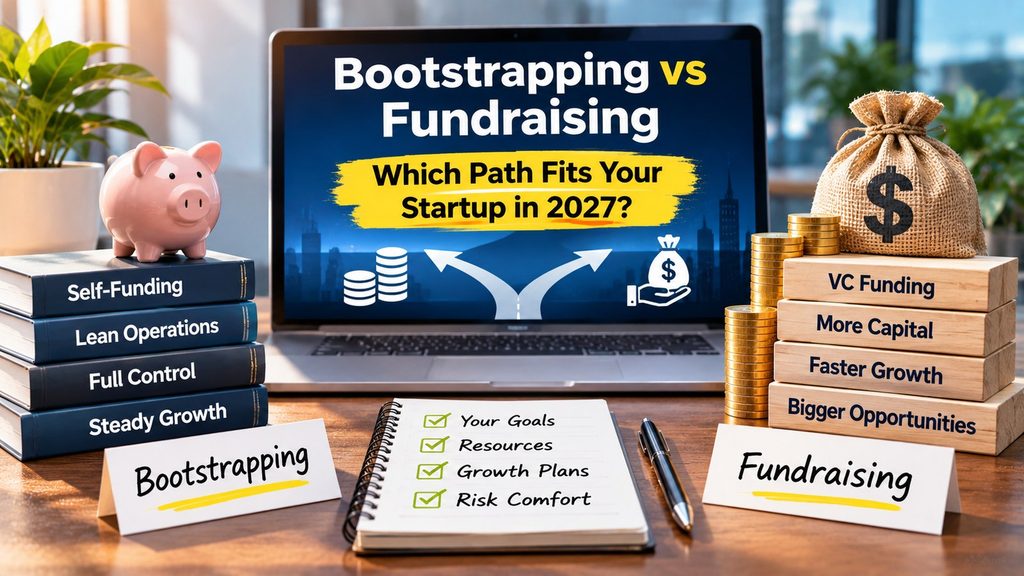
Quick answer: Bootstrap if your business can earn revenue early, grow steadily and you value control and profitability. Raise venture capital if you need large upfront investment, face a winner-takes-most market and are aiming for a very large outcome within roughly a decade. Many of the smartest founders do both in sequence: bootstrap to prove demand, then raise on stronger terms, or use middle-ground options such as angels and revenue-based financing.
Few decisions shape a startup as deeply as how it is funded. The choice affects how fast you grow, who you answer to, what success looks like and how much of the company you own at the end. For years, startup culture treated raising venture capital as the default sign of success. That has shifted. Tighter funding markets, more capital-efficient tools and a wave of profitable bootstrapped companies have made founders think harder about which path truly fits their business.
This guide gives you a practical framework: a decision path, a self-assessment quiz, a side-by-side comparison and an overview of hybrid options, so you can make the choice deliberately rather than by default.
Understanding the Two Paths
Bootstrapping
You fund the business from savings, early revenue and sometimes small loans. You keep full ownership and decide your own pace.
- Full control and ownership
- Discipline around profit and cash
- Freedom to build a lasting, steady business
- Slower growth and personal financial risk
Venture Fundraising
You sell shares to investors who back high-growth companies in return for a potentially large exit.
- Capital to grow fast and hire early
- Investor networks, advice and credibility
- Ownership dilution and board oversight
- Pressure for rapid scale and a big exit
The Decision Path
Answer these questions in order. They will point you toward the path that best fits your business.
1. Does your product need large investment before it can earn revenue? (for example, hardware, deep tech, biotech or heavy infrastructure)
Yes → Outside capital is likely necessary. Consider grants, angels and venture capital.
No → Continue to question 2.
2. Is your market winner-takes-most, where the fastest player captures most of the value? (for example, marketplaces or network-effect platforms)
Yes → Speed matters; venture capital may be worth the dilution.
No → Continue to question 3.
3. Can the business realistically reach a very large size, potentially hundreds of millions in revenue?
Yes → Venture capital is an option, but not required. Continue to question 4.
No → Bootstrapping or small-scale funding is usually a better fit. VC investors need very large outcomes.
4. Can you get paying customers within a few months?
Yes → Consider bootstrapping first to prove traction and raise later on better terms.
No → Early angel or pre-seed funding may help you reach first revenue.
5. How important are control, lifestyle and steady profit to you personally?
Very important → Lean toward bootstrapping or non-dilutive funding.
Less important than maximum growth → Venture capital aligns with your goals.
Side-by-Side Comparison
| Factor | Bootstrapping | Venture Capital |
|---|---|---|
| Ownership | Founders keep all or most | Diluted with each round |
| Speed of growth | Limited by revenue | Can be very fast |
| Main focus | Profitability and cash flow | Growth and market share |
| Decision-making | Founders decide | Shared with board and investors |
| Personal financial risk | Often higher early | Lower personal capital at risk |
| Exit expectations | Optional; can stay private forever | Expected acquisition or IPO |
| Hiring | Gradual and lean | Rapid team building |
| Failure mode | Stalls or stays small | Runs out of cash before next round |
| Best for | SaaS niches, services, digital products, profitable D2C | Deep tech, marketplaces, platforms, capital-heavy models |
Self-Assessment Quiz
Score each statement: 2 = strongly agree, 1 = somewhat agree, 0 = disagree.
- I want to own most of my company long term.
- Customers will pay for an early version of my product.
- My business can be profitable with a small team.
- I would rather grow steadily than grow at any cost.
- My market is not dominated by whoever raises the most money.
- I can support myself for 12 months while the business grows.
- I am uncomfortable reporting to a board.
- A strong outcome for me does not require a billion-dollar valuation.
12–16 points: Bootstrapping is likely your best fit. Focus on early revenue and efficient growth.
6–11 points: A hybrid approach suits you. Bootstrap to traction, then consider angels or targeted fundraising.
0–5 points: Venture fundraising aligns with your business and ambitions. Prepare a strong deck and build investor relationships early.
Why Bootstrapping Is Gaining Ground
Several trends have made bootstrapping more attractive than ever:
- Lower build costs. Cloud services, open-source software, no-code tools and AI assistants mean a small team can build and ship products that once required many engineers.
- Selective investors. Since the funding boom ended, investors have demanded more traction before writing cheques, so many founders need to prove demand themselves anyway.
- Founder priorities. More founders want ownership, sustainable workloads and profitable businesses rather than a race to a large exit.
- Proof of success. Profitable, founder-owned software and consumer brands have shown that bootstrapping can create significant wealth.
When Venture Capital Is the Right Call
Bootstrapping is not always realistic. Venture funding makes sense when:
- Building the product requires years of research or expensive equipment.
- Network effects mean the first player to scale wins most of the market.
- Regulation or certification requires large upfront spending, as in fintech, healthcare or energy.
- A competitor with heavy funding could outspend and outpace you.
- Investor networks, partnerships and credibility would unlock enterprise customers.
In these cases, the cost of dilution may be far smaller than the cost of moving too slowly.
Hybrid and Middle-Ground Funding Options
The choice is not binary. Many founders combine sources to keep control while accelerating growth:
| Option | How it works | Best for |
|---|---|---|
| Angel investors | Individuals invest smaller amounts, often with advice and connections | Early validation before larger rounds |
| Revenue-based financing | Capital repaid as a share of monthly revenue, no equity given | Companies with recurring revenue |
| Government grants and schemes | Non-dilutive funding or credit support for innovation and startups | Deep tech, research and early-stage innovators |
| Customer pre-payments | Annual plans, deposits or pre-orders fund operations | B2B software, products with strong demand |
| Crowdfunding | Many backers fund a product launch or invest small amounts | Consumer products with community appeal |
| Accelerators | Small investment plus mentoring and network access | First-time founders seeking structure |
| Venture debt | Loans to venture-backed startups to extend runway | Companies that already raised equity |
The “Bootstrap First” Strategy
A popular approach is to bootstrap until you have clear product-market fit, then decide whether to raise. This has several advantages. You learn what customers really want without investor pressure. You build a revenue base that makes your company less risky to investors. And when you do raise, you negotiate from strength, often giving up less equity for more money. Some founders discover along the way that they do not need to raise at all. Others find that a small angel round, timed after early traction, gives them just enough fuel without surrendering control.
Understanding Dilution in Plain Numbers
Dilution is easy to underestimate. Suppose two founders start with 100% of a company. At seed stage they sell 20% to investors, leaving them 80%. A Series A takes another 20%, reducing them to 64%. A Series B at 15% takes them to roughly 54%, and an employee stock option pool of 10% brings them near 49%. After three rounds, the founders together own less than half the company. That can still be an excellent outcome if the company becomes much larger, because a smaller share of a very valuable business is worth more than full ownership of a small one. But it shows why every round should fund a meaningful jump in value, and why bootstrapping to a stronger position before raising can preserve ownership.
Real-World Patterns
Looking across successful companies, a few patterns appear. Many profitable software firms serving specific industries were bootstrapped for years and only raised capital later, if at all, often on favourable terms. Consumer brands that grew through strong margins and word of mouth frequently reached scale with little outside capital. Meanwhile, ride-hailing, food delivery, social networks and most deep-tech companies needed large amounts of venture funding because their models required heavy investment before profits appeared. The lesson is that the business model, not founder preference alone, largely determines the right path.
Questions to Ask Before Deciding
- What would I do with outside money that I cannot do with revenue?
- How much of the company am I willing to give up, and for what milestone?
- What happens to my personal finances if growth is slower than planned?
- What does a successful outcome look like for me in ten years?
- Would the right investor bring expertise or customers I cannot get otherwise?
Key Takeaways
- Bootstrapping offers control and profit discipline; VC offers speed and scale.
- Capital-heavy and winner-takes-most markets usually need outside funding.
- Businesses that earn revenue early can often bootstrap, at least initially.
- Hybrid options such as angels and revenue-based financing reduce dilution.
- Bootstrapping first frequently leads to better fundraising terms later.
Frequently Asked Questions
What does bootstrapping a startup mean?
Bootstrapping means building a company using personal savings and revenue from customers rather than outside equity investment. Founders keep full ownership and control but grow at the pace their cash flow allows.
Is it better to bootstrap or raise venture capital?
Neither is universally better. Venture capital suits businesses that need heavy upfront investment and can grow into very large companies quickly. Bootstrapping suits businesses that can earn revenue early, grow steadily and where founders value control and profitability.
Can you bootstrap first and raise money later?
Yes. Many founders bootstrap to prove demand and reach early revenue, then raise money on better terms because they have traction and less risk. Bootstrapping first often reduces dilution.
What are the downsides of venture capital?
Venture capital brings dilution of ownership, pressure for rapid growth and a large exit, board oversight, and less flexibility to run the company for steady profit. If growth targets are missed, raising later rounds can become difficult.
What funding options exist between bootstrapping and VC?
Options include angel investors, revenue-based financing, government grants and startup schemes, crowdfunding, venture debt, strategic partnerships, customer pre-payments and accelerators that provide small amounts of capital and support.