
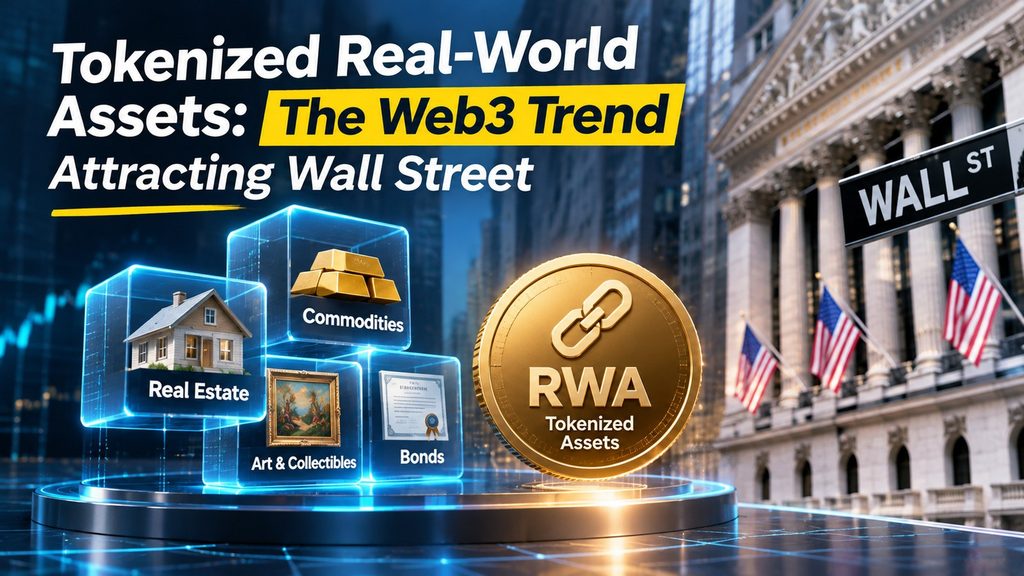
Definition: Tokenized real-world assets (RWAs) are blockchain tokens that represent ownership of, or a claim on, traditional assets such as government bonds, money market funds, private credit, real estate, commodities and equities. Tokenization aims to make these assets faster to settle, easier to transfer, divisible into smaller units and programmable. It has become one of the few Web3 trends embraced by major banks and asset managers, with tokenized Treasury and money market products leading early adoption.
For much of its history, the blockchain world and traditional finance moved in parallel. Crypto markets traded digital assets that existed only on-chain, while Wall Street ran on decades-old infrastructure of custodians, clearing houses and settlement cycles. Tokenization is where those worlds meet. By placing real assets on blockchain rails, financial institutions hope to combine the trust and value of traditional assets with the speed and flexibility of digital networks.
Major asset managers have launched tokenized funds that hold US Treasury bills and other short-term government debt. Banks are testing tokenized deposits and bonds. Regulators in Singapore, Hong Kong, the European Union, the UAE and elsewhere are running pilots and creating frameworks. The result is a fast-growing market that many analysts expect to expand significantly over the coming decade.
Because tokenization is often surrounded by hype, this guide uses a myth-versus-fact approach to separate what is real from what is not.
How Tokenization Works
In most cases, the real asset stays in the traditional financial system, held by a regulated custodian. A legal entity, such as a fund or special purpose vehicle, owns the asset and issues tokens representing shares in it. Smart contracts can automate tasks such as distributing interest, enforcing transfer restrictions so only verified investors can hold tokens, and processing redemptions.
Myths vs Facts
Why Wall Street Is Paying Attention
- Faster settlement: trades can settle in minutes rather than days, reducing counterparty risk and freeing up capital.
- 24/7 markets: blockchains operate continuously, unlike traditional market hours.
- Collateral efficiency: tokenized Treasuries and fund shares can be moved quickly and used as collateral for trading and lending.
- Lower operating costs: automating record-keeping, distributions and compliance can reduce administration expenses.
- New distribution: asset managers can reach digital-native investors and platforms that already hold stablecoins.
- Programmability: rules on who can hold an asset and how income is paid can be built into the token itself.
Asset Classes Being Tokenized
| Asset class | Maturity of market | Main appeal | Key challenge |
|---|---|---|---|
| Treasury bills & money market funds | Most developed | Yield-bearing, low-risk, used as on-chain cash | Regulatory access limits |
| Private credit | Growing quickly | Higher yields, new investor access | Borrower risk and transparency |
| Bonds | Pilots and issuances | Faster issuance and settlement | Integration with existing systems |
| Real estate | Early stage | Fractional ownership of property | Legal rights, liquidity, valuation |
| Commodities (e.g. gold) | Established niche | Easy transfer of physical metal ownership | Custody and audit trust |
| Equities & funds | Emerging | Round-the-clock trading, global access | Securities law and shareholder rights |
| Carbon credits & art | Experimental | Traceability and fractional access | Standards and verification |
Who Is Building the Market
The tokenization ecosystem has several layers, each with different players:
- Asset managers and issuers: traditional fund houses and specialist firms that create tokenized funds and securities, starting with short-term government debt.
- Banks: testing tokenized deposits, repo transactions, bond issuance and cross-border settlement, often on private or permissioned blockchains.
- Tokenization platforms: technology firms that handle token issuance, investor onboarding, compliance checks and record-keeping.
- Custodians and transfer agents: safeguard the underlying assets and maintain official ownership records.
- Blockchain networks: public chains and permissioned ledgers where tokens are issued and moved.
- Decentralised finance protocols: some accept tokenized Treasuries as collateral or use them to back stablecoins and yield products.
- Regulators and central banks: running sandboxes and pilots to understand how existing rules apply.
How to Evaluate a Tokenized Product
- Identify the underlying asset and confirm it is held by a reputable, regulated custodian.
- Read the legal documents to understand exactly what the token entitles you to.
- Check audits of both the asset holdings and the smart contracts.
- Understand redemption: how and how quickly you can convert tokens back to cash.
- Review fees compared with the traditional version of the same asset.
- Confirm eligibility under the securities laws of your country.
The Risks Investors Should Understand
Legal and structural risk
The most important question is what legal rights the token gives you. If the issuer fails, can you claim the underlying asset? Offering documents and jurisdiction matter more than the technology.
Custody and issuer risk
Token value depends on the asset actually being held and managed properly. Regular independent audits and reputable custodians are essential.
Smart contract and technology risk
Code bugs, hacks, key management failures and blockchain outages can cause losses or delays. Established, audited contracts reduce but do not eliminate this risk.
Liquidity risk
Being able to transfer a token is not the same as being able to sell it at a fair price. Redemption terms and market depth need careful checking.
Regulatory fragmentation
Rules differ by country. A product legal in one jurisdiction may be unavailable in another, and frameworks are still evolving.
What It Means for Businesses
Tokenization is not only for investors. Companies may eventually use it to raise capital through tokenized bonds or private credit, manage treasury cash in tokenized money market funds, improve supply-chain finance with tokenized invoices, or offer fractional ownership of assets such as equipment or property. Fintechs and wealth platforms are building services around tokenized products, creating opportunities for partnerships and new revenue streams.
Tokenization and Stablecoins: A Natural Pair
Tokenized assets need a way to pay for them on-chain. Regulated stablecoins and tokenized bank deposits provide that cash leg, allowing a buyer to exchange money for a tokenized bond in a single, near-instant transaction. This “atomic settlement” removes the risk that one side delivers while the other does not. As stablecoin regulation matures in major markets, the link between on-chain cash and tokenized assets is expected to strengthen, which is a key reason analysts see the two trends growing together.
The India Angle
India has shown strong interest in digital financial infrastructure through UPI, the e-rupee pilots and GIFT City’s international financial services centre, where regulators have explored frameworks for new financial technologies. At the same time, the treatment of private cryptocurrencies remains cautious. Any growth of tokenized real-world assets for Indian investors is likely to come through regulated channels, such as GIFT City entities or bank-led pilots, rather than unregulated platforms. Investors should follow official guidance closely.
What Comes Next
The next phase of tokenization will depend on three things: clearer legal frameworks that define token holder rights, interoperability so tokens can move between blockchains and traditional systems, and on-chain cash, such as regulated stablecoins or tokenized deposits, to settle trades instantly. As these pieces fall into place, tokenization could gradually move from pilots to core market infrastructure. The change is likely to be steady rather than sudden, but its long-term impact on how assets are issued, traded and managed could be substantial.
Key Takeaways
- Tokenized RWAs put traditional assets like Treasuries, credit and property on blockchains.
- Low-risk assets such as tokenized Treasury and money market funds lead adoption.
- Benefits include faster settlement, 24/7 transfer, collateral efficiency and lower costs.
- Legal rights, custody, smart contract and liquidity risks must be checked carefully.
- Regulated, institution-led products are driving the market’s growth.
This article is for general information only and is not investment advice. Digital assets and tokenized products carry significant risks. Consult a licensed adviser and check local regulations before investing.
Frequently Asked Questions
What are tokenized real-world assets?
Tokenized real-world assets (RWAs) are digital tokens on a blockchain that represent ownership of, or a claim on, physical or traditional financial assets such as government bonds, money market funds, real estate, private credit, commodities or art.
Why are big financial institutions interested in tokenization?
Tokenization can enable faster settlement, 24/7 transfer, lower administrative costs, fractional ownership, programmable compliance and easier use of assets as collateral, which could make financial markets more efficient.
Are tokenized assets the same as cryptocurrencies?
No. Cryptocurrencies such as bitcoin derive value from their own networks, while tokenized real-world assets derive value from an underlying asset held off-chain, such as a Treasury bill or a building, usually through a legal structure and a custodian.
What are the risks of tokenized real-world assets?
Key risks include legal uncertainty about token holders’ rights, custodian and issuer risk, smart contract vulnerabilities, limited liquidity on secondary markets, and differing regulation across countries.
Can retail investors buy tokenized assets?
Some tokenized products are available to retail investors in certain jurisdictions, but many are restricted to qualified or institutional investors. Availability depends on local securities laws, so investors should check regulation and use licensed platforms.