
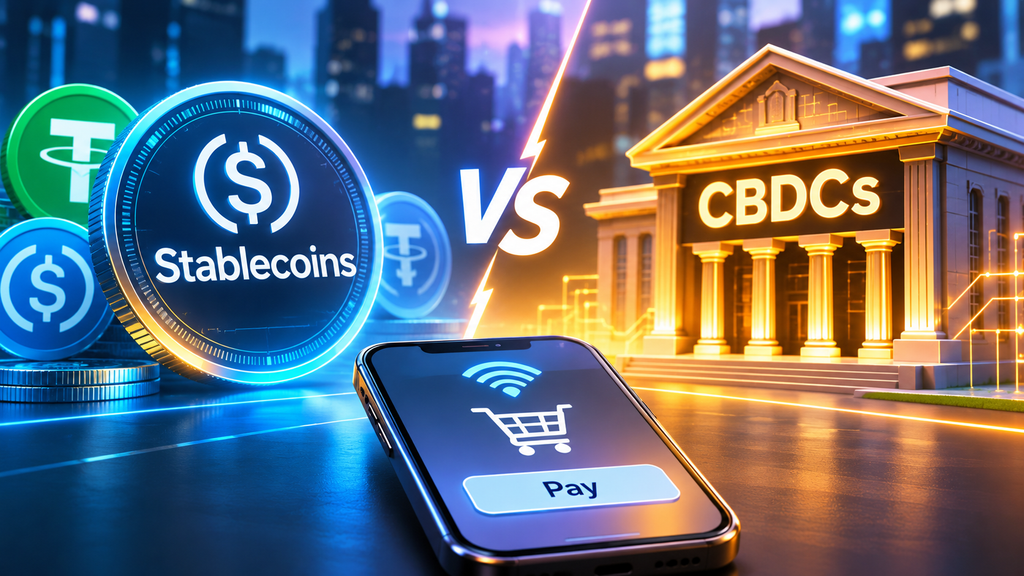
Stablecoins
Private digital tokens pegged to a currency such as the US dollar, backed by reserves and running on public blockchains. Examples include USDC and USDT.
CBDCs
Digital versions of national currency issued directly by a central bank. Examples include India’s e-rupee, China’s e-CNY and the digital euro under preparation.
Quick answer: Stablecoins and central bank digital currencies (CBDCs) both aim to make money digital, programmable and instant. The difference is who stands behind them. Stablecoins are issued by private companies and move freely across borders on blockchains. CBDCs are issued by central banks and carry the full backing of the state. In practice, many countries are heading toward a mix: regulated stablecoins for global and crypto-linked payments, and CBDCs or upgraded bank systems for domestic money.
Digital payments have already transformed how people shop and send money. In India, UPI made instant mobile payments part of daily life. Yet beneath these apps, money still moves through banking systems built decades ago, with cross-border transfers often taking days and carrying high fees. Stablecoins and CBDCs are two competing visions of what comes next. Understanding both helps businesses, investors and consumers prepare for the changes ahead.
How Stablecoins Work
A stablecoin is a cryptocurrency designed to hold a steady value, usually one unit of a fiat currency. The issuer holds reserves, typically cash and short-term government securities, equal to the tokens in circulation. When someone deposits a dollar, a token is created; when they redeem the token, it is destroyed and the dollar returned.
Because stablecoins run on public blockchains, they can be sent anywhere in the world, around the clock, often in seconds and for small fees. They have become the main settlement currency of the crypto economy and are increasingly used for cross-border business payments, remittances and as a dollar savings tool in countries with unstable currencies.
Regulation has caught up quickly. The United States passed a federal framework for payment stablecoins in 2025, setting reserve and disclosure requirements for issuers. The European Union regulates stablecoins under its Markets in Crypto-Assets (MiCA) rules. Other financial centres, including Singapore, Hong Kong and the UK, have introduced or are finalising their own regimes.
How CBDCs Work
A CBDC is digital money issued by a central bank. Unlike the balance in your bank account, which is a claim on a commercial bank, a CBDC is a direct claim on the central bank itself, just like a banknote. There are two main types:
- Retail CBDC: used by the public and businesses for everyday payments, usually through wallets offered by banks.
- Wholesale CBDC: used by banks and financial institutions to settle large transactions between themselves.
Many central banks are exploring or piloting CBDCs. The Reserve Bank of India has run e-rupee pilots since 2022. China’s e-CNY has been tested widely. The European Central Bank is preparing a possible digital euro. The United States, by contrast, has moved away from a retail CBDC, with policy favouring private stablecoins instead.
Head-to-Head Comparison
| Feature | Stablecoins | CBDCs |
|---|---|---|
| Issuer | Private companies | Central banks |
| Backing | Reserves of cash and short-term bonds | Direct liability of the central bank |
| Technology | Public blockchains | Central bank–controlled ledgers, varied designs |
| Cross-border use | Native and global | Mostly domestic; cross-border pilots ongoing |
| Privacy | Pseudonymous on-chain; KYC at on/off ramps | Designed by the state; privacy levels vary by country |
| Availability | 24/7, anyone with a wallet (subject to local rules) | Through approved banks and wallets |
| Main risk | Issuer, reserve and de-pegging risk | Surveillance concerns, bank disintermediation |
| Interest paid to holders | Generally not, under most new rules | Usually none |
Pros and Cons
Stablecoins: advantages
- Fast, low-cost global transfers
- Works with crypto and decentralised finance apps
- Innovation driven by competing companies
- Gives people in weak-currency economies access to dollars
Stablecoins: drawbacks
- Depends on issuer honesty and reserve quality
- Can lose its peg during market stress
- Regulatory treatment differs by country
- May weaken monetary control in smaller economies
CBDCs: advantages
- Backed by the central bank, no issuer risk
- Can support financial inclusion
- Offline and programmable payment options
- Lower settlement risk between banks
CBDCs: drawbacks
- Privacy and surveillance concerns
- Risk of deposits moving away from banks
- Slow adoption where existing payments already work well
- Limited cross-border use so far
What It Means for Everyday Payments
For consumers
Most people will not notice a dramatic change at the checkout. Payment apps will likely hide the underlying rails, whether the transfer settles in a stablecoin, a CBDC or a traditional bank system. The visible benefits will be faster international transfers, lower remittance fees and new features such as programmable payments that release funds when conditions are met.
For businesses
Exporters, freelancers and online sellers stand to gain the most. Stablecoins already let some businesses receive international payments within minutes rather than days. As regulated payment processors expand, accepting digital currency and converting it instantly to local money is becoming simpler. CBDCs could reduce settlement times and costs for domestic B2B payments, especially in supply chains.
For banks
Both developments challenge banks. Stablecoins compete for payment flows and dollar deposits, while a popular retail CBDC could pull deposits out of commercial banks. Many central banks plan holding limits or tiered designs to manage this risk, and banks are exploring tokenised deposits of their own.
The Indian Perspective
India is an interesting case. UPI already delivers instant, near-free domestic payments to hundreds of millions of people, so a retail CBDC must offer something extra, such as offline payments, programmable subsidies or easier cross-border links. Meanwhile, India’s stance on private cryptocurrencies has been cautious, with significant taxes on crypto gains and transactions. Businesses in India should watch both the e-rupee pilots and evolving rules on virtual digital assets before building payment strategies around either option.
Real-World Use Cases Today
Cross-border B2B payments
Companies paying overseas suppliers or contractors are using stablecoins to settle invoices within minutes, avoiding the delays of correspondent banking. Payment providers convert local currency to stablecoins and back at each end, so neither party needs to hold crypto for long.
Remittances
Workers sending money home can lose a meaningful share of each transfer to fees. Stablecoin-based remittance services aim to cut those costs and deliver funds faster, particularly on corridors where traditional options are expensive.
Treasury and savings
In countries with high inflation or currency controls, households and small businesses use dollar stablecoins to protect savings. This is one reason some central banks view stablecoins cautiously, as large-scale use can weaken the local currency.
Programmable government payments
CBDC pilots have explored programmable money, such as subsidies that can only be spent on specific goods or funds released automatically when a condition is met. This could reduce leakage in welfare programs but raises important questions about freedom and privacy.
Interbank settlement
Wholesale CBDC projects test whether banks can settle large payments, securities trades and cross-border transfers instantly on shared ledgers, reducing risk and the need for capital tied up in settlement.
Key Risks Businesses Should Understand
- Counterparty risk: with stablecoins, your money is only as safe as the issuer’s reserves and legal structure.
- Regulatory risk: rules on who may issue, hold or accept digital currency differ by country and are still changing.
- Operational risk: sending funds to the wrong blockchain address is usually irreversible, and wallet security matters.
- Accounting and tax: treatment of digital currency in company accounts and tax returns varies and needs professional advice.
- Reputational risk: customers and partners may have strong views on crypto or state digital money, so communication matters.
Is It Really a Battle?
Headlines often frame stablecoins and CBDCs as rivals, but the future is more likely to be layered. Central banks remain the anchor of the monetary system. Regulated stablecoins and tokenised bank deposits are likely to handle a growing share of global, internet-native and crypto-linked payments. CBDCs may play their strongest role in wholesale settlement and specific public-sector uses. Interoperability between these systems, so that money can move smoothly from one to another, will be the real challenge of the next decade.
How to Prepare Your Business
Whatever direction digital money takes, a few steps make sense now. Review how much you pay in cross-border fees and how long international payments take. Ask your bank and payment providers about their digital currency roadmap. Speak to an accountant about the tax treatment of digital assets in your country. And if you trade internationally, consider a small, controlled pilot with a regulated provider to understand the process before customers or suppliers ask for it.
The verdict
Stablecoins currently lead on global reach and real-world usage. CBDCs lead on safety and state backing but face slower adoption, especially where existing digital payments already work well. For businesses, the practical move is to understand both, follow local regulation closely and choose payment partners that can support multiple digital money types as the landscape settles.
Key Takeaways
- Stablecoins are private, reserve-backed tokens; CBDCs are central bank money in digital form.
- Stablecoins excel at cross-border, 24/7 payments; CBDCs offer the highest safety.
- Regulation for stablecoins is maturing in the US, EU and Asia.
- India is piloting the e-rupee alongside its highly successful UPI system.
- The likely future is coexistence, with interoperability as the key issue.
Frequently Asked Questions
What is the main difference between a stablecoin and a CBDC?
A stablecoin is issued by a private company and backed by reserves such as cash and short-term government bonds, while a CBDC is issued directly by a country’s central bank and is a direct liability of that central bank, like digital cash.
Are stablecoins safe?
Safety depends on the issuer’s reserves, transparency and regulation. Fully reserved, regularly audited stablecoins operating under clear rules are considerably safer than unregulated or algorithmic ones, but they still carry issuer, technology and redemption risks.
Does India have a CBDC?
Yes. The Reserve Bank of India has been piloting the digital rupee, or e-rupee, in both wholesale and retail forms since late 2022, with participating banks offering retail wallets to users in selected areas.
Will CBDCs replace cash?
Most central banks say CBDCs are designed to complement cash, not replace it. Physical cash is expected to remain available, with digital currency offered as an additional option.
Can businesses accept stablecoins for payments?
In many countries businesses can accept stablecoins through payment processors that convert them to local currency, but rules vary widely. Businesses should check local regulations, tax treatment and accounting requirements before accepting them.