
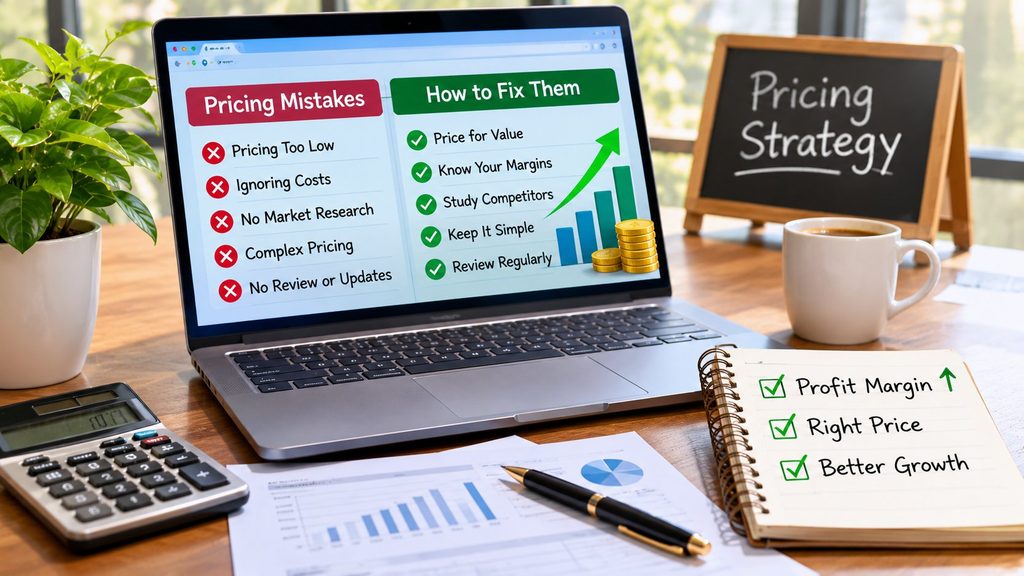
The short version: Pricing is the single fastest lever on profit, yet most businesses set prices once and rarely revisit them. The biggest margin killers are underpricing, cost-plus thinking, uncontrolled discounting, ignoring rising costs, one-size-fits-all pricing and failing to communicate value. Fixing even two or three of these can improve profitability more than months of cost cutting.
Ask most owners how they set their prices and you will hear some version of “we looked at what competitors charge” or “we added a markup to our costs.” Both approaches feel safe. Both quietly leave money on the table. Because a price change flows almost entirely to the bottom line, a small improvement in pricing usually has a bigger impact on profit than the same percentage gain in sales volume or reduction in costs.
The problem is that pricing mistakes rarely announce themselves. Revenue may look healthy while margins erode in the background. Below are ten of the most common mistakes, why each one hurts, and what to do instead.
1Copying Competitor Prices
Why it hurts: Your competitor may have a different cost base, different customers or a broken pricing strategy of their own. Matching them turns your product into a commodity and starts a race to the bottom.
Fix: Use competitor prices as one reference point, not the answer. Identify what makes your offer different, such as faster delivery, better support or specialist expertise, and price for that difference.
2Relying Only on Cost-Plus Pricing
Why it hurts: Cost-plus pricing guarantees a markup but ignores what customers are willing to pay. If your product saves a client significant time or money, a simple markup may capture only a fraction of that value.
Fix: Treat cost as your floor, not your price. Interview customers about the outcome your product delivers and move toward value-based pricing, where price reflects the benefit received.
3Discounting Without Doing the Maths
Why it hurts: Discounts cut straight into margin. With a 30% gross margin, a 10% discount reduces your profit per sale by a third. You would need about 50% more sales to earn the same gross profit. Few promotions achieve that.
Fix: Before any discount, calculate the extra volume needed to break even. Prefer value-adds, such as free setup or extended warranty, bundles, or time-limited offers tied to a clear goal like clearing old stock.
| Gross margin | Discount | Extra sales needed to keep same profit |
|---|---|---|
| 50% | 10% | +25% |
| 40% | 10% | +33% |
| 30% | 10% | +50% |
| 30% | 20% | +200% |
Formula: extra sales needed = discount ÷ (margin − discount).
4Not Raising Prices as Costs Rise
Why it hurts: Materials, wages, rent, software and shipping all creep up. If your prices stay flat, your margin shrinks every year even if nothing else changes.
Fix: Schedule an annual price review. Small, regular increases are easier for customers to accept than rare, large jumps. Build price-adjustment clauses into long-term contracts.
5Offering Only One Price Point
Why it hurts: A single price forces every customer into the same box. Budget buyers walk away, while customers who would happily pay more for premium features have no way to do so.
Fix: Introduce good, better and best tiers. A premium tier captures high-value customers and often makes the middle option look like great value, which is where many buyers settle.
6Giving Away Services for Free
Why it hurts: Rush orders, extra revisions, custom reports, installation and after-hours support all cost time and money. When they are given away, customers come to expect them and margins leak.
Fix: List every add-on service you provide and decide which should be paid extras. Publish a clear price list for them, and track how often they are requested.
7Letting Sales Teams Set Prices Freely
Why it hurts: Salespeople are rewarded for closing deals, so they naturally lean toward discounting. Without limits, prices vary widely between customers and average margins drift down.
Fix: Set clear discount bands with approval levels. Tie a portion of sales commission to gross margin, not just revenue, so incentives support profitable deals.
8Ignoring Customer Segments
Why it hurts: Different customers value different things. An enterprise client may care about reliability and support, while a startup cares about price. Treating them identically means undercharging some and losing others.
Fix: Segment by size, industry, use case or purchase volume. Tailor packages and pricing to each segment’s priorities rather than a single average customer.
9Failing to Communicate Value
Why it hurts: If customers do not understand what they are getting, every price feels high. Weak product pages, vague proposals and feature lists without outcomes push buyers toward cheaper alternatives.
Fix: Explain results, not just features. Use case studies, testimonials, comparison tables and simple return-on-investment examples to show why your price is justified.
10Never Testing Prices
Why it hurts: Most businesses guess their price and never check whether a different number would perform better. That means they never learn what the market will actually bear.
Fix: Test new prices with new customers, specific regions or a new product line. Track conversion rate, average order value and margin together, because a lower conversion rate at a higher price can still mean more profit.
Why Pricing Has Such a Big Effect on Profit
Imagine a business with ₹1 crore in revenue, ₹70 lakh in variable costs and ₹20 lakh in fixed costs, leaving ₹10 lakh in profit. A 5% price increase, with no loss of customers, adds ₹5 lakh in revenue that flows almost entirely to profit, lifting it by roughly 50%. A 5% increase in sales volume, by contrast, also raises variable costs and adds far less to profit. This is why pricing deserves regular leadership attention, not a one-time decision at launch.
The same logic works in reverse. A 5% price cut with no extra volume would wipe out half the profit in this example, which is why unplanned discounting is so dangerous.
How to Raise Prices Without Losing Customers
- Give notice: tell customers 30 to 60 days in advance.
- Explain the reason: rising costs, new features or improved service are understandable.
- Reinforce value: remind customers of results they have achieved with you.
- Protect loyal accounts: consider a phased increase or temporary price lock for long-standing clients.
- Offer an alternative: a lighter package can retain price-sensitive customers without discounting your core offer.
- Train your team: make sure sales and support staff can explain the change confidently.
Pricing Models Worth Considering
Moving away from a single list price opens up several proven models. Each suits different businesses:
- Tiered pricing: good, better, best packages that let customers self-select by need and budget. Common in software, services and memberships.
- Subscription pricing: recurring monthly or annual fees that smooth cash flow and increase customer lifetime value. Works for maintenance, content, software and consumables.
- Usage-based pricing: customers pay according to how much they use, such as per transaction, per user or per unit. Fair for customers and scales revenue with their growth.
- Bundling: combining products or services at a slightly lower combined price, which raises average order value while protecting individual item prices.
- Value-based project pricing: for consultants and agencies, pricing on the outcome delivered rather than hours worked rewards efficiency and expertise.
- Dynamic pricing: adjusting prices by demand, season or time, widely used in travel, hospitality and e-commerce. It requires good data and careful communication to avoid customer backlash.
The Psychology of Price
Customers rarely judge a price in isolation; they compare it with reference points. A few principles help businesses present prices more effectively. Anchoring means showing a premium option first so the standard option looks reasonable. The decoy effect occurs when a deliberately less attractive option makes another look like the best deal. Charm pricing, ending prices in 9 or 99, can lift conversion for consumer products, while round numbers often signal quality for premium services. Framing, such as expressing an annual fee as a small daily amount, makes value easier to grasp. Used honestly, these techniques help customers understand your offer rather than manipulate them.
Quick Pricing Self-Audit
Answer yes or no to each question. Every “no” is a margin opportunity.
- Have we reviewed our prices in the past 12 months?
- Do we know the gross margin of every product or service line?
- Do we have at least two or three price tiers?
- Are discount limits and approval rules written down?
- Are add-on services priced separately?
- Can we explain our value in one clear sentence?
- Have we tested a different price in the past year?
If you answered “no” to three or more questions, start with the quickest win: a written discount policy or a price review of your best-selling product. Small, focused changes often deliver results within a single quarter.
Key Takeaways
- Pricing is usually the most powerful single lever on profit.
- Use costs as the floor and customer value as the guide.
- Always calculate break-even volume before discounting.
- Review prices annually and introduce tiered options.
- Charge for extras, control sales discounts and test new price points.
Frequently Asked Questions
What is the most common pricing mistake small businesses make?
The most common mistake is underpricing, usually by copying competitors or adding a small markup to costs without considering the value customers receive. Underpricing limits profit, attracts price-sensitive customers and makes future increases harder.
How often should a business review its prices?
Review prices at least once a year, and whenever input costs, competitor positioning or your product changes significantly. Many businesses benefit from small, regular adjustments rather than rare large increases.
How does discounting affect profit margins?
Discounts cut directly into margin, so a modest discount can require a large increase in sales volume just to earn the same profit. For example, with a 30 percent gross margin, a 10 percent discount means you need roughly 50 percent more sales to break even on profit.
What is value-based pricing?
Value-based pricing sets prices according to the value a product delivers to the customer, such as time saved, revenue gained or risk avoided, rather than only on production cost or competitor prices.
How do I raise prices without losing customers?
Give advance notice, explain the reason clearly, emphasise the value and improvements customers receive, consider grandfathering loyal customers for a period, and offer a lower-priced option for those who are highly price sensitive.