
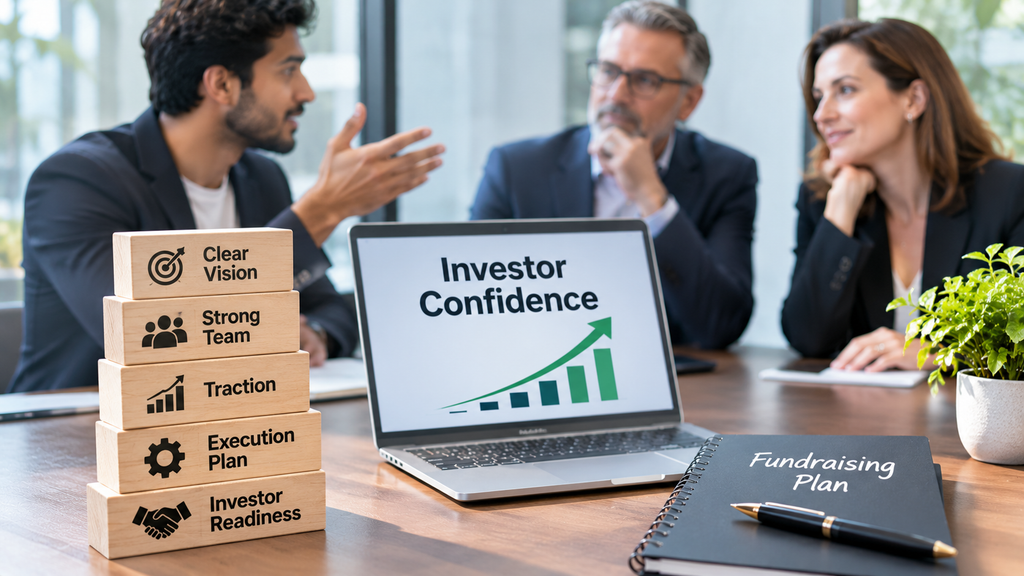
Starting a business is one challenge. Convincing someone else to invest in it is another. For first time founders, raising capital can feel like a difficult exercise, particularly when they have limited business history, no established investor network, and an idea that has not yet been tested at scale.
However, investors do not evaluate startups based on enthusiasm alone. They want to understand whether a founder can identify a genuine market opportunity, develop a commercially viable solution, manage resources responsibly, and make sound decisions when circumstances change.
The good news is that founders do not need to wait until they have a large customer base or significant revenue to establish credibility. Investor confidence can be developed well before the first fundraising conversation. It comes from the quality of preparation, the strength of early evidence, and the founder’s ability to explain where the business is heading.
Here are several practical ways first time entrepreneurs can build that confidence before approaching potential investors.
1. Start With a Business Problem, Not Just an Interesting Idea
Many new founders begin with a product concept they find exciting. While enthusiasm is important, investors generally want to understand the problem that makes the product necessary.
A business idea becomes more convincing when it addresses a clearly identifiable difficulty experienced by a particular group of customers.
For example, a founder developing an inventory management platform should be able to explain whether small retailers struggle with stock tracking, supplier coordination, product wastage, or inaccurate sales forecasting. Simply describing the software’s features does not establish that customers need it.
Founders should investigate the problem through customer conversations, industry observations, competitor research, and early product testing.
A useful starting point is to answer three questions:
- Who experiences this problem most frequently?
- What do they currently do to solve it?
- Why would they consider switching to a different solution?
The answers help establish that the business is responding to an actual market requirement rather than an assumption.
2. Demonstrate That Customers Are Willing to Pay
Customer interest and purchasing intent are two different things.
A potential customer might appreciate a product demonstration, subscribe to a newsletter, or express interest in an upcoming launch. However, these activities do not necessarily indicate commercial demand.
Investors become more comfortable when founders can demonstrate that customers are willing to spend money on the proposed solution.
Early evidence can take several forms:
- Initial paid orders.
- Pilot agreements with businesses.
- Preorders from interested customers.
- Repeat purchases.
- Paid product trials.
- Letters of intent from potential commercial partners.
A startup does not necessarily need hundreds of customers to demonstrate demand. A smaller group of paying customers can provide meaningful evidence when their purchasing decisions reflect a genuine business need.
Founders should also understand why customers choose their products. Knowing whether buyers value convenience, affordability, reliability, speed, or specialist functionality helps explain the business’s competitive position.
3. Build a Financial Model That Reflects Reality
Financial projections are an important part of fundraising preparation, but unrealistic forecasts can weaken an otherwise promising investment opportunity.
First time founders sometimes prepare projections based on ambitious revenue targets without explaining the assumptions behind them.
For example, projecting a tenfold increase in revenue over twelve months is not particularly convincing unless the business can explain how it expects to acquire customers, convert enquiries, retain buyers, and manage the additional operating costs.
A useful financial model should include:
Revenue assumptions: Explain expected pricing, customer numbers, sales frequency, and possible revenue streams.
Operating expenses: Include salaries, software, marketing, infrastructure, professional services, and other recurring costs.
Customer acquisition costs: Estimate how much the business spends to attract each paying customer.
Gross margins: Understand how much revenue remains after direct costs associated with delivering the product or service.
Cash flow: Identify when money enters and leaves the business, including periods when expenses may exceed revenue.
Runway: Estimate how long the company can continue operating with its available cash.
Founders should prepare conservative, expected, and optimistic scenarios. This demonstrates that they have considered different business conditions rather than assuming everything will go according to plan.
4. Develop a Product That People Can Actually Experience
A detailed presentation can communicate an idea, but a working product can make the opportunity much easier to understand.
Investors often find it helpful to see what the company is building rather than relying entirely on descriptions and proposed features.
This does not mean every startup needs a fully developed commercial product before fundraising.
A minimum viable product, prototype, interactive demonstration, or early service offering can provide enough evidence to explain the company’s direction.
The important consideration is whether the product demonstrates the startup’s central value proposition.
For example, a founder developing an AI-powered customer support platform could demonstrate how the system handles common enquiries, identifies customer issues, and reduces the time required for manual responses.
Early product development also helps founders discover technical limitations, customer expectations, and operational challenges before investing heavily in expansion.
5. Establish a Clear Understanding of the Competition
Claiming that a business has no competitors is rarely a convincing argument.
Even when a startup introduces something relatively new, customers are probably using existing products, manual processes, or alternative services to address the same problem.
Investors want to understand how a company fits into its market and what makes its approach commercially attractive.
Founders should examine:
- Direct competitors offering similar products.
- Indirect competitors solving the same customer problem differently.
- Existing alternatives that customers already trust.
- Pricing differences and service limitations.
- Opportunities that established companies have overlooked.
Competitive research should lead to a clear explanation of differentiation.
A startup might compete through a more affordable pricing structure, specialist functionality, better customer support, faster delivery, or a business model designed for an underserved market.
The objective is not to prove that competitors are weak. It is to explain why customers might choose the startup despite the alternatives available to them.
6. Show That the Founding Team Can Execute
Investors do not invest only in business ideas. They also evaluate the people responsible for turning those ideas into sustainable companies.
For first time founders, this can create a challenge because they may not have a previous startup exit or extensive entrepreneurial experience.
Nevertheless, professional experience, industry knowledge, technical expertise, and demonstrated problem-solving abilities can establish credibility.
Founders should explain how their background connects with the opportunity they are pursuing.
For example, someone who has spent several years working in logistics may have a stronger understanding of supply chain inefficiencies than someone entering the industry without relevant exposure.
It is equally important to identify gaps within the founding team.
A technically experienced founder may need someone with commercial expertise. A strong sales professional may need additional technical leadership.
Investors are generally more interested in a team that understands its limitations and knows how to address them than one that claims to possess every necessary skill.
7. Treat Early Business Operations as Evidence of Credibility
The way a startup manages its internal operations can influence investor perception.
Disorganised financial records, unclear ownership arrangements, undocumented customer agreements, and inconsistent business reporting can raise unnecessary concerns during due diligence.
Founders should establish basic operational discipline before beginning fundraising.
This includes maintaining accurate financial records, documenting major business decisions, keeping contracts organised, and ensuring that company ownership is properly recorded.
Intellectual property ownership is another important consideration. Founders should understand who owns the software, designs, content, trademarks, and other assets developed for the company.
Employment arrangements and agreements with contractors should also be documented appropriately.
These activities may not directly generate revenue, but they reduce uncertainty and help investors assess the business more efficiently.
8. Prepare a Pitch That Explains the Business Clearly
A strong pitch is not about using complicated financial terminology or presenting every possible business opportunity.
It is about helping an investor understand the company without unnecessary confusion.
A useful investor presentation generally covers:
- The problem the company is addressing.
- The target customer and market opportunity.
- The proposed product or service.
- Evidence of customer demand.
- The revenue model.
- Competitive positioning.
- The founding team’s capabilities.
- Financial performance and projections.
- The funding requirement.
- How the investment will support business development.
Founders should be particularly clear about how much capital they are seeking and what they intend to achieve with it.
For instance, a startup might be raising funds to complete product development, hire essential technical employees, expand into a new customer segment, or improve its distribution capabilities.
Each proposed expense should connect with a measurable business objective.
9. Build Relationships Before Asking for Investment
One common mistake among first time founders is approaching investors only when they urgently need funding.
Building professional relationships earlier can create a more productive fundraising environment.
Founders can participate in industry events, startup communities, accelerator programmes, business discussions, and networking opportunities.
They can also share meaningful company updates, product milestones, customer feedback, and industry observations.
The purpose is not to repeatedly ask people for introductions or investment. It is to develop relationships with individuals who understand the market and may eventually become valuable sources of advice, connections, or capital.
A founder who has established a genuine professional relationship with an investor may find it easier to have a meaningful discussion when fundraising begins.
10. Be Honest About Risks and Uncertainties
No startup has a completely predictable future.
Customer behaviour can change, competitors can introduce new products, operating expenses can increase, and market conditions can become less favourable.
Investors understand these realities.
What creates concern is when founders appear unaware of the risks or avoid discussing difficult questions.
Instead of presenting every assumption as a certainty, founders should explain what they know, what they are still testing, and how they plan to respond if results differ from expectations.
For example, if customer acquisition costs are higher than anticipated, the founder should be able to discuss alternative acquisition channels, pricing adjustments, or improvements to customer conversion.
Acknowledging uncertainty does not make a startup appear weak. It demonstrates that its leadership can make informed decisions in an unpredictable business environment.
11. Connect the Funding Requirement to a Measurable Milestone
Investors want to understand what their capital will help the company accomplish.
A fundraising request should therefore be connected to specific milestones rather than a general desire to grow.
A startup seeking investment might aim to:
- Complete the commercial launch of its product.
- Reach a defined number of paying customers.
- Expand its sales team.
- Enter a new geographical market.
- Improve manufacturing capacity.
- Achieve a particular revenue milestone.
The company should explain the expected timeline, resources required, and business assumptions behind these objectives.
This creates a clearer picture of how investment will be used and what progress could look like after the funding round.
12. Prepare for Difficult Questions Before the First Meeting
Investor meetings often involve questions that founders may not initially expect.
Some may concern customer retention, pricing pressure, cash requirements, technical scalability, regulatory exposure, or the possibility of larger competitors entering the market.
Rather than memorising scripted answers, founders should understand the underlying business information.
They should be able to explain why customers remain interested, which expenses could increase as the company grows, what would happen if sales targets are missed, and how the business intends to protect its competitive position.
It is also useful to prepare answers about the funding structure, proposed valuation, existing ownership, and future capital requirements.
Preparation allows founders to have more productive conversations and prevents avoidable confusion.
Conclusion
Building investor confidence is not something that begins when a startup prepares its first fundraising presentation. It develops through the decisions founders make from the earliest stages of the business.
Understanding customer problems, demonstrating genuine demand, maintaining financial discipline, developing a useful product, and building a capable team all contribute to a stronger investment proposition.
First time founders should remember that investors are not necessarily looking for a company that has already solved every problem. They are looking for evidence that the people behind the business understand what they are building and have a credible plan for moving forward.
A well-prepared founder does not need to make exaggerated promises. Clear thinking, honest communication, and measurable progress can make a much stronger impression.
Frequently Asked Questions
1. How can first time founders attract investors without previous startup experience?
They can demonstrate relevant industry knowledge, customer understanding, a validated business opportunity, early commercial progress, and the ability to execute. Previous startup experience can help, but it is not the only factor investors consider.
2. Do startups need revenue before approaching investors?
No. Some early stage investors support businesses before they generate revenue. However, founders should provide other evidence of progress, such as a working prototype, customer interviews, pilot projects, preorders, or letters of intent.
3. What financial documents should founders prepare before fundraising?
Founders should generally prepare financial statements where available, cash flow projections, an operating budget, revenue forecasts, expense breakdowns, and a funding utilisation plan. The exact requirements depend on the investment stage and investor.
4. How important is a minimum viable product when raising capital?
A minimum viable product can help investors understand the proposed solution and assess early customer reactions. It is particularly useful for technology startups, although some business models can demonstrate demand through paid pilots or early service delivery instead.
5. What makes investors lose confidence in first time founders?
Unrealistic financial projections, weak market research, unclear revenue models, poor financial documentation, exaggerated market claims, and an inability to explain business risks can create concerns.
6. How much equity should first time founders offer investors?
There is no universal percentage. The amount depends on the company’s valuation, funding requirement, investment stage, existing ownership, and negotiation terms. Founders should consider both the immediate investment and the potential dilution from future fundraising.
7. Should founders approach multiple investors at the same time?
Founders can approach multiple suitable investors during a fundraising round. They should maintain consistent communication, organise their fundraising information, and keep track of discussions and follow-ups.
8. How long should founders prepare before raising capital?
There is no fixed preparation period. Some startups may need several months to validate their business model, develop a product, and organise financial information. Others may already have sufficient evidence to begin investor discussions.
9. What is more important to investors: the business idea or the founding team?
Both matter, but their relative importance depends on the investment stage. At very early stages, the founding team’s capabilities and understanding of the market can carry considerable weight because limited commercial evidence is available.
10. Can a small startup build investor confidence without a large customer base?
Yes. A small startup can establish credibility through strong customer feedback, repeat purchases, successful pilot projects, specialist expertise, a well-developed product, and a realistic financial plan.