
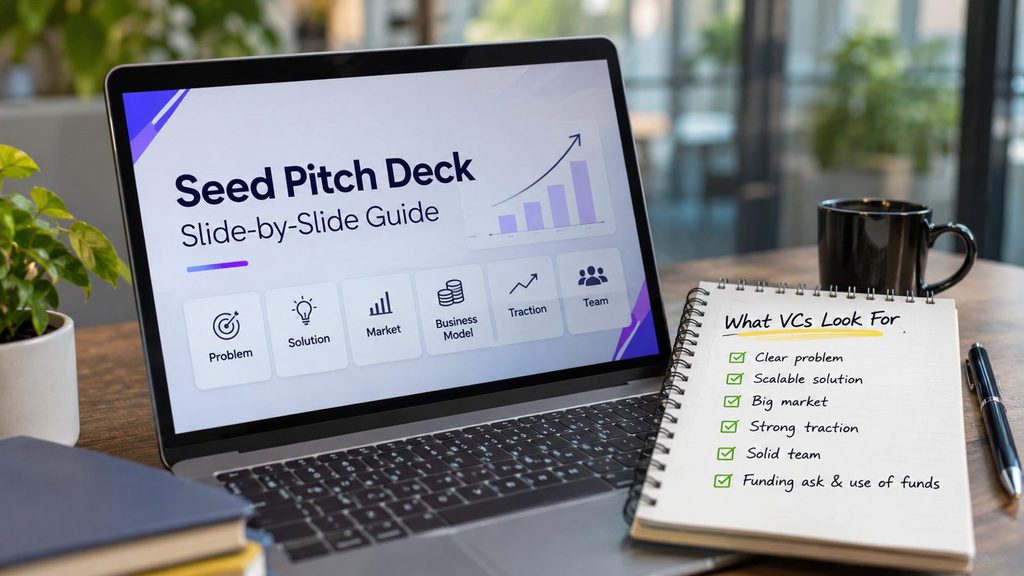
Short answer: At seed stage, investors look for a sharp problem, a credible team with an unfair advantage, early proof that customers want the product, a large and growing market, and a clear plan for how this round gets the company to the next milestone. Today they also ask how the startup uses AI to stay lean and what makes it defensible when products can be copied faster than ever. A great seed deck says all of this in 10 to 15 clear slides.
The seed funding market has changed considerably over the past few years. After the exuberance of 2021, investors became more selective, rounds took longer to close and the bar for traction rose. At the same time, artificial intelligence has reshaped both what startups build and how investors judge them. Startups can now build products faster and with smaller teams, which is good news for capital efficiency, but it also means competition arrives faster and defensibility matters more.
Your pitch deck is often the first, and sometimes only, chance to make an impression. Many investors skim a deck in a few minutes before deciding whether to take a meeting. This guide walks through the slides that matter, what investors are really asking on each one, and the red flags that get decks passed over.
The Seed Deck at a Glance
| # | Slide | What it must prove |
|---|---|---|
| 1 | Title & one-liner | You can explain what you do in one sentence |
| 2 | Problem | A painful, specific problem for a defined customer |
| 3 | Solution | Your product solves it clearly and better |
| 4 | Why now | Something has changed that makes this possible today |
| 5 | Product / demo | It is real and people use it |
| 6 | Market size | The opportunity can support a venture-scale company |
| 7 | Traction | Evidence that customers want it |
| 8 | Business model | How you make money and the unit economics |
| 9 | Go-to-market | How you will acquire customers efficiently |
| 10 | Competition & moat | Why you win and stay ahead |
| 11 | Team | Why you are the right people |
| 12 | The ask & use of funds | How much, what it buys, what milestone it reaches |
Slide-by-Slide: What Investors Are Really Asking
Investor is asking: “Can I understand this company in ten seconds?”
Lead with a plain-English description such as “Payroll software for Indian restaurants” rather than vague claims like “revolutionising the future of work.” Add your logo, name and contact details. If you have one standout metric or notable backer, it can go here too.
Investor is asking: “Is this a real, urgent problem, and who exactly has it?”
Describe the customer and the pain in concrete terms: time wasted, money lost, risk created. A short customer story or a quote from a user interview makes the problem vivid. Avoid problems that are merely “nice to solve.”
Investor is asking: “Does this clearly fix the problem, and is it meaningfully better?”
Show how the product works and the core benefit in one or two lines. Focus on outcomes, such as “cuts reconciliation time from two days to two hours,” not a feature list.
Investor is asking: “Why hasn’t this been done before, and why will it work today?”
Point to the change that opens the opportunity: new regulation, a technology breakthrough, a shift in customer behaviour or infrastructure such as digital public platforms. A strong “why now” separates timely ideas from ones that were tried and failed.
Investor is asking: “Is this real?”
Use clean screenshots, a short product walkthrough or a link to a demo video. Show the moment of value, when the user gets the result, rather than every screen.
Investor is asking: “Can this become a very large company?”
Build your market estimate from the bottom up: number of target customers multiplied by what each might pay. Investors are sceptical of huge top-down figures pulled from reports. Show the initial beachhead market and how you expand from it.
Investor is asking: “Do customers actually want this?”
This is often the most scrutinised slide. Show your strongest evidence: revenue and its growth rate, active users, retention, engagement, paid pilots, letters of intent or a waitlist with real activity. Use a simple chart. Be honest; inflated or vague metrics damage trust quickly.
Investor is asking: “How do you make money, and can the economics work at scale?”
Explain pricing, who pays, and early unit economics such as average contract value, gross margin, customer acquisition cost and payback period, if available. At seed stage, a credible path to healthy economics is more important than perfect numbers.
Investor is asking: “How will you reach customers without burning cash?”
Identify the specific channels that work so far, such as founder-led sales, partnerships, content, community or product-led growth, and how you will scale them. Investors value evidence from early experiments over theoretical plans.
Investor is asking: “Why will you win, and what stops others copying you?”
Never claim you have no competition. Show alternatives customers use today, including spreadsheets or doing nothing, and explain your advantage. Moats at seed stage might include proprietary data, deep workflow integration, network effects, distribution partnerships, regulatory expertise or exceptional speed of execution.
Investor is asking: “Why are these the people to build this?”
Highlight founder-market fit: relevant industry experience, technical depth, previous startup experience or personal connection to the problem. Show how founders split responsibilities. Key advisers can be included if genuinely involved.
Investor is asking: “What will my money achieve?”
State the amount you are raising, the planned runway and the milestones it will reach, such as a revenue level, product launch or market expansion, that set up the next round. Break down use of funds into a few clear categories.
How AI Has Changed Investor Expectations
Artificial intelligence now features in almost every investor conversation, whether or not the startup is an “AI company.” Expect questions such as:
- Efficiency: how are you using AI internally to build faster, sell more and support customers with a lean team?
- Defensibility: if a competitor can replicate your product quickly with AI tools, what keeps you ahead?
- Dependence: for AI products, how reliant are you on a single model provider, and how do costs scale?
- Data advantage: do you have proprietary data or feedback loops that improve the product over time?
- Real value: are customers paying for outcomes, or is the AI feature simply a novelty?
Founders who address these points directly in the deck, rather than waiting to be asked, signal maturity and clear thinking.
Red Flags That Get Decks Rejected
- Vague one-liners full of buzzwords.
- Huge top-down market sizes with no bottom-up logic.
- Claiming “no competitors.”
- Traction slides with unlabelled charts or cumulative numbers that hide weak growth.
- Unrealistic financial projections, such as hockey sticks with no assumptions.
- A team missing a key skill, such as no technical founder for a deep-tech product, without a plan to address it.
- No clear ask, or an ask with no link to milestones.
- Dense slides crammed with text that require the founder to explain them.
Design and Delivery Tips
- One idea per slide, with a headline that states the takeaway.
- Use visuals such as charts, screenshots and simple diagrams instead of paragraphs.
- Keep two versions: a self-explanatory “send” deck and a lighter presentation deck.
- Put detail in an appendix, including financial model summaries, customer case studies and product roadmaps.
- Practise the narrative so the deck tells a story: problem, insight, proof, opportunity, team, ask.
- Prepare a data room with key documents so diligence moves quickly when interest appears.
The Story Behind the Slides
The best decks are not a collection of slides but a single argument. A useful test is to read only the slide headlines in order. They should form a coherent story on their own, for example: “Restaurants lose hours every week to manual payroll. Our app automates it in minutes. New digital payment rails make this possible now. 300 restaurants already pay us, growing fast every month. The market is large and underserved. We have run restaurants and built fintech before. We are raising to reach the next major revenue milestone in 18 months.” If the headlines alone make a compelling case, the details on each slide will reinforce it.
Before You Send: Final Checklist
- Can a stranger understand what you do from slide one?
- Are all metrics clearly labelled with time periods?
- Does the traction slide show growth, not just totals?
- Is your market sizing logical and bottom-up?
- Does the team slide explain founder-market fit?
- Is the ask tied to specific milestones?
- Have you tailored the deck to the investor’s focus and stage?
Key Takeaways
- Keep seed decks to 10–15 clear slides with one idea each.
- Team and traction carry the most weight at seed stage.
- Use bottom-up market sizing and honest, well-labelled metrics.
- Address AI efficiency and defensibility proactively.
- Tie your funding ask to concrete milestones for the next round.
Frequently Asked Questions
How many slides should a seed pitch deck have?
Most effective seed decks have 10 to 15 slides. Investors often spend only a few minutes on a first read, so a concise deck covering problem, solution, market, traction, business model, team and the ask is usually best, with extra detail in an appendix.
What is the most important slide in a seed pitch deck?
At seed stage, the team and traction slides usually carry the most weight. Investors want evidence that the founders are uniquely suited to the problem and that real customers want the product, even if revenue is still early.
What traction do I need to raise a seed round?
Expectations vary by sector and market, but investors look for meaningful evidence of demand: paying customers, strong growth in usage, high retention, letters of intent, pilots with credible companies or a fast-growing waitlist with engagement.
Should I send my pitch deck before a meeting?
Many founders send a shorter, self-explanatory version before the meeting and use a more visual presentation version during the pitch. The sent version must make sense without you talking through it.
How has AI changed what investors expect in pitch decks?
Investors now ask how a startup uses AI to operate efficiently, what defensibility it has if competitors can build similar products quickly with AI, and whether an AI product relies on proprietary data, workflow integration or distribution rather than just a model.