
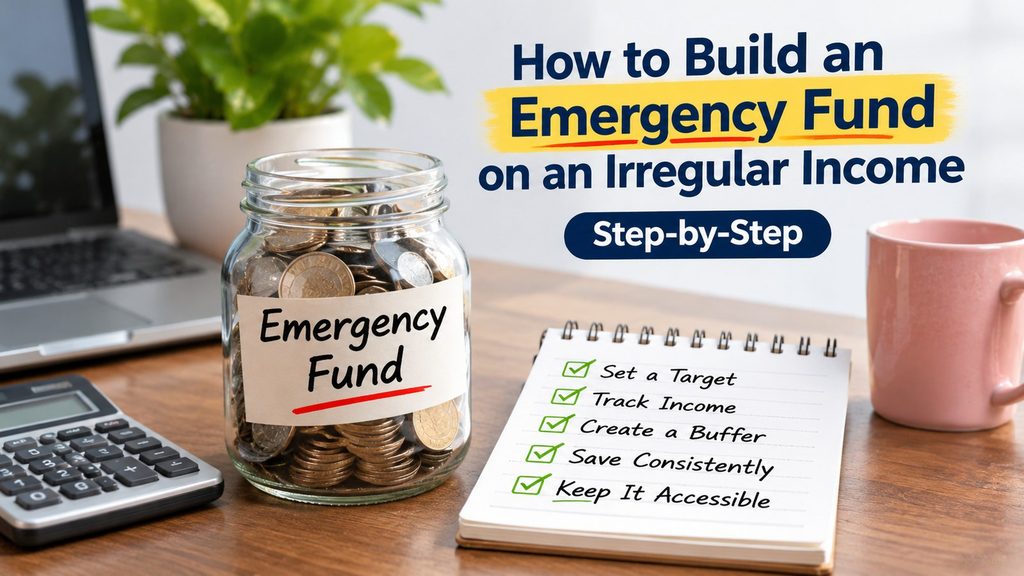
Quick answer: To build an emergency fund on an irregular income, (1) calculate your essential monthly expenses, (2) set a target of six to twelve months of those expenses, (3) find your baseline income from your lowest typical months, (4) route all income into a holding account, (5) pay yourself a fixed “salary,” (6) save a fixed percentage of every payment plus most of each windfall, and (7) keep the fund in a safe, liquid account. Start with a one-month starter fund and build up from there.
If you are a freelancer, consultant, creator, gig worker, commission-based salesperson or small business owner, you already know the rhythm: one month is excellent, the next is thin, and a client paying late can upset everything. Standard personal finance advice often assumes a steady monthly salary, which makes it hard to apply when your income looks more like a mountain range than a straight line.
An emergency fund matters even more for people with irregular income. It is not only protection against medical bills or a broken laptop; it is the buffer that smooths out the gaps between good months and bad ones. This step-by-step guide shows exactly how to calculate, build and protect one, with a worked example you can adapt to your own numbers.
Why Irregular Earners Need a Bigger Cushion
Salaried employees face emergencies such as illness, repairs or job loss. Irregular earners face all of those, plus income volatility itself. A slow season, a lost client, a platform algorithm change or a delayed invoice can create a shortfall even when nothing has “gone wrong.” Self-employed people also typically lack employer benefits such as paid sick leave or employer-provided health insurance, which makes personal reserves the main safety net.
That is why the usual guideline of three to six months of expenses is often too small. Many planners suggest irregular earners aim for six to twelve months of essential expenses, with the exact figure depending on how volatile income is and who depends on it.
Calculate your essential monthly expenses
List only the costs you must pay to live and work, even in a tough month: rent or home loan EMI, utilities, groceries, insurance premiums, school fees, minimum debt payments, transport, phone and internet, essential business tools and taxes you owe. Leave out restaurants, shopping, subscriptions you could pause and holidays. Review three to six months of bank statements to get an accurate figure.
Set your target fund size
Multiply your essential monthly expenses by a number of months that matches your risk level:
- 6 months: fairly steady clients, no dependants, partner with stable income.
- 9 months: moderate volatility or one or two dependants.
- 12 months: highly seasonal or project-based income, sole earner or several dependants.
Write the target down. A specific number is far more motivating than “save more.”
Find your baseline income
Look at your income over the past 12 to 24 months and identify your lower months, excluding extreme outliers. Your baseline is a conservative monthly figure you can expect to earn most of the time. Budgeting around the baseline, not the average, prevents you from committing to spending that only works in good months.
Create a holding account
Open a separate account where all your income lands first: client payments, platform payouts and business profits. This account acts as your personal “payroll” department. It separates money coming in from money you spend, which is the key to smoothing irregular income.
Pay yourself a fixed salary
Each month, transfer a fixed amount from the holding account to your everyday spending account, based on your baseline income and essential expenses. In good months, extra money stays in the holding account. In weak months, the holding account tops up the gap. Over time, this creates a stable personal income even when business income is uneven.
Save by percentage, not by fixed amount
Fixed monthly savings targets are hard to hit when income varies. Instead, commit to saving a percentage of every payment you receive, such as 10% to 20%, and automatically move it to your emergency fund. Then add a “windfall rule”: when a month exceeds your baseline, put a large share of the surplus, for example half, toward the fund until it is complete.
Keep it safe, separate and liquid
Your emergency fund should be boring. Use a high-interest savings account, a sweep-in fixed deposit or a liquid mutual fund that can be accessed within a day or two. Keep it separate from your spending account so it is not used accidentally, and avoid volatile assets like stocks or crypto for this money.
Worked Example: A Freelance Designer
Meera is a freelance graphic designer. Her income over the past year ranged from ₹45,000 in slow months to ₹1,60,000 in busy ones. Here is how she applies the method:
| Item | Amount |
|---|---|
| Essential monthly expenses | ₹50,000 |
| Risk level | High volatility, sole earner → 9 months |
| Emergency fund target | ₹50,000 × 9 = ₹4,50,000 |
| Starter fund goal (first milestone) | ₹50,000 (one month) |
| Baseline income | ₹65,000 |
| Fixed monthly “salary” | ₹58,000 |
| Savings rule | 15% of every payment + 50% of surplus above baseline |
In a ₹1,20,000 month, Meera saves 15% (₹18,000). The remaining ₹1,02,000 is ₹37,000 above her ₹65,000 baseline, and half of that surplus (₹18,500) also goes to the fund, for a total of ₹36,500 saved. Her ₹58,000 salary moves to her spending account and the rest stays in the holding account as a buffer. In a ₹50,000 month, she still saves ₹7,500, and the holding account covers the shortfall in her salary. At this pace, a few strong months build her starter fund, and she reaches the full target within roughly one to two years depending on how her income flows.
Build It in Milestones
Saving six to twelve months of expenses can feel impossible at the start. Break it into stages:
- Starter fund: one month of essential expenses. This stops small surprises from becoming debt.
- Clear high-interest debt: pay down credit cards and expensive personal loans while keeping the starter fund intact.
- Three-month fund: covers most common emergencies.
- Full fund: six to twelve months, matched to your risk level.
Celebrate each milestone. Progress is easier to sustain when you can see it.
A Simple Monthly Money Routine
- When money arrives: move the tax percentage and savings percentage immediately.
- First day of each month: transfer your fixed salary to your spending account.
- Mid-month: check outstanding invoices and follow up on late payments.
- End of month: review income versus baseline and apply the windfall rule.
- Every quarter: recalculate essential expenses and adjust your target if life has changed.
Ways to Make Income Less Irregular
Alongside saving, reducing volatility makes everything easier:
- Offer retainers or monthly packages to regular clients.
- Ask for deposits or milestone payments on larger projects.
- Diversify across several clients or platforms so one loss does not hurt as much.
- Use clear payment terms and send invoices promptly.
- Build a small recurring income stream, such as templates, courses or subscriptions.
When to Use the Fund, and How to Refill It
Use the fund for genuine emergencies: medical costs, essential repairs, sudden loss of a major client or several months below baseline. Do not use it for planned expenses such as festivals, weddings, travel or upgrades; give those their own savings goals. After using it, pause other savings goals and redirect your windfall rule toward refilling the fund until it is back to target.
Emergency Fund vs Business Reserve
If you run a business, keep two separate cushions. A business cash reserve covers operating costs such as rent, software, supplier bills and staff during slow periods. Your personal emergency fund covers household essentials. Mixing them makes it hard to see whether the business is genuinely profitable and risks draining family savings to prop up a struggling month. Many owners aim for a business reserve covering three to six months of fixed operating costs, alongside their personal fund.
Common Mistakes to Avoid
- Budgeting on your best months rather than your baseline.
- Mixing business and personal money in one account.
- Investing the emergency fund in volatile assets.
- Forgetting to set aside taxes.
- Waiting until income is “stable” before starting to save.
- Skipping insurance, especially health and term life cover, which protect the fund from very large shocks.
Key Takeaways
- Irregular earners should target six to twelve months of essential expenses.
- Budget around a conservative baseline income, not your average.
- Use a holding account and pay yourself a fixed monthly salary.
- Save a percentage of every payment plus a share of every windfall.
- Keep the fund safe, separate and liquid, and refill it after use.
This article is for general information and does not constitute financial advice. Consider speaking with a qualified financial planner for guidance tailored to your situation.
Frequently Asked Questions
How much emergency fund do I need with irregular income?
People with irregular income generally need a larger cushion than salaried workers. A common guideline is six to twelve months of essential expenses, depending on how volatile your income is, how many dependants you have and whether you have other safety nets.
Where should I keep my emergency fund?
Keep it somewhere safe and easy to access, such as a separate high-interest savings account, a sweep-in fixed deposit or a liquid fund. Avoid stocks or other volatile investments for money you may need at short notice.
Should I pay off debt or build an emergency fund first?
Most planners suggest building a small starter fund first, often one month of essential expenses, then focusing on high-interest debt such as credit cards, and then completing the full emergency fund. This prevents new debt when surprises arise.
How do I budget when my income changes every month?
Base your budget on a conservative baseline income, such as your lowest typical month. Pay yourself a fixed monthly amount from a holding account, and save or invest any surplus from higher-earning months.
What counts as an emergency?
An emergency is an unexpected, necessary expense or loss of income, such as a medical bill, urgent repair, job or client loss, or a sudden drop in business. Planned costs like holidays, festivals or gadget upgrades should have their own savings goals.