
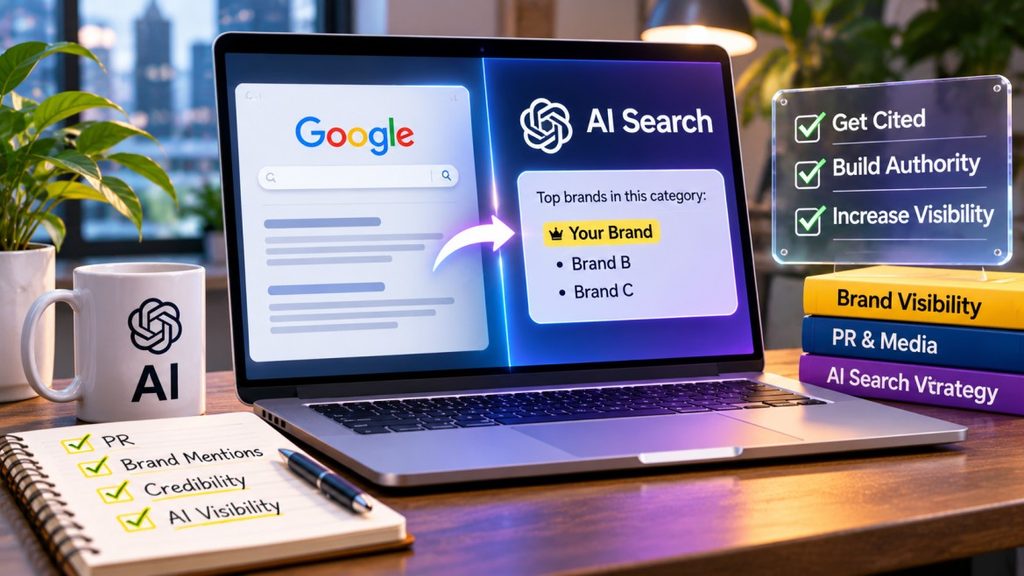
Key answer: To get cited in AI search, a brand must be easy for AI systems to find, understand and trust. That means publishing clear, question-led content with direct answers; keeping your brand information consistent everywhere online; earning mentions on credible third-party sites; using structured data; and tracking how AI assistants describe you. This approach is often called generative engine optimization (GEO) or answer engine optimization (AEO).
Search behaviour is changing faster than at any point since smartphones arrived. Buyers increasingly ask ChatGPT, Gemini, Perplexity, Claude or Google’s AI Overviews to compare products, recommend services or explain a problem, and they often get a complete answer without clicking a single link. For brands, this creates a new question: when an AI assistant answers a question about your industry, does it mention you?
Being cited in an AI answer can be more powerful than ranking tenth on a search results page, because the recommendation arrives with the authority of the assistant behind it. Being absent means you may not exist for a growing share of buyers. This article sets out a practical checklist, organised into five pillars, for improving your brand’s visibility in AI-generated answers.
How AI Answer Engines Choose Sources
Different tools work differently, but most AI search experiences combine two things: knowledge learned during training and live information retrieved from the web at the moment a question is asked. When retrieving, they run searches, read a selection of pages, and assemble an answer, often citing a handful of sources.
That process rewards content that is:
- Relevant to the specific question being asked.
- Extractable, meaning the answer is clearly stated rather than buried in long paragraphs.
- Corroborated by other independent sources across the web.
- Authoritative, coming from sites and authors with demonstrated expertise.
- Fresh where the topic changes, such as pricing, regulation or product features.
SEO vs GEO: What Changes and What Stays
| Area | Traditional SEO focus | GEO / AI search focus |
|---|---|---|
| Goal | Rank pages and earn clicks | Be mentioned, cited and recommended in answers |
| Content style | Keyword-targeted pages | Direct answers, definitions, comparisons, data |
| Authority signal | Backlinks | Backlinks plus brand mentions and citations across trusted sites |
| Brand data | Business listings | Consistent entity information everywhere |
| Measurement | Rankings, traffic | Share of AI answers, citation frequency, sentiment |
| Still essential | Crawlable site, fast pages, quality content, technical health | |
Pillar 1Write Content AI Can Quote
AI systems lift answers from content that states them clearly. Restructure key pages so each important question has a direct, self-contained answer.
- Start important pages with a two-to-four sentence summary that directly answers the main question.
- Use question-based headings that mirror how buyers ask, such as “How much does X cost?” or “Is X better than Y?”
- Answer immediately under each heading, then add detail.
- Include definitions, step lists, comparison tables and pros and cons, which are easy to extract.
- Add specific facts: prices, timeframes, specifications, locations and named examples.
- Publish original data, surveys or benchmarks that others will cite.
- Create honest comparison pages that include competitors, since AI is often asked “X vs Y.”
- Add a concise FAQ section to service, product and category pages.
Pillar 2Make Your Brand an Unambiguous Entity
AI models need to understand exactly who you are. Inconsistent names, descriptions or details across the web create confusion and reduce the chance of being recommended accurately.
- Use the same brand name, description, founding details and categories on your website and every profile.
- Build a clear About page that states what you do, who you serve, where you operate and key people.
- Keep business listings, social profiles and directory entries complete and consistent.
- Claim and maintain profiles on relevant review, industry and knowledge platforms.
- Link your official profiles together, and from your website to them.
- Give authors visible bios showing their real expertise.
Pillar 3Earn Third-Party Mentions
What others say about you matters as much as what you say about yourself. AI answers frequently draw on news articles, reviews, forums, listicles and industry publications.
- Pursue coverage on credible news and industry sites through press releases, expert commentary and data stories.
- Get included in reputable “best of” lists and comparison articles in your category.
- Encourage genuine customer reviews on established review platforms.
- Contribute expert answers in industry communities and Q&A forums, without spamming.
- Appear on podcasts, webinars and conference agendas that publish transcripts or summaries.
- Partner with associations and publications for co-branded research.
Pillar 4Strengthen Technical Foundations
If AI crawlers and search engines cannot access or interpret your content, nothing else matters.
- Check your robots.txt and firewall settings so legitimate search and AI crawlers are not accidentally blocked.
- Make sure key content is in the HTML, not hidden behind scripts, tabs that never load or images of text.
- Add structured data such as Organization, Product, Article, FAQPage and Review schema where appropriate.
- Keep pages fast, mobile-friendly and free of intrusive pop-ups.
- Maintain a clean XML sitemap and update “last modified” dates when content genuinely changes.
- Consider publishing a concise summary file of your key pages for AI tools, such as an llms.txt, as an optional extra.
Pillar 5Measure and Iterate
AI visibility can be tracked, though it requires new methods.
- List the 30 to 100 questions your buyers most often ask, across awareness, comparison and purchase stages.
- Run them monthly in the major AI assistants and record whether you appear, how you are described and which sources are cited.
- Track competitors’ share of mentions alongside your own.
- Note inaccurate descriptions and fix the underlying sources.
- Watch referral traffic from AI platforms in your analytics.
- Use AI visibility tracking tools if manual checks become too time consuming.
A Simple Measurement Grid
| Metric | What it tells you | How often |
|---|---|---|
| Mention rate | Share of target questions where your brand appears | Monthly |
| Citation rate | How often your own pages are linked as sources | Monthly |
| Recommendation position | Whether you are listed first, mid-list or last | Monthly |
| Accuracy and sentiment | Whether AI describes you correctly and positively | Quarterly |
| AI referral traffic | Visits arriving from AI platforms | Weekly |
A 30-Day Quick-Start Plan
If the full checklist feels overwhelming, start with a focused month of work:
- Week 1 – Audit: run your top 30 buyer questions through three AI assistants and record where you appear, where competitors appear and which sources are cited.
- Week 2 – Fix the foundations: correct inconsistent brand details on your website and main profiles, check crawler access and add Organization and FAQPage schema to key pages.
- Week 3 – Rewrite priority pages: add direct-answer summaries, question headings, comparison tables and FAQs to your five most important service or product pages.
- Week 4 – Earn one external signal: publish a newsworthy announcement or data story through credible distribution, pitch it to relevant publications and request reviews from recent satisfied customers.
Repeat the audit at the end of the month. Changes in AI answers can take time, especially where answers rely on training data, but answers based on live search often respond faster.
Examples of AI-Friendly Content Formats
- “What is” explainers that define a concept in the first sentence.
- “Best X for Y” guides with transparent criteria and honest pros and cons.
- Pricing pages that state real price ranges instead of “contact us” only.
- Alternatives and comparison pages that explain when a competitor might be a better fit.
- Annual reports and benchmarks with clearly labelled statistics.
- Glossaries covering the key terms in your industry.
These formats match the way people phrase questions to AI assistants, which makes it more likely that your content is retrieved and quoted when those questions are asked.
Mistakes That Hurt AI Visibility
- Thin, generic content that repeats what every competitor says gives AI no reason to cite you.
- Marketing fluff without facts, figures or specifics is hard to quote.
- Inconsistent brand details across profiles confuse entity recognition.
- Blocking crawlers by accident through overly strict security or robots settings.
- Fake reviews or manipulative tactics can damage trust with platforms and audiences.
- Ignoring off-site reputation, assuming your website alone is enough.
What This Means for Marketing Teams
GEO is pushing marketing teams to blend disciplines that were often separate: SEO, PR, content, reviews and brand management. A press mention is no longer just a reputation win; it is a data point AI systems may use when describing your company. A customer review is not only social proof; it shapes how assistants summarise your strengths and weaknesses. Brands that coordinate these efforts around the specific questions their buyers ask will gain a lasting advantage as AI search adoption grows.
The practical starting point is a shared list of buyer questions that every team works from. SEO writes the pages that answer them, PR earns coverage that supports them, and customer teams gather the reviews that prove them.
Key Takeaways
- AI assistants now answer buying questions directly, so being cited matters.
- Write clear, question-led content with direct answers and specific facts.
- Keep your brand entity consistent across the web.
- Earn mentions on credible news, review and industry sites.
- Track mention rate, citation rate and accuracy every month.
Frequently Asked Questions
What is generative engine optimization (GEO)?
Generative engine optimization is the practice of making your brand and content more likely to be found, understood and cited by AI-powered answer engines such as ChatGPT, Gemini, Perplexity, Claude and Google AI Overviews.
How do AI tools decide which brands to cite?
AI answer engines typically draw on web search results and their training data. They favour sources that are relevant, clearly structured, factually specific, consistent across the web and mentioned by other trusted sites, such as reputable media, review platforms and industry publications.
Is GEO different from SEO?
GEO builds on SEO rather than replacing it. Strong SEO foundations such as crawlability, quality content and backlinks still matter, but GEO adds emphasis on direct answers, entity consistency, third-party mentions, structured data and content that is easy for AI to quote.
How can I check if my brand appears in AI answers?
Create a list of the questions your customers ask, run them regularly in major AI assistants, and record whether your brand is mentioned, cited or recommended and which competitors appear. Dedicated AI visibility tracking tools can automate this monitoring.
Does press coverage help with AI search visibility?
Yes. Coverage and mentions on credible news sites, industry publications and respected directories give AI systems independent signals about your brand, which can make them more likely to describe and recommend you accurately.