

Imagine transforming a fleeting idea into a market-ready MVP that attracts investors and users alike-without wasting months or millions. For startup founders, this journey demands precision, from validating concepts via surveys and competitor analysis to launching a lean product.
This guide covers idea validation, team building, business modeling, legal setup, technical planning, MVP development, and launch strategies, revealing proven steps to accelerate your success.
Market Research Basics
Use Google Trends, Statista, and Ahrefs to analyze search volume for your keyword and identify market gaps. This step helps startup founders validate their idea early in the startup journey. Target keywords with steady interest to ensure demand for your MVP.
Follow this 5-step process for solid market research. It combines free and paid tools to uncover opportunities during idea validation. Each step builds toward problem-solution fit.
- Conduct keyword research with Ahrefs at $99 per month. Enter core terms related to your idea, like no-code prototyping tools, to spot search volumes and related queries.
- Perform trend analysis via Google Trends. Compare your keyword against competitors over time to detect rising interest or seasonal patterns.
- Calculate TAM, SAM, SOM. TAM represents the total market, SAM your serviceable portion, SOM the share you can capture realistically. Aim for TAM at $1B or more ideally.
- Review Statista industry reports for $39 per month. Access data on market size and growth drivers in your niche.
- Scan Reddit and Hacker News for trends. Search subreddits like r/startups for pain points and discussions on similar ideas.
Document findings in a market sizing spreadsheet template. This tool organizes your research for the pitch deck later. Use it to track assumptions and refine your value proposition.
| Section | Formula/Notes | Example |
| TAM | Total market value | $10B remote work tools |
| SAM | Your addressable segment | $2B no-code platforms |
| SOM | Realistic capture (1-5% SAM) | $50M year 1 target |
| Assumptions | List sources | Statista, Ahrefs data |
| Gaps | Opportunities | Underserved B2B niche |
Integrate customer interviews next to test these insights. This feedback loop confirms product-market fit before building the prototype. Adjust based on real founder stories from Indie Hackers.
Customer Problem Identification
Conduct 15 customer interviews using Steve Blank’s ‘Mom Test’ questions to uncover 3-5 core problems worth solving. This customer discovery step ensures your idea aligns with real needs in the startup journey. Focus on open-ended questions that let customers reveal pains without leading them.
Target 80% interview time on the customer talking by listening more than speaking. Use Typeform at $25/mo for quick screening to find your target audience. Categorize pains as functional, emotional, or social to map out problem-solution fit.
Here are 10 specific interview questions in the ‘Mom Test’ template: When was the last time you [activity]? What was hard about it?
- When was the last time you booked a freelance designer? What was hard about it?
- When was the last time you tracked your team’s project progress? What was hard about it?
- When was the last time you organized a virtual team meeting? What was hard about it?
- When was the last time you analyzed sales data? What was hard about it?
- When was the last time you found reliable childcare? What was hard about it?
- When was the last time you planned a family vacation? What was hard about it?
- When was the last time you shopped for niche fitness gear? What was hard about it?
- When was the last time you managed personal finances? What was hard about it?
- When was the last time you coordinated remote work schedules? What was hard about it?
- When was the last time you researched healthy meal options? What was hard about it?
Classify responses into functional pains like time-consuming tasks, emotional pains like frustration, and social pains like embarrassment. This idea validation builds a strong foundation for your MVP and lean startup approach.
Competitor Analysis
Create a competitor matrix in Airtable comparing 5 direct competitors on pricing, features, and customer reviews from G2 and Capterra. This competitive analysis step helps validate your idea during the startup journey. It reveals gaps where your MVP can stand out.
Use free tools like Airtable to build the matrix quickly. Add columns for competitor name, monthly price, key features, ratings, and weaknesses. Pull reviews from G2 and Capterra to spot common pain points.
Next, calculate a competitive density score from 1 to 10 based on similar offerings. A score of 8 or higher signals a crowded market, so aim for differentiation like pricing 20% lower or 2x faster performance. This guides your unique selling point in product development.
| Competitor | Monthly Price | Key Features | Ratings | Weakness |
| Example Competitor A | $49 | Basic analytics, email integration | 4.2/5 on G2 | Slow load times |
| Example Competitor B | $29 | Custom dashboards, API access | 4.5/5 on Capterra | Limited mobile support |
| Example Competitor C | $79 | AI predictions, team collaboration | 4.0/5 on G2 | High learning curve |
| Example Competitor D | $19 | Report templates, data export | 3.8/5 on Capterra | No real-time updates |
| Example Competitor E | $59 | Segmentation tools, integrations | 4.3/5 on G2 | Poor customer support |
For deeper insights, try SimilarWeb at $199 per month or BuiltWith at $295 per month. These tools show traffic sources and tech stacks. Combine findings with SWOT analysis to refine your lean startup approach and achieve problem-solution fit.
Initial Surveys and Interviews
Launch surveys with Typeform collecting 100 responses at $0.25/response ($25 total) targeting ‘definitely would buy’ at 40% threshold. This approach fits the lean startup method for quick idea validation. Founders use it to gauge problem-solution fit early in the startup journey.
Compare survey platforms like Typeform ($25/mo), Google Forms (free), and SurveyMonkey ($32/mo). Google Forms suits bootstrapped teams with basic needs, while Typeform excels in engaging designs for higher completion rates. Pick based on your target audience and budget during customer discovery.
Use this 12-question template with the Sean Ellis GTU test to measure demand. Ask about pain points, current solutions, and willingness to pay. Include questions like “How would you feel if you could no longer use this?” to spot early adopters.
| Platform | Pricing | Best For |
| Typeform | $25/mo | Engaging, mobile-friendly surveys |
| Google Forms | Free | Simple, quick setups |
| SurveyMonkey | $32/mo | Advanced analytics |
Distribute via Reddit, LinkedIn, and Facebook Groups, aiming for 5 targeted communities. Post in niche subreddits like r/Entrepreneur or industry groups to reach your target audience. A 40% GTU signals validation, prompting MVP development.
Follow surveys with customer interviews for deeper insights. Schedule 10-15 calls with respondents to explore feedback loops. This builds toward product-market fit and informs your value proposition.
Defining Your Value Proposition
Craft your value proposition using the Value Proposition Canvas template from Strategyzer with customer jobs, pains, and gains. This tool helps startup founders map out how their MVP solves real customer problems. It ensures problem-solution fit before product development.
Start by identifying your target audience and their daily jobs, like coordinating team tasks or managing projects. List their pains, such as missed deadlines or communication overload, and gains, like faster collaboration or better insights. Then, define your solution, pain relievers, and gain creators to create a clear unique selling point.
Here is a fillable template to guide your customer discovery:
| Customer Jobs | Pains | Gains | Your Solution | Pain Relievers | Gain Creators |
Compare examples like Slack’s tagline “Where work happens”, focusing on seamless communication, versus Basecamp’s “Build better products”, emphasizing project outcomes. Test your draft with 20 customers, aiming for most to grasp it quickly. Use tools like Canva for visual templates to refine during idea validation.
Target Audience Profiling
Create 3 customer personas in Notion using interview data: demographics, behaviors, goals, frustrations (BGF framework). This step sharpens your idea validation during the startup journey. Personas turn abstract market research into vivid profiles of real users.
Start with a simple persona template: Name/Age/Job | Goals | Frustrations | Behaviors | Quote. Use free tools like Notion to build these quickly. For example, ‘Sarah, 32, Marketing Manager, overwhelmed by reporting.’
Gather data through customer interviews to fuel your personas. Aim for at least 5 interviews per persona to spot patterns in behaviors and pain points. Validate by checking how well real feedback matches your profiles.
Tools like Xtensio offer templates for deeper dives at a low cost. These personas guide your MVP development, ensuring the minimum viable product solves true problems. They anchor your lean startup approach from ideation to prototype.
| Persona Element | Description | Example |
| Name/Age/Job | Basic demographics | Sarah, 32, Marketing Manager |
| Goals | What they want to achieve | Streamline weekly reports |
| Frustrations | Pain points they face | Manual data entry wastes hours |
| Behaviors | Daily habits and tools | Uses Excel, switches tabs often |
| Quote | Direct user voice | “Reporting eats my weekends.” |
Example Personas for a Reporting Tool MVP
Meet Sarah, the first persona: Sarah, 32, Marketing Manager | Goals: Automate reports to focus on strategy | Frustrations: Tedious data pulls from multiple sources | Behaviors: Relies on spreadsheets, checks email hourly | “I need reports that build themselves.”
Next, Tom, 28, Sales Rep | Goals: Hit quotas with quick insights | Frustrations: Outdated CRM dashboards | Behaviors: Mobile-first, logs calls on the go | “Slow data kills my deals.” These details emerge from customer discovery chats.
Finally, Lisa, 40, Team Lead | Goals: Align team metrics easily | Frustrations: Version control chaos in shared files | Behaviors: Leads standups, prefers collaborative apps | “One source of truth, please.”
Use these in your business model canvas to map value proposition against real needs. They inform wireframes and user stories for agile development. Test personas in early feedback loops to refine your problem-solution fit.
Feature Prioritization
Score 20 potential features using RICE framework (Reach, Impact, Confidence, Effort) targeting top 5 Must-Have features. This method helps startup founders focus on what truly matters for the MVP. It ensures your minimum viable product delivers maximum value with limited resources.
The RICE formula calculates a score with a simple equation: (Reach x Impact x Confidence) / Effort. Reach estimates users affected, Impact rates value on a 1-3 scale, Confidence gauges certainty in percentages, and Effort measures hours needed. High scores signal priority features for product development.
Create an Excel template to streamline this process. List features in rows with columns for Feature, Reach (users), Impact (1-3), Confidence %, Effort (hours), and Score.
| Feature | Reach (users) | Impact (1-3) | Confidence % | Effort (hours) | Score |
| Login | 1000 | 3 | 100 | 20 | 15 |
| Profile Setup | 800 | 2 | 90 | 15 | 9.6 |
| Search | 500 | 3 | 80 | 30 | 4 |
Use MoSCoW method as backup: categorize as Must-have, Should-have, Could-have, Won’t-have. Cut features with RICE score under 10 to maintain lean startup focus. This prioritization drives idea validation and problem-solution fit.
MVP Scope Definition
Define MVP as 3 core features solving 80% of the primary customer job in 8 weeks using the MVP Canvas template.
This approach keeps your minimum viable product focused and testable. The canvas breaks down your idea into key areas: Problem, Solution, Success Metrics, and Timeline. It ensures you target the real pain points from customer discovery.
Follow this rule: if you can’t explain your MVP in one sentence, it is too complex. For example, Dropbox’s MVP was a simple file sharing video demo that validated demand without building full software. This lean startup tactic saves time and resources during product development.
Budget $5K-15K for a no-code MVP using tools like Figma for wireframes and Airtable for management. Prioritize problem-solution fit over perfection. Track progress with agile development practices like user stories and weekly feedback loops.
Finding Co-Founders
Find co-founders on CoFoundersLab (free basic) and Y Combinator Co-Founder Matching by screening for complementary skills and 50/50 equity split. These platforms connect startup founders with like-minded individuals during the startup journey. They help match technical experts with business-savvy partners for idea validation and MVP development.
Other options include FounderDating for targeted searches based on industry and location. Create a detailed profile highlighting your idea, skills, and vision to attract the right matches. Focus on team building early to share the load of product development and customer discovery.
Use a screening checklist with key questions to evaluate candidates. Ask about their experience, commitment level, and equity expectations. This ensures alignment on problem-solution fit and long-term goals like achieving product-market fit.
- What relevant experience do you bring to startups or this industry?
- How many hours per week can you commit to this lean startup project?
- What are your equity expectations and thoughts on vesting schedules?
- Do your skills complement mine, such as coding for my business background?
- Have you worked remotely before, using tools like Trello or Notion?
- What is your approach to iteration and pivoting based on feedback?
- Can you share examples of past projects or prototypes you’ve built?
- How do you handle conflict in agile development teams?
- What motivates you in the startup ecosystem, like accelerators or YC?
- Are you open to a co-founder agreement outlining roles and exit terms?
Secure your partnership with a co-founder agreement template covering essentials like equity splits, decision-making, and IP ownership. Experts recommend consulting a lawyer to customize it for your business model canvas. This protects everyone as you move toward prototyping and launch.
Key Early Hires
Hire CTO ($120K-180K US) or growth marketer ($90K-140K) first based on MVP needs using AngelList and Product Hunt Jobs. Early hires shape your startup journey from idea validation to product development. Match roles to your lean startup stage for maximum impact.
Consider a role prioritization matrix by stage. In ideation and prototyping, prioritize a technical co-founder or CTO to build wireframes and mockups. For pre-launch and beta testing, bring on a growth marketer to drive user acquisition and early adopters.
Salary benchmarks for 2024 show CTO at $150K average and growth roles at $110K in the US. Adjust for remote work and equity offers in bootstrapping scenarios. Use tools like AngelList for free postings or LinkedIn Recruiter at about $8K per year for targeted outreach.
Job description templates should highlight your value proposition and problem-solution fit. For a CTO, emphasize agile development with Scrum or Kanban, user stories, and scalability using AWS or Heroku. Growth roles focus on AARRR framework, SEO, content marketing, and conversion optimization.
Role Prioritization Matrix
| Stage | Priority Role | Why It Matters |
| Ideation & Prototyping | CTO / Tech Lead | Builds prototype, handles technical debt, enables no-code tools like Figma |
| Customer Discovery & MVP | CTO + Product Manager | Validates hypothesis testing, iterates on feedback loop, creates landing page |
| Pre-Launch & Traction | Growth Marketer | Drives metrics, KPIs, growth hacking, acquires early adopters |
| Scaling & Product-Market Fit | Full Team (Sales, Ops) | Supports go-to-market, retention, churn reduction |
This matrix guides team building decisions. Founders often overlook timing, leading to mismatched hires. Align roles with your roadmap and milestones for efficient execution.
Job Description Templates
Craft clear job descriptions to attract talent in the startup ecosystem. Start with your founder story, unique selling point, and business model canvas. End with equity details and remote work flexibility.
- CTO Template: Lead product development from MVP to SaaS. Skills: Full-stack, cloud services, agile. Experience: Bootstrapped startups, Y Combinator alumni preferred.
- Growth Marketer Template: Own user acquisition via social media, email marketing. Skills: Analytics (Google Analytics, Mixpanel), pirate metrics. Experience: Indie Hackers, Product Hunt launches.
Post on Hacker News, Reddit communities, or Indie Hackers for visibility. Tailor to B2B or B2C needs, like freemium models or niche markets.
Interview Process
- Initial Screen (30 min): Review resume, discuss founder story and MVP vision.
- Skills Test: CTO codes a simple prototype; growth builds a mock campaign in Trello or Notion.
- Culture Fit (3 Interviews Total): Deep dive into mindset, resilience, OKRs alignment. Use Eisenhower matrix questions for prioritization.
This 3-interview structure ensures problem-solution fit with your team. Include reference checks and trial tasks. Focus on execution speed and perseverance to avoid common startup myths.
Freelancers vs Full-time
Use Upwork for MVP design at $3K-8K over 4 weeks versus full-time hires for post-MVP scaling. This approach often targets 30-50% cost savings with freelancers during early product development. It fits the lean startup method by keeping fixed costs low.
Full-time employees bring long-term commitment but demand higher upfront salaries and benefits. Freelancers offer flexibility for specific tasks like wireframes or landing page builds. Choose based on your startup journey stage, from ideation to beta testing.
| Task | Freelancer Cost/hr | Full-time Salary | Speed | Quality Risk |
| UI/UX Design | $20-80 | $80K/year | Fast | Medium |
| Frontend Dev | $30-100 | $100K/year | Medium | Low |
| Backend Dev | $40-120 | $120K/year | Slow | Medium |
| Project Mgmt | $25-90 | $90K/year | Fast | Low |
Platforms like Upwork ($20-80/hr), Toptal ($60-150/hr), and Fiverr ($50-500/project) connect you to talent for prototype work. Post listings with clear user stories and milestones. Review portfolios focused on no-code tools like Figma for quick iterations.
Mitigate risks with milestone payments tied to deliverables such as mockups or customer discovery feedback. Use NDAs and contract templates from free online resources to protect your idea. This supports agile development and rapid pivots in your MVP build.
Equity and Compensation
Offer co-founders 40-60% equity, first employees 0.5-2% using Slicing Pie dynamic equity model for fair distribution. This approach adjusts shares based on actual contributions during the startup journey. It helps avoid disputes as you move from idea validation to building the MVP.
For co-founder #2, aim for 25-35% equity benchmarks depending on their role in product development and customer discovery. Use tools like Carta at $99/mo or free Equity Calculator to model splits. Always include a 4-year vesting schedule with 1-year cliff to ensure commitment.
Early employee #1 might receive 1% equity, while advisors get around 0.25%. Combine this with salary packages tailored to bootstrapping stages. For example, a lead developer in a lean startup could take lower pay plus equity to align with problem-solution fit goals.
- Co-founder equity: 40-60% total, vested over 4 years.
- First hire: 0.5-2% with competitive salary.
- Advisor shares: 0.25-1% for strategic input on pitch deck or go-to-market.
- Vesting: Protects the team during pivots or iteration.
Track everything in Notion or Airtable for transparency. This builds trust in team building and supports traction as you scale toward product-market fit.
Revenue Streams
Target $10K MRR within 12 months with 3 streams: subscription ($29/mo, 300 customers), marketplace (10% fee), enterprise ($2K/mo). This mix balances predictable income from subscriptions with variable earnings from marketplaces and high-value enterprise deals. It supports your lean startup approach during the MVP phase.
Start by mapping revenue streams in your business model canvas. Subscriptions offer steady cash flow, ideal for SaaS products like team tools. Combine them with marketplaces to tap network effects early.
Pricing benchmarks vary by industry. For collaboration software, aim around Slack’s $6.67/user/mo; for automation, match Zapier’s $20/mo avg. Test these in customer interviews during idea validation.
Track LTV:CAC at 3:1 to ensure sustainability. Focus on retention to boost lifetime value while optimizing acquisition costs through content marketing and SEO. This keeps your startup journey funded without heavy reliance on investors.
| Model | Description | Pros | Cons | MVP Fit |
| Subscription | Recurring fees for access | Predictable revenue, high LTV | Churn risk | Great for SaaS MVPs |
| Freemium | Free tier upgrades to paid | Low barrier, viral growth | Conversion challenges | Ideal for consumer apps |
| Marketplace | Commission on transactions | Scales with users | Needs critical mass | Works for B2B platforms |
| Usage-based | Pay per use or action | Aligns with value | Revenue volatility | Suits API or cloud services |
Use this table to pick models matching your problem-solution fit. Validate via landing pages and beta testing with early adopters. Iterate based on pirate metrics like acquisition and retention.
Cost Structure
Build a $3K/mo burn rate: AWS $500, tools $300, salaries $2K using Baremetrics for cost tracking. This lean approach keeps your startup journey affordable during idea validation and MVP development. Track every dollar to maintain control as you move toward product-market fit.
Organize costs into clear categories: fixed costs like salaries, variable costs such as marketing, and one-time costs including legal fees. Fixed costs provide stability, while variable ones scale with growth. One-time expenses front-load your bootstrapping efforts.
Use tools like Baremetrics ($50/mo) or ChartMogul ($100/mo) to monitor expenses in real time. A burn rate calculator helps predict your runway. Aim to keep costs under control, targeting a benchmark where expenses stay below revenue generation.
- Fixed costs: Salaries for co-founder or early hires, office tools like Notion or Trello.
- Variable costs: Marketing via social media or email campaigns, cloud services like AWS or Heroku.
- One-time costs: Legal setup, prototype tools like Figma for wireframes and mockups.
Example: Secure a $50K runway minimum to cover 12-18 months, giving time for customer discovery, iteration, and pivot if needed. This structure supports lean startup principles from experts like Eric Ries. Focus on prioritization using the Eisenhower matrix to avoid waste.
Key Partners and Resources
Secure 3 key partnerships: AWS credits, Stripe Atlas for payments, Notion for operations. These alliances provide essential infrastructure and credibility during your startup journey from idea to MVP. They cut costs and accelerate product development.
Focus on three partnership types: strategic for credibility, co-marketing for reach, and tech for infrastructure. Strategic partners like accelerators boost your validation framework. Tech ones, such as cloud services, handle scalability needs.
Real examples show the power of partnerships. Airbnb integrated with Craigslist to tap into early users and gain traction. Dropbox leveraged Y Combinator demo day to secure initial buzz and users.
Outreach starts with a tailored email template. Introduce your value proposition, explain mutual benefits, and propose next steps like a call. Always follow up with an MOU to formalize terms and protect both sides.
- Subject: Partnership Opportunity for [Your Startup] MVP
- Body: Hi [Name], I’m [Your Name], founder of [Startup]. Our MVP solves [problem] for [target audience]. We’d love to partner via [specific type] to [mutual benefit]. Can we chat?
- Close: Best, [Your Name]
MOUs outline responsibilities, timelines, and deliverables. They build trust and clarify expectations in your lean startup approach. Prioritize partners aligning with your business model canvas and go-to-market strategy.
Customer Relationships
Target 5% monthly churn with automated onboarding (Intercom) and weekly NPS surveys (Typeform). This approach helps startup founders build strong customer relationships from the MVP stage. It keeps users engaged and provides data for quick iterations.
Choose relationship types by customer segment. Use personal assistance for high-value early adopters, like one-on-one calls during beta testing. Shift to self-service options, such as knowledge bases, for scaling users.
Automated services handle routine queries with chatbots, while communities foster peer support via forums. Tools like Intercom at $74/mo integrate messaging and automation. Zendesk at $49/mo offers ticketing for efficient support.
Track the retention loop: NPS surveys gather feedback, which informs product updates. This creates a feedback loop essential for product-market fit. Regularly review churn by industry benchmarks to refine your strategy during the startup journey.
Company Formation
Form Delaware C-Corp via Stripe Atlas ($500, 1 week) for 90% of YC startups and investor preference. This setup aligns with startup ecosystem norms, especially for those seeking funding from accelerators like Y Combinator. It provides flexibility for equity distribution and future scaling.
Compare entity types to match your startup journey. A C-Corp ($500) suits venture-backed ventures due to investor familiarity. An LLC ($300) offers simplicity for bootstrapping, while an S-Corp blends pass-through taxation with some structure.
Choose services based on speed and needs during idea validation. Stripe Atlas ($500) handles everything remotely, ideal for non-US founders. Clerky ($99+) and LegalZoom ($149) provide affordable options with templates for basic filings.
| Entity | Cost | Best For |
| C-Corp | $500 | Investors, scaling |
| LLC | $300 | Bootstrapping, simplicity |
| S-Corp | Varies | Tax benefits, small teams |
Select Delaware for business-friendly laws, strong courts, and VC appeal, even if operating elsewhere. Factors include tax rules, privacy, and filing ease. Expect a 1-2 week timeline from paperwork to EIN issuance.
Basic Legal Documents
Use Clerky templates for co-founder agreement ($99), IP assignment, and offer letters covering most early stage needs. These documents protect your startup journey from the start. They help secure co-founder commitments and ownership of ideas.
A co-founder agreement outlines equity splits, roles, and vesting schedules. It prevents disputes during idea validation or product development. Pair it with a free IP assignment to transfer inventions to the company.
Offer letters formalize early hires for your MVP team. Keep them simple with salary, equity, and at-will terms. Use free templates to onboard talent quickly while bootstrapping.
Review costs stay low with these basics, but trigger lawyer review at $2K-5K for funding rounds or complex terms. Here’s a checklist of essentials:
| Document | Cost | Purpose |
| Co-founder Agreement | $99 | Defines roles, equity, vesting |
| IP Assignment | Free | Transfers IP to company |
| Offer Letter | Free | Onboards early employees |
| NDA | $50 | Protects sensitive info |
Customize templates for your lean startup needs, like remote work clauses. This setup supports customer discovery without legal hurdles.
Initial Budgeting
Create a 12-month budget in Google Sheets targeting an 18-month runway at $8K monthly burn ($144K total). This approach gives your startup journey breathing room for idea validation and MVP development. Start by listing all expected expenses across key categories.
Follow these budget template categories with benchmarks: Product (40%) for tools like Figma and no-code platforms, Marketing (25%) for landing pages and customer interviews, Operations (20%) covering cloud services like AWS or Heroku, and Team (15%) for co-founder stipends or early hires. Adjust based on your bootstrapping needs or funding stage. Use the business model canvas to map revenue streams against this cost structure.
Tools like Google Sheets keep it free and simple for ideation and tracking. For advanced forecasting, try Runway at $35 per month to model scenarios and predict cash flow. Set a monthly review cadence to check KPIs like burn rate and pivot if market research shows shifts in target audience needs.
In practice, allocate product funds to wireframes and prototypes first, then marketing for pre-launch beta testing. This lean startup method ensures focus on problem-solution fit without overspending. Regularly apply the Eisenhower matrix for prioritization during reviews.
Funding Options Overview
Bootstrap to $10K MRR or raise $150K pre-seed from angels (10% dilution) using YC SAFE template. This funding ladder starts with self-funding and climbs to venture capital. Founders often begin here to validate their MVP without external pressure.
Bootstrapping relies on personal savings or early revenue from your minimum viable product. It keeps full ownership during idea validation and customer discovery. Many lean startup successes grow this way before seeking investors.
Next come friends and family rounds for initial product development. Angels follow, offering $50-250K for equity in promising prototypes. Success rates for angels sit around 1-3%, so craft a strong pitch deck highlighting problem-solution fit.
Accelerators like Y Combinator provide funding, mentorship, and networks, with acceptance rates near 1-2%. Choose between SAFE notes, which delay valuation, or priced rounds that set terms upfront. Use a dilution calculator to model ownership post-funding.
- Bootstrap: Control your startup journey fully.
- Friends/family: Quick cash for MVP builds.
- Angels: Bridge to traction with targeted investments.
- Accelerators: Fast-track via programs like YC.
- Seed VC: Scale after proving product-market fit.
Track metrics like MRR and user acquisition to attract the right funding stage. This ladder supports iteration from ideation to launch strategy.
Tech Stack Selection
Choose Bubble ($25-475/mo) + Stripe for no-code MVP or Next.js + Supabase for custom scale. This decision shapes your product development speed and costs as a startup founder. Match the stack to your lean startup goals during the MVP phase.
Your team skills matter first. If your group lacks coders, no-code tools like Bubble let non-technical founders build fast without hiring. Custom stacks demand developers but offer more control.
Consider a decision matrix for clarity. Weigh team skills, budget, timeline, and scale needs. This framework guides choices in your startup journey.
| Approach | Monthly Cost | Build Time | Best For |
| No-code (Bubble) | $200/mo | 4 weeks | Quick prototypes, idea validation |
| Custom (React) | $5K upfront | 8 weeks | High scale, custom features |
Use this table to compare options. No-code speeds up customer discovery and feedback loops. Custom builds suit long-term product-market fit.
Example stacks fit use cases. For a marketplace MVP, try Bubble with Stripe for payments. E-commerce? Next.js frontend with Supabase backend handles user data well.
SaaS tools like Figma for wireframes pair with any stack. Track progress in Trello or Notion. This keeps your agile development on track during iteration.
MVP Architecture
Design modular monolith architecture with 3 microservices (auth, core, analytics) using domain-driven design. This approach keeps your MVP simple yet scalable for the startup journey. It separates concerns like user authentication, main business logic, and basic tracking.
Follow core principles such as a single database to avoid complexity in early product development. Use an API gateway to route requests efficiently and enable horizontal scaling as user growth demands. These choices support lean startup methods during idea validation and iteration.
For diagramming, tools like Lucidchart help visualize your setup quickly. Create a simple template showing the monolith with bounded contexts for auth, core features, and analytics. This aids in customer discovery and feedback loops by clarifying your prototype’s structure.
Avoid common mistakes like over-engineering with too many services or tight coupling between components. Stick to user stories and wireframes to prioritize essentials. Experts recommend this for achieving problem-solution fit without technical debt.
- Map domains: Auth handles login, core manages key workflows, analytics tracks basic metrics.
- Test scalability: Simulate load with simple tools before launch.
- Iterate based on beta testing: Adjust boundaries from early adopter feedback.
Incorporate agile development with tools like Trello for task tracking. This ensures your MVP aligns with the business model canvas and go-to-market strategy. Focus on execution speed to reach product-market fit faster.
Development Timeline
Build MVP in 8 weeks using 2-week sprints: Week 1-2 Setup, 3-4 Core, 5-6 Polish, 7-8 Test. This agile development approach keeps the startup founder focused on execution and iteration. It aligns with lean startup principles to deliver a minimum viable product quickly.
Use a Gantt chart template in ClickUp to visualize the roadmap and dependencies. Break down work into sprints with story points for user stories like “as a user, I want to sign up so I can access features.” Tools like ClickUp (free) or Jira ($7.75/user) support scrum or kanban workflows.
Set clear milestones: Alpha by week 4 for internal prototype testing, Beta by week 7 for early adopters. Add a 20% buffer for unknowns like technical debt or feedback loops. This structure helps manage risk in product development.
Prioritize with Eisenhower matrix during sprint planning to focus on high-impact tasks. Track progress with OKRs and adjust based on customer discovery insights. Regular retrospectives ensure the team stays resilient amid pivots.
Tools and Platforms
Use Figma ($12/user), Notion ($8/user), GitHub (free), and Postman ($12/user) totaling $150/mo team cost for a small startup team. These tools cover design, project management, code, and testing needs during your startup journey. They help streamline product development from idea validation to MVP launch.
Start with Figma for creating wireframes and mockups to visualize your prototype. Use Notion to organize user stories, track feedback loops, and manage your roadmap. GitHub enables version control for code collaboration, while Postman tests APIs early in agile development.
To cut costs, prioritize free tiers and limit paid users to essentials. Experts recommend auditing tool usage monthly to avoid unused subscriptions. This keeps your bootstrapping budget lean while supporting iteration and pivots.
| Function | Primary Tool | Key Use Case |
| Design | Figma | Build wireframes and mockups for rapid prototyping |
| Project Management | Notion | Track tasks, roadmaps, and customer interviews |
| Code | GitHub / VSCode | Version control and local development environment |
| Testing | Postman / Cypress | API testing and end-to-end browser automation |
- Free alternatives: Canva or Penpot for design instead of Figma.
- Trello or Asana free tiers for project management over Notion.
- GitLab for code hosting as a GitHub substitute.
- Thunder Client (VSCode extension) or Insomnia for Postman-like testing.
Design and Wireframing
Create 15 wireframes in Figma, spending about 3 hours on each, then test the top 3 with 5 users each using Maze.co at $50 per month. This design process keeps your MVP focused on core user needs during product development. It fits the lean startup approach by prioritizing quick iterations.
Start with user flows for the top three paths, like landing page to signup to dashboard. Map these flows to capture the startup journey from idea validation to first use. This step ensures problem-solution fit before building.
Move to wireframes in Figma for low-fidelity sketches of key screens. Include common patterns such as landing signup dashboard to guide customer discovery. Refine based on feedback loops from early sketches.
Run usability tests in Maze to spot issues early, then create hi-fidelity mockups. Aim for smooth task completion as a success metric in your validation framework. This builds toward product-market fit with agile development practices.
Core Feature Development
Develop 3 core features using 12 user stories (4 per feature) in a 4-week sprint with daily standups. This approach keeps your MVP development focused and agile. It aligns with lean startup principles to deliver value quickly.
The user story template is simple: As a [user] I want [feature] so that [benefit]. For example, As a busy professional, I want to track tasks quickly so that I stay organized without hassle. This format ensures features solve real problems during product development.
Prioritize in this order: MVP essentials first, then nice-to-haves. Use daily standups to review progress, blockers, and plans. This builds momentum in your startup journey.
An acceptance criteria checklist confirms each story is complete. Include tests for functionality, usability, and edge cases. End sprints with code reviews to maintain quality and catch issues early.
- Write user stories collaboratively with your team or early adopters.
- Refine acceptance criteria before coding starts.
- Conduct peer code reviews after each feature pull request.
- Demo completed features in sprint retrospectives for feedback.
For a task app MVP, core features might include task creation, list views, and reminders. Map 4 stories per feature to cover key scenarios. This method supports iteration and problem-solution fit.
Testing and Iteration
Run 3 iterations with 20 beta users each using Hotjar ($39/mo) targeting <5% critical bugs at launch. This approach ensures your minimum viable product (MVP) meets basic quality standards before wider release. Startup founders often overlook rigorous testing, leading to costly post-launch fixes.
Follow the testing pyramid for efficient coverage: focus most efforts on unit tests for individual components, then integration tests for how they work together, and fewer end-to-end tests for full user flows. This structure catches issues early in product development. Tools like Jest for unit testing keep the process lean.
Set up a beta program with platforms like UserTesting ($49/test) for structured feedback and Hotjar for heatmaps and session recordings. Invite early adopters from your target audience via email lists or social media. Track metrics such as bug reports and user satisfaction to guide improvements.
Adopt a weekly iteration cycle: collect feedback, prioritize issues using tools like Trello, implement fixes, and retest with fresh users. This feedback loop aligns with lean startup principles from experts like Eric Ries. Repeat until you achieve product-market fit through data-driven pivots.
Minimum Viable Launch
Launch with 100 waitlist users and core 3 features tracking activation rate greater than 40% in week 1. This approach focuses on lean startup principles to validate your MVP quickly. Early data from these users guides iteration and confirms product-market fit.
Before going live, complete a launch readiness checklist with over 50 items covering code, design, and operations. Check user flows, payment integrations, and mobile responsiveness. This ensures a smooth rollout for your startup journey.
Apply strict go/no-go criteria: fewer than 3 critical bugs, 90% of automated tests passing, and staging environment matching production. If any fail, delay the launch. Experts recommend this to avoid post-launch chaos in agile development.
Prepare a rollback plan to revert changes if issues arise, such as database snapshots or feature flags. Set up post-launch monitoring with tools like Sentry for errors and Datadog for performance. Track KPIs like activation rate and churn to measure success.
- Verify core 3 features work end-to-end in staging.
- Test with beta testers simulating real usage.
- Confirm user acquisition channels are ready, like email marketing to waitlist.
- Document rollback steps for the team.
- Schedule post-launch review within 24 hours.
- Monitor retention metrics daily using Mixpanel or Google Analytics.
- Enable customer feedback loops via in-app surveys.
- Check scalability with load tests on Heroku or AWS.
- Prepare support channels like Intercom for early adopters.
- Align on OKRs for week 1 traction.
This checklist builds confidence for startup founders. It turns your prototype into a viable product ready for growth hacking. Focus on execution to achieve early traction.
Beta Testing Strategy
Recruit 100 beta users from your waitlist via TestFlight or BetaList to achieve strong weekly retention. Structure your beta program as invite-only over four weeks, with weekly feedback sessions to gather insights. This approach ensures focused customer discovery and quick iterations on your MVP.
Use tools like BetaList for a paid listing or Product Hunt for a free launch to attract early adopters. Set up cohort analysis to track user groups by sign-up week, spotting patterns in usage and drop-off. Weekly check-ins via email or calls create a tight feedback loop.
Define success with metrics like user retention and good to great usage, aiming for steady engagement. For example, measure if users return for core features weekly. Adjust based on problem-solution fit signals from this data.
- Week 1: Onboard users, share simple tutorials.
- Week 2: Collect initial feedback on usability.
- Week 3: Run targeted surveys for pain points.
- Week 4: Analyze cohorts, plan post-beta pivots.
Experts recommend this lean startup method to validate your prototype before full launch. Tools like Hotjar or Mixpanel help track heatmaps and sessions. Focus on early adopters who provide honest input for product-market fit.
Marketing Teaser Campaign
Build 1,500 email waitlist over 4 weeks using $500 LinkedIn ads (CAC $5) + Twitter threads. This marketing teaser campaign creates buzz for your MVP before launch. It drives idea validation through early sign-ups and feedback.
Follow a 4-week structure to build momentum. Week 1 launches a simple landing page. Weeks 2-4 layer on content, ads, and partnerships for steady growth.
Use tools like Carrd for the landing page at $19/year. Set a conversion goal of 20% from visitors to emails. Track with Google Analytics for real insights.
This approach fits the lean startup method. It tests your value proposition with minimal spend. Adjust based on early metrics like sign-up rates.
Week 1: Landing Page
Create a one-page site highlighting your problem-solution fit. Include a clear headline, benefits, and email capture form. Use Carrd’s template to go live fast.
Share on social media and startup communities like Reddit or Hacker News. Aim for organic traffic from your network. This starts customer discovery early.
Test messaging with A/B variations on the headline. Monitor bounce rates to refine. A strong page sets up the full campaign.
Week 2: Content Threads
Publish 3 Twitter threads teasing your MVP story. Cover pain points, your solution, and a call to join the waitlist. Post daily for visibility.
Example: Thread 1 on “Why current tools fail freelancers”, linking to your landing page. Use hashtags like #startups #MVP. Engage replies for feedback.
Repurpose threads for LinkedIn and Indie Hackers. This builds traction through content marketing. Track clicks to measure interest.
Week 3: Paid LinkedIn Ads
Spend $500 on LinkedIn ads targeting your audience. Focus on professionals in your niche with job titles and industries. Use carousel ads showing MVP mockups.
Set budget for $5 CAC to hit waitlist goals. Retarget landing page visitors. Optimize for email sign-ups as the key metric.
Combine with organic posts for amplification. This boosts user acquisition cost-effectively. Review ad performance daily.
Week 4: Partnerships
Reach out to 3-5 influencers or newsletters in your space. Offer early beta access for shoutouts. Swap guest posts or co-threads.
Leverage communities like Product Hunt for cross-promos. Host a joint Twitter Space on your topic. This expands reach organically.
Analyze full campaign KPIs like total sign-ups and sources. Use feedback for iteration before MVP launch. Celebrate hitting 1,500 emails.
Launch Day Checklist
Execute Product Hunt launch targeting top 5 daily with 500 upvotes using 10 influencer DMs. This approach drives early traction for your MVP in the startup ecosystem. Focus on personal outreach to build momentum.
Your 120-hour checklist breaks into clear phases: D-7 prep, D-1 final tests, D-Day launch plus support, and D+1 analysis. This timeline ensures nothing slips through. It aligns with lean startup principles for smooth execution.
For Product Hunt success, follow the PH success formula: post a compelling video, add screenshots, and reply to comments every 15 minutes. This keeps engagement high during peak hours. Tools like uptime monitoring with Pingdom prevent technical glitches.
- D-7 Prep: Finalize landing page, test user flows, and send influencer DMs with your founder story.
- D-1 Final Tests: Run beta testing with early adopters, check metrics via Google Analytics, and optimize conversion.
- D-Day Launch + Support: Go live at optimal time, monitor KPIs, and respond to user feedback in real-time.
- D+1 Analysis: Review pirate metrics like acquisition and retention, then plan iterations based on AARRR framework.
Track uptime monitoring rigorously to maintain trust. Use this checklist to turn your product development efforts into real traction. Stay resilient amid launch-day chaos.
Metrics to Track Post-Launch
Track AARRR metrics daily: Acquisition 1K visits, Activation 30%, Retention 40%, Referral 15%, Revenue $1K MRR. The AARRR framework, or pirate metrics, helps startup founders measure the full user journey after MVP launch. Focus on these to spot issues early in your startup journey.
In week 1, prioritize activation rate and bug reports. Activation tracks how many users complete key actions like signing up or first use. Monitor bug reports via tools to fix problems fast and retain early adopters.
Choose a North Star Metric based on your business type. For SaaS, use daily active users; for e-commerce, aim for repeat purchases. This single metric guides iteration toward product-market fit.
Use tools like Mixpanel with its AARRR dashboard template at $25/mo, Amplitude from $0-995/mo, or free Google Analytics. Set up an AARRR dashboard to visualize data. Review daily to inform pivots and growth hacking.
- Acquisition: Track visits from SEO, social media, or content marketing.
- Activation: Measure users reaching “aha” moments, like completing onboarding.
- Retention: Watch day 1, 7, and 30 return rates to cut churn rate.
- Referral: Count shares or invites from happy users.
- Revenue: Monitor MRR or first purchases for traction.
1. Idea Validation
Validate your startup idea in 4 weeks using structured methods from Steve Blank’s Four Steps to the Epiphany to avoid building products nobody wants. Idea validation prevents many startup failures tied to no market need. Focus on market research, customer problems, competitors, and surveys or interviews with clear tools and metrics.
Start with customer discovery to identify real pains in your target audience. Conduct customer interviews asking open-ended questions like “What frustrates you most about current solutions?”. Use tools such as Zoom for calls and Notion to log insights, aiming for 20-30 conversations in week one.
Next, perform competitive analysis using a SWOT framework to map strengths, weaknesses, opportunities, and threats. Tools like Airtable help organize data on rivals’ pricing and features. Track metrics such as market share estimates from public reports to spot your unique selling point.
Finally, test with surveys and landing pages using Google Forms or Typeform for quick feedback, and Carrd for mock pages measuring sign-up rates. Set KPIs like 10% conversion from visitors to email subscribers. This validation framework confirms problem-solution fit before prototyping.
2. Refining Your Idea
Transform validated ideas into focused MVPs using value proposition canvas and MoSCoW prioritization over 2 weeks. This step sharpens your concept after initial idea validation. It prevents feature bloat by targeting core value for early adopters.
Start with the value proposition canvas to map customer pains, gains, and how your product relieves them. Identify your target audience through customer discovery interviews. This ensures problem-solution fit before building.
Apply MoSCoW prioritization: Must-have, Should-have, Could-have, Won’t-have features. Limit MVP to must-haves only. Use a simple template to scope your minimum viable product.
- Must-haves: Core functionality solving the main pain point, like user login in a SaaS tool.
- Should-haves: Important but non-essential, defer to post-MVP.
- Could-haves: Nice-to-haves if time allows.
- Won’t-haves: Out of scope for launch.
Conduct competitive analysis and SWOT to refine your unique selling point. Test assumptions with a landing page prototype. Gather feedback to iterate quickly in your startup journey.
Defining Your Value Proposition
Craft a clear value proposition that explains why customers choose your MVP over alternatives. Use the value proposition canvas to align jobs, pains, and gains. This guides all product development decisions.
Answer key questions: What problem does it solve? Who is the target audience? What makes it unique? For example, a meal planning app targets busy parents with quick recipe suggestions based on fridge inventory.
Test with customer interviews from your network or Reddit communities. Refine based on feedback loops. Aim for product-market fit signals like enthusiastic responses.
Prioritizing Features with MoSCoW

MoSCoW method keeps your MVP lean by categorizing features ruthlessly. Focus on must-haves that deliver core value. This supports lean startup principles from experts like Eric Ries.
Create a table to visualize priorities. Involve your team or co-founder in brainstorming sessions. Adjust based on market research insights.
| Feature | MoSCoW Category | Rationale |
| User authentication | Must | Essential for access |
| Basic dashboard | Must | Core user view |
| Advanced analytics | Could | Nice enhancement |
| Social sharing | Won’t | Post-launch |
Review weekly using tools like Trello or Notion. This builds a prioritized roadmap for agile development.
Scoping the MVP
Scope your minimum viable product to launch fast and learn from users. Define success metrics like user signups or retention. Use user stories to describe MVP features simply.
Example user story: As a busy professional, I want quick task assignment so I stay organized. Limit to 5-10 stories for MVP. Sketch wireframes in Figma for clarity.
Build a business model canvas to outline revenue streams and cost structure. Plan go-to-market with beta testing for early adopters. This sets up your pre-launch feedback loop.
3. Building Your Team
Assemble your core team of 3-5 people within 6 weeks using co-founder matching platforms and equity benchmarks. The right team drives your startup journey from idea validation to MVP launch. Focus on complementary skills in product development, sales, and operations to achieve problem-solution fit.
Start with co-founder searches on platforms like FounderDating or CoFoundersLab. Look for shared vision in customer discovery and lean startup principles. Use tools like Notion for initial brainstorming sessions to test team dynamics.
For early hires, prioritize contractors via Upwork or Toptal to keep costs low during ideation and prototyping. Decide between equity, salary, or hybrid based on milestones like wireframes or beta testing. Remote work tools such as Slack and Trello ensure smooth collaboration.
Compensation structures often blend cash and equity. Offer vesting schedules over four years with a one-year cliff. Track progress with OKRs to align on KPIs like user acquisition and retention during product-market fit.
3.1 Finding Co-Founders
Seek co-founders who fill gaps in your technical skills or market expertise. Attend startup events or join communities like Indie Hackers and Hacker News. Conduct mock customer interviews together to gauge alignment on value proposition.
Use co-founder matching platforms to filter by experience in agile development or no-code tools like Bubble. Share your founder story and business model canvas early. Test commitment through a short-term project, such as building a landing page prototype.
Equity splits should reflect contributions to idea validation and execution. Common benchmarks give larger shares to those handling product development. Discuss exit strategies and pivot scenarios upfront to build resilience.
Experts recommend personality fit over just skills. Use tools like DISC assessments. Aim for a team ready for scrum or kanban to speed up MVP iteration.
3.2 Early Hires and Contractors
Hire your first employees after validating problem-solution fit with customer interviews. Post roles on AngelList or LinkedIn for roles in growth hacking or SEO. Start with part-time to manage bootstrapping budgets.
Choose contractors for specialized tasks like Figma mockups or Google Analytics setup. Platforms such as Fiverr suit quick wins in content marketing. Transition top performers to full-time as traction builds.
Prioritize hires who embrace lean startup methods. Look for experience in AARRR metrics or user stories. Remote work expands your talent pool across the startup ecosystem.
Set clear expectations with SMART goals and Eisenhower matrix for prioritization. This keeps focus on pre-launch and early adopters.
3.3 Compensation Structures
Blend salary, equity, and bonuses to attract talent without heavy funding. Base salaries for engineers often start modest in early stages. Equity vests to incentivize long-term commitment through scaling.
Use benchmarks from resources like the Startup Compensation Guide. Offer refreshers tied to milestones such as product-market fit or launch strategy. Include perks like flexible hours for burnout prevention.
For contractors, fixed-price bids work for one-off tasks like SWOT analysis or Gantt charts. Negotiate rates based on market research for your niche. Track value with feedback loops.
Align comp with revenue streams and cost structure. As you hit KPIs, shift toward performance-based pay to fuel growth hacking and retention.
4. Business Model Canvas
Map your business model using the Strategyzer Business Model Canvas, identifying 3 revenue streams and top 5 costs. This tool helps startup founders visualize their idea on one page. It drives idea validation before building the MVP.
Experts recommend filling all 9 blocks with specific assumptions. Test these through customer interviews and market research. Iterate based on feedback to achieve problem-solution fit.
For revenue streams, consider a freemium model, subscription tiers, and one-time purchases. List top costs like development tools, marketing, server hosting, salaries, and legal fees. Use this canvas in your lean startup journey.
Print or draw the canvas on a large sheet. Brainstorm with your co-founder during ideation sessions. This step ensures your MVP aligns with a viable business model.
Key Partners and Activities
Identify key partners such as suppliers, distributors, or tech providers like AWS for cloud services. These reduce risks and optimize operations. For example, partner with no-code tools like Bubble for faster product development.
Key activities include core tasks like customer discovery and prototype building. Focus on what drives your value proposition. Test assumptions with landing pages to validate demand.
List partners who help with user acquisition, such as content marketing agencies. Prioritize activities using the Eisenhower matrix. This keeps your startup journey efficient.
Value Propositions and Customer Relationships
Your value proposition solves a key pain point for the target audience. Craft a unique selling point, like AI-powered analytics for small teams. Validate it through customer interviews.
Customer relationships build retention via automated emails or community forums. Use tools like Intercom for support. Aim for low churn rate with personalized onboarding.
Combine these blocks to refine product-market fit. Run beta testing with early adopters. Adjust based on feedback loops for better resonance.
Customer Segments, Channels, and Revenue Streams
Define customer segments like B2B SaaS for marketers or B2C for niche hobbyists. Conduct market research to prioritize. Use personas from customer discovery.
Channels include social media, SEO, and email marketing for go-to-market. Test with a pre-launch landing page. Track metrics using Google Analytics.
Outline three revenue streams: subscription at $29/month, freemium upsells, and affiliate partnerships. Validate with surveys. This informs your MVP’s pricing.
Cost Structure and Validation Tests
List top 5 costs: software subscriptions, freelance designers, ad spend, cloud hosting, and founder time. Use bootstrapping to minimize early expenses. Track with Airtable.
Run validation tests for each block, like A/B tests on mockups in Figma. Measure KPIs from the AARRR framework. Pivot if traction is low.
Update the canvas after each iteration. Share in pitch decks for investors. This framework supports agile development toward launch strategy.
5. Legal and Financial Setup
Incorporate as a Delaware C-Corp using services like Stripe Atlas for around $500, and set up a $25K budget with 12-month runway calculations. This step protects your startup journey from personal liability and ensures funds last through idea validation and MVP development. Legal mistakes often drain resources early on.
Start with essential documents like a founders’ agreement and basic bylaws. These outline equity splits and decision-making to avoid disputes during product development. Experts recommend consulting a startup lawyer for tailored advice.
For budgeting, use simple templates in tools like Notion or Google Sheets. Track burn rate by listing fixed costs such as cloud services and variable ones like marketing. Aim for a lean startup approach to stretch your runway.
Explore funding options like bootstrapping or angel investors next. Each has timelines from weeks for friends-and-family rounds to months for accelerators like Y Combinator. Match options to your validation framework progress.
5.1 Incorporation Basics
Choose Delaware C-Corp status for its investor-friendly laws and established precedents. This structure suits startups eyeing venture capital or accelerators. File via online services to keep costs low and speed up the process.
Secure your EIN from the IRS immediately after incorporation. Open a business bank account to separate finances from personal ones. This builds credibility for pitch decks and early customer discovery.
Register trademarks for your unique selling point early if applicable. Conduct a basic competitive analysis to check name availability. These steps prevent costly rebrands during product-market fit pursuit.
Update your business model canvas with legal entity details. Share the incorporation docs with co-founders to align on the founder story. This foundation supports smooth team building and execution.
5.2 Essential Legal Documents
Draft a founders’ agreement covering vesting schedules and IP assignment. This prevents conflicts as you iterate on your prototype or pivot based on feedback loops. Use templates from trusted resources and customize them.
Prepare a cap table to track ownership from day one. Include clauses for future hires and advisors in your bylaws. These protect equity during growth hacking phases.
Set up basic contracts for freelancers, like NDAs for customer interviews. Standardize terms for user acquisition partnerships later. Review with legal counsel to cover risk management.
Maintain a document repository in tools like Google Drive or Notion. Organize for quick access during investor due diligence. This habit scales with your go-to-market strategy.
5.3 Budgeting Templates and Runway
Build a 12-month runway budget starting with your $25K baseline. Categorize expenses into product dev, marketing, and operations using a simple spreadsheet. Adjust monthly based on metrics and KPIs.
Incorporate cost structure from your business model canvas. Estimate tools like Figma for wireframes or Heroku for hosting. Prioritize using the Eisenhower matrix for prioritization.
Track burn rate weekly to spot overruns early. Include buffers for surprises like legal fees. This supports bootstrapping until traction builds.
Review budgets quarterly with OKRs in mind. Align spending to milestones like beta testing. Tools like Airtable help visualize cash flow for better time management.
5.4 Funding Options Overview
Bootstrapping uses personal savings for full control during MVP builds. It fits indie hackers validating ideas via landing pages. Timeline is immediate with no dilution.
Seek friends and family rounds for quick capital under $50K. Prepare a simple pitch deck highlighting problem-solution fit. Expect 2-4 week closings.
Apply to accelerators like Y Combinator for mentorship and $125K investments. Programs run 3 months with intense pitch prep. They boost your startup ecosystem network.
Approach angel investors post-MVP with traction data. Use platforms like AngelList for intros. Deals take 1-3 months, often with equity trades.
Technical Planning
Selecting the right technology stack is crucial for startup founders building an MVP. A mismatched stack often leads to technical debt that slows down product development. Focus on choices that match your team’s skills and future scaling needs.
Select no-code stack like Bubble and Airtable for a 6-week MVP at around $200 per month, or custom React and Node.js for better scale. No-code tools speed up prototyping without deep coding expertise. Custom builds offer more flexibility for complex features.
Plan your architecture early to support agile development. Use cloud services like AWS or Heroku for easy deployment. Map out timelines with tools like Gantt charts to track milestones and dependencies.
Consider team skills during technical planning. Involve developers in stack decisions to avoid rework. This step ensures your MVP aligns with lean startup principles and customer discovery insights.
Choosing Your Tech Stack
Startups must pick a tech stack that balances speed and scalability. Evaluate options based on your MVP’s core features and target audience. No-code platforms suit solo founders or small teams with tight timelines.
For quick builds, combine Bubble for frontend logic with Airtable as a backend database. These tools enable rapid iteration without hiring developers. Transition to custom stacks later if user growth demands it.
Custom options like React for frontend and Node.js for backend excel in handling high traffic. Pair them with databases like PostgreSQL for robust data management. Always prioritize stacks your team knows to minimize learning curves.
Test stacks with a small prototype during ideation. Gather feedback from early adopters to validate choices. This approach reduces risk in your startup journey.
Architecture and Scalability
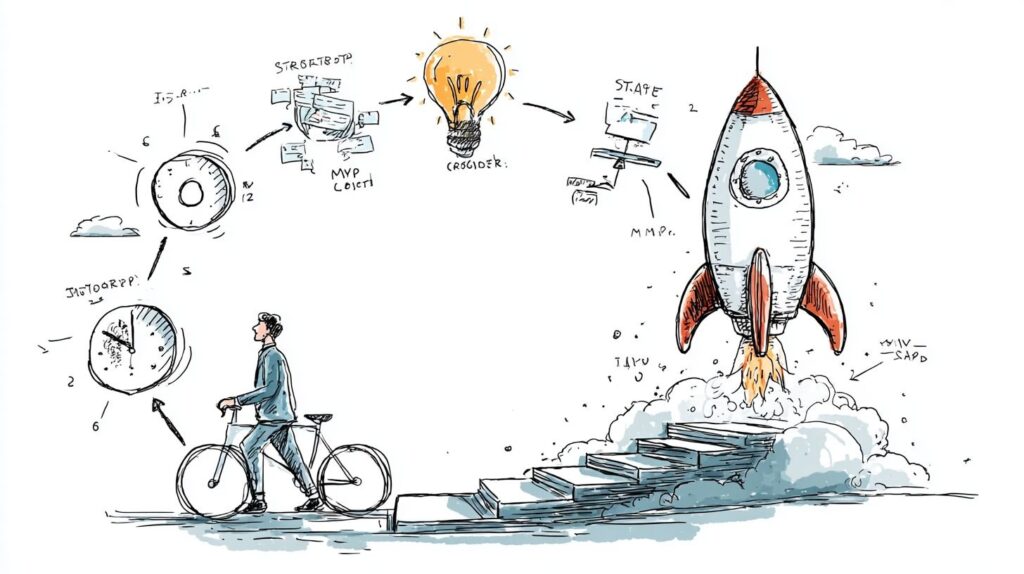
Design a simple MVP architecture focused on core value proposition. Use microservices only if needed, otherwise stick to monolithic setups for faster launches. Plan for scalability from day one with modular code.
Incorporate cloud services like Heroku for easy scaling. They handle traffic spikes without heavy upfront costs. Monitor with tools like Google Analytics to spot bottlenecks early.
Address technical debt by writing clean code and using version control like Git. Break features into user stories for scrum or kanban workflows. This keeps development agile and aligned with product-market fit goals.
Map dependencies with tools like Notion or Trello. Regular code reviews prevent issues down the line. A solid architecture supports growth hacking and future pivots.
Timeline and Tools
Create a realistic development timeline with milestones tied to OKRs. Aim for 4-8 weeks for most MVPs using no-code. Use Eisenhower matrix for prioritization to stay focused.
Essential tools include Figma for wireframes and mockups, Trello for task management, and Mixpanel for metrics tracking. Integrate Hotjar for user behavior insights during beta testing.
Break the timeline into sprints with daily standups. Track progress against KPIs like launch date and bug rates. Adjust based on customer interviews and feedback loops.
For remote teams, tools like Slack and Zoom keep communication smooth. This setup enables bootstrapping without large budgets. Regular retrospectives refine your process for iteration.
Building the MVP
Build MVP in 8 weeks using weekly customer feedback loops achieving high feature usage post-launch. Iterative building with customer validation helps avoid common pitfalls in the startup journey. This approach aligns with lean startup principles from experts like Eric Ries.
Start with core features that solve the primary problem identified during idea validation. Use agile development methods like scrum or kanban to break work into short sprints. Tools such as Trello or Notion keep teams organized during product development.
The design process begins with wireframes and mockups in Figma. Conduct customer interviews weekly to refine these into a functional prototype. Focus on problem-solution fit before expanding scope.
Testing cycles involve beta testing with early adopters. Track metrics like user engagement using Google Analytics or Hotjar. Prepare for launch readiness by setting up a landing page and monitoring KPIs for traction.
Design Process
Create wireframes to outline the user flow for your minimum viable product. Prioritize the value proposition and unique selling point from your business model canvas. This step ensures the MVP addresses the target audience’s pain points.
Move to mockups in tools like Figma for visual design. Incorporate feedback from customer discovery sessions to iterate quickly. Keep designs simple to support rapid prototyping.
Test low-fidelity prototypes with potential users early. Use user stories to guide design decisions. This iteration prevents overbuilding features that users ignore.
Align designs with your go-to-market strategy. Ensure mobile responsiveness for B2C or B2B audiences. Finalize with a style guide for consistency.
Core Development
Select no-code or low-code tools like Airtable or Bubble for faster builds if suitable. For custom needs, use cloud services such as Heroku or AWS. Focus on scalability from day one in product development.
Develop only core features based on hypothesis testing from ideation. Implement user stories in sprints with daily standups. Manage technical debt by prioritizing must-haves.
Integrate analytics like Mixpanel for pirate metrics in the AARRR framework. Build for freemium model or subscription revenue streams. Test integrations for retention and low churn rate.
Use version control with Git for team collaboration. Conduct code reviews in remote work setups. Aim for a working prototype by week four.
Testing Cycles
Run beta testing with early adopters recruited via social media or Reddit communities like Indie Hackers. Gather feedback loops through surveys and sessions. Iterate based on real usage data.
Employ agile development for multiple testing rounds. Fix bugs and refine user experience using heatmaps from Hotjar. Measure against OKRs and SMART goals.
Test for product-market fit with key KPIs like activation rate. Simulate load for scalability. Document learnings to inform pivots if needed.
Validate with competitive analysis and SWOT analysis. Ensure the MVP outperforms alternatives in your niche market. Prepare reports for co-founder or investor reviews.
Launch Readiness
Set up a landing page with email capture for user acquisition. Optimize for SEO and content marketing. Plan launch strategy around Product Hunt or Hacker News.
Define metrics for post-launch success like daily active users. Prepare growth hacking tactics such as referral programs. Monitor with Google Analytics.
Conduct a pre-launch dry run with your team. Secure bootstrapping funds or pitch to accelerators like Y Combinator. Build hype through founder story on social media.
Establish customer support channels for launch day. Review the roadmap with Gantt chart for next iterations. Celebrate milestones to maintain resilience.
Launch Preparation
Execute a 4-week launch sequence achieving 1,000 signups using Product Hunt plus LinkedIn targeting 15% conversion. Poor go-to-market strategies often doom startups, so focus on beta testing, teaser campaigns, launch day execution, and post-launch metrics with proven frameworks. This preparation turns your MVP into a traction-generating machine.
Start with beta testing to engage early adopters. Invite 50-100 users from customer discovery for hands-on feedback. Use tools like Hotjar for heatmaps and Mixpanel for user flows to spot issues before launch.
Build hype through teaser campaigns. Share your founder story on LinkedIn and Reddit communities like Indie Hackers. Create a landing page with waitlist signup to validate demand and collect emails.
On launch day, post on Product Hunt with a compelling pitch deck summary. Follow up with targeted LinkedIn ads to your niche market. Monitor KPIs like signups and activation rates in real-time using Google Analytics.
Beta Testing
Run beta testing with a closed group of early adopters to refine your MVP. Select users from prior customer interviews who fit your target audience. Aim for diverse feedback on usability and value proposition.
Set clear goals using the AARRR framework: track acquisition, activation, retention, referral, and revenue. Use no-code tools like Airtable to log bugs and feature requests. Iterate quickly based on this feedback loop.
Conduct weekly check-ins via Zoom or Notion-shared updates. Prioritize fixes with an Eisenhower matrix to focus on high-impact issues. This phase ensures product-market fit before full launch.
Example: A SaaS tool for remote teams tested with 75 freelancers, revealing a key pivot in onboarding that boosted retention.
Teaser Campaigns
Craft teaser campaigns to build anticipation and validate interest. Post wireframes or mockups on Hacker News and Twitter to spark discussions. Collect emails via a simple landing page built in Carrd or Webflow.
Leverage content marketing like blog posts on your problem-solution fit. Share on LinkedIn groups for startup founders and your niche. Use SEO keywords from market research to drive organic traffic.
Run email marketing sequences with tools like Mailchimp. Send value-first content, such as startup advice from Steve Blank or Eric Ries. Track open rates to refine your unique selling point.
This approach turns passive interest into a waitlist, setting up user acquisition for launch day success.
Launch Day Execution
Orchestrate launch day execution with a checklist in Trello or Notion. Submit to Product Hunt 24 hours early, prepare comments, and rally supporters for upvotes. Time LinkedIn posts for peak engagement.
Monitor live metrics with Google Analytics and Hotjar. Have a support channel ready in Slack or Intercom for early users. Execute growth hacking tactics like referral incentives.
Follow a launch playbook: pre-schedule social media blasts, email blasts to your list, and partner shoutouts. Use OKRs to measure success against signup goals.
Post-launch, analyze churn rate and retention to inform iterations. This structured day maximizes traction from your lean startup efforts.
Post-Launch Metrics
Track post-launch metrics using the pirate metrics of AARRR. Focus on retention and churn rate to gauge sticky product-market fit. Tools like Mixpanel provide cohort analysis for deeper insights.
Set up dashboards in Google Analytics for KPIs like daily active users and conversion rates. Review weekly with your team or co-founder using Scrum retrospectives.
Pivot based on data: if acquisition lags, refine SEO or social media. Celebrate small wins like first revenue from freemium upgrades to maintain founder resilience.
Regularly update your roadmap with Gantt charts, prioritizing features from user stories. This data-driven approach fuels scaling and investor pitches.
Frequently Asked Questions
What is ‘From Idea to MVP: A Startup Founder’s Guide’ all about?
‘From Idea to MVP: A Startup Founder’s Guide’ is a comprehensive resource that walks startup founders through the essential steps of transforming a raw idea into a minimum viable product (MVP). It covers ideation, validation, prototyping, and launch strategies to help you build and test your product efficiently while minimizing risks and resources.
How does ‘From Idea to MVP: A Startup Founder’s Guide’ help validate a startup idea?
In ‘From Idea to MVP: A Startup Founder’s Guide’, idea validation is a core focus. It teaches methods like customer interviews, surveys, and landing page tests to confirm market demand before investing heavily, ensuring your MVP addresses real problems and has potential for growth.
What are the key steps outlined in ‘From Idea to MVP: A Startup Founder’s Guide’ for building an MVP?
‘From Idea to MVP: A Startup Founder’s Guide’ breaks down MVP development into actionable steps: define core features, prioritize based on user needs, build a simple prototype, test with early users, and iterate based on feedback. This lean approach accelerates your path to a market-ready product.
Why is ‘From Idea to MVP: A Startup Founder’s Guide’ ideal for first-time founders?
‘From Idea to MVP: A Startup Founder’s Guide’ is tailored for beginners, offering practical templates, real-world examples, and pitfalls to avoid. It demystifies the process, give the power toing first-time founders to go from idea to MVP without needing a large team or budget.
How long does it typically take to go from idea to MVP using ‘From Idea to MVP: A Startup Founder’s Guide’?
Following ‘From Idea to MVP: A Startup Founder’s Guide’, most founders can reach an MVP in 4-12 weeks, depending on complexity. The guide emphasizes time-boxed sprints and no-code tools to speed up development and focus on learning from users quickly.
What tools are recommended in ‘From Idea to MVP: A Startup Founder’s Guide’ for startups?
‘From Idea to MVP: A Startup Founder’s Guide’ recommends accessible tools like Figma for prototyping, Google Forms for validation, no-code platforms such as Bubble or Adalo for building, and analytics tools like Google Analytics or Mixpanel for tracking MVP performance post-launch.