
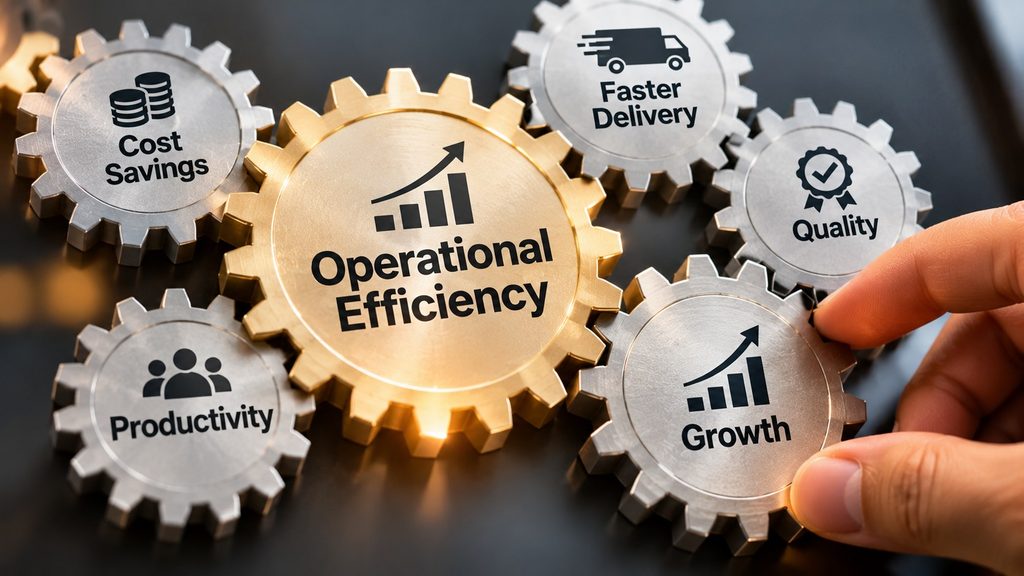
A company does not become successful simply because it generates more sales than its competitors. Its ability to manage resources, control operating costs, deliver consistent quality, and respond quickly to customer needs also plays an important role in long term performance.
This is why operational efficiency is becoming a major competitive advantage for modern companies.
Businesses across industries are facing pressure to deliver better products and services while managing rising expenses and changing customer expectations. Customers expect faster responses, reliable delivery, transparent pricing, and consistent experiences. At the same time, employees need effective systems, clear responsibilities, and tools that help them complete their work without unnecessary complications.
Companies that manage these expectations efficiently can often achieve stronger margins, better customer satisfaction, and more predictable business performance.
Operational efficiency is not simply about reducing expenses or asking employees to complete more work in less time. It involves designing business processes that use available resources intelligently while maintaining the quality customers expect.
What Does Operational Efficiency Mean in Business?
Operational efficiency refers to how effectively a company converts its resources into products, services, and business outcomes.
These resources may include employee time, equipment, technology, capital, raw materials, information, and physical infrastructure.
An operationally efficient business aims to minimise unnecessary effort, delays, errors, and waste while maintaining reliable output.
Consider two companies providing similar services. Both generate the same monthly revenue and employ a comparable number of people. However, the first company relies on manual reporting, repeated approvals, and disconnected communication systems. The second uses organised workflows, clear responsibilities, and integrated tools.
The second company may complete projects faster, spend less time correcting mistakes, and serve more customers without immediately increasing its workforce.
This difference can influence profitability and customer experience over time.
Operational efficiency generally involves four connected areas:
- Resource utilisation: Making effective use of employees, equipment, materials, and financial resources.
- Process management: Removing unnecessary steps and reducing delays in everyday operations.
- Quality control: Preventing errors and maintaining consistent standards.
- Performance measurement: Using reliable information to identify improvements and monitor results.
The goal is not to make every process as fast as possible. It is to ensure that each process contributes meaningful value to the business.
Why Operational Efficiency Matters More in Today’s Business Environment
Business competition is no longer determined only by product features, brand recognition, or pricing. The way a company operates can influence how quickly it responds to market changes and how consistently it serves customers.
Several developments have made operational efficiency particularly important.
Rising Operating Costs Are Putting Pressure on Margins
Businesses must manage expenses related to employee salaries, transportation, technology, energy, rent, materials, and professional services. When these costs increase, companies may find it difficult to maintain profitability without reviewing how their operations are organised.
An inefficient process can become expensive even when the individual cost appears small.
For example, repeated data entry across multiple systems may consume employee hours every week. Delayed approvals can extend project timelines. Poor inventory planning can lead to excess stock, storage expenses, or product shortages.
Improving these processes can reduce costs without necessarily reducing product quality or employee numbers.
Customers Expect Faster and More Reliable Service
Modern customers compare companies based on the complete experience, not just the final product.
A delayed response, incorrect order, confusing payment process, or missed delivery can affect customer confidence. Businesses that organise their operations effectively are better positioned to meet customer expectations consistently.
For an online retailer, this may involve improving inventory visibility and order processing. For a consulting firm, it could mean introducing structured project updates and clearer communication procedures.
Reliable operations help create a dependable customer experience.
Competition Requires Faster Decision Making
Market opportunities can change quickly. Companies that take too long to review information, approve decisions, or introduce improvements may struggle to respond effectively.
Operational efficiency helps reduce unnecessary decision making delays.
When departments have access to relevant information and understand their responsibilities, management can identify problems earlier and take action more confidently.
The Hidden Cost of Inefficient Business Processes
Some operational problems are easy to identify because they directly affect expenses. Others remain unnoticed because their cost is spread across different departments.
A business may not immediately recognise how much time is lost through unclear communication, repeated approvals, manual reporting, or poorly organised information.
These problems can gradually reduce productivity.
Repeated Work and Manual Administration
Employees may enter the same information into multiple platforms, prepare similar reports for different departments, or manually transfer data between systems.
Although each task may take only a few minutes, the combined time can become significant.
Companies should examine administrative activities and identify where standardisation or automation could reduce repetition.
Unclear Responsibilities
When employees are unsure who owns a task, work can be delayed or duplicated.
For example, a customer request may pass between sales, customer support, and operations because no department has clear responsibility for resolving it.
Defining ownership, escalation procedures, and expected response times can improve accountability.
Delayed Approvals
Approval processes are necessary for financial control, compliance, and risk management. However, too many approval stages can slow down ordinary business activities.
Companies should identify which decisions genuinely require multiple approvals and which can be handled through predefined guidelines.
A well designed approval process maintains appropriate control without creating unnecessary delays.
Poor Information Management
When important documents, customer records, or project updates are stored across disconnected systems, employees spend additional time searching for information.
This can also lead to outdated records and inconsistent decisions.
Centralised information management, appropriate access controls, and clear documentation practices can make daily operations more reliable.
How Companies Can Build More Efficient Operations
Operational improvement does not always require a major restructuring programme. Businesses can achieve meaningful results by examining existing processes and addressing the areas that create the greatest friction.
1. Map the Processes That Affect Business Performance
Before introducing new software or changing employee responsibilities, companies should understand how work currently moves through the organisation.
Process mapping helps identify each stage involved in completing an activity, from the initial request to the final outcome.
For example, a company may map its customer onboarding process:
- A potential customer submits an enquiry.
- The sales team reviews the requirements.
- A proposal is prepared.
- The customer approves the proposal.
- The operations team receives the project details.
- Work begins and progress is communicated.
- The final service is delivered.
This exercise may reveal that customer information is collected more than once or that project handovers regularly create delays.
Once the process is visible, management can decide which stages should be simplified, automated, or assigned more clearly.
2. Establish Clear Performance Standards
Employees need to understand what successful performance looks like.
Without clear standards, different departments may follow different procedures for similar activities. This can create inconsistent results and make it difficult for managers to identify operational problems.
Businesses should establish practical standards for areas such as:
- Customer response times.
- Order processing accuracy.
- Project completion schedules.
- Product quality checks.
- Invoice processing.
- Internal reporting.
- Issue resolution.
These standards should be realistic and connected to customer expectations.
For instance, a customer support team may have a response time target, but management should also measure whether the response actually resolves the customer’s problem. Speed without quality can create additional work later.
3. Introduce Automation Where It Creates Real Value
Automation can help reduce repetitive tasks and improve consistency.
Companies may automate invoice reminders, appointment confirmations, document approvals, inventory notifications, routine reporting, and customer communication.
However, automation should not be introduced simply to replace every manual activity.
A process that is poorly designed can become more complicated when automated. Businesses should first understand the workflow, remove unnecessary steps, and then decide whether technology can improve it.
For example, automating an approval process that contains too many unnecessary stages will not necessarily solve the underlying problem.
The best automation projects usually have a clear objective, such as reducing processing time, preventing data entry errors, or improving information availability.
4. Improve Communication Between Departments
Many operational delays occur because departments work with incomplete or inconsistent information.
Sales teams may promise delivery timelines without checking operational capacity. Finance departments may receive incomplete purchase documentation. Customer support teams may not know about product changes introduced by another department.
These issues can be reduced through better communication practices.
Companies should define how information is shared, which systems contain the latest records, and who is responsible for communicating important changes.
Regular cross departmental meetings can also help, provided they focus on decisions and problem solving rather than lengthy status updates.
5. Use Data to Identify Operational Weaknesses
Business decisions become more reliable when management understands what is happening inside the organisation.
Operational data can reveal where resources are being wasted, which processes take too long, and which activities generate the most errors.
Useful measurements may include:
Process completion time: How long does it take to complete a specific business activity?
Error rate: How frequently do mistakes occur in orders, documents, reports, or service delivery?
Cost per transaction: How much does the business spend to complete an individual transaction?
Employee productivity: How much meaningful output is produced using available working time and resources?
Customer complaint rate: How often do operational issues affect customer experience?
On time delivery rate: How consistently does the company meet agreed delivery schedules?
The purpose of measurement is not to monitor employees unnecessarily. It is to understand how the system performs and identify where improvements are needed.
6. Review Inventory and Resource Allocation
For manufacturers, retailers, distributors, and service providers, poor resource planning can create avoidable expenses.
Holding excessive inventory ties up capital and increases storage requirements. Insufficient inventory can result in missed sales and disappointed customers.
Companies should review historical demand, seasonal patterns, supplier reliability, and product movement before deciding how much stock to maintain.
The same principle applies to employee scheduling and equipment utilisation.
A business may have enough resources overall but still experience shortages during busy periods because they are not allocated effectively.
Planning resources around actual demand can improve both productivity and service reliability.
7. Invest in Employee Skills and Process Ownership
Technology and systems cannot deliver operational improvements without employees who understand how to use them.
Training should help employees understand the purpose of a process, the tools involved, and the standards they are expected to maintain.
Companies should also assign process ownership. This means identifying the person or team responsible for monitoring a particular workflow and recommending improvements.
Process ownership prevents important activities from becoming everyone’s responsibility but nobody’s priority.
Employees who work directly with a process should be encouraged to report recurring problems. Their practical experience can help management identify issues that may not appear in formal performance reports.
The Role of Technology in Modern Operational Efficiency
Digital tools are changing how businesses coordinate their work. From small companies to large enterprises, technology can improve visibility across departments and reduce dependence on disconnected manual activities.
However, selecting technology requires a clear understanding of business requirements.
Enterprise Resource Planning Systems
Enterprise resource planning systems help organisations manage connected business functions such as finance, purchasing, inventory, production, and operations.
Instead of maintaining separate records across departments, businesses can use integrated information to improve coordination.
The value of such systems depends on the quality of implementation, employee adoption, and the suitability of the software for the organisation’s size and processes.
Customer Relationship Management Platforms
Customer relationship management systems help businesses organise customer information, track sales opportunities, manage communication, and monitor relationships.
When sales and customer service teams have access to accurate information, they can provide more consistent support and avoid asking customers to repeat information.
Cloud Based Collaboration Tools
Cloud collaboration platforms allow teams to share documents, coordinate tasks, and communicate across locations.
These tools can be particularly useful for companies with remote employees, multiple offices, or external partners.
Businesses should establish appropriate access permissions and document management policies to prevent security and information control problems.
Artificial Intelligence and Predictive Analysis
Artificial intelligence can support operational activities such as demand forecasting, document processing, customer enquiry classification, and analysis of business data.
Predictive tools may help companies identify patterns that are difficult to recognise through manual reporting.
Nevertheless, AI generated recommendations should be evaluated against reliable business information. Poor quality data can produce misleading outputs, and important decisions may still require human judgement.
How to Measure Whether Operational Improvements Are Working
An operational change should produce an observable improvement. Otherwise, companies may spend money and employee time without achieving meaningful results.
Management should establish a baseline before introducing a new process. This provides a reference point for comparing performance after implementation.
Consider a company that takes an average of five days to process customer orders. After reviewing the workflow, it removes duplicate data entry and introduces automated order notifications.
If the average processing time falls to three days without increasing errors or customer complaints, the change has produced a measurable improvement.
However, management should also examine the wider impact. Faster processing may not be beneficial if it increases returns, creates quality problems, or places excessive pressure on employees.
A balanced evaluation should consider productivity, cost, quality, customer satisfaction, and employee experience together.
Common Operational Efficiency Mistakes
Companies often struggle with operational improvement because they focus on visible changes rather than the actual problems affecting performance.
Cutting costs without understanding their impact: Reducing essential resources may weaken service quality and create larger expenses later.
Buying software before reviewing processes: New technology cannot automatically correct inefficient workflows.
Measuring activity instead of outcomes: Tracking the number of tasks completed does not necessarily show whether customers receive better service.
Ignoring employee feedback: Employees who perform daily activities often understand process problems better than senior management.
Changing too many processes at once: Large scale changes can create confusion and make it difficult to identify which improvement produced the result.
Failing to review results: An operational improvement should be monitored after implementation to confirm that it continues to deliver value.
Operational Efficiency as a Long Term Competitive Advantage
Operational efficiency is not a one time project. Customer expectations, technology, market conditions, and organisational requirements continue to change. Processes that work well today may become unsuitable as a company grows.
Businesses should therefore treat operational improvement as an ongoing management responsibility.
An efficient organisation can often respond to customer requests more reliably, manage costs more carefully, and introduce new services with greater confidence. It may also be better prepared to handle periods of increased demand without immediately expanding its workforce or infrastructure.
The strongest advantage comes when efficiency becomes part of the company’s culture. Employees understand why processes matter, managers use evidence to make decisions, and teams are encouraged to identify practical improvements.
Companies that build this discipline are not simply trying to do more with less. They are creating a business that uses its resources intelligently and delivers consistent value.
In competitive markets, that ability can be just as important as having an attractive product or a recognised brand.
Frequently Asked Questions
1. What is operational efficiency in a modern company?
Operational efficiency is the ability to deliver products or services using resources effectively while controlling unnecessary costs, delays, and errors. It focuses on improving how work is organised without compromising quality or customer satisfaction.
2. Why is operational efficiency important for business growth?
Efficient operations can improve profit margins, increase productivity, reduce avoidable expenses, and create a more reliable customer experience. These improvements can help a company grow without increasing its operating costs at the same rate as revenue.
3. How can a company identify inefficient processes?
Companies can review process completion times, error rates, customer complaints, employee feedback, repeated administrative work, and operational expenses. Mapping workflows can also reveal unnecessary approvals and delays between departments.
4. Does operational efficiency mean reducing the workforce?
No. Operational efficiency is primarily about improving how resources and processes are managed. Businesses may achieve better results through automation, training, clearer responsibilities, and improved planning without reducing employee numbers.
5. Which technologies help improve operational efficiency?
Enterprise resource planning systems, customer relationship management platforms, workflow automation tools, cloud collaboration software, inventory management systems, and data analytics platforms can all support operational improvements when they match actual business requirements.
6. How does automation improve business operations?
Automation reduces repetitive manual work, improves consistency, and can lower the risk of data entry errors. It is particularly useful for routine activities such as invoice reminders, document routing, appointment notifications, and standard reporting.
7. What are the most useful operational efficiency metrics?
Common metrics include process completion time, cost per transaction, error rate, employee productivity, customer complaint rate, inventory turnover, and on time delivery performance. The most relevant indicators depend on the company’s industry and business model.
8. How can small businesses improve operational efficiency?
Small businesses can begin by documenting important workflows, clarifying employee responsibilities, organising customer and financial records, automating repetitive tasks, and reviewing recurring expenses. Improvements should focus on activities that consume significant time or create frequent problems.
9. How often should a company review its operational processes?
Important processes should be monitored continuously through relevant performance indicators. A formal operational review every month or quarter can help management identify recurring problems, evaluate improvements, and update procedures as the business changes.
10. What is the difference between operational efficiency and operational effectiveness?
Operational efficiency focuses on using resources well and reducing waste. Operational effectiveness focuses on achieving the intended business outcomes. A company needs both because completing work quickly is not valuable if the work does not meet customer requirements.
11. Can operational efficiency improve customer satisfaction?
Yes. Better organised operations can reduce delivery delays, prevent errors, improve response times, and make service more consistent. These improvements can strengthen customer confidence and encourage repeat business.
12. Why should employee feedback be part of operational improvement?
Employees often understand the practical difficulties involved in everyday processes. Their feedback can reveal repeated delays, unclear responsibilities, unnecessary tasks, and technology problems that management may not see through financial reports alone.