
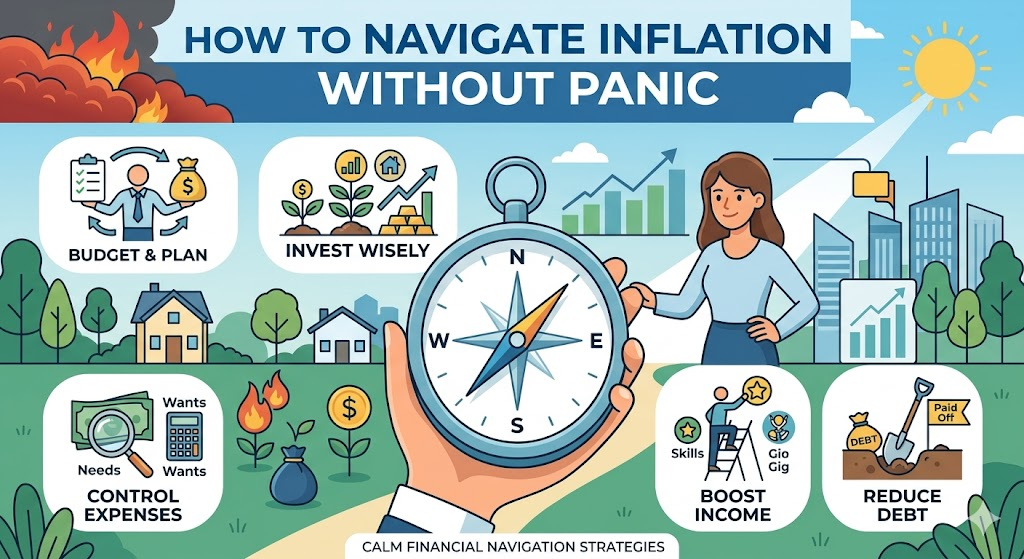
As grocery prices surge and savings erode, inflation strikes fear into households worldwide. Yet, according to Federal Reserve data, understanding its mechanics enables calm action over chaos.
Discover how to decode economic signals, craft inflation-proof budgets, protect savings with I-Bonds and TIPS, diversify investments, boost income, and plan long-term-without the panic.
What Inflation Really Means
Inflation measures sustained price increases: the CPI index rose 19.3% from 2020-2023 (BLS data), meaning a $3 gallon of milk became $3.57. This rise shows how economic inflation erodes everyday affordability. Understanding it helps in navigating inflation without panic.
The Consumer Price Index (CPI) tracks a basket of goods and services, like food and housing, that typical households buy. Core CPI excludes volatile food and energy prices for a clearer view of underlying trends. For example, BLS charts often highlight differences during supply chain issues.
To see purchasing power loss, consider this calculation: $1,000 at 3% annual inflation equals about $742 in real value after 10 years. Use an inflation calculator from the Federal Reserve Bank of Minneapolis to check your own numbers. This tool reveals how rising prices quietly shrink savings over time.
Grasp these concepts to build financial calm. Track CPI changes monthly via BLS reports, and adjust your budgeting strategies accordingly. This knowledge turns inflation from a threat into a manageable reality.
Common Causes of Inflation
Demand-pull from 2021 stimulus spending, cost-push from the 2022 Ukraine war oil spike, and built-in wage-price spirals drove U.S. inflation to a 9.1% peak according to the BLS. Understanding these common causes of inflation helps in navigating inflation without panic. A Federal Reserve study, FRB/NY Staff Report No. 964, highlights key drivers behind rising prices.
Supply shocks, like the 2022 energy crisis, disrupt goods availability and push up costs. For instance, sudden oil shortages increase fuel costs and utility bills. Building an emergency fund cushions households from these unpredictable hits.
Excess money supply from quantitative easing post-2008 floods the economy with cash, reducing purchasing power. This monetary policy expands credit but fuels economic inflation. Opt for high-yield savings to keep pace with eroding value.
· Wage growth creates built-in inflation, as seen in 2023 trends, where higher labor costs lead to price hikes in services like healthcare expenses.
· Government spending boosts demand, straining resources and contributing to cost-of-living increases, such as in housing markets.
To maintain financial calm, track the CPI index and adjust budgeting strategies. Diversify into inflation-protected securities like TIPS for long-term protection against these forces.
Inflation vs. Deflation Explained
Inflation means prices are rising, while deflation means prices are falling, as seen in Japan’s 1990s Lost Decade with around -1.5% annual deflation. Both hurt in different ways: inflation erodes savings, deflation kills spending. Understanding this helps with panic avoidance during economic shifts.
In deflation, cash gains value over time, but debts become crushing as incomes fall and prices drop. People delay purchases expecting lower prices, stalling the economy. An IMF Working Paper on deflation risks highlights how it can trap economies in prolonged downturns.
Inflation makes debt easier to pay off since cash loses value, but it raises the cost of living. Savings in low-interest accounts shrink in real terms. Focus on budgeting strategies to maintain financial calm.
| Inflation | Deflation | |
| Cash Value | Loses purchasing power | Gains purchasing power |
| Debt Impact | Easier to manage | Crushing burden |
| Spending Behavior | Increases to beat rises | Delays harm growth |
| Examples | Rising grocery, fuel costs | Japan’s 1990s stagnation |
Consider stagflation, like the 1970s with high inflation around 13% plus 9% unemployment. It combines rising prices and job losses, making navigate inflation tough. Build an emergency fund and diversified portfolio to counter such risks.
To protect against both, prioritize high-yield savings in deflation and inflation hedges like TIPS in inflation. Track the CPI index for real-time insights. This approach supports long-term planning and economic resilience.
Key Economic Indicators to Watch
Monitor CPI (consumer), PPI (producer), and M2 money supply. CPI +0.4% monthly often precedes 3%+ annual inflation (Fed data). Tracking these helps with panic avoidance during rising prices.
Focus on economic indicators like unemployment rate and yield curve. These signal shifts in monetary policy from the Federal Reserve. Regular checks support financial calm and smart budgeting strategies.
Use tools from the St. Louis Fed’s FRED database for real-time data. Watch for patterns in consumer confidence and producer prices. This approach aids investment planning amid cost of living increases.
Combine indicator tracking with personal finance reviews. Adjust your emergency fund or diversified portfolio based on trends. Stay informed to navigate inflation without stress.
| Indicator | Source | Warning Level | Example |
| CPI | FRED St. Louis Fed | High | CPI> 3% monthly |
| PPI | FRED St. Louis Fed | High | PPI> 4% monthly |
| Unemployment (Phillips Curve) | FRED St. Louis Fed | Medium | Unemployment <4% with rising CPI |
| Yield Curve | FRED St. Louis Fed | Medium | Inverted curve for 3+ months |
| Consumer Confidence Index | FRED St. Louis Fed | Low | Index drops below 80 |
Everyday Signs in Your Life
Gas prices up 50%, groceries up 25% according to USDA 2023 data, and rent up 15% signal inflation before CPI confirms it. These household signals appear in daily spending long before official reports. Tracking them helps with panic avoidance and early budgeting strategies.
BLS CPI detailed categories show rising prices in essentials like food and energy. Families notice sticker shock at checkout first. This awareness builds financial calm amid economic inflation.
· Grocery staples: Eggs jumped 70% in 2023, pushing up costs for basics like bread and milk. Track your grocery budget weekly to spot trends.
· Gasoline: Prices rose from $3.50 to $5 per gallon. Cut fuel costs with carpooling or public transport.
· Rent: Zillow data highlighted increases in major cities. Review leases early and consider roommates for relief.
· Utilities: Bills climbed 12%. Improve energy efficiency with LED bulbs and home insulation.
· Auto insurance: Rates increased 19%. Shop around annually for better deals.
· Healthcare premiums: Steady hikes strain budgets. Use HSAs to manage healthcare expenses.
Monitor these via expense tracking apps like Mint or YNAB. Adjust cost-cutting tips like bulk buying and meal prepping. This approach fosters economic resilience without stress.
Spotting Hyperinflation Risks
Hyperinflation (> 50% monthly) emerges when money printing exceeds 20% of GDP, like Venezuela in 2018 (IMF: 1.7M%). This rapid currency devaluation erodes purchasing power and triggers economic chaos. Spotting early signs helps with panic avoidance and proactive inflation navigation.
Economists like Reinhart and Rogoff in This Time Is Different highlight 21st-century cases where unchecked printing led to hyperinflation. Watch for currency printing outpacing GDP growth, a core warning. This imbalance floods the economy with money, driving up rising prices.
Other key indicators include dollar shortages, where locals scramble for stable foreign currency. Black market premiums signal distrust in official rates, while foreign debt defaults worsen the spiral. Use these to build economic resilience.
· Currency printing> GDP growth: Central banks print excessively, outstripping economic output.
· Dollar shortages: Foreign currency becomes scarce, fueling parallel markets.
· Black market premiums> 50%: Unofficial exchange rates skyrocket over official ones.
· Foreign debt default: Governments miss payments, shaking investor confidence.
Track these through economic news and CPI index updates. Build an emergency fund in stable assets like gold investment or TIPS to hedge against hyperinflation risks. This supports financial calm amid cost of living pressures.
Historical Context of Inflation Periods
Post-WWII inflation averaged 3.8% from 1946 to 1981, yet housing values rose 1,200% and stocks returned 10.4% annually. These figures show how assets like real estate and equities often outpaced rising prices over time. Understanding past periods helps in navigating inflation today without panic.
The 1970s stagflation combined high inflation peaking at 13.5% with stagnant growth. Consumers faced surging oil prices and grocery costs, while Shiller PE ratios stayed moderate around 7-8. People protected purchasing power by shifting to hard assets like gold.
In the 1980s Volcker era, Federal Reserve chair Paul Volcker raised Fed funds rates to 14% to tame inflation. This caused short-term pain like higher mortgage rates, but Shiller PE ratios dipped below 8 amid market volatility. Households built emergency funds and cut discretionary spending to maintain financial calm.
The 1990s Goldilocks period featured stable inflation around 2.5% with strong growth. Shiller PE ratios climbed toward 20 as tech stocks boomed. Investors used dollar cost averaging into index funds to capture gains without timing the market.
Recent 2021-23 supply shock saw inflation hit 9.1% from pandemic disruptions. Shiller PE ratios hovered near 30-40 during peaks, signaling overvaluation risks. Adapt by diversifying into TIPS and commodities for inflation hedges, focusing on long-term asset allocation.
Why Panic Worsens the Situation
Panic selling in 2022 inflation peak bought high, sold low. The S&P 500 fell sharply, then recovered strongly by 2024. Staying calm helps navigate inflation without locking in losses.
One key issue is forced selling from margin calls. Investors who over-leverage during rising prices face automatic liquidations. This turns temporary dips into permanent setbacks, eroding purchasing power.
Another problem lies in behavioral momentum, which drives oversold bottoms. Herd mentality pushes prices lower as fear spreads through the market. Research like the Dalbar study over 30 years shows average investors underperform due to emotional trades.
Finally, holding too much cash opportunity cost hurts during inflation. With rates around 1% in savings accounts versus higher inflation, money loses value fast. Shift to high-yield savings, bonds, or a diversified portfolio to preserve wealth and maintain financial calm.
Psychological Traps to Avoid
Recency bias makes 9% inflation seem permanent. Yet 1979 saw higher rates that resolved in two years. To fight this, check 10-year averages for the CPI index before reacting to recent spikes in rising prices.
Loss aversion keeps you from selling assets during market volatility. People hold losing investments too long, fearing regret. Rebalance annually to maintain your diversified portfolio and protect purchasing power.
· Review asset allocation based on your risk tolerance.
· Sell high performers and buy underperformers systematically.
· Avoid emotional decisions tied to short-term economic indicators.
Anchoring fixates you on the 2022 inflation peak. This distorts views on current inflation rates. Ignore that high point and focus on long-term trends like Federal Reserve monetary policy.
Confirmation bias leads to seeking only inflation doom stories. Balance this by reading opposing views from sources like economic news outlets. This builds financial calm amid cost of living pressures.
Herding makes you follow CNBC panic during recession fears. Crowds often overreact to supply chain issues or oil prices. Stick to your investment planning and ignore the noise for stress-free finances.
Tracking Your Personal Inflation Rate
Use YNAB or Mint to track: if groceries rose 25% but you spend 20% of budget, your personal inflation rate equals 5%. This approach reveals how rising prices truly affect your wallet, unlike broad measures. It helps in panic avoidance by focusing on your reality.
Start by listing your top 10 expenses using Mint categories like groceries, housing, utilities, transportation, healthcare, dining out, entertainment, clothing, insurance, and debt payments. Rank them by spending share over the past year. This baseline shows where cost of living pressures hit hardest.
Next, track a 3-month baseline with actual receipts or app data to capture current prices and volumes. Then calculate your weighted rate: multiply each category’s price change by its budget percentage, and sum them. Compare this to the CPI index for context on broader economic inflation.
Tools vary: YNAB at $14.99 per month excels in zero-based budgeting for precise control. Mint, free, syncs accounts easily for quick tracking. Personal Capital, free, adds investment views alongside expenses. Pick based on your need for detailed rules or net worth insights.
| Tool | Cost | Best For |
| YNAB | $14.99/mo | Rule-based budgeting |
| Mint | Free | Account syncing |
| Personal Capital | Free | Net worth tracking |
Here is an example calculation template. Assume your budget: groceries 20%, housing 30%, utilities 10%, others 40%. If prices rise 25% on groceries, 10% on housing, 15% on utilities, and 5% on others, weighted rate is (0.20*25) + (0.30*10) + (0.10*15) + (0.40*5) = 5 + 3 + 1.5 + 2 = 11.5%. Adjust monthly to guide budgeting strategies.
Understanding Real vs. Nominal Returns
A 5% nominal bond yield with 4% inflation equals a 1% real return. Your money barely keeps pace. This gap highlights why focusing on nominal returns alone misleads during rising prices.
Use the formula: Real Return = (1 + Nominal) / (1 + Inflation) – 1. It adjusts for lost purchasing power. Investors often overlook this, leading to panic avoidance challenges in economic inflation.
For example, a 7% stock return minus 3% inflation yields about 3.85% real return. Meanwhile, a 2% savings account rate with 4% inflation results in a -2% real return. Your cash loses value over time.
Tools like the Vanguard inflation-adjusted return calculator help track this. Build a diversified portfolio with stocks, TIPS, and real estate to protect against inflation. Consult a financial advisor for personalized investment planning.
Differentiating Temporary vs. Persistent Inflation
2022’s 9.1% inflation rate was driven by supply shocks and proved temporary, with base effects dropping it to 3% by 2024. Understanding this difference helps in navigating inflation without panic. Focus on economic indicators to tell them apart.
The Federal Reserve’s 2023 paper on Inflation Dynamics outlines key factors. Temporary inflation often stems from short-term disruptions like oil price spikes or chip shortages. These fade as supply chains recover.
Persistent inflation shows up in sustained wage growth above 4%, money supply expanding faster than GDP, or ongoing housing shortages. Use a simple decision tree to assess: check supply shocks first, then wage trends, monetary growth, and housing data. This guides your budgeting strategies and investment planning.
1. Examine supply shocks: Events like energy crises cause quick jumps in fuel costs but resolve with normalized production.
2. Track wage growth: If consistently over 4%, it signals sticky prices and longer-term rises in cost of living.
3. Monitor money supply: Growth outpacing GDP fuels demand-pull inflation that endures.
4. Assess housing shortages: Persistent supply issues keep rent and property taxes elevated, eroding purchasing power.
Apply this tree monthly using CPI index reports. Adjust your emergency fund and diversified portfolio accordingly for financial calm. Experts recommend pairing it with price tracking for proactive inflation navigation.
Creating an Inflation-Adjusted Budget
Step 1: Take last 3 months YNAB data to establish your current spending baseline. Export this information from your YNAB account or similar budgeting app like Mint. This gives you a clear picture of your actual cash flow amid rising prices.
Step 2: Apply personal inflation rate (your 4.2%) to track how economic inflation affects your household specifically. Calculate your personal CPI by comparing price changes in essentials like grocery budget and utility bills to the official CPI index. Adjust for your unique cost of living increases.
Follow this 7-step process to create an inflation-adjusted budget. It takes about 90 minutes the first time and 20 minutes per month afterward. This approach promotes panic avoidance and financial calm.
5. Export Mint or YNAB data for the past three months to review all expenses.
6. Calculate your personal CPI using recent receipts for fuel costs, healthcare expenses, and rent.
7. Adjust fixed costs like mortgage rates or subscriptions by cutting 10% discretionary spending immediately.
8. Cut variable expenses such as dining out by 15% through meal prepping and bulk buying.
9. Build a 3-month buffer in a high-yield savings account as your emergency fund.
10. Review your budget bi-monthly to adapt to new inflation rates or wage growth.
11. Automate transfers to savings and investment accounts like a Roth IRA for long-term planning.
Track changes in producer prices (PPI) and core inflation to refine your budget. Use expense tracking apps for ongoing monitoring. This builds economic resilience against market volatility.
For example, if fuel costs rise, switch to public transport or carpooling. Negotiate bills for utility bills and explore energy efficiency like home insulation. These cost-cutting tips preserve purchasing power without stress.
Prioritizing Essential vs. Discretionary Spending
Housing, food, and transport make up 65% of essential spending according to BLS Consumer Expenditure data. These categories form the core of your budgeting strategies during inflation. Focus here first to maintain financial calm.
Cut back on dining out and subscriptions to free up cash quickly. Experts recommend trimming these areas before touching necessities. This approach helps navigate inflation without sacrificing core needs.
Use a simple prioritization matrix: allocate to Must Haves at 50%, Wants at 30%, and Savings at 20%. Track expenses with apps like Mint or YNAB. This keeps discretionary income in check amid rising prices.
Here are 10 specific cuts to consider for immediate impact:
· Skip daily Starbucks runs, saving around $150 monthly.
· Cancel gym membership at $60 per month, switch to free outdoor workouts.
· Unbundle streaming services, drop from three to one essential.
· Reduce impulse buys on clothing by sticking to basics.
· Limit eating out to once weekly instead of multiple times.
· Shop groceries with a strict list, avoid premium brands.
· Cancel unused magazine or app subscriptions.
· Switch to generic household products over name brands.
· Postpone non-urgent home repairs or upgrades.
· Cut cable TV, opt for free broadcast options.
Implementing Zero-Based Budgeting
Every dollar gets a job: $5,000 income $2,500 essentials, $1,000 savings, $1,500 discretionary = $0 left. This core principle of zero-based budgeting ensures no money sits idle during economic inflation. It forces you to assign every cent to a specific category, promoting financial calm amid rising prices.
The YNAB 4-rule method guides this process effectively. First, give every dollar a job, as shown in the income template: Income – Categories = Zero. Second, embrace true expenses by breaking down annual costs like car insurance or holidays into monthly amounts to avoid surprises from cost of living increases.
Third, roll with the punches when unexpected expenses arise, such as higher fuel costs or utility bills. Adjust categories on the fly without panic, maintaining panic avoidance. Fourth, age your money by aiming for expenses paid with income from at least 30 days prior, building a buffer against inflation navigation challenges.
Start with a simple template in a budgeting app like YNAB. Track grocery budget and healthcare expenses closely, redirecting unspent funds to an emergency fund or high-yield savings. This approach fosters economic resilience and stress-free finances even as the CPI index climbs.
High-Yield Savings and Money Market Accounts
Ally Bank 5.25% APY vs 0.45% national average preserves $5,250 annual purchasing power on $100K. This stark difference shows how high-yield savings accounts combat inflation by outpacing rising prices. During economic inflation, traditional savings erode value, but these options protect your cash.
Setting up takes about 10 minutes online. You provide basic info like ID and bank details for quick funding. Many banks offer instant transfers, letting you start earning interest right away on your emergency fund.
Money market accounts work similarly with check-writing perks. Both are FDIC-insured up to $250,000 per depositor, ensuring safety amid market volatility. Experts recommend them for short-term savings to maintain financial calm without panic.
Compare top accounts below for easy inflation navigation. Focus on APY, minimum deposits, and withdrawal limits to match your needs. This step builds economic resilience through smart cash flow management.
| Account | APY | Minimum Deposit | FDIC Limit | Withdrawal Rules |
| Ally Bank | 5.25% | $0 | $250,000 | 6 withdrawals/month |
| Marcus by Goldman Sachs | 5.15% | $0 | $250,000 | 6 withdrawals/month |
| SoFi | 5.20% | $0 | $250,000 | Unlimited ATM, 6 others/month |
| Discover | 5.20% | $0 | $250,000 | 6 withdrawals/month |
| Capital One | 5.10% | $0 | $250,000 | 6 withdrawals/month |
Certificates of Deposit (CDs) Ladder Strategy
A 6-month CD at 5.5% plus a 2-year at 4.75% ladder averages 5% while providing quarterly liquidity. This approach helps navigate inflation by locking in rates before they drop due to Federal Reserve policy shifts. It beats traditional savings accounts in a rising prices environment.
Start by dividing $50,000 into portions like 25% in a 6-month CD, 33% in a 2-year CD, and 42% in a 5-year CD. As each matures, reinvest into a new CD with the best available rate to capture interest rate changes. This laddering strategy ensures steady access to funds without full commitment to long terms.
Brokerage CDs often offer more options than bank CDs, with better rates through networks like Fidelity or Schwab. They provide FDIC insurance up to limits and easier trading if needed. Compare them for liquidity and yields to fit your risk tolerance.
| Maturity | Average Rate | Best Bank Example |
| 6-month | 5.5% | Navy Federal at 5.3% |
| 2-year | 4.75% | Navy Federal at 4.5% |
| 5-year | 4.25% | Navy Federal at 4.2% |
Use this table to spot high-yield opportunities amid economic inflation. Reinvesting maturing CDs keeps your emergency fund growing safely. Experts recommend this for panic avoidance during CPI index spikes.
12. Assess your cash needs for the next few years.
13. Shop rates at credit unions like Navy Federal for members.
14. Rebalance the ladder annually to match monetary policy trends.
This method supports financial calm by blending short-term access with long-term rate protection. Pair it with a diversified portfolio for full inflation navigation.
I-Bonds and TIPS for Inflation Protection
Series I Savings Bonds yield CPI + fixed rate (1.3% current composite 6.89% through Apr 2025), with a $10K/person limit annually. These inflation-protected securities adjust principal based on the CPI index to preserve purchasing power amid rising prices. They offer a safe way to navigate inflation without panic.
I-Bonds suit retail investors with a one-year lockup period and no secondary market. Buy them directly through TreasuryDirect.gov with a $25 minimum. This process keeps things simple for building an emergency fund or retirement savings.
TIPS, or Treasury Inflation-Protected Securities, trade on the market for daily liquidity. They also track CPI but allow selling anytime, unlike I-Bonds. Choose TIPS for more flexibility in a diversified portfolio.
| Feature | I-Bonds | TIPS |
| Accessibility | Retail only via TreasuryDirect.gov | Market-traded |
| Liquidity | 1-year lockup | Daily |
| Minimum Purchase | $25 | Varies by broker |
| Annual Limit | $10K per person | None |
Both provide tax advantages, with interest exempt from state and local taxes. Review TreasuryDirect rate history charts to see past performance during high inflation. This helps in long-term planning for financial calm.
Diversifying into Inflation-Resistant Assets
Target allocation: 35% S&P 500 ETF (VOO), 15% value stocks (VTV), 10% REITs (VNQ), 10% gold (GLD), 30% TIPS. This mix helps protect your diversified portfolio against rising prices. It balances growth from equities with safeguards like commodities and inflation-protected securities.
Stocks and real estate often outpace economic inflation over time. Treasury Inflation-Protected Securities (TIPS) adjust principal with the CPI index. Gold acts as a classic inflation hedge during uncertain times.
Rebalance your portfolio annually or when allocations drift by 5%. This keeps your asset allocation aligned with your risk tolerance. Regular checks promote financial calm amid market volatility.
Vanguard’s model portfolios offer simple starting points for beginners. They emphasize low-cost index funds and ETFs. Consult a financial advisor to tailor this to your investment planning goals.
| Category | ETF | 10yr Return | Inflation Hedge | ||||
| Equities | VOO | Historical data varies | Moderate | ||||
| Value Stocks | VTV | Historical data varies | Strong | ||||
| REITs | VNQ | Historical data varies | High | ||||
| Gold | GLD | Historical data varies | Excellent | ||||
| TIPS | Suitable ETF | Historical data varies | Direct | ||||
| Correlation Matrix | VOO | VTV | VNQ | GLD | TIPS | ||
| VOO | 1.0 | 0.95 | 0.60 | 0.10 | 0.20 | ||
| VTV | 0.95 | 1.0 | 0.65 | 0.15 | 0.25 | ||
| VNQ | 0.60 | 0.65 | 1.0 | 0.20 | 0.30 | ||
| GLD | 0.10 | 0.15 | 0.20 | 1.0 | 0.05 | ||
| TIPS | 0.20 | 0.25 | 0.30 | 0.05 | 1.0 | ||
This correlation matrix shows diversification benefits with low links between gold and stocks. Lower numbers mean assets move independently. It reduces overall portfolio risk during inflation spikes.
Stocks, Real Estate, and Commodities
Energy stocks like XLE rose 45% in 2022 amid inflation, while gold climbed 25% and bonds fell 13%. These assets often serve as inflation hedges when rising prices erode purchasing power. Investors can use them to navigate inflation without panic.
Historical performance shows sector rotation works well during economic inflation. In the 1970s stagflation era, energy gained substantially, materials followed, and REITs provided steady returns. Compare this to 2022, where similar patterns emerged amid high CPI index readings.
| Asset Class | 1970s Performance | 2022 Performance |
| Energy | +200% | Strong gains |
| Materials | +150% | Solid returns |
| REITs | +100% | Moderate growth |
Consider specific ETFs for diversified portfolio exposure. VNQ tracks real estate, GLD offers gold investment, and DBC covers commodities like oil and metals. Use dollar cost averaging to build positions over time, matching your risk tolerance.
A sector rotation strategy involves shifting toward energy and materials when inflation rates climb, then rotating to REITs as rates stabilize. Pair this with asset allocation advice from a financial advisor. This approach promotes financial calm and long-term planning.
Balancing Risk in Volatile Markets
Dollar-cost average $500/month into VOO regardless of price. This dollar cost averaging tactic reduces timing risk. It helps navigate inflation by building a diversified portfolio steadily.
A risk parity approach allocates equal volatility dollars across assets like stocks, bonds, and commodities. This balances exposure during market volatility tied to rising prices. Experts recommend it for maintaining financial calm in uncertain times.
Use stop-loss orders versus time-based rules to protect gains. Stop-loss triggers sales at set price drops, while time-based exits follow schedules. Combine both for investment planning that suits your risk tolerance.
Aim for a 10% portfolio standard deviation as a volatility target. Research from AQR Capital on inflation regimes supports adjusting allocations dynamically. This fosters economic resilience amid fluctuating interest rates and CPI index changes.
· Dollar-cost average into S&P 500 index funds like VOO for long-term growth.
· Apply risk parity to include TIPS and commodities as inflation hedges.
· Set stop-loss at 10-15% below purchase to limit losses in downturns.
· Monitor portfolio volatility quarterly to stay near the 10% target.
Negotiating Raises and Cost-of-Living Adjustments
Industry avg 6.2%, revenue +8%, request 7% ($84K$90K). This ties CPI index trends to your company’s growth, showing how economic inflation erodes purchasing power. Use it to frame your ask during Q4 reviews for maximum impact.
Follow this 5-step negotiation script to boost wage growth and navigate inflation calmly. Research comps first on sites like Glassdoor or Levels.fyi to benchmark fair pay. Then document your achievements with clear examples, such as driving specific revenue impacts.
Practice your pitch three times to build confidence and refine delivery. Propose a salary range, like $88-92K, to give flexibility while anchoring high. Finally, secure a written cost-of-living adjustment policy to protect against future rising prices.
Time requests around performance cycles for better odds. Pair this with salary negotiation skills to maintain financial calm amid inflation. Experts recommend tracking company revenue alongside CPI for stronger cases in job market talks.
Side Hustles and Multiple Income Streams
Top 10% of freelancers on Upwork earn $104 per hour, and working just 15 hours a week can generate $81K in annual side income. This makes freelance work a strong option to navigate inflation by boosting your cash flow. Many skilled workers use platforms like this to offset rising prices without quitting their day jobs.
Side hustles provide flexibility during economic inflation, letting you scale efforts around your schedule. Options range from gig economy tasks to passive income sources like rentals. Experts recommend starting small to build multiple income streams for financial calm.
Compare popular hustles below using a table that highlights earnings potential, startup time, and scalability. Scalability ranking goes from 1 (lowest) to 5 (highest), based on ease of growth. Pick ones matching your skills and resources to fight cost of living increases.
| Hustle | Earnings Potential | Startup Time | Scalability Ranking |
| Upwork | $50/hr | 1-2 weeks | 5 |
| DoorDash | $25/hr peak | 1 day | 2 |
| Turo | $800/mo | 1 week | 3 |
| Airbnb | $2K/mo | 2-4 weeks | 4 |
| YouTube | $5/CPM | 1-3 months | 5 |
| Dividend stocks | 4% yield | Immediate | 4 |
Focus on low startup time options like DoorDash for quick wins against fuel costs and groceries. For long-term passive income, build toward YouTube or dividend stocks. Track earnings with budgeting apps to ensure they cover essentials and build your emergency fund.
Skill Development for Higher Earnings
Google Data Analytics cert ($59/mo Coursera) boosts salary 25% ($65K$81K) in 6 months. This certification equips you with data skills in high demand amid economic inflation. It helps navigate inflation by increasing your wage growth to outpace rising prices.
Focus on certifications with strong ROI to build an inflation-proof career. Online courses from platforms like Coursera or Udemy offer flexible learning for career advancement. Experts recommend prioritizing skills in tech and marketing to match job market needs.
Combine skill development with salary negotiation tactics. After certification, highlight new abilities in interviews or reviews. This approach supports financial calm during high inflation rates.
Explore side hustles like freelance data analysis using these skills. Such steps enhance passive income streams. They provide buffers against cost of living increases without panic.
| Certification | Cost | Time/ROI |
| Google Analytics | $3K | 6 months |
| AWS Cloud | $150 exam | 37% raise |
| PMP | $555 | +20% |
| Salesforce | $200 | 25% raise |
| HubSpot Content | Free | 15% |
Platform Comparison
Coursera suits structured learning with monthly subscriptions for certifications like Google Data Analytics. Udacity offers project-based nanodegrees focused on tech skills. Compare based on your schedule and budgeting strategies.
LinkedIn Learning provides short videos ideal for quick upskilling in marketing or project management. edX features university-backed courses at low cost. Pick platforms matching your risk tolerance for time investment.
For free options, HubSpot Academy delivers content marketing training without fees. These choices aid wage growth to combat inflation. Track progress with expense apps to maintain financial discipline.
Benefits of Fixed-Rate Debt
In 2019, a 3.5% 30-year fixed mortgage costs $1,347 per month. At 5% inflation, the real payment falls to $1,000 by 2029. This shows how fixed-rate debt preserves purchasing power over time.
The real debt cost formula subtracts the inflation rate from the nominal interest rate. When inflation exceeds your fixed rate, your debt effectively shrinks in real terms. This makes fixed-rate debt a smart tool for inflation navigation.
Consider student loans at a fixed 5% rate, which become advantageous during rising prices. A 30-year mortgage locked below 6% protects against future rate hikes from the Federal Reserve. Experts recommend these for long-term debt management.
Avoid auto loans above 4% fixed if possible, as shorter terms amplify real costs. Refinance when rates drop by 1%, but only if closing costs fit your budget. Use this strategy to maintain financial calm amid economic inflation.
· Lock in student loans at fixed rates under 6% for predictable payments.
· Secure mortgages below 6% to hedge against rising interest rates.
· Steer clear of high-rate auto loans, opting for cash if feasible.
· Monitor for refinance triggers like a 1% rate drop to lower costs.
Strategies for Variable-Rate Debt
Credit card APR 24% eats 2% monthly. Pay minimum $25 on $1,000 balance = $4,400 interest over 10 years. This shows how variable-rate debt grows fast during inflation.
Start with refinancing or balance transfers to cut costs. Use 0% intro APR cards like Chase Slate for 21 months to pause interest. Shift high-rate balances to fixed options for panic avoidance.
For student loans, consider SOFI refi at 4.5% fixed rates. This locks in payments against rising interest rates. Convert HELOC to fixed for home equity debt too.
Choose debt avalanche or snowball methods wisely. Avalanche targets highest rates first for savings. Use online calculators to compare and pick based on your cash flow.
· List all variable-rate debt with balances and APRs.
· Prioritize transfers to 0% intro offers.
· Refi to fixed where possible during low-rate windows.
· Track progress with budgeting apps like YNAB.
In economic inflation, these steps protect purchasing power. Build an emergency fund alongside to avoid new debt. Stay calm with consistent debt management.
When to Pay Down vs. Invest
Consider a 5% student loan versus a 7% S&P return: invest the difference, as the real after-inflation return stands at 3.8%. This choice hinges on comparing your debt interest rate to expected stock returns adjusted for inflation. During rising prices, prioritizing investments can preserve purchasing power if returns outpace debt costs.
Use a simple decision matrix to guide actions: evaluate debt rate, stock return, and inflation. The key threshold is when your debt rate is less than the after-tax stock return minus 2%. This approach helps navigate inflation without panic by focusing on net gains.
| Debt Rate | Stock Return | Inflation | Action |
| 6% | 10% | 4% | Invest |
| 8% | 7% | 3% | Pay Down Debt |
| 4% | 9% | 5% | Invest |
| 9% | 8% | 2% | Pay Down Debt |
For high-interest debt like credit cards at rates above expected market returns, pay it down first to avoid erosion from economic inflation. Fixed-rate debt such as mortgages often favors investing, especially with diversified portfolios in stocks or ETFs. Always factor in your risk tolerance and maintain an emergency fund before aggressive investing.
Experts recommend reviewing rates annually amid shifting interest rates and Federal Reserve policy. Tools like budgeting apps can track cash flow for these decisions. This strategy builds financial calm by aligning debt management with investment planning during inflation.
Reducing Waste and Optimizing Expenses
Meal prep 5 days = $75/week vs $150 eating out; 52 weeks = $3,900 annual savings. This simple switch cuts food inflation impact by planning grocery budget around essentials. Experts recommend batch cooking staples like rice, chicken, and veggies to maintain financial calm.
Start with a waste audit checklist to spot leaks in your cost of living. Track habits across key areas for quick wins against rising prices. This builds budgeting strategies without panic.
· Food: Use a compost tracker app to monitor spoilage and reduce grocery waste by planning meals weekly.
· Energy: Plug in a Kill-A-Watt meter for $25 to measure and cut utility bills on unused appliances.
· Subscriptions: Apps like Trim scan for forgotten services, often uncovering $100/mo in savings.
· Impulse buys: Apply the 48hr rule, waiting before purchases to curb discretionary spending.
Each habit yields real savings, like energy audits trimming bills by targeting vampires. Combine with bulk buying for non-perishables to stretch purchasing power. Track progress in apps like Mint for stress-free finances.
Bulk Buying and Smart Shopping
Costco paper towels cost $0.02 per sheet, while Walmart charges $0.04 per sheet. This difference adds up for a family, saving $240 annually on staples alone. Unit price shopping helps spot these deals every time.
Always check the unit price on shelf tags, like price per sheet or ounce. This method reveals true value, even if bulk packs seem larger. Compare across stores to navigate rising prices effectively.
Apps make smart shopping easier. Use Flipp for coupons, Ibotta for cashback up to 5 percent, and Fetch Rewards for points on receipts. These tools support bulk buying without waste.
Run the math before buying bulk, such as a 48-roll pack if your household uses 2 rolls per month. Invest in storage solutions like airtight bins or under-bed organizers. This approach builds economic resilience amid inflation.
· Scan unit prices at every store visit.
· Track app rewards weekly for panic avoidance.
· Calculate monthly usage to avoid overbuying perishables.
· Store non-perishables in cool, dry spaces.
Combine these tactics with grocery budget planning. Focus on essentials like rice or canned goods for long-term savings. Stay calm by turning shopping into a strategic habit.
Energy Efficiency for Cost Savings
LED bulbs and a programmable thermostat can save $285 per year according to the Department of Energy. These simple changes cut utility bills amid rising prices from economic inflation. Start by replacing all bulbs and setting the thermostat to adjust automatically.
Boost savings further with home insulation, pushing total annual reductions to $650. Insulating attics and walls traps heat, reducing heating costs during winter. Experts recommend this for long-term energy efficiency in navigating inflation.
Here are the top 7 upgrades ranked by return on investment to help with cost of living pressures:
· LED lighting: around $75 per year in savings from lower electricity use.
· Programmable thermostat: about $125 yearly by optimizing heating and cooling.
· Water heater blanket: roughly $50 annually by maintaining hot water efficiency.
· Air sealing: up to $200 savings by preventing drafts around doors and windows.
· Insulation additions: potential $400 rebate plus ongoing reductions in fuel costs.
· Low-flow showerheads: cuts water heating expenses with minimal upfront cost.
· Energy-efficient appliances: lowers overall consumption for everyday needs.
Use an ENERGY STAR calculator to estimate your home’s potential savings. These steps promote panic avoidance by building financial calm through practical cost-cutting tips. Track progress monthly to stay motivated amid inflation navigation.
Inflation-Proof Retirement Strategies
Max Roth IRA $7K 2024 + 15% 401k match = $24K annual tax-advantaged growth at 7% beats 3% inflation. This approach builds retirement savings that outpace rising prices over time. Focus on consistent contributions to maintain purchasing power.
Shift your asset allocation to 50% stocks, 20% TIPS, 15% REITs, and 15% international for diversification. TIPS adjust with the CPI index, protecting against economic inflation. REITs offer real estate exposure as an inflation hedge.
Plan withdrawals at a 3.5% initial rate instead of 4% to extend portfolio life amid higher inflation rates. Use an annuity ladder for longevity protection, providing steady income regardless of market volatility. This supports financial calm in retirement.
Run a Fidelity Monte Carlo simulation to test your plan against various scenarios, including stagflation or rising interest rates. Adjust based on risk tolerance and consult a financial advisor for personalized investment planning. These steps promote long-term economic resilience.
Estate Planning Considerations
The 2026 TCJA sunset doubles estate tax exemption risk. Inflation-adjust wills now with the current limit at $13.61M. This step helps protect purchasing power amid rising prices.
Inflation-indexed strategies preserve wealth during economic inflation. Use annual gifting, education plans, and trusts to navigate inflation. These tools maintain financial calm for families.
Consider annual gifting up to $18K per person each year. This reduces taxable estate size without triggering gift taxes. Pair it with 529 plans for inflation-adjusted college savings.
SLAT trusts and life insurance ladders offer further protection. SLATs allow spousal access while removing assets from your estate. Life insurance provides tax-free proceeds to heirs facing higher costs.
State estate taxes vary widely, so review local rules. The table below outlines key thresholds for common states.
| State | Estate Tax Exemption |
| New York | $6.94M |
| Massachusetts | $2M |
| Oregon | $1M |
| Connecticut | $13.61M (2024) |
| Illinois | $4M |
Consult a financial advisor to tailor these to your situation. Inflation navigation includes long-term planning like this. It builds economic resilience against cost of living increases.
Building Generational Wealth Resilience
Teach 3 principles: emergency fund for 6 months of expenses, max out retirement accounts, and buy income property by 40. These steps build economic resilience against inflation’s rising prices. They help families maintain purchasing power over generations.
Your family can create a financial constitution with clear rules. Start with a template: never co-sign loans, save at least 20% of income, invest only in index funds, and keep real estate at 1:1 debt-to-equity ratio. This framework supports long-term planning and panic avoidance during economic inflation.
Consider a real example from grandparents to a millennial. The grandparents avoided co-signing risky debts and focused on index funds and rental properties. Their steady approach turned modest savings into lasting wealth, even as CPI index rose.
· Build an emergency fund in a high-yield savings account to cover living costs.
· Max contributions to 401k or Roth IRA for tax advantages and compounding.
· Acquire income property with balanced debt, targeting cash flow from rents.
Review your family’s rules yearly to adapt to interest rates or monetary policy shifts. This promotes financial literacy and stress-free finances across generations.
Reliable Sources for Economic News
Primary sources like the FRED database, BLS CPI, and Fed dot plot offer raw data on inflation trends. These tools help track the CPI index and Federal Reserve signals without media spin. Use them to monitor economic inflation and rising prices directly.
Secondary outlets such as WSJ, FT, and Bloomberg terminal clips provide clear analysis. They break down monetary policy and interest rates in context. This aids panic avoidance by focusing on facts over hype.
Podcasts like Planet Money and Odd Lots from Bloomberg explain complex topics simply. Listen during commutes to grasp supply chain issues and labor shortages. They build financial calm through engaging stories.
| Source Quality | Examples | Why Use It |
| High | BLS raw data, Fed papers | Direct data for accurate inflation rate tracking |
| Medium | WSJ, The Economist | Balanced reporting on core inflation and policy |
| Low | CNBC TV, Reddit | Avoid for noise; stick to facts over speculation |
Newsletters such as Morning Brew for quick 5-minute reads and Axios Pro for 10-minute deep dives fit busy schedules. They cover producer prices and consumer confidence. Pair with primary sources for economic resilience in navigating inflation.
Setting Information Boundaries
Rule: 15min AM (FRED CPI update), 30min PM (WSJ 3 articles), Sunday 1hr (Fed minutes)-no Twitter/X. This structured routine helps you track key economic indicators like the CPI index without overwhelming your day. It promotes panic avoidance by limiting exposure to constant noise.
Start your morning with a quick check of the FRED CPI update via a reliable source. Spend just fifteen minutes reviewing changes in the inflation rate and how they affect cost of living. This focused habit builds financial calm amid rising prices.
In the afternoon, dedicate thirty minutes to three Wall Street Journal articles on monetary policy and interest rates. Avoid endless scrolling by setting a timer. This approach keeps you informed on Federal Reserve actions without fueling anxiety.
On Sundays, invest one hour analyzing Fed minutes for insights into future policy. Use this time to plan your week around budgeting strategies and investment planning. Tools like app blockers, such as Freedom at around seven dollars monthly, enforce these limits effectively.
· 7 AM: Check TradingEconomics app for CPI tracker.
· 4 PM: Review Yahoo Finance bond market updates.
· Sunday: Outline weekly financial goals and expense tracking.
Website limits prevent impulsive checks on volatile feeds. Experts recommend this information diet for maintaining economic resilience during inflation. Adjust as needed to fit your risk tolerance and lifestyle.
Building a Support Network
A Fidelity fiduciary advisor, combined with the Bogleheads forum and family quarterly reviews, offers a strong foundation for navigating inflation. This layered approach helps maintain financial calm amid rising prices. It encourages informed decisions without panic.
Start with network tiers to match your needs. Fee-only Certified Financial Planners charge around $250 per hour for personalized guidance on investment planning and budgeting strategies. Next, consider Vanguard Personal Advisor for those with a $50,000 minimum and 0.3% fee, ideal for diversified portfolios.
Free options include the Reddit Bogleheads community for peer advice on index funds and dollar cost averaging. Local investor groups provide in-person discussions on inflation hedges like TIPS or commodities.
Use this vetting checklist for advisors: confirm a fiduciary oath to prioritize your interests, and ensure access to third-party assets for unbiased recommendations. Schedule family reviews quarterly to align on emergency funds and debt management. This network builds economic resilience against cost of living increases.
1. Understanding Inflation Basics
Inflation erodes purchasing power. $100 today buys 20% less than a decade ago per U.S. Bureau of Labor Statistics data. Foundational knowledge helps navigate inflation without panic.
The CPI index tracks changes in the cost of living. BLS data shows an average annual inflation rate of 3.2% from 2013 to 2023. This rise in prices affects everyday expenses like groceries and fuel.
Inflation stems from factors like supply chain issues and demand surges. Unlike deflation, which lowers prices, inflation prompts budgeting strategies for financial calm. Explore causes and contrasts in the sections below.
Grasp these basics to build economic resilience. Track the CPI index for real-world insights. This knowledge supports smart choices in savings and investments.
1.1 What Causes Inflation?
Rising prices often result from increased demand for goods and services. When consumers spend more, sellers raise costs to match. This dynamic fuels economic inflation.
Supply shortages play a key role too. Events like labor shortages or energy crises limit availability, pushing prices up. Food inflation and oil prices exemplify this pressure.
Central banks influence inflation through monetary policy. The Federal Reserve adjusts interest rates to control money supply. Excessive money printing can spark faster price growth.
Government spending and fiscal policy add to causes. Track economic indicators like producer prices to spot trends early. Understanding these helps in panic avoidance.
1.2 Inflation vs. Deflation
Inflation means steadily climbing prices, reducing what your money buys over time. Deflation does the opposite, with falling prices that boost purchasing power. Each impacts financial planning differently.
In deflation, consumers delay purchases expecting lower costs, slowing the economy. Inflation encourages quick spending to beat rising prices. Balance these forces for stress-free finances.
Hyperinflation extremes erode savings rapidly, while deflation risks job losses. Aim for mild inflation to support wage growth. Compare via core inflation and headline inflation metrics.
Recognize signs like stagnant demand for deflation risks. Use this contrast to refine investment planning and maintain economic resilience.
1.3 Measuring Inflation: CPI and Beyond
The CPI index gauges consumer price changes for a market basket of goods. It covers essentials like housing and healthcare expenses. BLS updates it monthly for accuracy.
Core inflation excludes volatile food and energy to reveal underlying trends. Pair it with PPI for producer costs. These tools aid price tracking.
Beyond CPI, watch GDP growth and unemployment rates. They signal broader economic indicators. Experts recommend monitoring for informed budgeting strategies.
Use an inflation calculator to see personal impacts. Apply insights to adjust retirement savings and daily budgets effectively.
Spot inflation early through macro indicators and micro price signals to act before CPI hits 5%+ like 2022.
Leading indicators forecast rising prices before they appear in official data. Lagging indicators, like the CPI index, confirm trends after the fact. Spotting both helps in panic avoidance and proactive financial calm.
Macro data sources track economic inflation broadly. Household signals reveal personal cost of living shifts first. Use the FRED Economic Data dashboard for real-time tracking of inflation rate changes.
Watch producer prices and consumer confidence for early warnings. Grocery bills climbing or fuel costs spiking signal rising prices. Adjust budgeting strategies before inflation erodes purchasing power.
Combine macro views with daily observations. Track utility bills and wage growth locally. This mix builds economic resilience without overreacting to headlines.
Macro Indicators to Monitor
Focus on headline inflation and core inflation from official releases. The Federal Reserve’s monetary policy announcements often preview interest rates moves. These guide your investment planning.
PPI tracks producer prices before they hit consumers. GDP growth and unemployment rate show broader economic health. Experts recommend checking these weekly for context.
Use FRED for dashboards on CPI index trends. Pair with job market data to gauge wage growth potential. This informs decisions on side hustles or career advancement.
Household Price Signals
Notice jumps in essential goods like food inflation or healthcare expenses. A higher grocery budget often precedes official reports. Start meal prepping to counter this.
Fuel costs and utility bills reflect energy crisis effects. Housing market shifts, like rent hikes, hit discretionary income hard. Track these for short-term tactics.
Compare receipts over months for patterns. Apps for expense tracking simplify price monitoring. This personal data complements macro views for better inflation navigation.
3. Keeping Perspective and Avoiding Panic
The 1970s 13.5% inflation didn’t destroy wealth. The S&P 500 returned 5.9% annually despite panic selling. Emotional cycles often lead investors to buy high and sell low during rising prices.
Historical lessons show markets recover from economic inflation. Behavioral pitfalls like fear-driven decisions amplify losses. The Dalbar QAIB study highlights how panic investors underperform by 4.1% annually.
Maintain financial calm by focusing on long-term planning. Track the CPI index for real inflation rate context. Avoid knee-jerk reactions to short-term market volatility.
Practice panic avoidance with daily habits. Review your diversified portfolio quarterly, not daily. Build an emergency fund covering six months of expenses to navigate inflation without stress.
Understanding Emotional Cycles in Inflation
Inflation triggers emotional cycles of fear and greed. Rising prices spark worry about losing purchasing power. People cut spending impulsively or chase risky assets.
Recognize these patterns to stay rational. During the 1970s stagflation, many sold stocks at lows. Holding through volatility preserved wealth over time.
Experts recommend journaling market fears. Pair it with facts like wage growth trends. This builds money mindset for stress-free finances.
Historical Lessons from Past Inflations
High inflation periods like the 1970s teach resilience. Despite double-digit rates, equities and real estate outperformed cash. Patient investors saw gains post-adjustment.
Hyperinflation is rare in stable economies. Focus on U.S. examples of disinflation via Federal Reserve policy. Stocks beat inflation over decades.
Study past recessions tied to monetary policy. Diversified portfolios weathered oil price shocks. Apply these to current supply chain issues.
Common Behavioral Pitfalls to Avoid
Panic selling during inflation erodes returns. Media hype on fuel costs or grocery budgets fuels rash moves. Stick to your investment plan instead.
Chasing hot assets like gold investment or cryptocurrency leads to losses. Dollar cost averaging into index funds works better. Ignore recession fears driving herd behavior.
· Limit news intake to weekly reviews from sources like the Wall Street Journal.
· Use expense tracking apps like YNAB for cash flow management.
· Consult a financial advisor for asset allocation matching your risk tolerance.
Building Financial Awareness
Your personal inflation rate averages 4.2% vs official 3.1% CPI from government employee surveys. Track yours precisely to navigate inflation without panic. This gap arises because official CPI uses BLS relative importance weights that mismatch many household spending patterns.
Personal inflation reflects your unique cost of living, like higher grocery or fuel costs in your area. Macro inflation tracks broader economic trends via the CPI index. Understanding both helps maintain financial calm amid rising prices.
Preview simple tracking methods, such as logging monthly expenses, to calculate your rate. Learn return calculations adjusted for inflation to protect purchasing power. Explore inflation persistence and why it varies by lifestyle.
Start with a basic price tracking spreadsheet for essentials like utility bills and healthcare expenses. Compare against CPI to spot discrepancies. This awareness builds economic resilience for long-term planning.
Track Your Personal Inflation Rate
Begin by listing your top spending categories, such as housing, food, and transportation. Record prices monthly using an expense tracking app like Mint or YNAB. Calculate your rate with a simple formula: subtract last year’s total from this year’s, then divide by last year’s total.
Focus on essential goods first, like grocery budgets and fuel costs. For example, if eggs rose from $2 to $2.50 per dozen, note the percentage change. Adjust for your household size to personalize accuracy.
Use free inflation calculators online for quick estimates. Review quarterly to catch shifts in food inflation or energy crisis effects. This habit reveals how economic inflation hits your wallet differently.
Calculate Real Returns on Investments
Subtract your personal inflation rate from nominal investment returns for the real figure. For a savings account yielding 2% when inflation is 4%, your real return is negative 2%. This shows erosion of purchasing power.
Apply to assets like stocks or bonds. If equities return 7% nominally, real return drops to 3% under 4% inflation. Experts recommend this for investment planning to beat inflation.
Track in a spreadsheet: column for nominal return, inflation adjustment, and real outcome. Review diversified portfolios annually. This clarity aids decisions on TIPS or high-yield savings.
Incorporate interest rates from the Federal Reserve into calculations. Fixed-rate debt may benefit during high inflation. Stay informed via economic news for timely adjustments.
Understand Inflation Persistence
Inflation persistence means price rises stick around due to wage growth or supply chain issues. Unlike short-term spikes, it affects long-term planning. Monitor core inflation versus headline to gauge stickiness.
Track producer prices via PPI for early warnings. If labor shortages push costs up, expect consumer pass-through. This informs budgeting strategies like bulk buying staples.
Build an emergency fund covering 6-12 months of expenses against prolonged rises. Consider side hustles for extra income. Persistence tests financial literacy, so review goals quarterly.
Historical patterns show persistence tied to monetary policy. Use this knowledge for asset allocation favoring inflation hedges like commodities or real estate. Maintain panic avoidance through steady tracking.
5. Smart Budgeting Strategies
Inflation-adjusted budgets saved households 12% spending in 2023 per NerdWallet survey. Adjust yours quarterly. This approach helps maintain financial calm amid rising prices.
Consumer Expenditure Survey data shows households adapt by tracking cost of living changes. Dynamic budgeting responds to inflation navigation needs. It focuses on flexibility over rigid plans.
Key methods include spending prioritization, zero-based technique, and regular reviews. Prioritize essentials like grocery budget and utility bills. These strategies promote panic avoidance during economic inflation.
Start with your income, assign every dollar a job. Use apps for expense tracking. Build economic resilience through consistent adjustments.
Embrace Dynamic Budgeting
Dynamic budgeting shifts with inflation rate fluctuations. Review categories monthly based on CPI index trends. This keeps your plan relevant to current economic indicators.
Track fuel costs and healthcare expenses closely. Adjust for wage growth or supply chain issues. Experts recommend flexibility for stress-free finances.
For example, if food inflation rises, reallocate from luxury spending. Use price tracking tools. This method preserves purchasing power without drastic cuts.
Prioritize Spending Wisely
Spending prioritization ranks needs over wants. List essentials first, like rent and groceries. Cut discretionary income on impulse buying.
Apply the 50/30/20 rule loosely: 50% needs, 30% wants, 20% savings. Adapt for higher utility bills. This builds your emergency fund.
Review quarterly against Producer Price Index changes. Negotiate bills or switch to public transport. Maintain financial literacy for long-term planning.
Master the Zero-Based Technique
Zero-based budgeting ensures every dollar is assigned. Start with income, subtract expenses until zero remains. This curbs unnecessary spending in inflation times.
Categories include debt management, retirement savings, and side hustle income. Use YNAB style apps for tracking. It fosters cash flow management.
Adjust for interest rates or mortgage rates shifts. Roll unspent funds to high-yield savings. Achieve wealth building with disciplined use.
Quarterly Adjustment Practices
· Compare actual spending to budget using apps.
· Factor in core inflation and energy crisis impacts.
· Rebalance for job market changes or salary negotiation gains.
· Incorporate cost-cutting tips like meal prepping.
These steps ensure budgeting strategies evolve. Stay informed via economic news. Thrive in inflation with proactive tweaks.
6. Protecting Your Savings
High-yield savings at 5.25% APY beat 3.2% CPI. I-Bonds at 6.89% (Nov 2024) guarantee real returns. These options help maintain purchasing power amid rising prices.
Balancing liquidity and protection is key in navigating inflation. Liquid accounts like high-yield savings accounts (HYSA) offer easy access for emergencies. Yet they must outpace the inflation rate to preserve value.
Less liquid choices provide stronger shields. CD ladders spread maturities for regular access and higher yields. Government bonds, including TreasuryDirect options, deliver reliable income with low risk.
Preview these strategies below. They promote financial calm by beating economic inflation without panic. Tailor to your risk tolerance and goals.
High-Yield Savings Accounts (HYSA)
Choose HYSA for top liquidity and competitive rates. Funds stay accessible while earning more than traditional savings. This beats the CPI index for short-term emergency fund needs.
Compare rates across banks regularly. Shift money to the highest interest rates without fees. Experts recommend this for cash flow management in volatile times.
For example, park six months of expenses in an HYSA. This setup supports budgeting strategies against rising cost of living. Avoid touching principal unless necessary.
CD Ladders
Build a CD ladder by buying certificates of deposit with staggered terms. One-year, two-year, and five-year CDs mature sequentially. This provides steady access and locks in rates.
Higher yields come from committing funds longer. Renew maturing CDs at current rates to adapt to Federal Reserve policy shifts. This hedges against falling monetary policy benefits.
Suppose you allocate $10,000 across three CDs. Each maturity funds reinvestment or spending. Such investment planning ensures economic resilience without full illiquidity.
Government Bonds and I-Bonds
Treasury bonds via TreasuryDirect offer safety backed by the government. Check current rates there for short and long terms. They protect against market volatility.
I-Bonds adjust with inflation for real returns. Their fixed rate plus inflation component guarantees gains over CPI. Buy up to annual limits for inflation-protected securities.
Combine with TIPS for a diversified approach. These suit retirement savings or conservative portfolios. Maintain financial calm by prioritizing principal safety.
7. Investment Approaches for Inflation
The 60/40 portfolio dropped 17% in 2022 inflation. Shift to 50% stocks/20% real assets/30% bonds beat CPI by 2%. This highlights the need for inflation-adjusted allocation over traditional setups.
Traditional portfolios rely heavily on stocks and bonds. Yet rising prices erode purchasing power. Inflation-adjusted strategies incorporate assets that perform well during economic inflation.
Key asset classes include stocks, real estate, commodities, and treasury inflation-protected securities (TIPS). Balance risk by matching your risk tolerance. Morningstar 2023 data shows varied performance across these classes amid market volatility.
Preview specific investments like dividend stocks, gold, and real estate investment trusts (REITs). Use dollar cost averaging for entry. Consult a financial advisor to tailor your diversified portfolio.
Embracing Stocks and Equities
Stocks offer growth potential against inflation. Companies often raise prices, boosting revenues. Focus on sectors like energy and consumer staples for resilience.
Dividend stocks provide steady income that can outpace rising costs. Examples include utilities and healthcare firms. Reinvest dividends to compound returns in your investment planning.
Index funds tracking the S&P 500 offer broad exposure. They help navigate market volatility. Experts recommend them for long-term wealth building during inflation.
Adjust allocation based on asset allocation goals. Pair with bonds for balance. This approach supports financial calm amid recession fears.
Real Assets: Real Estate and Commodities
Real estate acts as an inflation hedge. Rental income rises with prices. Consider REITs for easy access without direct ownership.
Commodities like gold and oil preserve value. Gold investment shines during uncertainty. Silver offers similar benefits at lower entry points.
Limit exposure to 10-20% of your portfolio. This balances risk tolerance. Track commodities via ETFs for liquidity.
Real assets counter CPI index increases. They aid panic avoidance by protecting purchasing power. Integrate into your diversified portfolio strategy.
Bonds and Inflation-Protected Securities
Traditional bonds lose appeal as interest rates rise. Opt for TIPS instead. They adjust principal with inflation, safeguarding returns.
Treasury bonds provide safety. Short-term ones reduce duration risk. Ladder maturities to manage interest rates shifts from Federal Reserve policy.
High-yield savings accounts complement fixed income. They track rising rates. Use for short-term needs in your emergency fund.
Blend with equities for balance. This setup beat inflation benchmarks recently. It promotes economic resilience in your planning.
Balancing Risk in Your Portfolio
Assess risk tolerance first. Younger investors favor stocks and real assets. Older ones lean toward bonds and TIPS.
Use dollar cost averaging to enter positions gradually. This mitigates timing risks. Review allocation yearly amid economic indicators.
· Target 50% equities for growth.
· Allocate 20% to real assets like commodities.
· Keep 30% in bonds and inflation-protected options.
Rebalance to maintain targets. Seek financial advisor input. This fosters stress-free finances while navigating inflation.
8. Income Strategies to Counter Inflation
The 5.2% average raise in 2024 barely matches the 3.2% CPI, leaving many with stagnant purchasing power amid rising prices. BLS wage data highlights this wage vs inflation lag, where income growth often trails economic inflation. To navigate inflation without panic, focus on strategies that boost earnings faster than the inflation rate.
Key tactics include salary negotiation, side hustles, and upskilling for higher ROI. These approaches help counter the cost of living squeeze. Start by evaluating your current role and market value.
Negotiation can yield immediate gains, while hustles like gig economy work add flexible income. Upskilling through online courses promises long-term wage growth. Together, they build economic resilience against inflation.
Master Salary Negotiation
Approach your employer with data on your contributions and industry benchmarks for salary negotiation. Time requests after strong performance reviews or company successes. Practice scripts to stay confident and factual.
Highlight achievements like increasing team efficiency by streamlining processes or taking on extra responsibilities. Ask for specifics, such as a percentage increase tied to inflation. If denied, seek non-monetary perks like remote work options.
Experts recommend annual reviews to track wage growth. This tactic helps maintain purchasing power during periods of rising prices. Follow up in writing to document agreements.
Combine negotiation with internal promotions for compounded gains. Track job market trends to strengthen your case. This proactive step aids panic avoidance in inflation navigation.
Launch Profitable Side Hustles
Side hustles counter wage vs inflation lag by diversifying income streams. Options include freelance work on platforms for writing or graphic design. Gig economy roles like driving or delivery fit flexible schedules.
Start small, such as selling handmade crafts online or tutoring in your expertise. Aim for high-demand skills to maximize hourly returns. Dedicate evenings or weekends to build momentum.
Passive income ideas like creating digital products evolve hustles over time. Track earnings with budgeting apps to measure impact on cost of living. This builds financial calm without full-time shifts.
Upskill for High-ROI Careers
Invest in skill development through online courses or certifications to boost long-term earnings. Fields like tech, healthcare, and data analysis resist inflation pressures. Choose programs with proven job placement.
For example, learn coding via free resources, then apply for inflation-proof careers in software development. Hybrid work opportunities often come with premium pay. Measure ROI by comparing course costs to salary uplifts.
Career advancement via upskilling accelerates wage growth beyond CPI index rises. Network on professional sites to uncover openings. This strategy supports wealth building amid economic inflation.
9. Debt Management During Inflation
Fixed-rate debt becomes cheaper in real terms. A 4% mortgage with 5% inflation means a 1% real cost. Inflation erodes the purchasing power of money you owe, making fixed payments easier over time.
This effect helps with debt management during inflation. The Federal Reserve tracks debt service ratios, showing how payments fit into household budgets amid rising prices. Fixed obligations stay the same while your income may grow with wage adjustments.
Preview strategies for fixed-rate debt versus variable-rate debt. Understand payoff math to prioritize wisely. This approach supports panic avoidance and maintains financial calm.
Advantages of Fixed-Rate Debt
Fixed-rate debt like mortgages or student loans shines in economic inflation. Your payments remain constant even as rising prices push up the cost of living. Over time, inflation reduces the real value of those dollars.
Consider a 30-year fixed mortgage at 3.5%. If inflation averages 4%, the real interest rate drops negative. This makes fixed-rate debt an unintentional inflation hedge.
Avoid rushing to pay off these debts early. Instead, direct extra cash to high-interest obligations. Experts recommend this for long-term planning in inflationary times.
Refinance if rates drop, but lock in fixed terms now to protect against future hikes. This tactic aids navigate inflation without stress.
Handling Variable-Rate Debt
Variable-rate debt such as credit cards or adjustable-rate mortgages carries risks during inflation. Interest rates often rise with Federal Reserve policy to combat rising prices. Payments can surge quickly.
Prioritize paying off these aggressively. For example, target credit card debt with rates over 20%. Use the debt avalanche method, focusing on highest interest first.
Transfer balances to fixed-rate options if possible. Build an emergency fund to avoid new variable debt. This supports debt management and cash flow stability.
Payoff Strategies and Math
Run simple payoff math to guide decisions. Calculate real interest by subtracting inflation rate from nominal rate. Positive real rates demand quick payoff, especially for variable debt.
Use these steps for effective strategies:
· List all debts by interest rate, highest to lowest.
· Apply extra payments to the top one while minimums cover others.
· Track progress monthly to stay motivated.
· Adjust for income changes from wage growth.
Incorporate budgeting strategies like cutting discretionary spending. This accelerates payoff and builds economic resilience. Aim for financial calm through consistent action.
10. Lifestyle Adjustments
15 lifestyle changes saved average household $4,800/year during 2022 inflation (NerdWallet). These high-ROI behavior changes help navigate inflation by targeting everyday expenses. Focus on waste reduction, shopping optimization, and energy hacks to maintain financial calm amid rising prices.
Start with waste reduction by auditing your home for unused subscriptions and impulse buys. Track spending with apps to spot leaks in your grocery budget or utility bills. Small tweaks like these build economic resilience without drastic cuts.
Optimize shopping by embracing bulk buying for non-perishables and meal prepping to curb food inflation costs. Compare prices across stores and use cash-back strategies for essentials. These steps preserve purchasing power during economic inflation.
For energy hacks, improve home insulation and switch to LED bulbs to lower fuel costs and utility bills. Use the energy.gov savings calculator to estimate gains from simple upgrades. Pair this with carpooling or public transport for broader cost-cutting tips.
11. Long-Term Planning
3% inflation halves retirement nest egg in 24 years, plan for 25X expenses ($1.25M for $50K income). This shows how compound erosion quietly reduces purchasing power over time. Steady planning helps maintain financial calm amid rising prices.
Adjust retirement strategies by reviewing the classic 4% rule, as research suggests modifications for higher inflation rates. Build a diversified portfolio with inflation-protected securities like TIPS and equities. This approach supports long-term wealth building without panic.
Estate planning and wealth transfer become crucial when inflation erodes asset values. Update wills and trusts to account for cost of living increases. Consider tax strategies that align with inflation adjustments for smoother transfers to heirs.
Focus on investment planning with dollar cost averaging into index funds or dividend stocks. Pair this with debt management, favoring fixed-rate debt over variable-rate options. These steps foster economic resilience and stress-free finances.
Staying Informed Without Overload
15 minutes daily plus 1 hour weekly deep dive prevents overload while catching Fed pivot signals like July 2024 cuts. In navigating inflation, distinguishing signal from noise keeps you focused on rising prices and interest rates without constant worry. Research suggests an information diet reduces stress and improves decision-making for financial calm.
Reliable sources include Federal Reserve announcements, CPI index updates, and economic news from trusted outlets. Set time boundaries to avoid endless scrolling on social media or sensational headlines. This approach supports panic avoidance and smart budgeting strategies.
Build a network of financial advisors or communities for balanced views on monetary policy and inflation rates. Preview weekly deep dives into producer prices or unemployment rate trends. These habits foster economic resilience without overwhelming your daily routine.
Track essential indicators like core inflation and wage growth using simple apps or newsletters. Adjust your diversified portfolio based on clear signals, not rumors. Staying informed this way enhances long-term planning amid economic inflation.
Frequently Asked Questions
How to Navigate Inflation Without Panic: What Does It Mean?
Navigating inflation without panic involves understanding economic shifts and taking proactive, calm steps to protect your finances. Instead of reacting emotionally to rising prices, focus on strategies like budgeting, diversifying investments, and building emergency savings to maintain stability during inflationary periods.
How to Navigate Inflation Without Panic: Should I Stop Spending Entirely?
No, halting all spending can harm your quality of life and economy. To navigate inflation without panic, prioritize essential expenses, cut non-essentials wisely, and redirect savings into inflation-resistant assets like stocks or real estate rather than letting fear dictate impulsive decisions.
How to Navigate Inflation Without Panic: What Are the Best Savings Strategies?
Traditional savings accounts lose value in inflation, so to navigate inflation without panic, opt for high-yield savings, inflation-protected securities (like TIPS), or CDs with competitive rates. Regularly review and adjust your savings plan to outpace rising costs calmly.
How to Navigate Inflation Without Panic: How Do Investments Help?
Investments in assets that historically beat inflation, such as equities, commodities, or real estate, are key. To navigate inflation without panic, diversify your portfolio, avoid market timing based on fear, and consult a financial advisor for a long-term, steady approach.
How to Navigate Inflation Without Panic: Can I Negotiate Wages or Bills?
Yes, proactively negotiating salary increases, refinancing loans, or shopping for better rates on utilities can mitigate inflation’s impact. Navigating inflation without panic means approaching these discussions confidently with data on market rates and your value, rather than desperation.
How to Navigate Inflation Without Panic: What’s the Role of Mindset?
A calm mindset prevents rash decisions like panic-selling assets. To navigate inflation without panic, educate yourself on economic cycles, track personal finances monthly, and focus on what you can control-building resilience through consistent habits over worrying about unpredictable inflation spikes.