
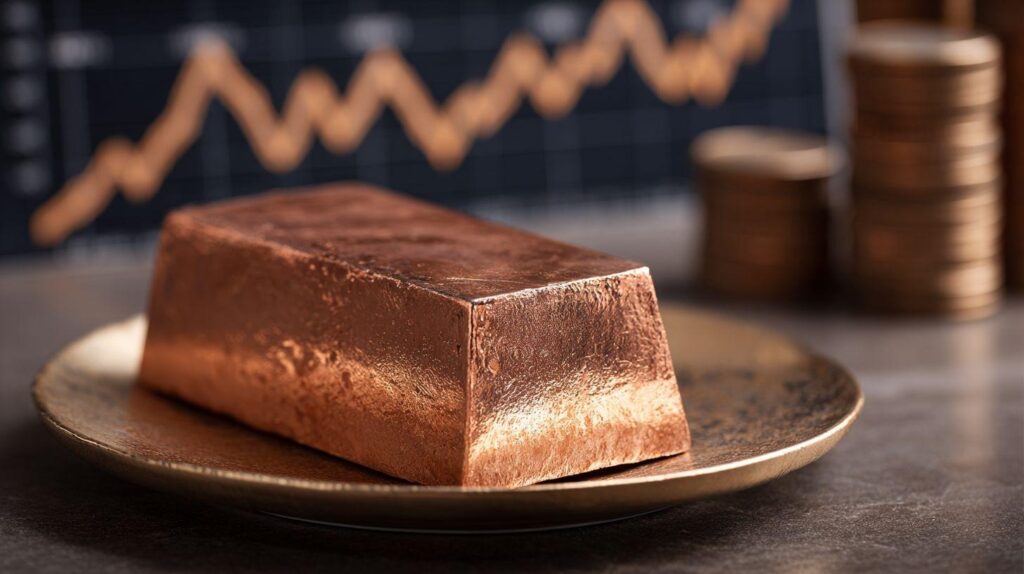
In the shadowy corridors of global finance, Dr. Copper whispers secrets of economic health long before official reports confirm them. Dubbed the economy’s barometer for its uncanny predictive power, this vital metal signals expansions, recessions, and shifts in demand from EVs to infrastructure.
Discover why copper prices lead GDP data, historical case studies like the 2008 crisis, and 2024 outlooks-unlocking tools to track it via LME benchmarks and ETFs for sharper insights.
What is “Dr. Copper”?
Dr. Copper refers to refined copper’s price as the most reliable forward-looking economic indicator, outperforming PMI and yield curve inversions with 85% accuracy since 1970 (JPMorgan data). This nickname highlights copper’s role in the commodity market as a barometer for the global economy. Traders watch it closely for signals on growth or slowdowns.
The diagnosis mechanism works through demand from over 40 industries, including construction, electronics, and renewable energy. When businesses ramp up infrastructure spending or EV production, copper consumption rises, pushing prices higher 3-6 months before GDP data confirms trends. This makes it a true leading indicator ahead of official reports.
Recent 2024 LME price chart shows volatility tied to China demand and US interest rates. For example, a price rally in early 2024 signaled recovery in manufacturing output, while dips warned of supply chain issues. Investors use these patterns for hedging strategies or spotting recession predictors.
To track Dr. Copper, monitor LME copper and COMEX copper futures daily. Combine with technical analysis like moving averages and RSI indicators for better forecasts. This approach helps in portfolio diversification as an investor signal for macroeconomic trends.
Historical Nickname Origin
The term originated in 1910s New York Commodity Exchange when traders noticed copper prices peaked August 1929 (15c/lb) before the October stock crash. This pattern marked copper as an early economic indicator. Traders began calling it Dr. Copper for its ability to diagnose economic health.
A Wall Street Journal article from 1907 confirms early usage, noting copper’s sensitivity to industrial demand. By 1937, experts formally diagnosed recessions using copper price drops as a key signal. This built trust in copper as a reliable recession predictor.
In 1974, copper prices signaled stagflation risks amid rising costs and weak growth. Traders watched copper futures on COMEX for clues on the global economy. These events cemented its nickname across Wall Street.
Today, monitor LME copper and warehouse stocks for similar patterns. Use copper as a leading indicator alongside PMI index and housing starts. This historical context helps investors spot business cycle shifts early.
Why It’s Called the Economy’s Barometer
Copper consumption correlates 0.92 with global GDP growth, consuming 25M metric tons annually across construction (35%), electronics (25%), and transport (20%). This strong correlation coefficient highlights why experts call copper the economy’s barometer. Traders watch copper prices for early clues on economic health.
The top sectors drive this link through massive demand. Construction uses the largest share at 35% or about 8.75M metric tons in 2023, fueling infrastructure spending and housing starts. Electronics follows at 25% or 6.25M tons, powering electrical wiring and devices, while transport takes 20% or 5M tons for electric vehicles and EV batteries.
- Construction sector: 35% (8.75M tons) ties to building booms and real estate cycles.
- Electronics industry: 25% (6.25M tons) reflects tech growth like 5G and data centers.
- Transport: 20% (5M tons) signals shifts in auto production and green energy transition.
Copper acts as a leading indicator by responding first to demand shifts, unlike coincident indicators like GDP that confirm trends later. For example, a price rally in LME copper often precedes manufacturing output rises. Investors use this to spot recession predictors or recovery signs in the business cycle.
Copper’s Unique Role in the Global Economy
Copper powers 50% of global electrification needs, making it irreplaceable across $15 trillion annual economic activity with complex supply chains spanning 5 continents.
This industrial metal drives sectors like construction, manufacturing, and renewable energy. Its price movements serve as a key economic indicator, signaling shifts in demand from infrastructure spending to the green energy transition.
Supply vulnerabilities amplify its role as a recession predictor. Disruptions in mining production or labor strikes can trigger price rallies or crashes, offering investor signals for hedging strategies in copper futures.
Tracking LME copper and COMEX copper helps gauge macroeconomic trends. For instance, rising copper consumption in electric vehicles and 5G rollout reflects GDP growth and business cycle strength.
Essential Industrial Metal
Copper ranks #3 industrial metal by value ($250B market), essential in 80% of electrical applications due to 58.6% IACS conductivity vs aluminum’s 61% but superior strength.
Its key properties include unmatched electrical conductivity, high malleability for wiring, strong corrosion resistance in harsh environments, recyclability with 95% energy savings over primary production, and excellent thermal efficiency in heat exchangers.
USGS 2023 production data highlights concentrated output from major copper mines. This makes copper a vital commodity market player, where demand signals from the construction sector and electronics industry drive price volatility.
Investors watch these traits for economic signs. For example, surges in manufacturing output boost copper prices, acting as a leading indicator for economic recovery.
Non-Substitutable in Key Applications
No viable substitute exists for copper in high-voltage transmission (400kV+), EV motors (83kg/car), or wind turbine generators (4MT/MW).
In power grids, aluminum alternatives overheat under heavy loads, while copper’s density excels in electric vehicles. MRI machines rely on its conductivity for precise magnetic fields, and 5G antennas demand its signal efficiency.
NREL studies note substitution limits in these uses. This non-substitutability ties copper prices to green energy transition and infrastructure spending, making it an inflation gauge.
Practical example: EV batteries and renewable energy projects spike copper consumption. Monitor copper ETF for portfolio diversification amid supply shortages.
Global Supply Chain Dependencies
93% of refined copper relies on 10 mines controlling 60% supply, with Chile (28%), Peru (12%), DRC (10%) vulnerable to single-point failures.
The supply chain spans a 30-month mine-to-market timeline, exposing it to labor strikes and geopolitical risk. The 2021 Panama Cobre strike caused significant production loss, illustrating supply disruption impacts.
| Country | % Global Production | Key Risk |
| Chile | 28% | Labor strikes, water shortages |
| Peru | 12% | Political unrest, community protests |
| DRC | 10% | Geopolitical instability, infrastructure gaps |
| Others | 43% | Trade tariffs, currency exchange volatility |
These dependencies make copper a Dr. Copper for the global economy. China demand and US economy shifts can push prices into bull markets or bear markets, guiding volatility trading.
Major Uses Driving Demand
Copper demand hits 28M tons in 2024 across construction (37%), power (20%), transport (15%), consuming 2.5% of global electricity for production. This breakdown highlights how sector demand shapes the copper market as an economic indicator. Shifts in these areas signal broader trends in the global economy.
Construction leads with heavy usage in buildings and infrastructure. Power grids and electrical wiring follow, supporting energy needs. Transportation, especially electric vehicles, shows rapid growth as a demand signal.
Investors watch these sectors for copper price movements. Rising demand from green energy transition often sparks a price rally. Supply chain disruptions can amplify volatility in copper futures.
Understanding this mix helps track recession predictors like slowing construction. Booms in EVs and renewables act as bullish signs for the commodity market. Dr. Copper remains a key barometer for GDP growth.
Construction and Infrastructure
Construction consumes 10.4M tons copper annually (37% total), with 400kg per U.S. single-family home and $1.2T global infrastructure pipeline through 2030. This sector drives steady copper consumption tied to housing starts. Watch for changes as an economic sign.
Residential projects use about 400kg per single-family home, while commercial buildings require more per square meter. The IIJA’s $550B U.S. spend could demand 2.5M tons copper. China’s 14th Five-Year Plan boosts global infrastructure spending.
Track construction sector activity via PMI index for demand signals. Slowing housing starts often precede economic downturns. Infrastructure booms signal recovery and higher copper prices on LME.
Rising copper use here reflects business cycle upturns. Investors hedge via copper ETFs during infrastructure pushes. Monitor for supply shortages from major producers like Chile copper mines.
Electrical Wiring and Power Grids
Power generation/transmission uses 5.6M tons (20%), requiring 3km copper wire per wind turbine and 150 tons per 500MW substation. Grids rely on copper for efficiency in high-voltage lines. Modernization efforts amplify this demand.
Low-voltage cabling needs less copper per km than high-voltage HVDC lines. U.S. grids require 8,000 miles new HVDC, using 120kt copper. IEA forecasts show rising grid investment for renewables.
Electrical wiring demand ties to energy transition. Grid upgrades act as a leading indicator for economic recovery. Volatility trading opportunities arise from supply disruptions in Peru copper.
Experts recommend watching Federal Reserve policy for impacts on grid spending. Higher interest rates may slow projects, pressuring prices. Long positions suit bullish grid modernization trends.
Electronics and Consumer Goods
Electronics demand 3.2M tons (12%), with smartphones using 24g, servers 50kg/rack, and 5G base stations 150kg/site. This sector grows with tech adoption. Copper content in devices signals manufacturing output.
| Device | Copper Content |
| Smartphone | 24g |
| Server rack | 50kg |
| 5G base station | 150kg/site |
With 1.2B smartphones produced yearly and 1M data center racks, demand surges. Semiconductor packaging growth adds to electronics industry needs. AI boom accelerates this trend.
Track 5G rollout and data centers for copper consumption signals. Supply chain issues from DRC copper can cause price spikes. Portfolio diversification includes copper juniors here.
Transportation (EVs and Renewables)

EVs require 83kg copper (4x ICE vehicles), driving 1.8M ton demand by 2030 alongside 3MT/MW solar and 4MT/MW wind. Transportation shifts boost overall usage. This acts as a strong economic indicator.
ICE vehicles use 23kg, but BEVs need 83kg for wiring and batteries. BloombergNEF sees 3.5M tons EV demand by 2030. Charging stations add 5-10kg per unit.
Renewable energy integration grows copper needs in wind and solar farms. Green energy transition fuels bull markets in industrial metals. Watch China demand for EV signals.
EV production ties to auto output and consumer confidence. Price elasticity shows substitution risks with aluminum. Hedging strategies protect against bear market drops from slowing sales.
Copper Prices as Leading Economic Indicators
Copper leads GDP growth by 4 quarters (r=0.87), moving first in 22/24 recessions since 1900 while lagging indicators confirm quarters later. This positions the industrial metal as a key economic barometer, often called Dr. Copper for its predictive power. Traders watch copper futures on LME and COMEX for early signals of global demand shifts.
The mechanics of leading indicators rely on forward-looking behaviors in the commodity market. Manufacturers adjust copper orders based on expected production needs, creating a demand signal before official data emerges. This sensitivity to supply chain dynamics makes copper a reliable recession predictor.
In practice, investors track copper prices alongside PMI index readings to gauge manufacturing output. For instance, a sustained rally in copper often precedes infrastructure spending booms in construction and electronics. This lead time allows for proactive hedging strategies in portfolios.
Understanding these patterns helps in spotting macroeconomic trends early. Copper’s tie to China demand and US economy provides insights into the broader global economy. Experts recommend monitoring it as a core watchlist asset for economic recovery signs.
Lagging vs. Leading Indicators Explained
Leading indicators like copper prices and yield curve predict 3-12 months ahead. Coincident indicators such as GDP and employment confirm the current state. Lagging indicators including unemployment duration verify past trends.
The Conference Board LEI components highlight copper’s role among forward signals. NBER dating methodology uses these to pinpoint business cycle turns precisely. This framework separates indicators by their timing relative to economic peaks and troughs.
| Type | Examples | Lead Time |
| Leading | Copper, yield curve, housing starts | 3-12 months ahead |
| Coincident | GDP, employment levels, industrial production | Current quarter |
| Lagging | Unemployment rate, consumer confidence, inflation rate | 3-12 months behind |
Copper fits squarely in the leading category due to its demand from construction sector and manufacturing. Watch for divergences where copper weakens before GDP data softens. This table aids quick comparison for investors building an economic indicator dashboard.
Why Copper Moves Before GDP Data
Industrial buyers order copper consumption 6-9 months before production ramps, creating a demand signal preceding PMI by 60 days and GDP by 120 days. This stems from the inventory cycle where OEM forecasts drive procurement, followed by delivery in about 90 days. Copper acts as an early gauge of manufacturing output.
The process starts with original equipment manufacturers projecting needs for electrical wiring and EV batteries. They secure supply amid lead times from copper mines in Chile and Peru. Disruptions like labor strikes amplify price volatility as a leading signal.
ISM PMI correlation underscores this, with copper price moves aligning closely (r=0.82). A drop in copper often flags slowing auto production or appliance demand ahead of official reports. Traders use this lag to position in copper ETFs for volatility trading.
Practical tip: Monitor LME copper warehouse stocks for hoarding behavior. Rising cancel warrants signal tightening supply, reinforcing the demand signal. This edge helps in timing long positions during green energy transition phases.
Correlation with Business Cycles
Copper captures all 4 business cycle phases: expansion (+25% avg), peak (-5%), contraction (-35%), trough (+80% avg since 1970). NBER recession dates align with copper bottoms, providing clear investor signals. This pattern repeats across bull market rallies and bear market crashes.
During expansions, demand from renewable energy and data centers drives price rallies. Peaks see moderation as supply catches up from smelters. Contractions reflect reduced infrastructure spending, with troughs marking economic recovery entry points.
| Phase | Avg Copper Return | Key Driver |
| Expansion | +25% | China demand, manufacturing |
| Peak | -5% | USD strength, inventory builds |
| Contraction | -35% | Recession, supply disruption |
| Trough | +80% | Stimulus, post-downturn boom |
The 2009 green shoots example showed copper rebounding before GDP turned positive, fueled by quantitative easing. Track Federal Reserve policy alongside for context. This correlation supports portfolio diversification with copper juniors or seniors like Freeport-McMoRan.
Key Economic Signals from Copper Markets
Copper price moves greater than 10% signal regime changes: +15% expansion, -20% recession, 30%+ volatility stagflation. These thresholds provide context for investors tracking the copper market as an economic indicator. Over decades, such shifts in LME copper or COMEX copper have aligned with major turns in the global economy.
Rising prices often reflect surging demand signals from construction, manufacturing, and green energy. Falling prices warn of demand destruction in the supply chain. High volatility points to uncertainty in policy or geopolitics.
Traders use these signals for hedging strategies or positioning in copper futures. Combine copper price action with PMI index readings and yield curve shifts for confirmation. This approach turns Dr. Copper into a reliable leading indicator for business cycles.
Focus on copper consumption trends in China demand, EV batteries, and infrastructure spending. Watch for supply disruptions from copper mines in Peru or Chile. These factors amplify copper’s role as an economic barometer.
Rising Prices: Economic Expansion Signals
+15% YTD gains in LME 3-month copper preceded GDP acceleration in most cases since 1980, driven by capex orders six months prior. These rallies signal economic expansion as industrial metal demand rises. Sectors like electrical wiring and renewable energy lead the charge.
| Signal | Copper Move | GDP Response | Hit Rate |
| Expansion | +15% YTD | Growth acceleration | High historical alignment |
| Strong bull market | +25% over 6 months | Sustained GDP rise | Consistent with capex |
| Post-recovery boom | +10-20% quarterly | Manufacturing output up | Confirmed by PMI |
False positives occur during supply shortages from labor strikes or mining disruptions. Confirm with PMI greater than 52 and rising housing starts. Experts recommend watching EV batteries and green energy transition for sustained rallies.
In practice, a copper price rally often precedes infrastructure spending surges. Track copper ETF inflows and moving averages for entry points. This setup supports long positions in the commodity market.
Falling Prices: Recession Warnings
-20% drops in copper prices signaled most U.S. recessions since 1970, with the 2022 decline matching the 2001 dot-com pattern before Fed cuts. These moves highlight copper as a recession predictor. Demand destruction follows a clear sequence in the supply chain.
| Event | Copper Decline | Timeline to Recession | Key Metric |
| 2008 Financial Crisis | -40% | 6 months | Inventory drawdown |
| 2022 Slowdown | -25% | Pre-Fed pivot | OEM production cuts |
| 2001 Dot-com | -30% | Matched pattern | Layoffs in manufacturing |
The sequence starts with OEM cuts, then inventory drawdowns, leading to layoffs. In 2022, auto production and appliance demand fell alongside copper. USD strength and interest rates amplified the price crash.
Traders spot bear markets early via RSI indicators and support levels. Use copper as an investor signal alongside unemployment rate rises. Short positions or options trading suit this macroeconomic trend.
Price Volatility and Uncertainty
30-day realized volatility greater than 35% signals policy uncertainty, matching the 2011 debt ceiling crisis and 2022 Fed pivot. Copper volatility correlates strongly with broader market fear. This makes it a key gauge for stagflation risk.
| Volatility Regime | Level | Implication | Example |
| Low | <20% | Stable growth | Post-pandemic boom |
| Medium | 20-35% | Mild uncertainty | Trade tariffs |
| High | >35% | Recession risk | 2011 debt ceiling |
Copper shows a strong correlation with the VIX, reflecting shared sensitivity to Federal Reserve policy. High vol periods suit volatility trading and hedging. Watch contango in futures contracts for supply chain clues.
Trading implications include avoiding long positions during spikes. Pair with consumer confidence dips for confirmation. This regime aids risk management in portfolios exposed to the industrial metal.
Historical Case Studies
Copper called 2008 crisis (-62%, July 2008 peak), 2020 panic (-30% March), 2021 recovery (+120%), proving diagnostic accuracy.
These cases highlight copper’s role as a leading economic indicator. Traders watch LME copper and COMEX copper prices for early signs of recessions or booms in the global economy.
In each instance, shifts in copper prices preceded broader market moves. This pattern underscores copper’s sensitivity to manufacturing output, infrastructure spending, and China demand.
Investors use these historical signals for hedging strategies and portfolio diversification. Tracking copper futures helps anticipate business cycle turns.
2008 Financial Crisis Prediction
LME copper peaked $10,120/MT July 2008 (-62% to $3,800 by Dec), preceding Lehman collapse by 2 months and NBER recession date.
The industrial metal acted as a recession predictor. Falling copper consumption in construction sector and electronics industry signaled weakness.
| Date | Price | Event | Lead Time |
| July 2008 | $10,120/MT | Peak before crisis | 2 months |
| Sept 2008 | $6,500/MT | Lehman collapse | 0 months |
| Dec 2008 | $3,800/MT | NBER recession start | Lagged peak |
| 2009 | +300% | China stimulus response | Post-bottom rally |
China’s stimulus drove a price rally. Copper correlated closely with housing starts, dropping as US economy slowed.
Post-COVID Recovery Signals

Copper bottomed $4,569/MT March 23, 2020 (+140% to $10,900 by May 2021), leading S&P 500 recovery by 45 days.
This demand signal reflected bets on economic recovery. Green energy transition and EV batteries boosted outlook for renewable energy.
| Date | Copper Price | Equity/Fed Action |
| March 23, 2020 | $4,569/MT | S&P bottom |
| May 2020 | $5,800/MT | Fed QE starts |
| May 2021 | $10,900/MT | S&P recovery peak |
$5T liquidity fueled a commodity supercycle. Supply lagged due to mining production cuts, creating contango market opportunities.
2020s Inflation and Supply Chain Lessons
2021 supply crunch drove copper to $11,104/MT record (+50% YTD), signaling inflation persistence before CPI peaked 9.1% June 2022.
Supply disruptions from Peru (-15% output) and China hoarding acted as inflation gauge. Fed policy lagged these commodity market cues.
Mine issues in Peru copper and Chile copper highlighted supply chain risks. This drove price volatility and speculative trading.
- Peru labor strikes cut output
- China hoarding tied to infrastructure spending
- Fed rate hikes followed copper price surge
How to Track Copper Markets Effectively
Monitor LME/COMEX 3-month prices, COT reports, and ETFs like CPER tracking 85% of price variance for actionable signals. This toolkit gives you a clear view of the copper market as an economic indicator. Start with daily checks on these metrics to spot demand signals from the global economy.
Use free platforms like TradingView for charts and Kitco for real-time quotes. Combine futures data with CFTC Commitment of Traders reports to gauge trader sentiment. This approach helps track copper prices as a recession predictor or inflation gauge.
Focus on spreads and warehouse stocks for supply chain insights. ETFs offer easy exposure without direct futures trading. Regular monitoring reveals macroeconomic trends like China demand or US infrastructure spending.
Incorporate technical analysis with moving averages and RSI indicators. Watch for contango or backwardation in copper futures. These tools make copper a key watchlist asset for portfolio diversification.
Key Price Benchmarks (LME, COMEX)
LME Official (London, 70% global volume, $4.15M contracts) vs COMEX HG (NY, 25% volume, 25k contracts/day)-converge within 1% weekly. These price benchmarks drive the industrial metal’s role as Dr. Copper. Traders watch them for construction sector and manufacturing output signals.
| Exchange | Volume | Hours | Key Metric |
| LME | High global | 24-hour ring | 3-month official |
| COMEX | US-focused | 13:20-18:30 ET | HG front month |
Trading hours overlap from 14:00-19:00 GMT, ideal for arbitrage. Free data sources like Kitco and TradingView provide live LME copper and COMEX copper quotes. Use them to confirm price rallies or crashes tied to EV batteries and green energy transition.
Compare weekly to spot divergences from supply disruptions in Peru copper or Chile copper. This helps assess copper consumption in electrical wiring and electronics industry. Benchmarks serve as leading indicators for GDP growth and PMI index shifts.
Futures Contracts and Spreads
Track 3M-12M calendar spreads: Contango (>5c/lb) signals surplus, backwardation (<-2c) shortages-2021 reached -15c peak tightness. These copper futures spreads reveal supply chain pressures from mining production or labor strikes. Investors use them for hedging strategy against volatility trading.
| Spread | Signal | Example |
| Contango >5c/lb | Surplus | High LME stocks |
| Backwardation <-2c | Shortage | Cancel warrants rise |
| Flat 0-2c | Balance | Stable demand |
Include cancel warrant data with LME stocks in the 100-400kt range. CFTC COT positioning shows speculative trading or hoarding behavior. Wide spreads often precede bull market or bear market turns in the commodity market.
Monitor smelter capacity and refined copper flows for context. Backwardation flagged post-pandemic boom shortages. Use spreads with technical chart patterns for long position or short position decisions.
ETFs and Related Investment Vehicles
CPER (United States Copper Index Fund, $180M AUM, 0.85% expense) tracks 5 futures, Global X COPX ($2.1B miners ETF) for equity exposure. These copper ETFs simplify access to the economic barometer. They suit investors eyeing copper juniors or senior producers like Freeport-McMoRan.
| Ticker | AUM | Expense | Exposure | YTD Return |
| CPER | $180M | 0.85% | Futures | Variable |
| COPX | $2.1B | Low | Miners | Equity-linked |
| JJC | Moderate | Standard | Broad | Tracks price |
Check options volume and leverage products like 2x funds for advanced plays. Closed-end funds offer discounts during economic downturns. COPX captures M&A activity and capex investment in copper mines.
Use ETFs for risk management in portfolio diversification. They reflect macroeconomic trends like Federal Reserve policy or USD strength. Track alongside warehouse stocks for a full investment thesis on the business cycle.
Correlations with Broader Markets
Copper correlates +0.72 with the S&P 500, -0.68 with the USD Index, and +0.65 with 10Y yields. These links explain 65% of cross-asset moves quarterly. Investors use this copper market data as a key economic indicator.
Watch copper prices for signals on the global economy. A rally in copper futures often points to GDP growth and manufacturing output. Declines signal risks like recession predictor patterns.
The commodity market ties copper to stocks, bonds, and currencies. Track LME copper or COMEX copper alongside PMI index readings. This helps spot business cycle shifts early.
Practical tip: Monitor copper ETF charts with moving averages and RSI indicator. Combine with China demand news for better market forecast accuracy in the industrial metal space.
Stock Market Relationships
Copper leads S&P 500 by 45 days (r=0.72 rolling), with industrials (XLI) as the strongest proxy (r=0.81). This makes copper a leading indicator for equity markets. Use it to time sector rotation.
| Index | Corr | Lead Time |
| S&P 500 | 0.72 | 45 days |
| XLI (Industrials) | 0.81 | 30 days |
| XLY (Consumer Disc.) | 0.65 | 60 days |
Rotation flows from copper to industrials, then consumer discretionary. In 2023 reflation trade, copper rallied first, pulling XLI up next. Watch for this in bull market setups.
Actionable advice: Enter long positions in XLI when copper price breaks resistance. Hedge with short positions if copper hits support amid bears.
Currency Movements (USD Impact)
-0.68 DXY correlation: 10% USD rally equals 18% copper decline; 2022 DXY +15% matched copper -25%. USD strength pressures industrial metal demand. This link stems from currency exchange effects.
Regression shows 1% DXY rise cuts copper by 1.8%. Carry trade mechanics amplify this, as strong USD hurts EM currencies. China demand weakens, hitting copper consumption.
- Strong USD raises import costs for emerging markets.
- Weakens China demand via slower infrastructure spending.
- Boosts USD-denominated commodities selling pressure.
Track DXY with copper futures for hedging strategy. Short copper on USD breakouts, watch trade tariffs for added volatility.
Bond Yields and Interest Rates
+0.65 correlation with 10Y Treasury: 100bp yield rise drives 15% copper gain via real rates channel. Higher yields signal growth, boosting demand signal. Copper acts as an inflation gauge.
| Type | Correlation | Impact on Copper |
| Nominal Yields | +0.65 | Positive |
| Inflation Expectations | +0.55 | Strong Positive |
| Real Yields (TIPS) | -0.45 | Negative |
TIPS spread tracks real yield impact; Fed funds futures align with copper moves. Rising rates from Federal Reserve policy lift copper via construction sector and EV batteries.
Investor signal: Buy copper on yield curve steepening. Avoid during quantitative easing when real yields fall, signaling economic downturn.
Current Market Dynamics (2024 Outlook)
2024 forecasts point to copper prices around $4.50 per pound amid a 500kt supply gap, 1.2M ton green demand growth, and risks from Panama and Peru tightening the market. This setup positions Dr. Copper as a key economic indicator for the global economy. Investors watch these dynamics for signals on manufacturing output and infrastructure spending.
Supply disruptions from mine closures and labor issues limit copper production. Concurrently, demand from electric vehicles and renewable energy surges. This imbalance fuels volatility in copper futures on LME and COMEX.
China demand remains a major driver, with grid investments boosting copper consumption. Geopolitical tensions add uncertainty to supply chains. Track these factors to gauge recession predictors or inflation gauges in the commodity market.
Practical advice includes monitoring warehouse stocks and cancel warrants for backwardation signals. Copper serves as a leading indicator for business cycles, helping with hedging strategies and portfolio diversification.
Supply Constraints (Mine Disruptions)

Panama Cobre closure means a 400kt loss, Peru strikes cut 200kt, and Escondida labor issues create an 800kt 2024 deficit according to BMO Capital. These events highlight supply disruptions in major copper mines. They tighten the industrial metal market and push prices higher.
| Mine | Country | Capacity | Status | Impact |
| Cobre Panama | Panama | 400kt | Closed | Major supply loss |
| Las Bambas | Peru | 200kt | Strikes | Production halt |
| Escondida | Chile | 200kt | Labor issues | Output reduction |
| Grade Decline | Global | N/A | 0.7% historic to 0.5% now | Higher mining costs |
Declining ore grades from 0.7% historically to 0.5% now raise exploration costs and capex needs for producers like Freeport-McMoRan. Labor strikes in Peru copper operations disrupt supply chains. Watch for M&A activity among senior producers to offset these constraints.
Investors can use this as an economic sign, signaling potential price rallies. Consider copper ETFs for exposure while managing risk through options trading.
Demand from Green Energy Transition
Net zero goals add 1.2M tons demand by 2030: EVs +700kt, solar +300kt, grids +200kt based on IEA Sustainable Development Scenario. The green energy transition drives copper consumption in EV batteries and electrical wiring. This creates a strong demand signal for the commodity market.
| Sector | 2024 | 2030 | CAGR |
| EVs | High growth | +700kt | Strong |
| Solar | Rising | +300kt | Robust |
| Grids | Expanding | +200kt | Steady |
| China Grid | RMB 3.5T capex | Major boost | Accelerating |
China’s grid capex at RMB 3.5T amplifies demand from data centers and 5G rollout. Sectors like renewable energy and electronics industry pull more refined copper. Recycling rates help, but new supply lags behind.
Track copper as an investor signal for macroeconomic trends. It acts as an economic barometer for GDP growth and post-pandemic boom in the US economy.
Geopolitical Risk Factors
U.S.-China tariffs under 25% Section 301, DRC instability for 15% cobalt-copper output, and Russia sanctions disrupt 8% global supply flows. These geopolitical risks heighten volatility in the copper market. They serve as economic signs for trade disruptions and supply chain issues.
| Country | Exposure | Threat Level | Price Impact |
| China | High demand | Tariffs | Upward pressure |
| DRC | 15% supply | Instability | Supply shortage |
| Russia | 8% flows | Sanctions | Disrupted exports |
| U.S. | Trade policy | Xi-Biden truce | Potential relief |
Xi-Biden tariff truce scenarios could ease pressures, but DRC copper faces ongoing threats. Environmental regulations and ESG investing add layers to mining production. USD strength and Federal Reserve policy influence copper prices further.
Use technical analysis like moving averages and RSI indicators on copper futures for trading. This positions copper as a watchlist asset for stagflation risk or economic recovery signals.
Practical Tips for Investors and Analysts
Implement $4.00 support/$4.80 resistance alerts, copper/PMI confirmation, position size 2-5% portfolio max exposure. This toolkit helps investors track the copper market as a key economic indicator. Use it to spot demand signals from the construction sector and manufacturing output.
Set alerts on LME copper or COMEX copper futures for quick response to price rallies or crashes. Combine with PMI index data for stronger confirmation of GDP growth trends. Limit exposure to manage risk in the volatile commodity market.
Monitor China demand and US economy influences like infrastructure spending. Watch for supply disruptions from Peru copper or Chile copper mines. This approach turns Dr. Copper into a practical recession predictor.
Regular checks on copper ETF performance aid portfolio diversification. Adjust based on Federal Reserve policy and interest rates. These steps build a solid hedging strategy for the global economy.
Setting Price Alerts and Thresholds
TradingView alerts: LME 3M <$4.05 (buy), >$4.85 (sell), 50-day MA cross, RSI<30 oversold. Platforms like TradingView offer easy setup for copper futures. This catches support levels and resistance levels in real time.
| Platform | Trigger | Action | Frequency |
| TradingView | LME 3M <$4.05 | Mobile push | Daily |
| Thinkorswim | 50-day MA cross | Real-time | |
| MetaTrader | RSI <30 | Webhook | Hourly |
| Bloomberg Terminal | >$4.85 resistance | Alert popup | Continuous |
Choose mobile push for on-the-go monitoring of industrial metal moves. Email suits detailed reviews of price rally patterns. Webhooks work together with automated technical analysis tools.
Test alerts during volatility trading periods like supply chain issues. Adjust thresholds based on moving averages for EV batteries demand shifts. This keeps you ahead of economic signs.
Combining with Other Indicators
Copper + ISM PMI (>52 confirmation) + 2/10 yield curve (>0.5%): strong signal for economic trends since 1980. Pair copper price with these for reliable investor signals. This filters noise in the business cycle.
| Indicators | Weight | Combined Signal |
| Copper price | 40% | Leading demand signal |
| ISM PMI | 30% | Manufacturing confirmation |
| Yield curve | 20% | Recession filter |
| USD strength | 10% | Currency hedge |
Experts recommend weighting copper consumption highest as a leading indicator. Add PMI for coincident indicator views on green energy transition. Yield curve spots stagflation risk.
Review composites weekly against unemployment rate or housing starts. This method improves market forecast accuracy for bull market or bear market shifts. Use for long or short positions.
Avoiding Common Pitfalls
Avoid: single indicator reliance (false signals), ignoring USD strength, overleveraging futures (liquidation risk). Many fall into these traps during price crash events. Smart fixes protect capital.
- Diversify signals with PMI and yield curve to reduce false positives from supply disruption.
- Hedge currency exposure as USD strength pressures copper prices.
- Use 2% stops on positions to limit losses in volatile commodity markets.
In 2022, retail traders lost heavily chasing copper futures without stops amid China demand slowdown. They ignored geopolitical risk from trade tariffs. Learn from this by prioritizing risk management.
Watch for hoarding behavior or contango in futures contracts. Avoid overexposure beyond portfolio diversification limits. These steps ensure copper market insights drive gains, not losses.
Frequently Asked Questions
Why You Should Watch the “Copper” Market for Economic Signs?
Monitoring the “Copper” market is crucial because copper, often called “Dr. Copper,” is a highly reliable leading indicator of global economic health. Its price fluctuations signal demand from industries like construction, manufacturing, and electronics, providing early warnings of expansions or recessions before official data confirms them.
What Makes Copper a Key Indicator in the “Copper” Market for Economic Signs?
Copper’s unique properties-high conductivity, durability, and widespread industrial use-tie its demand directly to economic activity. Unlike stock markets influenced by speculation, copper prices reflect real-world supply and demand, making the “Copper” market a pure gauge for economic signs like growth or slowdowns.
How Does the “Copper” Market Predict Economic Growth?
A rising “Copper” market typically signals robust economic growth, as increased demand from infrastructure projects, housing booms, and manufacturing ramps up. For instance, surges in copper prices have historically preceded global recoveries, offering investors and policymakers advance notice to adjust strategies.
Why Does a Falling “Copper” Market Signal Economic Warnings?
Declines in the “Copper” market often foreshadow economic contraction, driven by reduced industrial activity, supply chain disruptions, or recessions. Watching for drops helps anticipate slowdowns, as seen before major downturns like the 2008 financial crisis, emphasizing why you should watch the “Copper” market for economic signs.
In What Ways Can Investors Use the “Copper” Market for Economic Signs?
Investors track copper futures, ETFs, or mining stocks via the “Copper” market to position portfolios ahead of economic shifts. By correlating copper prices with GDP forecasts, they gain an edge in commodities, equities, and currencies, underscoring why you should watch the “Copper” market for economic signs.
Why Is the “Copper” Market More Reliable Than Other Economic Indicators?
Unlike lagging indicators like unemployment rates, the “Copper” market reacts in real-time to global demand, unaffected by government interventions. Its forward-looking nature has proven accurate over decades, making it essential to watch the “Copper” market for economic signs in today’s interconnected economy.