
Remember when ping pong tables defined startup cool? Those foosball-fueled fantasies from the early tech boom are fading fast. As venture capital dries up and remote work reshapes realities, startups prioritize profitability, meaningful work, and sustainable perks like equity and learning stipends over gimmicks. Discover why this shift signals a maturing ecosystem-and what it means for your career.
Origins in Early Tech Boom
Netscape’s 1995 Mountain View office introduced ping pong tables to boost engineer morale during 80-hour crunch weeks. Founders saw these office perks as a fun break from coding marathons. This marked the start of startup culture embracing games for retention.
Netscape engineer Jim Clark later recalled in Silicon Valley History by Michael Malone, We needed something to keep the team sane amid the browser wars. The table became a symbol of work-life balance efforts. It drew talent eager for innovative environments.
By Google’s 2004 expansion, the company installed 12 ping pong tables across its campus, coinciding with a soaring valuation. Founders Larry Page and Sergey Brin tied these perks to creativity, saying they fueled late-night breakthroughs. Photos from early Google offices show teams huddled around tables during breaks.
Airbnb in 2009 placed ping pong tables in its HQ amid funding rounds. Co-founder Joe Gebbia noted in interviews how it sparked ideas during pivots from air mattresses to global listings. As cited in Malone’s book, this era’s tech industry leaders used such features to build mission-driven companies.
Symbol of “Fun” Workplaces
Ping pong symbolized the ‘Don’t be evil’ work-hard-play-hard ethos, appearing in many early tech offices. It represented a shift from stiff corporate environments to casual spaces where creativity could thrive. Startups used these perks to signal a fun atmosphere amid long hours.
Common office perks included elaborate setups to boost morale. Here are five typical packages with setup or annual costs:
- Ping pong and foosball tables: $2,500 setup for interactive breaks.
- Free snacks and drinks: $15K/year to keep energy high during late nights.
- Beer Fridays: $8K/year for casual end-of-week bonding.
- Arcade games: $10K for nostalgic gaming corners.
- Dog-friendly policies: Minimal direct cost but requires pet areas and cleanup supplies.
Experts once believed such perks improved engagement, as noted in a Harvard Business Review 2014 study linking them to a 12% productivity lift. Yet, over time, these symbols faced scrutiny for masking deeper issues like employee burnout.
In practice, a Silicon Valley startup might install a ping pong table next to desks to encourage spontaneous play. This aimed to foster team building, but often led to distractions rather than true rest. Modern workplace trends now prioritize sustainable well-being over gimmicks.
Shift in Startup Priorities
Post-2022 layoffs shifted focus from office perks like ping pong tables to runway extension, with median startup burn rate dropping. Founders now prioritize cash preservation over flashy amenities. This change reflects broader workplace trends in the tech industry.
In 2021, venture capital peaked, fueling startup culture with perks that ate into budgets. By 2023, funding dried up, forcing lean operations. Companies cut non-essential spending to survive longer without new rounds.
Consider burn rate math: a team spending $500K monthly with perks drops to $420K lean. This extends runway by months, buying time for product-market fit. Bootstrapped successes like Mailchimp show perks-free paths to scale.
Startups now emphasize profitability goals and customer funding over VC dreams. Remote work and hybrid work models replace foosball tables with tools for productivity. The pivot favors meaningful work and sustainable growth.
Focus on Profitability Over Perks
Basecamp ditched ping pong tables in 2021, redirecting funds to achieve steady revenue growth without VC. CEO Jason Fried noted this freed resources for core product work. The move highlighted lean startup principles in action.
Perks often inflate costs without boosting output, leading to employee burnout from toxic hustle culture. Lean models cut these, focusing on results-only work environments. Teams gain clarity on priorities like customer success.
- CAC reduction through targeted marketing and referrals.
- LTV:CAC improvement by nurturing long-term customer value.
- Churn drop via better onboarding and feedback loops.
- MRR growth from upsells and retention efforts.
Experts recommend tracking these profitability metrics weekly. Basecamp’s approach proves bootstrapping builds resilient businesses. Founders should audit expenses, favoring professional development over free snacks.
Rise of Bootstrapped Models
Mailchimp bootstrapped to a massive acquisition by Intuit without ping pong tables, prioritizing product-market fit over perks. The company grew steadily over two decades on customer revenue alone. This story inspires startup founders seeking independence.
Other successes follow suit with no-frills operations. Basecamp sustains high ARR through disciplined cash flow. ConvertKit hits strong MRR by listening to creators, not chasing unicorns.
- Mailchimp: $700M exit after 20 years of self-funding.
- Basecamp: Steady $100M ARR with remote-first culture.
- ConvertKit: $3M MRR from email marketing focus.
- Buffer: Profitability after layoffs, emphasizing transparency.
The formula blends customer funding, zero perks, and 18-month runway discipline. Remote work enables global talent pools without office costs. Founders adopt agile methodology for quick pivots and MVP development.
Evolving Workforce Expectations
Deloitte’s 2023 survey shows 49% of Gen Z prioritize mental health over perks, compared to 22% of Millennials in 2015. This shift marks a key change in startup culture, where younger workers seek work-life balance over office perks like ping pong tables. Founders now focus on employee well-being to attract talent.
Gen Z workers often reject toxic hustle culture, favoring roles with flexible hours and clear company missions. Pew Research notes 82% of Gen Z reject hustle culture, pushing startups toward mission-driven companies. This trend helps reduce employee burnout and boosts retention.
| Priority | Gen Z | Millennials |
| Flex hours | 62% | Remote 42% |
| Mission | 58% | Equity 48% |
Gen Z founders emphasize purpose-driven hiring. One founder shared, “We hire for shared values, not foosball skills.” This approach builds high-performance teams focused on productivity focus over gimmicks.
Millennials vs. Gen Z Values
Millennials valued free lunches (67% priority, 2018 Glassdoor); Gen Z demands four-day workweek (72% priority, 2024 LinkedIn). This highlights evolving workplace trends in startups, moving from office perks to hybrid work model. Companies adapt by offering unlimited PTO and wellness programs.
| Ranking | Millennials | Gen Z |
| 1st | Equity | Flexibility |
| 2nd | Remote | Purpose |
| 3rd | Pay | Growth |
| 5th | Perks | Equity |
Gen Z shows 2.3x higher attrition risk from values mismatch, urging startups to align with mental health priorities. Millennials chased equity compensation for unicorn dreams; Gen Z seeks professional development. This demands talent retention strategies like mentorship programs.
Practical steps include core hours for collaboration and asynchronous communication via Slack channels. Such changes foster psychological safety and cut quiet quitting risks from the great resignation era.
Demand for Meaningful Work
Patagonia’s mission focus yields 4% annual turnover vs tech average 13.2%, despite no ping pong tables. Gen Z craves meaningful work over free snacks or beer Fridays. Startups like Buffer use transparency reports for 92% retention through mission alignment.
- Impact tops demands at 68%, with workers wanting real-world change.
- Growth at 62%, via skill-building workshops and hackathons.
- Flexibility at 58%, including remote-first setups.
- Pay at 52%, paired with fair equity.
- Perks lag at 18%, like gym memberships or nap pods.
Founders should prioritize company values in hiring, using OKRs for purpose tracking. Examples include climate tech startups tying goals to sustainability initiatives. This builds inclusive leadership and long-term loyalty.
Shift to results-only work environment with no-meeting days supports deep work. Such practices enhance innovation culture, helping SaaS or AI startups achieve product-market fit without outdated perks.
Remote and Hybrid Work Realities
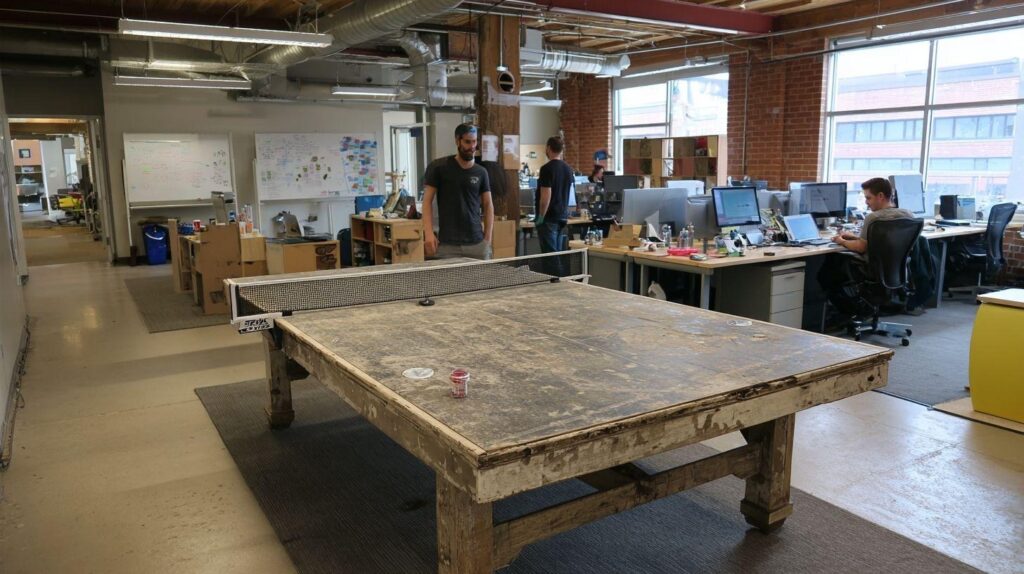
95% of ping pong tables became obsolete as 74% of startups went remote-first by 2023 (Stanford Future Work survey). Before 2020, 92% of startups relied on office-based work. By 2023, that dropped to 26% due to lasting shifts in remote work preferences.
Startup culture now prioritizes hybrid work models and flexible hours over physical spaces. Leaders focus on productivity through tools like Slack channels and Zoom meetings. This change supports employee well-being and reduces burnout from long commutes.
Physical perks like ping pong tables, foosball games, nap pods, catered lunches, beer fridges, arcade games, and gym memberships lost appeal in remote settings. These items gathered dust as teams embraced asynchronous communication. Companies shifted to scalable benefits that fit digital nomads and global talent pools.
- Ping pong tables sit unused in empty offices.
- Foosball tables fail to engage remote teams.
- Nap pods offer no value without on-site presence.
- Catered lunches cannot reach distributed workers.
- Beer fridges limit after-hours bonding.
- Arcade games stay idle in vacant spaces.
- Gym memberships overlook home-based wellness needs.
Decline of Physical Office Spaces
GitLab’s 1,800 remote employees across 60+ countries saved $11M/year by eliminating 50,000 sq ft offices. Consider typical savings: $25/sq ft lease times 10,000 sq ft times 12 months equals $3M/year per location. These funds fuel professional development and equity compensation instead.
The WeWork bankruptcy highlighted office space risks, dropping from $47B valuation to Chapter 11. Startups now avoid such leases to extend runway and focus on cash flow management. Remote hiring expands the talent pool by 3.2x, tapping diverse skills worldwide.
Remote-first companies like Basecamp thrive without office furniture or dog-friendly policies. They invest in collaboration tools and mentorship programs for team building. This approach boosts talent retention amid the great resignation and quiet quitting trends.
Hybrid models with core hours preserve some office time for deep work sessions. Yet, most prioritize mission-driven work over free snacks or swag merchandise. Leaders emphasize psychological safety and inclusive leadership for high-performance teams.
Perks That Don’t Travel
Slack audited perks in 2022, cutting $2.1M in foosball/ping pong costs that benefited only 14% of remote workforce. Office perks like beer Fridays and nap pods do not scale with distributed teams. Startups now seek remote equivalents to maintain work-life balance.
Traditional perks fail in remote work realities, prompting a shift to digital options. For example, ping pong tables give way to virtual tournaments via apps. This evolution supports mental health and prevents employee burnout.
- Ping pong Virtual tournaments on platforms like Challonge.
- Free lunch $50/mo meal stipend for local deliveries.
- Beer Fridays Digital happy hours on Zoom with breakout rooms.
- Nap pods Async PTO for flexible rest without tracking.
- Arcade games Learning budget for online courses and skill-building.
- Gym memberships Wellness apps like Calm or Peloton reimbursements.
These changes align with startup culture trends toward meaningful work and wellness programs. Companies offer therapy stipends and four-day workweeks for better retention. The focus remains on results-only environments and OKRs over toxic hustle culture.
Financial Pressures on Startups
VC funding dropped 58% from $457B in 2022 to $194B in 2023, forcing 1,200+ tech layoffs averaging 18% headcount cuts. This shift marked a stark turn from the easy money era. Startups now face intense financial pressures to survive.
The 2022-2023 crisis saw peak venture capital inflows of $50B per month plummet to $15B per month. Median runway shrank from 28 months to 14 months, pushing founders to rethink every expense. Layoffs.fyi tracked 212K tech layoffs as companies scrambled for stability.
Examples like Twitter’s massive staff reductions highlight the pain. Founders shifted from ping pong tables and free snacks to core survival tactics. This pressure accelerated the end of perk-heavy startup culture.
Practical steps emerged, such as auditing burn rates weekly and prioritizing runway extension. Remote work cut office costs, while equity compensation retained talent without cash outlays. These moves fostered leaner, more resilient operations.
Venture Capital Drought
Series A valuations dropped 44% from $15M median in 2022 to $8.5M in 2023, per Carta data, killing perk-heavy budgets. Funding timelines tell the story: Q4 2021 hit $143B, while Q4 2023 sank to $28B. This venture capital drought starved ambitious plans.
Impacts rippled through the ecosystem, with 61% fewer unicorns and 72% decline in Series A deals. Sequoia Capital’s efficiency memos became standard, urging startups to prove unit economics early. Founders pivoted from growth at all costs to profitability paths.
Real-world cases, like fintech startups slashing marketing spends, show adaptation. Investors now demand clear product-market fit before perks like foosball tables return. This forces focus on customer discovery and MVP development over office flash.
To navigate, experts recommend bootstrapping where possible or seeking revenue-based financing. Build transparent cap tables and practice radical candor in pitch decks. These habits extend runway and attract mission-driven investors in tough times.
Cost-Cutting for Sustainability
Stripe cut 12% staff plus office perks in 2022, extending runway from 16 to 28 months amid $6.5M daily burn scrutiny. Startups eliminated four cost tiers: luxury offices at $4M per year, game rooms at $250K, events at $1.2M, and travel at $800K. This yielded +12 months runway and +23% gross margins.
Office perks like ping pong tables and nap pods vanished first, as teams embraced remote-first models. Companies redirected funds to equity compensation and professional development, boosting retention without cash drain. Sustainability became the new mantra over toxic hustle culture.
Take Airbnb’s perk purge during the downturn; they focused on core hours and asynchronous communication. This cut employee burnout while sharpening productivity. Hybrid work models proved more effective than beer Fridays for true work-life balance.
Actionable advice includes ranking expenses by ROI, like prioritizing wellness programs via therapy stipends over arcade games. Implement OKRs for cash flow management and monthly burn reviews. Founders who master this build antifragile teams ready for scalable growth.
Employee Burnout and Wellness
Research suggests higher employee burnout rates in startups compared to corporate settings, even with perks like ping pong tables meant for relief. These games offer only a short-term distraction, not addressing root causes of stress from long hours and high pressure. True wellness requires focusing on work-life balance through flexible policies.
Experts recommend shifting from superficial office perks to real solutions like flex time and unlimited PTO. These approaches promote recovery and sustained productivity, unlike games that fail to reduce deeper fatigue. Companies adopting such changes see better talent retention amid the great resignation.
WHO data highlights the global economic toll of burnout, pushing startups to prioritize mental health. Practical steps include mental health days and remote work options, fostering a culture away from toxic hustle. This evolution in startup culture supports long-term success over fleeting fun.
Contrast fake fixes like arcade games with proven strategies such as wellness programs and empathetic management. Leaders who implement these build resilient teams, reducing quiet quitting and enhancing innovation in hybrid work models.
Ping Pong as Distraction, Not Relief
Research from UC Berkeley found office games like ping pong can increase stress through performance pressure, rather than providing relaxation. This turns play into another competitive arena, spiking cortisol for many employees. Startup culture once celebrated these, but now recognizes their limits.
Psychological pitfalls include competition anxiety, where the drive to win adds tension instead of easing it. Non-players often feel excluded, harming team cohesion and leaving some sidelined during breaks. These dynamics undermine the intended stress relief.
Games also mask real issues, allowing burnout symptoms to go ignored under the guise of fun. The APA Workplace Wellness report notes how such perks distract from needed changes like better hours. Forward-thinking firms replace foosball tables with focus time and async communication.
- Competition anxiety raises stress hormones during play.
- Exclusion affects non-participants, weakening bonds.
- Masking issues delays action on true wellness needs.
True Mental Health Priorities
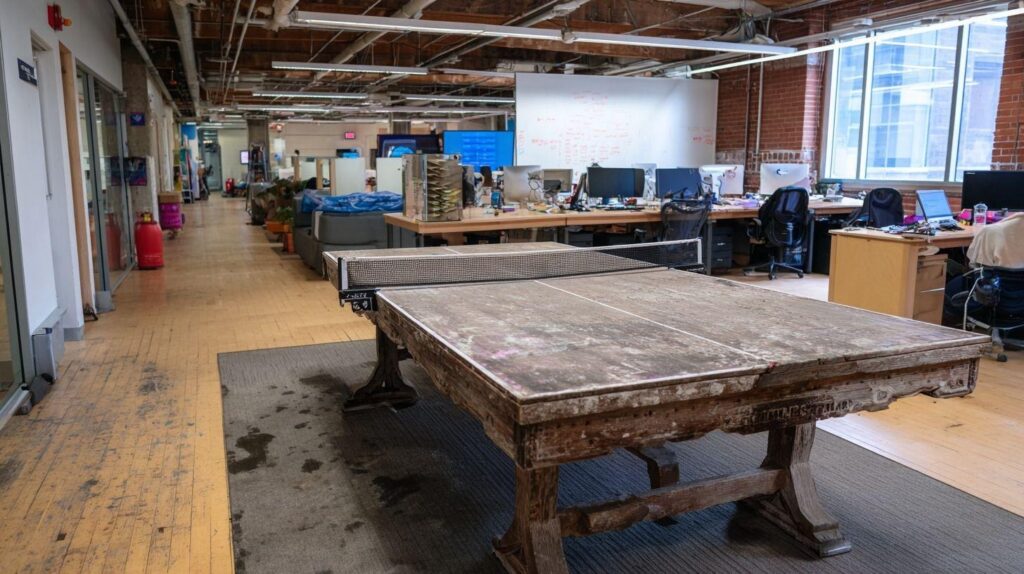
Notion provides a therapy stipend and unlimited PTO, leading to high employee satisfaction compared to perk-heavy peers. This model shows how targeted support boosts engagement over ping pong tables or free snacks. Startups now prioritize mental health for sustainable growth.
Real solutions offer strong returns, with therapy access yielding better outcomes than one-time perk investments. Experts recommend programs focused on psychological safety and professional development. These build high-performance teams without gimmicks.
Evidence-based options include apps and services for accessible care. Companies integrate these into benefits packages alongside flexible hours and no-meeting days. Headspace for guided meditation and mindfulness. Lyra Health for therapy matching and coaching. Modern Health for comprehensive emotional support. EAP programs for confidential counseling. Learning budgets for skill-building workshops.
- Headspace for guided meditation and mindfulness.
- Lyra Health for therapy matching and coaching.
- Modern Health for comprehensive emotional support.
- EAP programs for confidential counseling.
- Learning budgets for skill-building workshops.
Shifting to these priorities aligns with workplace trends, emphasizing employee well-being over office furniture like nap pods. This cultural shift retains talent in competitive fields like tech and AI startups.
Maturation of Startup Ecosystem
18-year-old startups now prioritize SOC2 compliance over foosball, reflecting public market maturity. The ecosystem has grown with over 1,200 unicorns shifting toward enterprise sales. These companies face demands for reliability and scale.
Recent IPO classes show no mentions of ping pong tables in filings. Founders focus on profitability goals to attract public investors. This marks a shift from early startup culture perks to professional standards.
Private equity firms push for scalable growth and cash flow management. They replace office perks like free snacks with equity compensation and professional development. This evolution supports talent retention through meaningful work.
Experts recommend balancing work-life balance with productivity focus. Mature startups adopt hybrid work models and wellness programs over arcade games. This aligns with post-pandemic workplace trends.
From Garage to Grown-Up
Snowflake’s IPO path eliminated game rooms for 4,000+ employees focused on Fortune 500 sales. Early seed stages tolerate foosball tables and beer Fridays. As companies hit Series B, they reduce these for professional development.
By Series D, perks like nap pods vanish to meet enterprise client demands. Clients view foosball-free offices as signs of a serious partner. This supports product-market fit in B2B SaaS.
IPO preparation demands full professionalization. Startups invest in SOC2 compliance, mentorship programs, and OKRs over swag merchandise. This evolution fosters high-performance teams.
Practical advice includes auditing perks at each funding stage. Transition to flexible hours and asynchronous communication for better employee well-being. Focus on customer success drives sustainable growth.
Institutional Investor Influence
BlackRock and SoftBank mandates have killed perks in many deals. Investor checklists evolved from culture fit in 2021 to unit economics today. Term sheets now emphasize professional workplaces.
Private equity firms post-acquisition often cut non-essential perks. They prioritize profitability goals and runway extension over gym memberships. This reflects demands for scalable growth.
Investors like Tiger Global stress disciplined operations in memos. Startups adopt results-only work environments and KPIs instead of catered lunches. This supports exit strategies like IPOs or acquisitions.
Founders should align with venture capital expectations early. Build psychological safety through inclusive leadership, not dog-friendly offices. Focus on DEI initiatives and feedback loops for long-term success.
New Perks Replacing Old Ones
Modern perks deliver better returns than ping pong tables. Options like equity compensation, four-day workweeks, and $1,200 learning stipends focus on long-term value. They support talent retention and productivity in startup culture.
Old perks such as free snacks or arcade games offered short-term fun. They often failed to address employee burnout or career growth. Today’s workplace trends prioritize meaningful benefits.
Equity builds wealth for employees over time. Flexible hours improve work-life balance. Learning stipends encourage professional development and skill-building.
| Perk Type | Annual Cost | Estimated ROI | Key Benefit |
| Ping Pong Table | $2,000 | 1.1x | Short-term morale boost |
| Learning Stipend | $1,200/year | 4.2x | Retention and promotions |
Equity, Flexibility, and Growth
Atlassian’s 0.1% equity grants created millionaires for employees. This contrasts with ping pong tables’ zero wealth impact. Equity compensation aligns staff with company success in startup culture.
Tiered modern perks start with equity offers from 0.05% to 0.5%. These can lead to significant payouts in exits or IPOs. They motivate teams toward scalable growth.
A four-day workweek boosts focus during core hours. Relocation stipends up to $2,000 attract global talent. Unlimited PTO reduces burnout and supports mental health.
- Equity: Ties pay to company valuation and long-term wins.
- Four-day weeks: Allow deep work and better recovery.
- Relocation aid: Builds diverse, remote-first teams.
- Unlimited PTO: Promotes trust and prevents quiet quitting.
Learning Stipends Over Games
GitHub’s $5,000 learning stipend generated strong returns through internal promotions. It filled senior roles without external hires. This shifts focus from foosball tables to real growth.
High-ROI programs replace office games with practical tools. Employees gain skills that drive innovation. Retention improves as staff see clear career paths.
Options include subscriptions like MasterClass for leadership training. Nanodegrees on platforms like Udacity build tech expertise. Conferences expand networks and ideas.
- MasterClass: $180/year for creative and business skills.
- Udacity nanodegrees: $399 for specialized tech training.
- Conferences: $2,000 per event for industry insights.
- Books: $300/year via allowances for ongoing reading.
- AWS certifications: $150 to certify cloud skills.
These stipends foster a learning organization. They support professional development over fleeting fun.
Case Studies of the Shift
Three emblematic shifts: Twitter/X cut ping pong for $1B savings; Brex eliminated perks pre-$12B valuation; Zapier stayed lean-remote.
These moves highlight a broader startup culture pivot from flashy office perks to productivity focus. Leaders now prioritize remote work and cash flow management over ping pong tables and foosball. This change supports talent retention through meaningful work and equity compensation.
Twitter/X removed 500 tables, saving $1.2M and extending runway by 18 months amid staff cuts. Brex shifted $800K perks budget to $200K stipends, maintaining growth. Zapier hit $140M ARR with zero offices, embracing asynchronous communication.
Experts recommend auditing perks for real employee well-being. Replace nap pods with flexible hours and wellness stipends. This fosters psychological safety and scalable growth in tech industry startups.
Companies Ditching the Tables
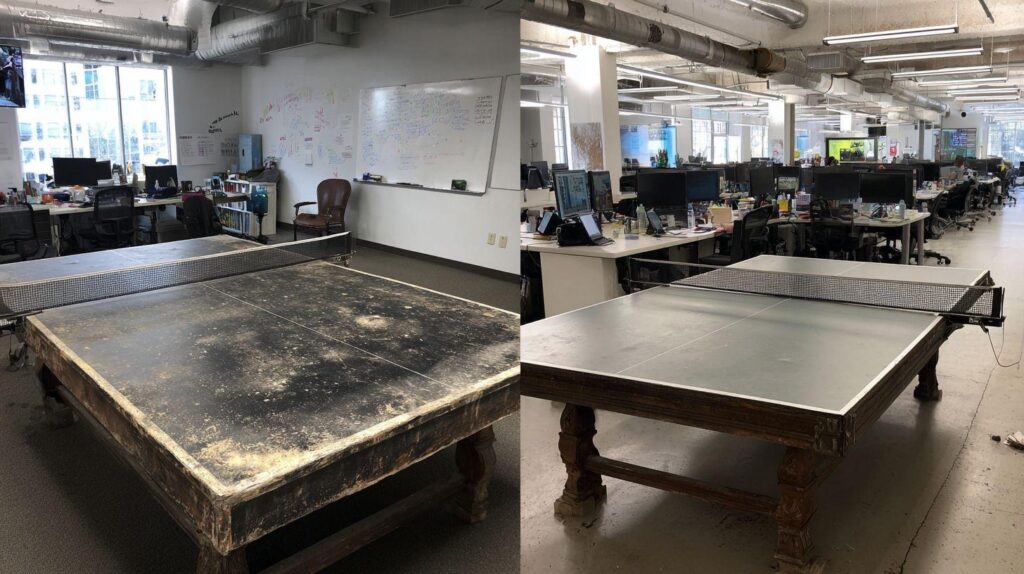
Twitter/X removed 500+ ping pong tables across 15 offices in 2022, saving $1.2M annually amid 80% staff cuts.
Before the shift, lavish amenities drained resources during hypergrowth. After, the company extended its 18-month runway, focusing on core operations. This allowed pivot to essential collaboration tools like Slack channels and Zoom meetings.
Brex moved from a $800K perks budget to $200K individual stipends, preserving its $7.4B valuation. Employees now choose gym memberships or learning budgets, boosting professional development. Shopify adopted office-optional policy, improving margins by 33% through hybrid work model.
These cases show perks like free snacks and beer Fridays often mask weak fundamentals. Founders should implement runway extension strategies early. Prioritize results-only work environment for high-performance teams.
Lessons from Failures
WeWork’s $47B valuation crashed 99% partly due to $2B+ in excessive perks including luxury ping pong arenas.
The company spent heavily on nap pods, catered lunches, and arcade games, ignoring profitability goals. Bankruptcy followed as perks failed to prevent employee burnout. Core issues like overexpansion went unaddressed.
Opendoor cut game rooms amid 22% layoffs, shifting to lean operations. Talkdesk slashed $1.5M amenities for a profitability pivot, embracing remote-first setup. Key lesson: office perks mask fundamentals like product-market fit.
- Audit expenses quarterly to spot perk bloat.
- Invest in mentorship programs over swag merchandise.
- Build transparent culture with radical candor and feedback loops.
Future of Startup Culture
2025+ startups will prioritize deep work architecture: async comms, no-meeting Wednesdays, mission equity. This shift moves away from ping pong tables and office perks toward systems that boost real output. Founders now focus on structures that support sustained focus and alignment.
Remote-first models lead workplace trends, drawing talent with flexibility over free snacks or foosball tables. Teams use tools like Slack channels for asynchronous communication, cutting Zoom meetings. This setup aids work-life balance and cuts employee burnout.
Equity compensation and mission-driven companies retain Gen Z workers who seek meaningful work. Stock options tie personal success to company growth, replacing nap pods or beer Fridays. Professional development through mentorship programs builds loyalty.
Trends like deep work systems, AI talent hiring, and substance metrics shape the future. No-meeting days create distraction-free environments for high-performance teams. Leaders adopt OKRs to track progress, fostering innovation culture without gimmicks.
Towards Substance Over Spectacle
Companies like Linear prove async + OKRs beat ping pong + happy hours. They emphasize results over games, using objectives and key results for clarity. This approach drives productivity in remote-first companies.
OKRs replace arcade games as the Google standard for goal setting. Teams set quarterly targets tied to customer success, like improving LTV:CAC ratios. Leaders hire based on outcome potential, not gym memberships.
- Implement 90-day outcome cycles to test ideas fast, similar to lean startup methods.
- Tie equity vesting to profitability milestones for aligned incentives.
- Build culture via results, focusing on psychological safety and feedback loops.
Experts recommend results-only work environments to boost satisfaction. Cross-functional teams share knowledge through demo days, not catered lunches. This cultural shift prioritizes scalable growth and talent retention over superficial perks.
Frequently Asked Questions
Why Startup Culture is Moving Away from “Ping Pong Tables”?
Startup culture is shifting from superficial perks like ping pong tables to more substantive benefits because modern employees prioritize meaningful work, work-life balance, and professional growth over gimmicky distractions. Investors and founders now focus on sustainable growth rather than flashy office amenities to attract top talent effectively.
What are the main reasons why Startup Culture is Moving Away from “Ping Pong Tables”?
The primary reasons include rising costs of maintaining fun-focused offices, a post-pandemic emphasis on remote work flexibility, burnout from hustle culture, and data showing that perks like ping pong tables don’t correlate with higher productivity or retention. Startups are reallocating budgets to equity, mental health support, and skill development instead.
How has the pandemic influenced why Startup Culture is Moving Away from “Ping Pong Tables”?
The pandemic accelerated remote and hybrid work models, making physical ping pong tables irrelevant for distributed teams. Why Startup Culture is Moving Away from “Ping Pong Tables” stems from this shift, as companies invest in collaboration tools like Slack and Zoom rather than on-site recreation that few employees can access.
Why Startup Culture is Moving Away from “Ping Pong Tables”: Is it about maturity in the industry?
Yes, as the startup ecosystem matures, why Startup Culture is Moving Away from “Ping Pong Tables” reflects a transition from early-stage experimentation to scalable, professional environments. Established startups emulate Big Tech’s focus on culture through policies like unlimited PTO and diversity initiatives, ditching juvenile perks.
What replaces ping pong tables now that Startup Culture is Moving Away from “Ping Pong Tables”?
Modern replacements include flexible hours, mental health days, stock options, learning stipends, and inclusive team-building events. Why Startup Culture is Moving Away from “Ping Pong Tables” highlights a preference for perks that support long-term well-being and career advancement over short-term fun.
Does why Startup Culture is Moving Away from “Ping Pong Tables” mean the end of fun in startups?
No, fun evolves into organic, low-cost activities like virtual game nights or team offsites, rather than expensive fixtures. Why Startup Culture is Moving Away from “Ping Pong Tables” signals a smarter approach where enjoyment comes from purpose-driven work and genuine relationships, not forced recreational setups.