
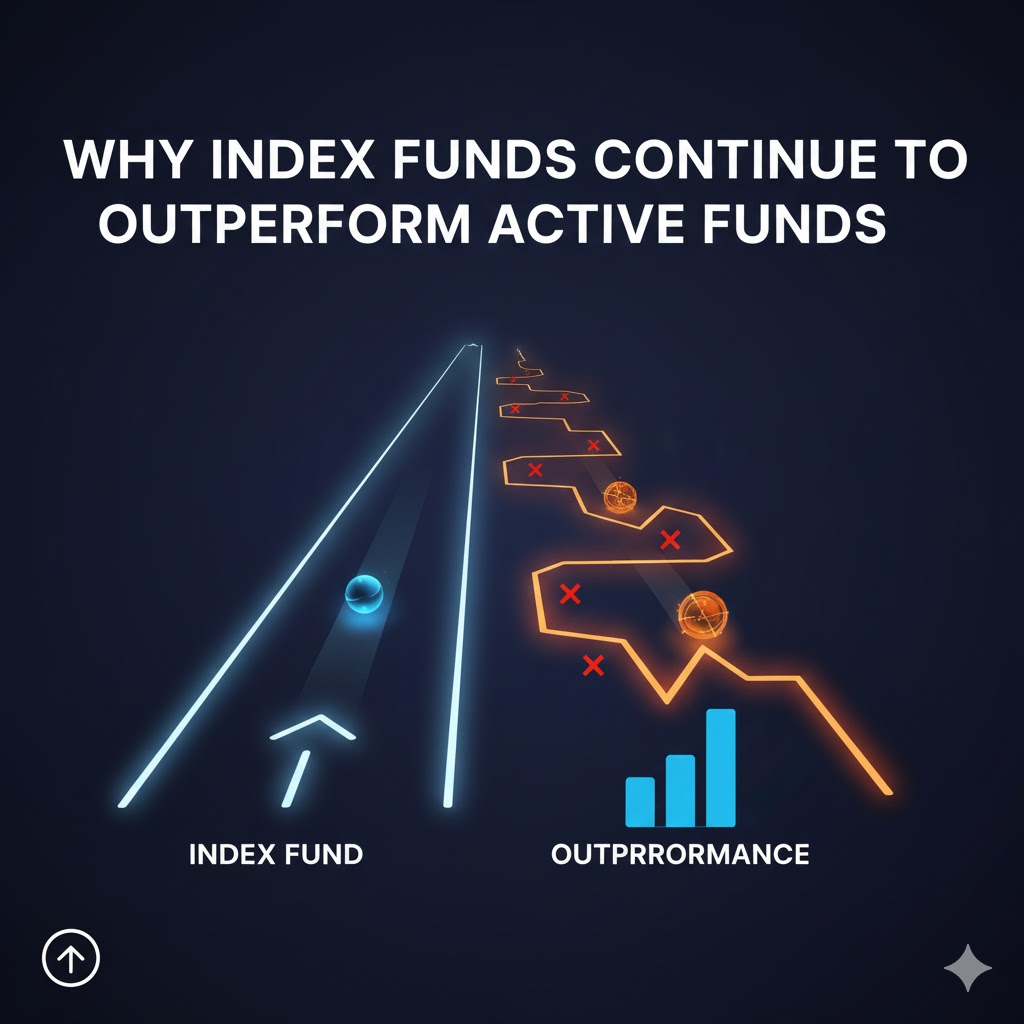
Index funds have gained massive popularity over the years, and for good reason. Despite the expertise and resources behind actively managed funds, index funds consistently deliver better results for most investors over the long term. This trend continues to reshape how individuals and institutions approach investing.
Understanding why index funds outperform active funds helps investors make smarter and more confident decisions.
What Are Index Funds and Active Funds
Index Funds Explained
Index funds are designed to track the performance of a specific market index such as the S and P 500. Instead of trying to beat the market, they aim to match it by holding the same securities in similar proportions.
Active Funds Explained
Active funds are managed by professional fund managers who select stocks or assets in an attempt to outperform the market. Their success depends on timing, research, and market predictions.
Lower Costs Give Index Funds a Major Advantage
Minimal Management Fees
Index funds typically have much lower expense ratios than active funds. Since they follow a set index, they require less research, fewer trades, and lower management costs.
Over time, lower fees significantly improve net returns.
Reduced Transaction Costs
Active funds trade more frequently, leading to higher transaction costs. Index funds trade less often, which helps preserve investor returns.
Consistency Beats Prediction
Markets Are Hard to Beat Consistently
Very few active fund managers outperform the market consistently over long periods. While some may succeed temporarily, maintaining outperformance year after year is extremely difficult.
Index funds do not rely on predictions. They benefit from overall market growth.
Long Term Reliability
By holding a broad mix of companies, index funds capture market returns over time without the risk of individual stock selection errors.
Diversification Built In
Broad Market Exposure
Index funds automatically provide diversification across sectors and companies. This reduces the impact of poor performance by any single stock.
Lower Risk Through Balance
Diversification helps smooth returns and reduce volatility, making index funds suitable for long term investors.
Transparency and Simplicity
Easy to Understand
Index funds clearly show what they invest in. Investors always know which assets they hold and how the fund operates.
Fewer Surprises
Active funds can change strategies or holdings unexpectedly. Index funds follow predictable rules, offering stability and clarity.
Behavioral Advantages for Investors
Less Emotional Decision Making
Index fund investing encourages a long term mindset. Investors are less likely to react to short term market movements or chase trends.
Discipline Through Simplicity
Simple strategies are easier to stick with. Consistency often leads to better results than complex approaches.
Tax Efficiency
Lower Capital Gains Taxes
Because index funds trade less frequently, they generate fewer taxable events. This makes them more tax efficient than many active funds.
Better After Tax Returns
Tax efficiency further enhances long term performance, especially in taxable investment accounts.
Data Supports the Trend
Long Term Performance Studies
Multiple long term studies show that the majority of active funds underperform their benchmark indexes over time, especially after fees.
Survival Bias in Active Funds
Poorly performing active funds often close or merge, making long term success rates even lower than they appear.
When Active Funds May Still Make Sense
Specialized or Inefficient Markets
In certain niche markets, skilled active managers may add value. However, these cases are the exception rather than the rule.
Investor Preference and Strategy
Some investors value active management for specific goals, but it requires careful selection and ongoing monitoring.
Conclusion
Index funds continue to outperform active funds because of lower costs, consistent market exposure, built in diversification, and behavioral advantages. Rather than trying to beat the market, index funds focus on capturing its long term growth.
For most investors, this simple and disciplined approach leads to better outcomes, less stress, and more predictable results over time.