
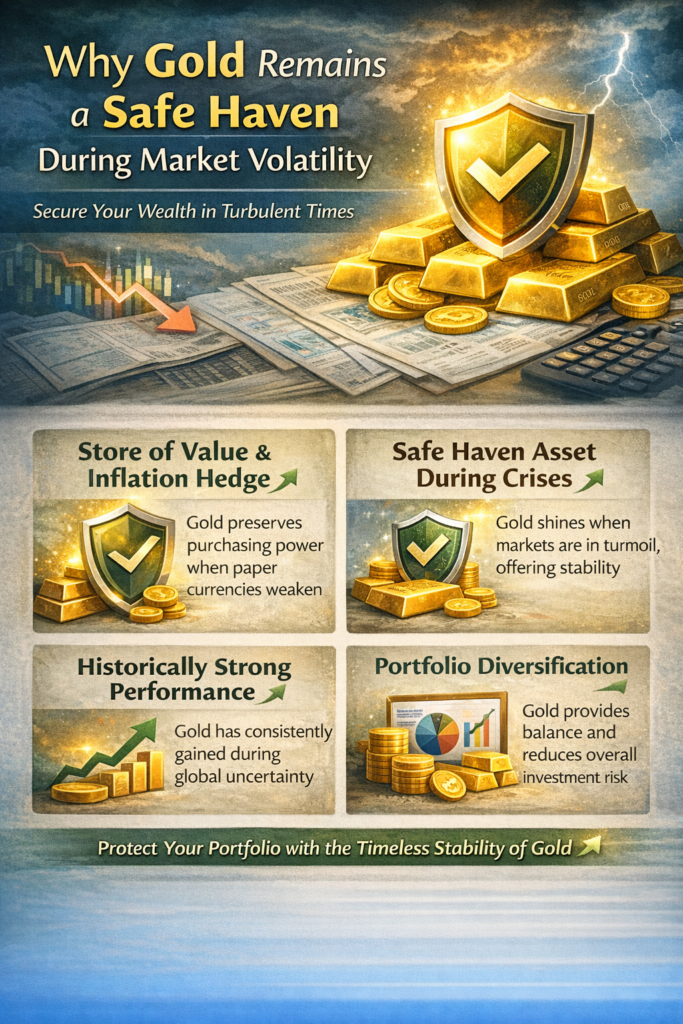
Financial markets move in cycles, but uncertainty is a constant. Economic slowdowns, inflation fears, geopolitical tensions, and stock market corrections often create anxiety among investors. During such periods, gold consistently stands out as a trusted store of value.
For centuries, gold has played a unique role in protecting wealth when traditional assets struggle. Even in modern financial systems, gold remains a powerful hedge against volatility and uncertainty.
Gold’s Historical Role as a Store of Value
Gold’s reputation as a safe-haven asset is built on history.
Unlike paper currencies or stocks, gold does not depend on corporate earnings or government policies to retain value. Across economic crises, wars, and market crashes, gold has preserved purchasing power when other assets weakened.
This long-standing reliability makes gold a psychological and financial anchor during turbulent times.
Protection Against Inflation and Currency Risk
One of gold’s strongest advantages is its ability to hedge against inflation.
When inflation rises, the value of money declines. Gold, however, often moves in the opposite direction, maintaining or increasing its value as currencies lose purchasing power. This makes it particularly attractive during periods of aggressive monetary policy or rising consumer prices.
Gold also protects against currency devaluation, offering stability when exchange rates fluctuate or confidence in fiat money weakens.
Low Correlation With Traditional Assets
Gold behaves differently from stocks and bonds.
During market volatility, equities may fall sharply due to fear-driven selling. Gold often remains stable or even rises during such periods because investors shift capital toward safety.
This low correlation makes gold an effective diversification tool, helping reduce overall portfolio risk when markets become unpredictable.
Liquidity and Global Acceptance
Gold is one of the most liquid assets in the world.
It can be easily bought or sold across global markets, regardless of economic conditions. Central banks, institutional investors, and individual savers all recognize gold’s value, making it universally accepted.
This liquidity ensures that investors can access funds quickly during financial stress without relying on market timing.
Gold as a Hedge Against Geopolitical Uncertainty
Political instability and global conflicts often trigger market volatility.
During geopolitical tensions, trade disruptions, or global crises, investor confidence in financial markets tends to decline. Gold often benefits in these moments as it is not tied to any single country’s economy or political system.
This independence adds to gold’s appeal as a neutral and resilient asset.
Role of Gold in Modern Investment Portfolios
Gold is no longer just a traditional investment. It has evolved into a strategic asset within diversified portfolios.
Investors today use gold to balance risk, stabilize returns, and protect long-term wealth. Whether held as physical gold, funds, or digital instruments, its core purpose remains the same: capital preservation during uncertainty.
Even a small allocation to gold can improve portfolio resilience during volatile market phases.
Conclusion: Why Gold Still Matters
Market volatility is unavoidable, but smart preparation makes all the difference.
Gold continues to prove its value as a safe haven because it offers stability, liquidity, and protection when confidence in financial markets fades. While it may not always deliver rapid growth, its role in preserving wealth during uncertain times remains unmatched.
For investors seeking balance, security, and long-term resilience, gold remains a timeless and reliable choice.