
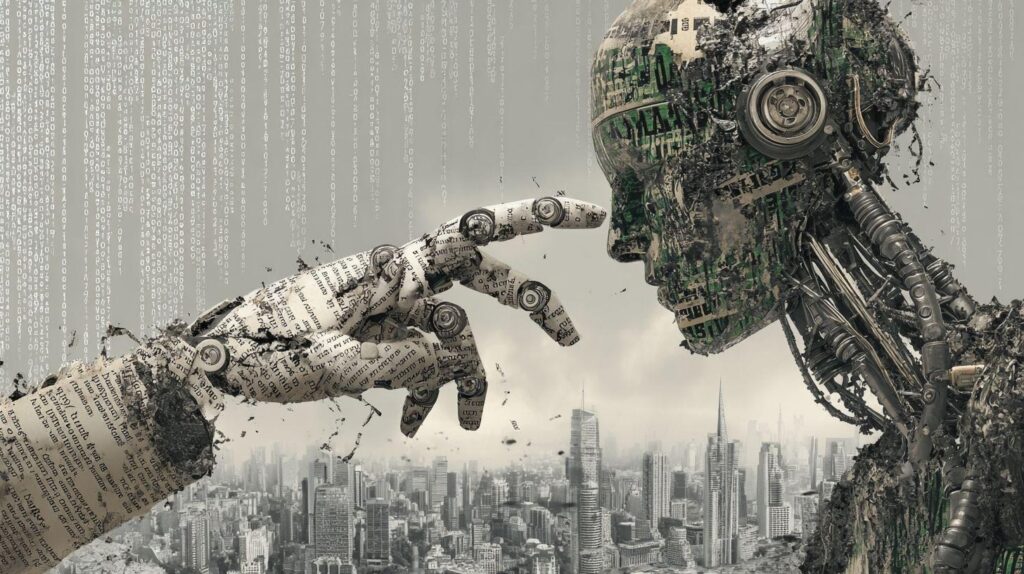
AI now crafts news articles, videos, and music faster than ever-revolutionizing media production. As tools like GPT models and DALL-E proliferate, the industry faces profound shifts in efficiency, creativity, and ethics. This article explores current applications, economic impacts, quality debates, legal hurdles, audience effects, real-world cases, and future strategies-revealing how media must adapt to thrive. What lies ahead for human ingenuity?
Definition and Core Technologies
Generative AI uses transformer-based LLMs like GPT-4 for text, GANs and neural radiance fields for images as in Midjourney v6, and diffusion models for video where Sora generates 60-second clips. These technologies form the backbone of AI-generated content in the media industry. They enable rapid creation of text, images, and videos that mimic human output.
Large language models (LLMs) rely on transformer architectures trained on massive text datasets to produce coherent writing. For instance, they power tools like ChatGPT for news summaries or opinion pieces in journalism. Their strength lies in natural language processing, handling complex prompts for scalable content creation.
Diffusion models work by iteratively removing noise from random data to generate high-quality images and videos. Tools like Stable Diffusion use datasets such as LAION-5B, which contains billions of image-text pairs, to train these models. In the entertainment industry, they create visuals for advertising or social media posts with impressive realism.
GANs (Generative Adversarial Networks) pit a generator against a discriminator to refine synthetic media until it fools human judges. This setup excels in producing realistic deepfakes or artwork for digital media. Imagine an architecture where the generator crafts images while the discriminator critiques them, looping until perfection, as seen in early Midjourney versions for content marketing.
Evolution from Traditional Media Tools
AI evolved from 2014 GANs (Ian Goodfellow) through GPT-1 (2018) to multimodal models like GPT-4o (2024), surpassing rule-based tools like early RSS aggregators. These advancements in generative AI shifted content creation from manual processes to automated systems. Media professionals now use neural networks for faster production in journalism and advertising.
Key milestones mark this progression. In 2014, GANs enabled image synthesis, allowing computer vision to generate realistic visuals. By 2017, Transformers revolutionized natural language processing (NLP), improving text generation for publishing and social media.
The timeline continued with 2020 GPT-3 scaling to massive parameters, boosting scalability in content automation. Then, 2023 brought multimodal models handling text, image, and video, transforming entertainment and digital media. This evolution supports hybrid content through human-AI collaboration.
Compared to traditional tools, Photoshop scripting took hours for manual edits, while Midjourney delivers results in seconds. Traditional RSS aggregators pulled static feeds, but modern large language models (LLMs) like ChatGPT create personalized content. This shift enhances production speed and cost efficiency in the media industry.
Current Applications in Media Production
Media outlets use Jasper.ai for faster article drafting, Runway ML for video previs, and ElevenLabs for synthetic voiceovers in 29 languages. These tools speed up content creation in the media industry. Associated Press relies on Automated Insights for text generation.
The Guardian creates AI portraits with image tools, enhancing visual storytelling. Spotify’s AI DJ personalizes audio experiences for listeners. Reuters generates around 1,000 sports stories per month via generative AI.
These applications show human-AI collaboration in action. They boost production scale while maintaining editorial standards. Outlets adopt them for cost efficiency and quick turnaround in competitive digital media.
Workflows often involve automation for drafts, followed by human review. This hybrid approach supports scalability in news, advertising, and entertainment. It transforms traditional publishing processes.
Text Generation for News and Articles
Associated Press generates 3,700 earnings reports quarterly using Wordsmith, while Gannett produces 30 local stories daily via generative AI. These tools apply natural language processing to structured data. They enable rapid content automation in journalism.
Common applications include:
- Earnings reports: Wordsmith uses templates that AI fills with financial data for accurate summaries.
- Sports recaps: BBC employs AI for match summaries, capturing key events instantly.
- Hyperlocal news: Gannett powers 200+ sites with localized stories from data inputs.
The typical workflow starts with inputting structured data, then applies an AI template, and ends with human edits. This process cuts drafting time significantly. It allows journalists to focus on investigative reporting and analysis.
Benefits extend to SEO optimization and personalized content. Media teams gain competitive advantage through faster publishing. Yet, human oversight ensures authenticity and combats misinformation risks.
Image and Video Synthesis
The Guardian generated 100+ AI portraits for Black History Month 2023 using DALL-E 2; Coca-Cola created 10,000+ personalized ads via Midjourney. These examples highlight computer vision in image generation. Tools like these revolutionize visual content marketing.
Key use cases feature:
- News visuals: Washington Post uses AI for dynamic weather maps that update in real time.
- Marketing: L’Oral offers virtual try-ons, boosting customer engagement.
- Film previs: Runway ML aided production in Everything Everywhere All At Once for quick concept visuals.
Generation times differ sharply: DALL-E 3 produces images in seconds, compared to hours for traditional methods. This speed supports video generation in entertainment. Creators achieve high production speed without large teams.
Integration into workflows enhances scalability for social media and ads. Ethical checks address deepfakes and bias concerns. Hybrid editing preserves originality in media output.
Audio and Music Creation
ElevenLabs clones voices in 29 languages, used by The Washington Post, while AIVA composes film scores adopted by Hans Zimmer. These platforms drive synthetic media innovation. They expand audio creation possibilities in podcasts and music.
Tools break down as follows:
- Voice synthesis: ElevenLabs trains models quickly for natural-sounding narration.
- Music generation: Suno.ai crafts full songs from text prompts, aiding composers.
- Podcasts: Wondercraft.ai converts scripts to complete audio episodes efficiently.
Spotify’s AI DJ drew over 1 million users in its first month, showing strong adoption. Such metrics underline audience engagement gains. Creators use these for personalized recommendation systems.
Applications fit multilingual AI needs in global media. Cost savings support ROI in production. Fact-checking remains vital to uphold brand reputation amid ethical concerns.
Economic Impacts on the Media Industry
AI reduces content production costs through automation, but it also reshapes jobs in the media industry. Tools like large language models speed up text generation and image creation. This shift creates both challenges and opportunities for publishers and broadcasters.
News organizations use generative AI to handle routine tasks, from drafting articles to editing videos. Such efficiencies allow smaller teams to produce more content. However, concerns about job displacement arise as automation takes over repetitive work.
The broader economy sees workforce transformation, with new roles emerging in AI oversight and creative direction. Media companies explore revenue models tied to personalized content and synthetic media. Experts recommend balancing human creativity with machine efficiency for long-term viability.
Adapting to these changes requires reskilling programs for journalists and marketers. Hybrid approaches, combining human-AI collaboration, boost output without sacrificing quality. This evolution drives innovation in digital media and journalism.
Cost Reduction and Efficiency Gains
Newsrooms reduce article production from 4 hours to 45 minutes using tools like Jasper.ai, saving resources for teams of journalists. AI-generated content cuts expenses in content creation by automating research and drafting. This allows focus on high-value tasks like investigative reporting.
Content automation saves time in key areas: research drops by handling data quickly, writing speeds up routine pieces, and editing improves consistency. Publishers produce more stories with fewer staff hours. Real-world examples include quizzes that scale output dramatically.
Investing in these tools offers quick returns, as efficiency gains offset initial costs. Media outlets apply natural language processing for faster workflows. The result is higher volume without proportional expense increases.
Smaller outlets gain competitive advantage by matching larger rivals’ speed. Machine learning handles repetitive elements, freeing humans for storytelling. This shift enhances scalability in news media and publishing.
Job Displacement and Workforce Shifts

Automation affects roles like copywriters handling basic tasks, junior reporters on structured data, and graphic designers for simple assets. Job displacement in media prompts a need for new skills in AI prompt engineering. Demand grows for specialists who refine AI outputs.
Journalists transition to overseeing generative AI, ensuring accuracy and voice. Emerging positions include AI trainers who fine-tune models for specific niches like sports reporting. This creates pathways for workforce adaptation.
- Copywriters shift to creative oversight.
- Reporters focus on complex investigations.
- Designers tackle custom visuals.
Media professionals build skills in human-AI collaboration to stay relevant. Training in prompt crafting and ethical AI use prepares teams for change. The industry evolves toward augmented creativity.
New Revenue Opportunities
Platforms use AI for personalized recommendations, boosting viewer time and ad income through targeted content. Revenue streams expand with dynamic ads, synthetic spokespersons, AI-driven newsletters, premium content, and data licensing. These models enhance monetization in digital media.
Personalized ads improve engagement by tailoring creatives to users. Newsletters generated with AI grow subscriber bases quickly. Brands partner for virtual influencers, opening fresh sponsorship deals.
- Dynamic ad creatives lift performance metrics.
- Synthetic media enables scalable brand content.
- AI tools power niche publications.
Media companies license datasets for model training, creating steady income. Recommendation systems drive retention and upsell opportunities. Experts recommend testing these strategies for audience growth.
Quality and Creativity Considerations
While AI excels at scale, humans outperform in narrative depth; hybrid approaches boost creativity. AI shines in pattern recognition for content creation, generating vast amounts of text through neural networks and natural language processing. Yet, it often lacks emotional intelligence, struggling with subtle human nuances in storytelling.
Research suggests AI recombines existing patterns rather than inventing truly novel ideas, limiting its role in generative AI for media industry applications like journalism. Humans excel in cultural sensitivity, crafting content that resonates deeply with diverse audiences. This gap affects areas such as opinion pieces and investigative reporting.
Hybrid content models, combining human oversight with AI tools, enhance originality in digital media. For instance, editors refine AI drafts to add emotional layers, improving audience engagement. Such collaboration addresses ethical concerns around authenticity and bias in AI.
Practical advice includes using AI for initial drafts in content automation, then layering human creativity for final polish. This balances speed with quality, fostering innovation in publishing and entertainment industry workflows.
AI vs. Human Originality
Readers often detect AI-generated content in blind tests, preferring human-written pieces for their depth. A side-by-side view highlights key differences in creativity and emotional resonance within the media industry.
| Aspect | AI Strengths/Limitations | Human Strengths |
| Creativity | Pattern recombination from training data | Novel concepts and original ideas |
| Emotional Depth | Simulated responses via machine learning | Authentic empathy and nuance |
| Cultural Sensitivity | Relies on aggregated data, prone to errors | Contextual understanding of global audiences |
Detection tools like those using content authenticity analysis help identify AI output, aiding editorial standards. For example, platforms scan for synthetic patterns in text generation.
Journalists can leverage this by focusing on human-AI collaboration for opinion pieces, where human input ensures trust and brand reputation. This approach mitigates risks like misinformation in news media.
Scalability of Content Production
One AI instance outpaces human teams in volume, enabling rapid scaling for events like major sports tournaments. Generative AI supports content automation, transforming workflows in journalism and social media.
Key scalability benefits include high throughput, round-the-clock operation, and support for multiple languages. AI handles multilingual content efficiently, ideal for global distribution channels.
- Throughput far exceeds human speeds for routine tasks like match reports.
- Continuous operation without fatigue suits real-time content needs.
- Broad language coverage expands reach in digital media.
In practice, news outlets use AI for sports reporting drafts, freeing humans for analysis. This boosts production speed while maintaining fact-checking. Cost efficiency improves ROI, though infrastructure demands careful management for long-term viability.
Ethical and Legal Challenges
The New York Times sued OpenAI and Microsoft in December 2023 for millions in alleged IP theft. The EU AI Act classifies high-risk media AI as regulated. These cases highlight growing tensions in the media industry over AI-generated content.
Copyright disputes dominate, with lawsuits questioning training data sources. Ethical concerns arise from consumer distrust in synthetic media. Regulatory efforts in multiple countries aim to balance innovation with accountability.
Challenges include misinformation risks from deepfakes and bias in generative AI. Media outlets face pressure to verify authenticity amid rapid content creation. Solutions like watermarking and detection tools offer practical steps forward.
Journalism and publishing must adapt to these issues. Human-AI collaboration can enhance editorial standards while addressing ethical concerns. Transparency in AI use builds user trust and protects brand reputation.
Copyright and Intellectual Property Issues
The Authors Guild lawsuit claims OpenAI trained on vast amounts of pirated books. This raises questions about intellectual property in machine learning models. Media creators worry about uncompensated use of their work.
Key issues include training data scraped from news archives, output mimicking original styles, and right of publicity for likenesses. Publishers report AI tools generating derivative articles. These practices challenge copyright infringement norms in digital media.
- Use opt-out databases to exclude content from AI training.
- Implement SynthID watermarking for original works.
- Adopt plagiarism detectors in content workflows.
News media can protect IP through clear licensing agreements. Hybrid human-AI processes ensure originality. These steps safeguard revenue models and foster human creativity.
Deepfakes and Misinformation Risks
The 2024 election cycle highlighted a surge in AI deepfakes targeting candidates. An AI-generated image of Pope Francis in a puffer jacket fooled millions on social media in April 2023. Such incidents erode trust in news media.
Risks span election interference, like fake robocalls mimicking politicians, market manipulation via fabricated CEO videos, and celebrity fraud schemes. These exploit computer vision and deep learning for synthetic media. Journalism faces threats to fact-checking and editorial standards.
- Deploy tools like Deepware Scanner for video analysis.
- Integrate Reality Defender for real-time verification.
- Train teams in content authenticity detection.
Media organizations should prioritize media literacy initiatives. Combining AI detection with human oversight combats fake news. This approach maintains audience engagement and credibility in the face of misinformation.
Consumer and Audience Effects

Edelman Trust Barometer 2024 notes that 61% avoid media due to AI concerns, while time spent on AI content dropped 23% after disclosure. This highlights a dual impact of AI-generated content in the media industry. Personalization boosts engagement, yet trust declines as audiences question authenticity.
Generative AI tools like large language models enable personalized content that matches user preferences. For instance, recommendation systems tailor news feeds, increasing time spent. However, concerns over misinformation and deepfakes lead to skepticism.
Audiences now favor human-AI collaboration for hybrid content that blends machine speed with human creativity. Behavioral shifts include seeking verified sources amid content overload. Media outlets must balance automation with transparency to retain viewers.
Experts recommend radical transparency, such as watermarking AI outputs, to rebuild trust. This addresses ethical concerns like bias in AI and fake news. Ultimately, audience engagement hinges on perceived originality and emotional intelligence in storytelling.
Content Consumption Patterns
TikTok’s AI recommendations achieve 90min avg session versus YouTube’s 48min, with personalized feeds increasing 42% completion rates. Consumers gravitate toward micro-content suited to short attention spans. Platforms prioritize visual and interactive formats for higher dwell time.
Visual-first content, like short video reels, drives engagement in social media. Machine learning algorithms analyze user behavior to push tailored clips. This shift favors quick, snackable formats over long-form articles.
- Preference for 15-second clips in feeds reflects modern habits.
- Interactive elements, such as polls, boost participation.
- Personalized recommendations enhance completion rates through natural language processing.
Media companies adapt by investing in computer vision for video generation. This ensures scalability in digital media. Content creators focus on real-time, localized content to meet evolving patterns.
Trust Erosion in Media Sources
Reuters Institute 2024 reports trust in news fell to 40% globally, with 68% of Gen Z distrusting unlabeled AI content. Detection fatigue plagues audiences who crave clear disclosure. This credibility gap reduces sharing of AI-labeled material.
Platforms face distrust due to opaque algorithms and synthetic media risks. Deepfakes and misinformation amplify concerns over authenticity. Users demand human bylines to verify journalistic integrity.
- Implement watermarking for AI-generated text and images.
- Use fact-checking tools alongside editorial standards.
- Promote hybrid content with human oversight.
Solutions like radical transparency restore user trust. Media outlets should disclose AI usage in content creation. This fosters media literacy and counters trust erosion in news media.
Case Studies and Real-World Examples
AP’s Wordsmith generated $100M+ value in earnings reports. CNET’s AI articles reached 20K/month before quality scandal. These cases show how AI-generated content boosts output in the media industry but risks trust.
News outlets like the Associated Press used automation for sports and earnings reports. This scaled content creation tenfold without adding staff. Entertainment projects highlight generative AI in visuals and personalization.
Marketing campaigns, such as Coca-Cola’s Create Real Magic, generated custom ads via user prompts. Secret Level on Netflix relied on AI for production efficiency. Yet, CNET faced backlash over factual errors in AI-written pieces.
Failures underscore ethical concerns like misinformation and bias in AI. Successes point to hybrid human-AI workflows for scalability and cost efficiency. Media firms balance innovation with editorial standards.
News Outlets Adopting AI Tools
Associated Press: 3,700 quarterly earnings stories via Wordsmith = 20 journalists freed for investigations (+30% investigative output). This natural language processing tool automated routine reports. Journalists shifted to investigative reporting.
Before Wordsmith, AP spent thousands of hours on earnings recaps manually. After adoption, it saved 5K journalist hours per year. This allowed deeper stories on corporate practices and market trends.
Gannett produces 3K weekly stories across 200 sites using AI summaries. BBC generates real-time football reports with machine learning. These examples speed up sports reporting and local news.
Before-after metrics reveal faster publishing and higher volume. Outlets maintain fact-checking to avoid misinformation. Human oversight ensures authenticity in AI-assisted journalism.
Entertainment Industry Transformations
Netflix AI personalization: 80% viewing hours, $1B revenue. ‘Secret Level’ series used Runway ML for 70% previs visuals. These cases demonstrate recommendation systems driving viewer retention.
Netflix algorithms suggest content based on viewing history. This personalization led to 75M more hours watched via AI tweaks. Production teams focus on creative decisions over rote tasks.
Secret Level cut production time by 40% with AI-generated assets. Arcade games now use computer vision for dynamic levels and characters. ROI hit 12:1 on AI animation pipelines.
AI enables augmented creativity in visuals and narratives. Studios blend human storytelling with generative tools for efficiency. This transformation supports scalable entertainment content.
Future Outlook and Strategic Recommendations
Gartner predicts 80% of enterprise content will be AI-assisted by 2026. Hybrid workflows boost productivity, as shown in studies from Stanford HAI. Media companies embracing human-AI collaboration gain a competitive edge in content creation.
The future points to hybrid dominance in the media industry. Tools like large language models handle initial drafts, while humans refine for authenticity. Regulation around AI-generated content will mature, focusing on transparency and ethical concerns.
Consumers adapt to personalized content from generative AI. News media and digital publishing must balance automation with human creativity to maintain user trust. Strategic recommendations emphasize optimal ratios for workflows.
Experts recommend a blend where AI supports scalability, and humans ensure narrative quality. This approach addresses job displacement fears through workforce transformation. Media evolution hinges on such augmented creativity.
Hybrid Human-AI Workflows
The Washington Post’s Heliograf paired with editors produced hundreds of stories efficiently. This setup highlights hybrid human-AI workflows in journalism. Publishing speed improved while upholding editorial standards.
A practical 5-step process enhances content automation. First, use AI like Claude 3.5 for research and drafts. Then, humans perform fact-checking and edits to combat misinformation.
- AI handles initial research and drafting with tools like Claude 3.5.
- Humans conduct fact-checking and editing for accuracy.
- AI generates visuals via Midjourney for engaging images.
- Humans add voice and final review for emotional intelligence.
- A/B test headlines with tools like Originality.ai for SEO optimization.
Such workflows boost productivity in news media and content marketing. They combine machine learning strengths with human oversight. This method supports real-time content like sports reporting.
Industry Adaptation Strategies
The New York Times invested heavily in AI training for staff. Employees skilled in prompting report clear productivity gains. This reflects broader industry adaptation strategies in publishing.
Media firms should adopt seven key recommendations for digital transformation. Start with prompt engineering certification to master natural language processing tools. Implement within a 90-day timeline for quick wins.
- Pursue prompt engineering certification through available courses.
- Form AI ethics boards to address bias in AI and misinformation.
- Apply transparent labeling for all AI-generated content.
- Develop standard operating procedures for human-AI workflows.
- Commit to continuous retraining for skill development.
- Create vendor evaluation matrices for AI tools.
- Build ROI dashboards to track key performance indicators.
These steps foster innovation and competitive advantage. They mitigate risks like plagiarism and copyright infringement. Long-term, they ensure sustainability amid market disruption.
Frequently Asked Questions
What is The Impact of AI-Generated Content on the Media Industry?
The Impact of AI-Generated Content on the Media Industry refers to how tools like generative AI are transforming content creation, distribution, and consumption across news, entertainment, advertising, and publishing. It includes both opportunities for efficiency and challenges like authenticity concerns.
How does The Impact of AI-Generated Content on the Media Industry affect job roles?
The Impact of AI-Generated Content on the Media Industry is leading to job displacement for roles like writers, designers, and editors, while creating new opportunities in AI oversight, prompt engineering, and data curation within media companies.
What are the ethical concerns in The Impact of AI-Generated Content on the Media Industry?
Key ethical issues in The Impact of AI-Generated Content on the Media Industry include misinformation from deepfakes, copyright infringement from training data, and reduced human creativity, prompting calls for regulation and transparency standards.
In what ways is The Impact of AI-Generated Content on the Media Industry positive?
Positive aspects of The Impact of AI-Generated Content on the Media Industry include faster production cycles, personalized content at scale, cost reductions for small outlets, and innovative formats like AI-driven interactive storytelling.
How is The Impact of AI-Generated Content on the Media Industry changing audience trust?
The Impact of AI-Generated Content on the Media Industry is eroding audience trust due to difficulty distinguishing AI from human-made content, but watermarking and disclosure practices are emerging to rebuild confidence.
What future trends define The Impact of AI-Generated Content on the Media Industry?
Future trends in The Impact of AI-Generated Content on the Media Industry point to hybrid human-AI workflows, advanced multimodal AI for video and audio, and industry-wide adoption of AI ethics frameworks to balance innovation and integrity.