

Imagine a world where the NYSE’s iconic trading floor yields to a borderless blockchain ledger. As decentralized exchanges like Uniswap surge, traditional markets face existential questions. This article examines the NYSE’s storied operations, blockchain’s disruptive principles, advantages in speed and transparency, regulatory hurdles, hybrid innovations like Nasdaq’s trials, and bold predictions on replacement or coexistence.
The Role and History of the NYSE
Founded in 1792 under the Buttonwood Agreement, NYSE evolved from open outcry to electronic trading with Pillar platform processing 1.5M orders/second. This shift marked a key transition in stock exchanges history. Traders gathered under a buttonwood tree to formalize rules for trading securities.
In 1971, NASDAQ introduced competition as the first electronic exchange. This challenged NYSE’s dominance in central limit order book trading. Open outcry floors began fading as electronic systems gained ground.
The 2006 launch of NYSE Arca accelerated the electronic shift, fully integrating automated order matching. By 2019, NYSE hit a record 2.46 billion shares traded in a single day. Today, it handles about 41% of US equity volume through high-speed platforms.
NYSE relies on DTCC for settlement under T+2 rules, clearing roughly $2 quadrillion daily. This clearing house ensures trades settle securely via traditional infrastructure. As blockchain explores instant settlement, NYSE’s role in liquidity and market making remains central.
Current Operations and Infrastructure
NYSE’s Pillar trading engine supports 2,000+ order types with 1ms latency, handling HFT firms comprising 50% volume. This system powers the core of stock exchange operations. It ensures precise order matching in a central limit order book.
Trading sessions divide into pre-market from 4am to 9:30am, core hours from 9:30am to 4pm, and after-hours beyond that. Pre-market allows early liquidity for news reactions. Core hours drive peak trading volume with market makers active.
Infrastructure relies on a Mahwah NJ data center connected by 4,000+ miles of fiber. This setup minimizes latency for high-frequency trading. Settlement occurs via DTCC T+2 process, handling trillions daily through a clearing house.
Key systems include:
- Pillar: Core trading platform for speed and reliability.
- NYFIX: Direct market access for institutional orders.
- ICE Connect: Connectivity hub for global participants.
These elements form the backbone of NYSE efficiency. They contrast with blockchain promises of instant settlement in the future of stock exchanges.
Understanding Blockchain Technology
Blockchain eliminates central authorities through distributed consensus, processing the crypto market cap via DLT. This core shift moves from permissioned systems like traditional stock exchanges to permissionless networks open to anyone. Stock exchanges such as the NYSE rely on clearing houses like DTCC for T+2 settlement, while blockchain enables instant settlement.
At its heart, blockchain uses hash chains with algorithms like SHA-256 to link blocks securely. Each block contains a cryptographic hash of the previous one, ensuring immutability. Nodes across the network validate transactions, preventing tampering without majority control.
This technology underpins the future of stock exchanges, potentially replacing centralized order matching and central limit order books. Public blockchains like Bitcoin offer transparency, while permissioned ones like Hyperledger suit regulatory compliance for securities tokenization. The transition promises 24/7 trading and global liquidity without intermediaries.
Understanding these basics sets the stage for core principles and real-world applications in decentralized finance.
Core Principles: Decentralization and Distributed Ledgers
Bitcoin’s blockchain uses Proof-of-Work consensus with 15-minute blocks, while Ethereum’s Proof-of-Stake validates 12-second blocks across 1M+ nodes. Decentralization spreads control across participants, eliminating single points of failure seen in NYSE systems. Distributed ledgers record transactions on every node for transparency and resilience.
Immutability relies on Merkle trees, which efficiently verify large transaction sets within blocks. Once added, data cannot change without altering all subsequent hashes, protecting against fraud in high-frequency trading environments. This contrasts with mutable databases vulnerable to hacks.
Key principles include Sybil resistance, where consensus mechanisms prevent fake identities from overwhelming the network. Proof-of-Work demands computational power, while Proof-of-Stake requires token staking. Both secure the ledger against attacks.
| Consensus | Energy Use | Speed | Security |
| PoW (Bitcoin) | High | Slower blocks | Battle-tested |
| PoS (Ethereum) | Low | Faster validation | Stake slashing |
These principles enable disintermediation, reducing reliance on custodian banks and market makers for stock exchange functions.
Smart Contracts and Tokenization
Ethereum smart contracts execute DeFi via Solidity code, tokenizing assets from real estate like RealT to stocks. These self-executing programs use if/then logic to automate agreements without intermediaries. In stock exchanges, they could handle IPOs and proxy voting instantly.
Standards like ERC-20 power fungible tokens such as USDC, while ERC-721 enables NFTs for unique assets. Tokenization fractions ownership, allowing investors to buy 1/100th of a Tesla share on blockchain. Platforms like tZERO issue security tokens compliant with SEC rules.
Benefits include instant settlement, bypassing T+2 delays and DTCC clearing. Fractional ownership boosts liquidity for illiquid assets like real estate or art. Smart contracts also support yield farming and staking rewards in DeFi protocols.
- Automate order matching without central limit order books.
- Enable 24/7 trading across global markets.
- Ensure regulatory compliance via KYC and AML built into code.
Current Blockchain-Based Trading Platforms
DEXs processed $2.1T volume in 2023, led by Uniswap V3 ($1.6T) versus the NYSE’s centralized model. Trading has shifted from centralized exchanges (CEX) to decentralized exchanges (DEX) using automated market makers (AMM) instead of central limit order books (CLOB).
This change enables 24/7 trading on public blockchains like Ethereum. Top platforms by volume include Uniswap, Curve, and SushiSwap, powering decentralized finance (DeFi).
These DEXs leverage smart contracts for trustless execution, contrasting with traditional clearing houses like DTCC. Platforms like Balancer offer customizable pools for advanced liquidity strategies.
Transitioning to specifics, DEXs like Uniswap demonstrate how blockchain technology handles high volumes without intermediaries. This sets the stage for comparing them to giants like the NYSE.
Decentralized Exchanges (DEXs) like Uniswap
Uniswap V3’s concentrated liquidity pools generated $2.75B fees for LPs, using AMM math versus NYSE CLOB order matching. Providers set price ranges to optimize capital efficiency on Ethereum.
Uniswap holds a dominant share of DEX market volume through its x*y=k formula. Traders swap tokens instantly, with fee tiers at 0.05%, 0.3%, or 1% directing earnings to liquidity providers.
| Feature | Uniswap (AMM) | NYSE (CLOB) |
| Matching Mechanism | Automated via pools | Order book matching |
| Trading Hours | 24/7 | 6.5 hours/day |
| Custody | $0 user-held wallets | Prime brokers |
| Settlement | Instant on-chain | T+2 via DTCC |
Risks include impermanent loss, where LP value drops if prices shift. For example, providing ETH-USDC at equal value loses to holding if ETH doubles, calculated as sqrt(price ratio) divergence.
Security Token Platforms and Examples
tZERO tokenized $500M+ assets including Overstock stock, while Securitize powers BlackRock’s BUIDL fund ($500M TVL). These platforms enable securities tokenization on permissioned blockchains.
Key players offer distinct features for compliant trading. tZERO focuses on secondary trading with ATS approval.Securitize handles KYC/AML via automated checks.Polymath provides templates for Reg D/S compliance.Tokeny enforces transfer restrictions on-chain.
- tZERO focuses on secondary trading with ATS approval.
- Securitize handles KYC/AML via automated checks.
- Polymath provides templates for Reg D/S compliance.
- Tokeny enforces transfer restrictions on-chain.
Real-world cases include the Aspen St. Regis $18M STO for fractional resort ownership. St. Regis Aspen tokenized shares allow 24/7 liquidity with instant settlement, bypassing T+2 delays.
Over 150 STOs have issued billions in market value. Platforms integrate smart contracts for governance, like shareholder voting via DAOs, ensuring regulatory alignment under SEC rules.
Advantages of Blockchain Over Traditional Exchanges

Blockchain cuts settlement times from T+2 to T+0, enabling instant finality. This shift saves billions in annual costs tied to clearing houses like DTCC. Traditional stock exchanges like the NYSE rely on intermediaries, while decentralized finance platforms use smart contracts for direct order matching.
These efficiencies open doors to 24/7 trading and global access, bypassing time zone limits. Tokenization of securities allows fractional ownership on public blockchains like Ethereum. Investors gain from reduced custody risks and enhanced liquidity pools.
Key benefits include transparency via distributed ledger technology and lower fees without prime brokers. Platforms like Uniswap demonstrate real-world DeFi advantages over central limit order books. This paves the way for the future of stock exchanges.
Transitioning to detailed advantages reveals how blockchain addresses core flaws in systems like the NYSE.
24/7 Trading and Global Accessibility
Uniswap enables 24/7 trading across hundreds of pairs versus the NYSE’s 6.5-hour window, capturing volume from Asian and European markets. Decentralized exchanges run continuously, unlike traditional finance with just 13% uptime. This allows traders to act on opportunities anytime.
Global accessibility comes from wallet connections like MetaMask, skipping broker approvals and KYC delays. Time zone arbitrage shines, such as trading at 1am Tokyo time when NYSE is closed, via Uniswap pools. Perpetual Protocol offers 24/7 BTC futures without market hours.
Institutional adoption grows with digital wallets and layer 2 solutions like Polygon for faster throughput. Retail users access liquidity from anywhere, fostering inclusive global markets. Examples include cross-chain bridges for seamless asset swaps.
This model supports real-time trading in volatile assets like stablecoins, reducing missed chances from closed exchanges.
Reduced Costs and Intermediaries
Blockchain eliminates 5-7 intermediaries like custodians and clearinghouses, cutting equity trade costs significantly according to expert analyses. Traditional trades involve broker fees, clearing at 3bps, and custody charges, while DEX trades drop to minimal gas fees. Disintermediation removes prime brokers like Goldman Sachs handling billions in custody.
Uniswap charges 0.3% fees compared to NYSE specialist costs and market maker spreads. Smart contracts automate order matching on central limit order books without HFT front-running. This lowers barriers for retail and institutional traders alike.
Examples show DEX platforms slashing overall expenses, from settlement to custody. No need for DTCC processing means faster capital efficiency. Tokenization further reduces paperwork in IPOs and securities trading.
Practical advice: Use audited DeFi protocols for cost savings, but verify smart contract security first.
Enhanced Transparency and Immutability
Blockchain’s public ledger reveals all trades instantly, unlike NYSE dark pools hiding substantial volume. Tools like Etherscan provide real-time visibility versus FINRA reports with delays. This fosters trust in decentralized finance.
Immutability prevents alterations to settled transactions, avoiding fat finger errors like past UBS incidents. Chainlink oracles secure price feeds for accurate data in derivatives and futures. Every transaction leaves a traceable audit trail.
Contrast this with HFT opacity and market microstructure issues in traditional exchanges. Public blockchains ensure tamper-proof records for regulatory compliance under SEC or MiFID II rules. DAO governance adds community oversight to trading platforms.
Experts recommend on-chain analytics for monitoring liquidity and detecting manipulation risks early.
Challenges and Limitations of Blockchain
Blockchain faces critical hurdles in institutional adoption for replacing stock exchanges like the NYSE. Key issues include scalability limits, regulatory uncertainty, and security vulnerabilities. These block the shift from traditional central limit order books to decentralized systems.
Ethereum processes 15 TPS versus Visa’s 1,700, leading to high gas fee losses in decentralized finance. This gap disrupts high-frequency trading and large trading volumes seen on the NYSE. Institutions demand reliable performance for real-time order matching.
Regulatory compliance adds complexity with rules like SEC oversight on securities tokenization. Permissioned blockchains offer paths forward, but full replacement remains distant. Experts recommend hybrid models blending distributed ledger technology with existing clearing houses like DTCC.
Security risks from hacks further slow adoption by Wall Street firms such as BlackRock and JPMorgan. Despite benefits like instant settlement, these limitations highlight why future stock exchanges may evolve gradually rather than fully decentralize.
Scalability Issues and Transaction Speeds
Ethereum mainnet handles 15 TPS with 12-second finality, far below NYSE’s Pillar platform at 2 million orders per second, creating arbitrage opportunities in high-frequency trading. This mismatch hampers liquidity and real-time trading in DeFi. Traditional exchanges excel in handling peak volumes without delays.
Layer 2 solutions address these gaps effectively. For example, rollups like Arbitrum target 40,000 TPS, while sharding in Ethereum 2.0 aims for 100,000 TPS. Polygon achieves high throughput with fast confirmation times.
| Network | TPS | Key Features |
| Ethereum L1 | 15 TPS | $2 average gas, 12s finality |
| Polygon | 65,000 TPS | 2s settlement |
| Optimism | 2,000 TPS | Rollup scaling |
Gas wars, like those in May 2021, drove up costs and exposed vulnerabilities. Developers recommend layer 2 for scalability in tokenized stocks and 24/7 global markets. Still, matching NYSE’s order matching requires further innovation in consensus mechanisms like proof of stake.
Regulatory and Compliance Hurdles
SEC scrutiny under the Howey Test often classifies DEX tokens as securities, blocking institutional flows from managing vast assets. This affects platforms like Uniswap and stalls securities tokenization for IPOs. Compliance demands registration and transparency akin to MiFID II.
CFTC rules on derivatives and KYC/AML requirements raise setup costs significantly. Firms must implement know your customer checks to prevent money laundering. Permissioned chains like Corda enable consortium blockchains for regulated environments.
- SEC investigations into DEX operations highlight unregistered securities risks.
- CFTC oversight covers futures contracts and perpetual swaps.
- MiFID II mandates trade reporting for transparency.
Hybrid custody solutions from Fireblocks secure assets while meeting standards. The Binance.US delisting of numerous tokens shows enforcement impact. Experts suggest sandbox programs and pilot initiatives like Project Ion for gradual regulatory alignment in stock exchanges.
Security Risks and Hacks
DeFi suffered major losses in 2023 from exploits, contrasting with NYSE’s strong record of zero trader-facing hacks since 2007. Vulnerabilities undermine trust in smart contracts for trading volume and custody. Institutional adoption demands robust cybersecurity.
Common risks include smart contract bugs, as in the Ronin bridge hack, private key theft like Bitfinex, and oracle manipulation seen in Mango Markets. These expose users to theft in yield farming or staking. Multisig wallets and hardware wallets mitigate key risks.
- Audits from firms like Certik review thousands of projects for bugs.
- Insurance via Nexus Mutual covers potential losses.
- Bug bounties encourage white-hat hacking for formal verification.
The FTX collapse revealed an $8 billion shortfall from poor risk management. Solutions like Chainlink oracles enhance data reliability for derivatives. For the future of stock exchanges, blending blockchain immutability with traditional safeguards ensures safer transitions to tokenized assets.
Regulatory Landscape
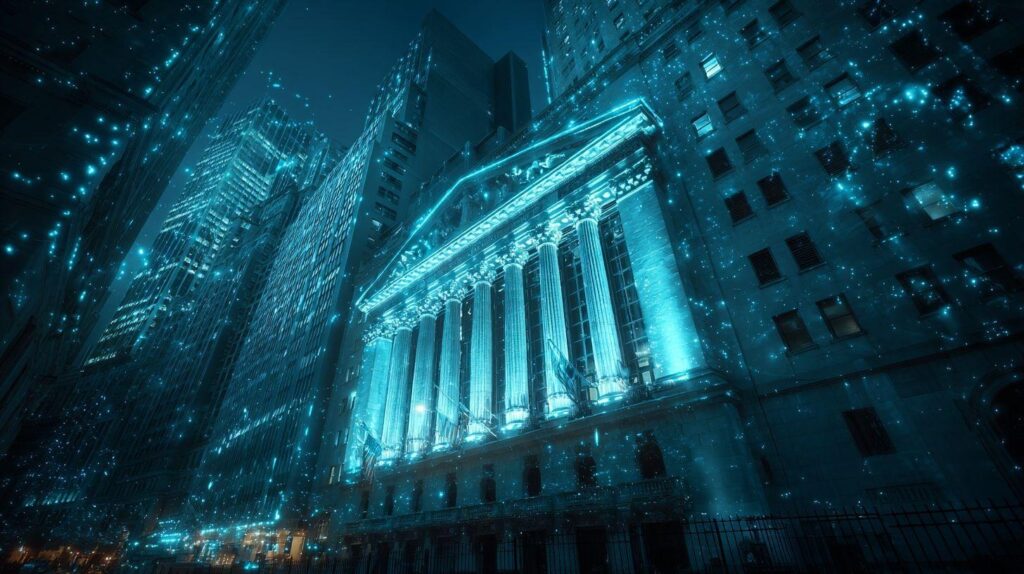
Evolving rules play a key role in institutional adoption of blockchain for stock exchanges. Traditional bodies like the SEC now scrutinize decentralized platforms alongside the NYSE. This shift affects the future of stock exchanges.
The SEC’s 2024 crypto enforcement doubled to 120 actions, targeting DEXs and token issuers. These moves aim to ensure regulatory compliance in DeFi. Global regulators follow similar paths.
In the US, focus remains on classifying assets under securities laws. Internationally, frameworks like MiFID II adapt to tokenization. Pilots test distributed ledger technology for settlement.
Clear rules could enable securities tokenization on permissioned blockchains. Firms must navigate KYC and AML requirements. This landscape shapes blockchain’s role versus traditional exchanges.
Current SEC Regulations on Crypto Trading
SEC applies Howey Test to many crypto assets; Ripple XRP case fined $125M for unregistered securities. This test determines if tokens count as securities based on investment expectations. Over 50 cases apply it to ICOs and STOs.
Exchanges face registration mandates under SEC rules. The Uniswap Wells Notice highlights risks for DEXs mimicking central limit order books. Operators must register or face enforcement.
Custody Rule 206(4)-2 governs how advisors hold digital assets. Coinbase faced a lawsuit in June 2023 over unregistered exchange activities. Compliance demands robust digital wallets and custody solutions.
A practical path involves Reg A+ for STOs, where 1 token equals 1 share. This allows fractional ownership of tokenized stocks. Firms like BlackRock explore such compliant structures for institutional adoption.
Global Approaches to Blockchain Securities
EU MiFID II treats tokenized securities as regulated instruments; Singapore MAS sandbox approved 20+ STOs. These rules cover portfolio management and trading. They promote liquidity in global markets.
Singapore’s STS framework supports security token offerings. Switzerland’s VQF SRO oversees self-regulation for crypto firms. UAE’s VARA licenses platforms handling $2B in assets.
- EU emphasizes investor protection under MiFID II.
- Singapore tests STOs in sandboxes for real-time trading.
- Switzerland uses SROs for AML compliance.
- UAE focuses on VARA for custody and KYC.
Pilots like DTCC Project Ion enable 24-hour blockchain settlement, cutting T+2 times. HKMA’s tokenization sandbox explores CBDCs and smart contracts. G20 roadmap eyes 2025 harmonization for cross-border DLT.
Hybrid Models: Integration Paths
Traditional stock exchanges like the NYSE and Nasdaq are testing blockchain waters to modernize operations. They aim to blend distributed ledger technology with existing systems for faster settlement and better liquidity. This shift promises shorter T+2 settlement times without full replacement.
Nasdaq Linq tokenized five pre-IPO companies, while ICE explored DLT settlement in 2018. These steps show a cautious path toward hybrid models. Exchanges balance innovation with regulatory compliance from the SEC and CFTC.
Specific experiments highlight practical integration. Permissioned blockchains like R3 Corda enable secure, private networks for institutions. This approach supports tokenization of securities while maintaining KYC and AML standards.
The future of stock exchanges lies in phased adoption. Internal pilots lead to regulatory sandboxes, then broader mainnet use. Such paths reduce clearing house dependencies and enhance transparency.
Nasdaq and Other Experiments with Blockchain
Nasdaq Linq platform issued 300M+ private shares on Corda; DTCC Project Ion achieved T+0 settlement. These efforts demonstrate permissioned DLT for real-world finance. Nasdaq tokenized Overstock shares with 2-second settlement times.
DTCC’s Project Ion involved an eight-bank pilot for instant clearing. It tested blockchain against traditional systems, showing potential for distributed ledger technology in post-trade processes. This cuts settlement risks in high-volume trading.
- Australian Securities Exchange’s CHESS replacement uses Hyperledger Fabric in a $1.3B project for faster processing.
- R3 Corda powers over 300 institutions with smart contracts for private transactions.
- Live pilots focus on securities tokenization and interoperability.
Status remains in testing phases with regulatory approval pending. Exchanges address scalability and cybersecurity while integrating with central limit order books. These cases pave the way for hybrid stock exchanges.
Potential NYSE Blockchain Adoption Strategies
NYSE parent ICE acquired tZERO equity; potential strategies mirror Nasdaq Linq for pre-IPO tokenization. This positions the NYSE for blockchain integration in settlement and trading. Hybrid models combine legacy systems with DLT for efficiency.
- Use private DLT like Corda consortium for settlement to enable instant finality.
- Tokenize ETFs following BlackRock’s BUIDL model for fractional ownership and 24/7 access.
- Implement hybrid CLOB+AMM for order matching with automated market makers.
A phased approach starts with internal pilots, moves to regulatory sandboxes, and ends in mainnet integration. This minimizes disruption to high-frequency trading and market makers. Experts recommend focusing on interoperability with Ethereum and Chainlink oracles.
Research suggests cost reductions through faster settlement times and lower custody needs. NYSE could enhance liquidity for tokenized stocks while ensuring MiFID II compliance. Such strategies support institutional adoption by firms like BlackRock and JPMorgan.
Economic and Market Implications
Blockchain liquidity pools rival HFT market makers, with Uniswap TVL at $5B compared to NYSE designated market makers. This shift promises to transform liquidity in the future of stock exchanges. Traditional exchanges rely on centralized intermediaries for order matching.
Decentralized finance platforms use smart contracts on Ethereum to enable instant settlement. This reduces reliance on clearing houses like DTCC and shortens T+2 settlement times. Investors gain access to 24/7 trading without geographic limits.
Institutional adoption accelerates change, as seen with BlackRock BTC ETF inflows. Tokenization of securities allows fractional ownership on blockchain. This could boost trading volume while enhancing transparency through distributed ledger technology.
Market efficiency improves with DeFi protocols offering constant liquidity. However, challenges like gas fees and scalability persist. Regulators like SEC monitor these developments for compliance with KYC and AML rules.
Impact on Liquidity and Market Efficiency
Automated liquidity pools provide constant spreads versus HFT quote fading. Uniswap V3 improved capital efficiency 4,000x through concentrated liquidity. This contrasts with traditional central limit order book systems on NYSE.
NYSE uses CLOB with 50ms latency for order matching, while AMMs employ constant product formulas. Slippage stands at 0.1% on Uniswap versus 0.05% on NYSE. MEV extraction reaches $1B, highlighting profitability issues for liquidity providers.
Institutions face shifts, with BlackRock BTC ETF at $20B AUM signaling adoption. Market microstructure evolves as LP incentives replace HFT rebates. This promotes disintermediation from prime brokers and custodian banks.
- Constant spreads reduce volatility in low-volume trades.
- Instant settlement cuts counterparty risk versus T+2.
- Permissioned blockchains like Hyperledger support regulatory compliance.
- Layer 2 solutions like Polygon enhance transaction throughput.
Future Predictions and Scenarios
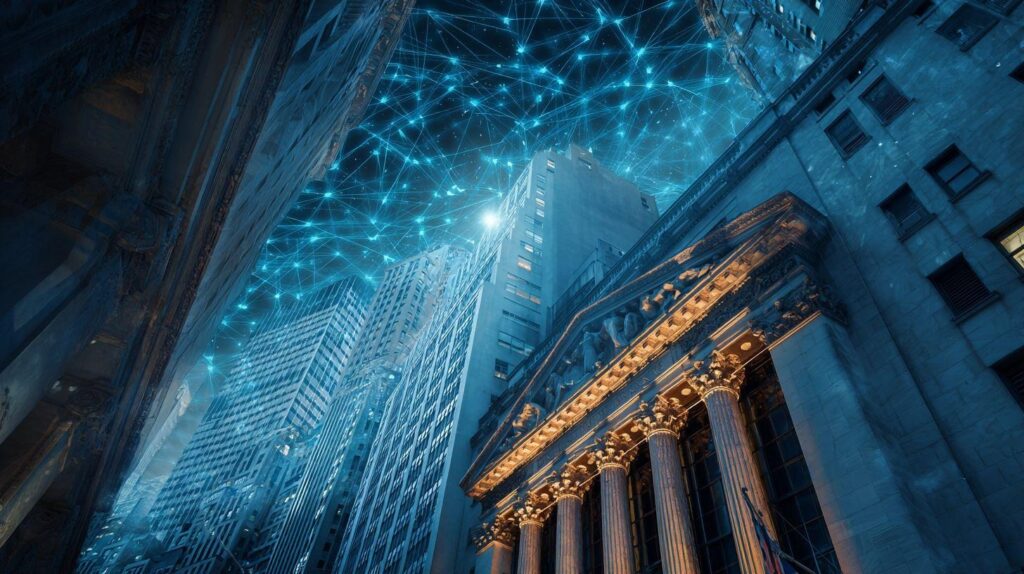
Gartner predicts 20% public securities tokenized by 2030. Layer 2 TVL to hit $100B. These forecasts highlight how blockchain technology could reshape stock exchanges like the NYSE.
Experts see tokenization speeding up settlement times from T+2 to instant. Distributed ledger technology offers transparency and reduces counterparty risk. Institutional players like BlackRock explore these shifts through pilots.
Scenarios range from full replacement to hybrid models. Decentralized finance grows with Ethereum upgrades and layer 2 solutions like Polygon. Regulatory changes will influence the pace of adoption.
Practical steps include monitoring CBDC developments and custody solutions. Firms preparing for securities tokenization gain early advantages in liquidity and global access.
Full Replacement vs. Coexistence
Coexistence likely: NYSE + blockchain settlement (DTCC Ion) vs full DEX replacement faces 10-year regulatory lag. Hybrid models blend traditional infrastructure with DLT for efficiency.
In a hybrid scenario, Nasdaq-like exchanges integrate smart contracts for faster clearing. JPM Coin handles daily volumes, showing banks adapt blockchain for payments. Fidelity offers crypto custody, bridging TradFi and DeFi.
Full replacement via retail DEXs remains unlikely soon. DAO voting tools like Aragon challenge proxy advisory firms in shareholder governance. Regulatory compliance hurdles slow public blockchain adoption.
Status quo persists if scalability issues linger. Permissioned blockchains like Corda suit institutional adoption. Watch for interoperability via Chainlink oracles to enable smooth transitions.
Timeline for Potential Shifts
2025: L2 scaling (Polygon 100k TPS); 2027: Tokenized treasuries ($1T); 2030: 30% settlement on-chain. This timeline maps key milestones for the future of stock exchanges.
By 2024, custody solutions from BlackRock and Fidelity mature. Ethereum Dencun cuts gas fees sharply, boosting layer 2 rollups like Optimism. SEC rules on digital asset custody accelerate institutional entry.
In 2026, regulated DEXs emerge with CLOB order matching. 2028 brings CBDC interoperability for cross-chain bridges. Hybrid exchanges by 2032 combine 24/7 trading with KYC compliance.
| Year | Milestone | Catalyst |
| 2024 | Custody solutions | Institutional pilots |
| 2026 | Regulated DEXs | SEC approvals |
| 2028 | CBDC interoperability | Central bank tests |
| 2032 | Hybrid exchanges | Tokenized assets |
Frequently Asked Questions
The Future of Stock Exchanges: Will Blockchain Replace the NYSE?
Blockchain has the potential to disrupt traditional stock exchanges like the NYSE by enabling decentralized, transparent, and efficient trading. However, a full replacement is unlikely in the near term due to regulatory hurdles, legacy infrastructure, and the NYSE’s entrenched position. Instead, hybrid models integrating blockchain for settlement and clearing are more probable.
What advantages does blockchain offer over the NYSE in the future of stock exchanges?
Blockchain provides faster transaction speeds, reduced intermediaries, immutable records, and 24/7 global access, potentially lowering costs and minimizing errors compared to the NYSE’s centralized system. For the future of stock exchanges, this could lead to tokenized assets and fractional ownership.
Will blockchain completely replace the NYSE in the future of stock exchanges?
No, blockchain is unlikely to fully replace the NYSE soon. The NYSE’s reliability, regulatory compliance, and vast liquidity make it critical. In the future of stock exchanges, blockchain may complement rather than supplant it, as seen in pilots like NYSE’s blockchain-based trading explorations.
How is blockchain already impacting the future of stock exchanges like the NYSE?
Blockchain is influencing stock exchanges through distributed ledger technology for post-trade processes. The NYSE has tested blockchain for equity trading and IPOs, signaling a gradual integration in the future of stock exchanges rather than outright replacement.
What challenges prevent blockchain from replacing the NYSE in the future of stock exchanges?
Key challenges include scalability issues, cybersecurity risks, lack of standardized regulations, and integration with existing financial systems. For the future of stock exchanges, these barriers mean the NYSE will likely evolve by adopting blockchain selectively.
What does the future hold for stock exchanges if blockchain doesn’t replace the NYSE?
The future of stock exchanges will likely feature a hybrid ecosystem where the NYSE incorporates blockchain for efficiency gains, such as real-time settlement and smart contracts, while maintaining its core centralized framework for stability and oversight.