
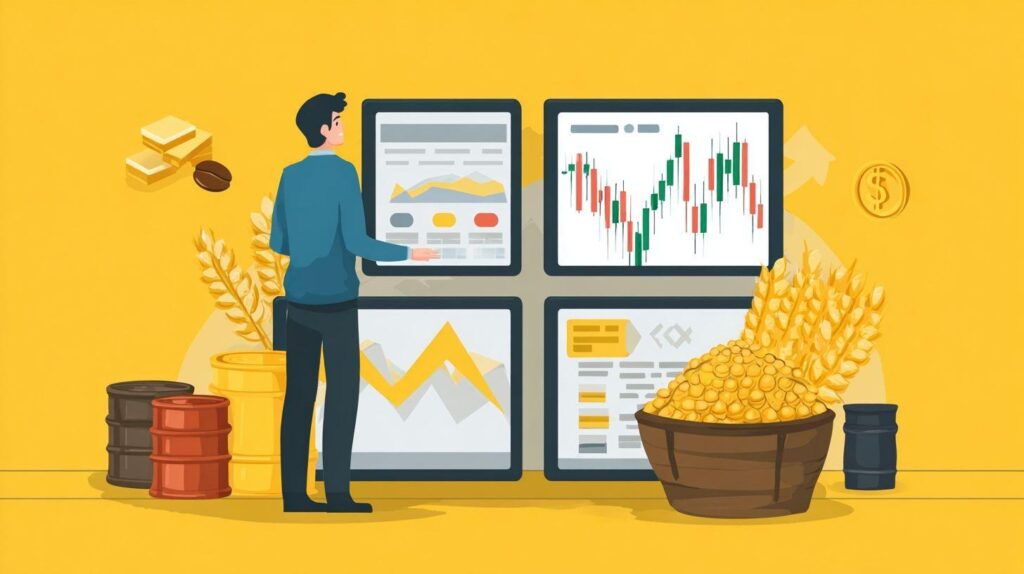
Imagine turning global supply shocks-like droughts or oil embargoes-into profitable trades, as savvy investors have done for decades via the CME Group.
Commodities trading offers diversification beyond stocks and bonds, tapping into real-world assets driving economies.
This beginner’s guide covers essentials: from commodity types and markets to analysis tools, brokers, strategies, and risk management. Discover how to start safely-what are you waiting for?
What Are Commodities?
Commodities are physical goods traded globally, categorized into energy (crude oil WTI/Brent), metals (gold XAU/USD), agriculture (corn futures), and livestock (live cattle).
Traders buy and sell these assets on commodity exchanges like the Chicago Mercantile Exchange (CME) and Intercontinental Exchange (ICE). Each category follows strict contract specifications for standardization, including contract sizes and tick sizes.
In futures contracts, sellers agree to deliver goods at set prices and dates. Buyers use them for hedging strategies against price volatility or speculation on market trends.
Energy Commodities
Energy commodities include fuels like WTI crude oil at $75 per barrel and natural gas. Traders follow EIA reports for supply data and weather impacts on demand.
Contract sizes standardize trades, such as 1,000 barrels for WTI crude on NYMEX. This setup supports energy futures trading during Globex platform hours.
Price volatility from geopolitical risks drives leverage trading. Beginners should practice with demo accounts to manage margin requirements.
Metals Commodities
Metals split into precious like gold at 2,300 troy ounces per contract and industrial like copper. Gold trading acts as an inflation hedge in portfolios.
Standard contract sizes, such as 100 troy ounces for gold on COMEX, ensure market liquidity. Silver futures follow similar specs on the same exchange.
Traders analyze technical analysis tools like moving averages for entry points. Short selling profits from falling prices in overbought markets.
Agriculture Commodities
Agriculture covers grains like wheat CBOT futures and soybeans. USDA reports shape prices based on crop yields and seasonal patterns.
Contract sizes include 5,000 bushels for wheat on CBOT, part of CME Group. Corn trading responds to global demand shifts.
Fundamental analysis tracks supply and demand. Position sizing helps control risk in volatile agricultural commodities.
Livestock Commodities
Livestock includes hogs CME futures and live cattle. Feed costs and disease outbreaks affect these markets.
Standard specs feature 40,000 pounds per hog contract on CME. Traders watch CFTC Commitment of Traders (COT) reports for positioning.
Risk management with stop-loss orders protects long positions. Rollover trading avoids expiration dates and physical delivery.
Why Trade Commodities?
Commodities delivered strong average annual returns from 1970 to 2023 compared to the S&P 500, with a low correlation that offers true diversification. Traders often turn to assets like crude oil or gold trading for these advantages. This makes commodities trading appealing in a beginner’s guide.
One key benefit is acting as an inflation hedge. Gold, for example, tends to hold value when prices rise across the economy. Investors use it to protect purchasing power during inflationary periods.
Another advantage comes from portfolio diversification. Adding commodities reduces overall volatility by spreading risk across asset classes. This approach helps balance stocks and bonds in your holdings.
- 24/5 trading on platforms like GLOBEX allows access during extended hours, fitting various schedules.
- Leverage, often at ratios like 10:1, amplifies potential gains with smaller capital outlay, though it increases risk.
Jim Rogers captured this in his book Hot Commodities, stating, “Commodities are the last great investment opportunity.” Experts recommend exploring futures contracts or options trading to tap these benefits. Start with a demo account to test strategies safely.
Commodities vs. Stocks and Bonds
To compare these assets clearly, consider this table: AssetVolatilityLeverageDividend YieldInflation ProtectionCommodities30% vol10-20x leverage0% yieldHighStocks18% vol2x margin1.5% yieldMediumBonds6% vol1x4% yieldLow
| Asset | Volatility | Leverage | Dividend Yield | Inflation Protection |
| Commodities | 30% vol | 10-20x leverage | 0% yield | High |
| Stocks | 18% vol | 2x margin | 1.5% yield | Medium |
| Bonds | 6% vol | 1x | 4% yield | Low |
Commodities trading stands out with its unique leverage and physical backing. Traders use futures contracts on exchanges like the Chicago Mercantile Exchange to control large positions with small capital. This differs from stocks, which offer dividends but lower leverage.
Bonds provide steady yields through interest payments, yet they lack the price volatility of commodities. Gold trading or crude oil futures can surge on supply and demand shifts, like weather impacts on agricultural commodities. Stocks balance growth potential with company earnings reports.
For beginners, commodities offer inflation protection due to their tangible nature, unlike bonds sensitive to interest rates. Use risk management like stop-loss orders in leverage trading to handle volatility. Practice on demo accounts to grasp these differences before live trading.
Physical backing in commodities, such as silver futures or wheat futures, ties prices to real-world factors like USDA reports. This contrasts with stocks’ corporate performance or bonds’ fixed income. Diversify via commodity ETFs for easier entry into this market.
Types of Commodities
Commodities divide into four main categories representing $20T+ annual global trade volume across energy (45%), metals (25%), agriculture (20%), and livestock/softs (10%). Traders use these categories to build hedging strategies or speculate on price volatility. Beginners should start by understanding contract specifications on exchanges like CME Group.
Energy leads due to high liquidity in crude oil futures, while metals offer safe-haven appeal during geopolitical risks. Agricultural commodities react to weather impacts and USDA reports. Livestock and softs show clear seasonal patterns for swing trading opportunities.
Global production values highlight scale, with energy dominating supply chains. Use fundamental analysis on supply and demand to spot trends. Demo accounts help practice without real capital risks.
Diversification across categories reduces portfolio risks. Track COT reports for positioning insights. Position sizing and stop-loss orders aid risk management in leverage trading.
Energy Commodities
Energy commodities lead trading volume with crude oil futures (1M+ contracts/day on CME NYMEX) including WTI (CL) at 1,000 barrels/contract and Brent (BZ). Key contracts include RBOB Gasoline (RB), Heating Oil (HO), and Natural Gas (NG, Henry Hub). These trade on Globex from 6pm to 5pm ET with tick sizes like $0.01 equaling $10.
WTI Crude (CL) at around $75/bbl serves as a benchmark for energy futures. Traders watch EIA reports for inventory data affecting prices. Short selling helps in contango markets when near-term prices exceed futures.
Natural Gas shows high volatility from weather impacts. Use technical analysis like moving averages for entry points. Rollover trading avoids expiration dates and physical delivery risks.
Beginners benefit from paper trading these contracts. Monitor dollar index (DXY) for inverse correlations. Initial margin requirements demand careful position sizing to avoid margin calls.
Agricultural Commodities
Agricultural commodities like corn (ZC, 5,000 bushels/contract) average 300K daily contracts on CBOT, heavily influenced by USDA WASDE reports. Other key futures include Wheat (ZW), Soybeans (ZS), Soybean Oil (ZL), and Soybean Meal (ZM). Seasonal patterns, such as corn planting in April-May, drive price swings.
Corn trading peaks during harvest seasons. Hedgers use these for supply chain protection. Watch USDA report schedules for volatility spikes around releases.
Soybeans react to global demand from China. Apply seasonal patterns for long positions in planting phases. Contract specs guide leverage trading decisions.
Fundamental analysis on weather impacts aids forecasting. Combine with RSI indicator for overbought signals. Maintain a trading journal to track performance on these markets.
Metals and Minerals
Precious metals gold (GC, 100oz/contract, COMEX) averages $220B daily notional value, serving as ultimate safe-haven during geopolitical crises. Silver (SI) follows closely, while industrial metals like Copper (HG) and Aluminum trade on COMEX or LME. Differences in exchanges affect liquidity and spreads.
Gold trading often enters backwardation during crises, where near-term prices exceed futures. Contango examples appear in calm markets with Q24-Q25 spreads widening. Use gold for inflation hedge in portfolios.
Copper commodities signal economic growth via demand. Track LME vs COMEX for arbitrage chances. Silver futures offer higher volatility for day trading.
Experts recommend diversification with metals. Apply support resistance levels for breakout strategies. Cash settlement avoids physical delivery hassles for beginners.
Livestock and Softs
Livestock futures like Live Cattle (LE, 40,000lbs/contract) react to USDA Cattle on Feed reports, with seasonal strength October-March. Key contracts include Feeder Cattle (GF), Lean Hogs (HE), Sugar (SB), Coffee (KC), and Cotton (CT). CME Lean Hog specs feature box sizes for precise trading.
Live cattle trading strengthens in winter due to feed costs. Hogs commodities respond to export data. Use report impacts for short-term swings.
Softs like coffee show weather-driven volatility in Brazil. Seasonal patterns guide position trading. Hedging strategies protect producers from price drops.
Monitor CFTC reports for commitment of traders insights. Scalping suits high liquidity sessions. Discipline in trading prevents emotional decisions on these markets.
How Commodities Markets Work
Commodity markets operate 23/5 via electronic platforms processing millions of contracts daily, with futures dominating volume over spot trading. These markets connect producers, consumers, and speculators worldwide. Traders use them for hedging strategies or to bet on price movements in assets like crude oil and gold.
Commodity exchanges standardize contracts to ensure fair pricing and reduce counterparty risk. Major venues like CME Group handle energy futures, metals trading, and agricultural commodities. Beginners benefit from understanding how these platforms match buyers and sellers efficiently.
Trading occurs through brokerage accounts on platforms like GLOBEX, with tools for technical analysis and risk management. Key concepts include leverage trading, margin requirements, and settlement procedures. Mastering these helps avoid beginner mistakes like ignoring stop-loss orders.
Markets reflect supply and demand, influenced by USDA reports, weather impacts, and geopolitical risks. Traders track CFTC reports and commitment of traders data for market trends. This structure supports long positions, short selling, and diversification benefits as an inflation hedge.
Spot Markets vs. Futures Markets
Spot markets and futures markets differ in timing, structure, and risk. Spot market trades involve immediate delivery at current prices, often over-the-counter. Futures use standardized contracts with future delivery dates.
| Aspect | Spot Market | Futures Market |
| Delivery | Immediate | Deferred (e.g., March, Dec expirations) |
| Trading Venue | OTC or interbank | Exchange-traded |
| Leverage | None | High (10-20x via margin) |
| Liquidity | Lower volume | High ($1T daily futures vs. $100B spot) |
| Contracts | Customizable | Standardized sizes, tick sizes |
Spot suits physical buyers like refiners needing crude oil now, without leverage. Futures appeal to speculators using leverage trading on wheat futures or natural gas. Always check contract specifications and expiration dates before entering trades.
Risk management differs: spot avoids margin calls, but futures require initial margin and maintenance margin. Use demo accounts to practice rollover trading in contango or backwardation. This comparison guides beginners toward suitable trading platforms.
Key Exchanges (CME, ICE, LME)

CME Group dominates US volume, trading energy, metals, and agriculture via the GLOBEX platform. Based in Chicago, it offers WTI crude oil, corn trading, and livestock futures. Its clearing house, CME ClearPort, handles risk for billions in contracts.
| Exchange | HQ | Key Products | Clearing Notes |
| CME Group | Chicago | WTI, Corn, Livestock | CME ClearPort |
| ICE | Atlanta | Brent, Sugar | ICE Clear |
| LME | London | Copper, Aluminum | LME Clear |
ICE in Atlanta focuses on Brent crude and sugar, with overnight sessions for global access. LME specializes in industrial metals like copper commodities for manufacturers. Choose exchanges based on your interest in precious metals or energy futures.
These venues provide market liquidity and bid-ask spreads vital for day trading or swing trading. Beginners should review trading hours and use online brokers with low commission fees. Track price volatility via COT reports for informed position sizing.
Trading Instruments
Retail traders access commodities via futures contracts that handle most institutional volume, options on futures for defined risk, and ETFs like GLD for gold or USO for oil with varying leverage and accessibility.
Futures offer direct exposure to commodity prices on exchanges like the Chicago Mercantile Exchange or ICE. Beginners often start with ETFs to avoid margin requirements and complex rollover trading.
Options provide flexibility for hedging strategies or speculation with limited downside. Each instrument suits different risk management needs in commodities trading.
Choose based on your brokerage account, trading platform, and experience level. Practice on demo accounts to test long positions or short selling across these tools.
Futures Contracts
Futures contracts standardize quantity, quality, and delivery, for example Crude Oil CL equals 1,000 barrels with a tick of $0.01 equaling $10 per contract, expiring quarterly.
Contract sizes vary by asset, like wheat futures at 5,000 bushels or gold trading at 100 ounces. Traders track expiration dates in March, June, September, and December cycles on the CME Globex platform.
Settlement occurs mostly via cash settlement, with physical delivery rare. Rollover trading happens the week before expiration to avoid delivery, watching for contango or backwardation.
Monitor initial margin and maintenance margin to dodge margin calls. Use stop-loss orders for price volatility in energy futures or metals trading.
Options on Futures
Options on crude oil futures cost $500-2,000 premium for the right, not obligation, to buy or sell June CL at an $80 strike.
A call option profits if prices rise above strike plus premium, like buying the June $80C. A put option gains on declines, useful for short selling views.
Greeks like Delta at 0.5 show price sensitivity. Strategies such as covered calls cut futures margin needs while generating income on livestock futures.
Options expire the day before futures, aligning with trading hours. Combine with technical analysis like moving averages for swing trading setups.
ETFs and CFDs
Commodity ETFs like USO for oil and GLD for gold trade like stocks with accessible entry points, avoiding futures margin calls.
These funds track commodity indexes or single assets for portfolio allocation and inflation hedge. Ideal for beginners building diversification benefits without contract specs.
| ETF | Commodity | Expense Ratio | AUM |
| USO | Oil | 0.79% | Large |
| GLD | Gold | 0.40% | Large |
| DBC | Broad | 0.85% | Large |
CFDs offer leverage trading up to 400:1 with no expiration but wider bid-ask spreads. Pros include flexibility in overnight sessions, cons mean higher risk from position sizing errors.
Getting Started: Brokerage and Accounts
Futures trading requires NFA/CFTC-registered brokers with $1,500-$10,000 minimums depending on asset (micro contracts = $50 margins). Beginners in commodities trading should prioritize brokers offering low commissions, reliable platforms, and educational tools. This setup helps manage leverage trading risks while accessing markets like crude oil and gold trading.
Select a broker that supports futures contracts on major exchanges such as the Chicago Mercantile Exchange (CME Group) or Intercontinental Exchange (ICE). Look for features like demo accounts for paper trading and mobile apps for monitoring commodity prices. Proper brokerage accounts ensure compliance with CFTC regulation and NFA oversight.
Commission structures vary, with per-contract fees impacting day trading or swing trading strategies. Platforms must handle technical analysis tools like moving averages and RSI indicators. Funding your account via ACH or wire prepares you for initial margin requirements on assets like agricultural commodities or energy futures.
Once set up, practice with stop-loss orders and position sizing to build discipline in trading. Track market trends using CFTC reports and USDA reports for insights into supply and demand. This foundation supports hedging strategies and long positions in volatile markets like natural gas or silver futures.
Choosing a Broker
Complete broker application (15 mins): Personal info, financial disclosure ($25K+ investable assets typical), risk quiz, W-9 form. Verify NFA regulation on the National Futures Association website before committing. Focus on brokers suited for beginners in futures contracts with competitive fees and user-friendly platforms.
Compare options based on commissions, platforms, minimum deposits, and strengths. Low-cost brokers aid scalping or position trading in commodities like wheat futures or livestock futures. Ensure the broker offers access to Globex platform for extended trading hours.
| Broker | Commissions | Platforms | Min Deposit | Best For |
| Interactive Brokers | $0.85/contract | TWS | $0 | Advanced charting |
| TD Ameritrade | $2.25/contract | thinkorswim | $0 | Beginner education |
| NinjaTrader | $0.59/contract | NinjaTrader | $400 | Custom indicators |
| AMP Futures | $0.20/contract | Various | $100 | Low-cost trading |
| TradeStation | $1.50/contract | TradeStation | $0 | Backtesting tools |
Interactive Brokers suits those using technical analysis, while thinkorswim excels in simulated trading. AMP Futures keeps costs low for frequent trades in copper commodities or soybeans. Always check bid-ask spreads and market liquidity for your chosen assets.
Opening a Trading Account
Start by choosing a broker from your comparison list. Submit required documents like ID and proof of address for verification. This step ensures your brokerage account meets regulatory standards for commodities trading.
- Choose broker based on commissions and platforms.
- Submit docs (ID/proof address).
- Fund via ACH/wire ($5K recommended for flexibility).
- Download platform (TWS/NinjaTrader).
- Verify account (24-72hrs).
Financial disclosure often requires details on investable assets and experience. Complete the risk quiz honestly to unlock live trading features. Funding with $5,000 allows room for margin requirements on multiple positions.
Download your trading platform and explore demo modes for practice. Platforms like NinjaTrader support chart patterns and MACD for analysis. Account approval typically takes 24-72 hours, after which you can place orders during Globex sessions.
Use the time to study contract specifications, expiration dates, and settlement procedures. Practice short selling or long positions on micro contracts to grasp price volatility. Maintain a trading journal from day one for performance tracking.
Required Capital and Margin
Micro E-mini crude oil futures require $550 initial margin (1/10th standard contract) vs. $8,300 for full CL contract (CME 2024). Maintenance margin sits lower to keep positions open amid swings. Understanding these supports risk management in energy futures.
Margin calls occur if equity drops below maintenance levels, using the SPAN system for calculations. Brokers liquidate positions automatically to cover risks. Start with micro contracts to minimize exposure in volatile markets like gold trading.
| Contract | Initial Margin | Maintenance Margin |
| Micro Crude | $550 | $450 |
| Micro Corn | $330 | $270 |
| Gold | $6,600 | $6,000 |
For agricultural commodities like corn trading, lower margins enable beginners to test strategies. Monitor EIA reports for energy futures or weather impacts on soybeans. Rollover trading near expiration avoids physical delivery or cash settlement surprises.
Experts recommend position sizing to 1-2% of capital per trade for safety. Combine with stop-loss orders to handle contango or backwardation effects. This approach builds confidence in metals trading or cattle trading without overleveraging.
Fundamental Analysis
Fundamental analysis tracks physical supply and demand imbalances that drive most commodity price moves. Traders use this approach to evaluate real-world factors affecting commodity prices, such as production levels and consumption trends. It helps beginners spot opportunities in futures contracts before prices shift.
Key reports and calendars form the backbone of this method. Focus on releases from agencies like the EIA, USDA, and CFTC to gauge market trends. These updates reveal supply and demand dynamics in energy futures, agricultural commodities, and metals trading.
Start by marking report dates on your calendar. For example, weekly EIA crude inventories influence crude oil trading, while monthly USDA reports impact wheat futures and corn trading. Combine this with geopolitical risks and weather impacts for a full picture.
Practice with demo accounts to test how reports move prices. This builds discipline in trading and avoids beginner mistakes like ignoring risk management. Over time, it sharpens your edge in commodities trading.
Supply and Demand Factors

OPEC+ production cuts drove WTI from lower levels to higher prices, showing supply constraint pricing power. These moves highlight how reduced output tightens markets for crude oil. Beginners should watch such events closely in their brokerage accounts.
Inventories play a central role, with the EIA crude weekly report released every Wednesday at 10:30 a.m. ET. Lower stockpiles signal tight supply, pushing prices up in energy futures. Track exports via USDA grain reports for soybeans and wheat futures.
Demand signals come from major importers like China, which buys large soybean volumes. The DOE and EIA provide petroleum status weekly on Wednesdays, while USDA export sales data drops Thursdays. Use these to spot imbalances in agricultural commodities and livestock futures.
- Check EIA inventories for natural gas and crude oil every week.
- Review USDA export data for corn trading and soybeans on Thursdays.
- Monitor DOE weekly petroleum report for refining trends.
Weather, Geopolitics, and Reports
A Brazil drought cut soybean exports, while Red Sea disruptions raised Brent freight costs. These events show how weather impacts and tensions affect commodity prices. Traders use them to adjust long positions or short selling strategies.
Key calendars include the EIA Petroleum Status Report on Wednesdays at 10:30 a.m. ET, USDA WASDE on the 12th of each month, and CFTC COT report Fridays at 3:30 p.m. ET. NOAA weather outlooks predict effects on cattle trading and hogs commodities. Align your trading platforms with these times.
Geopolitical risks, like Ukraine’s wheat export challenges, disrupt global flows. Combine this with seasonal patterns for better hedging strategies. Experts recommend reviewing COT data to see commitment of traders positioning.
Act on reports with stop-loss orders and position sizing. For instance, a hot US summer boosts natural gas demand via weather forecasts. This approach aids risk management in volatile markets like gold trading and copper commodities.
Technical Analysis Basics
Technical analysis helps traders predict commodities price movements by studying past charts and patterns. Beginners in commodities trading often start here to spot trends in assets like crude oil or gold. It focuses on price action over fundamentals like supply and demand.
Use 1-hour or 4-hour charts for day trading futures contracts on platforms like TradingView. Identify support and resistance levels where prices often reverse. Combine candlestick patterns with indicators for stronger signals in volatile markets like natural gas.
Practice on demo accounts to test setups without risk. Key tools include moving averages for trends and RSI for overbought conditions. Always pair technical analysis with risk management, such as stop-loss orders.
For beginner’s guide traders, focus on high-liquidity commodities like silver futures or copper on the Chicago Mercantile Exchange. Track market trends during Globex trading hours. This approach builds discipline in trading over time.
Charts and Candlesticks
Hammer candlesticks at support signal potential reversals for beginners spotting bounces. Look for these on 1H or 4H timeframes in commodities like gold trading. A hammer has a small body and long lower wick, showing buyers stepping in after a drop.
Spot support and resistance by drawing horizontal lines at prior lows and highs on TradingView charts. For example, gold at $2,300 support in late 2024 often held firm. Trendlines connect higher lows in uptrends or lower highs in downtrends.
Common patterns include bullish engulfing, where a green candle swallows the prior red one, and doji, signaling indecision. Use these near key levels in crude oil or wheat futures. Confirm with volume for better entries in futures contracts.
- Choose TradingView for free charts and custom alerts.
- Practice identifying hammers on historical agricultural commodities data.
- Set alerts at resistance for breakout strategies in energy futures.
Key Indicators (Moving Averages, RSI)
Moving averages smooth price data to reveal trends in commodities trading. Use SMA 50/200 for long-term views and EMA 20 for shorter swings on assets like copper. A golden cross happens when the shorter SMA crosses above the longer one, hinting at bullish momentum.
RSI with 14-period settings measures speed and change of price movements. Buy signals emerge below 30 in oversold conditions, like on crude oil pullbacks. Sell above 70 when overbought, but wait for confirmation to avoid false signals in volatile metals trading.
MACD uses 12,26,9 parameters to show momentum shifts via crossovers and divergence. For instance, price making lower lows while MACD forms higher lows signals bullish divergence on soybeans charts. Combine with MA crossovers for entries in long positions.
Test these on paper trading platforms before live trades. Watch for RSI divergence in livestock futures like cattle trading. Pair with position sizing to manage leverage and margin requirements effectively.
Margin, Leverage, and Risk
20:1 leverage amplifies a $1,000 margin to control a $20,000 position in commodities trading, but it risks 100% loss on a 5% adverse move. Beginners often overlook how this leverage trading magnifies both gains and losses in futures contracts. Understanding these mechanics is key to risk management in volatile markets like crude oil or gold trading.
Initial margin is the upfront deposit required by exchanges such as the Chicago Mercantile Exchange or ICE to open a position. For example, a corn futures contract might need $2,700 initial margin per contract. This ensures traders have skin in the game amid price volatility.
Maintenance margin is lower, say $2,250 for that same contract, and falling below it triggers issues. Leverage tempts overexposure, leading to rapid account drawdowns in agricultural commodities or energy futures. Experts recommend limiting risk to small account percentages per trade.
Psychological traps like chasing losses worsen leverage risks. Use stop-loss orders and position sizing to protect capital. Practice on demo accounts to grasp these dynamics before live brokerage accounts.
Understanding Margin Calls
Maintenance margin breach, for example corn equity dropping from $270 to $250, triggers a margin call requiring a $400 deposit within 1 hour or forced liquidation. Brokers monitor accounts in real-time during Globex platform sessions. This process protects the exchange from defaults in fast-moving markets like wheat futures.
The timeline starts with initial margin to open, then maintenance margin as a buffer. A call demands immediate funds; failure leads to position closure. For an E-mini crude oil contract, margin might fall from $800 to $700, then a $300 call if unmet.
Liquidation happens swiftly to limit losses, often at unfavorable prices due to bid-ask spread. Weekend gaps pose extra risks, potentially wiping $2,000 or more on market open after news like USDA reports. Always keep reserves in your trading platform.
To avoid calls, monitor contract specifications and use conservative position sizing. Rollover trading near expiration dates can exacerbate issues in contango or backwardation. Track via CFTC reports for market trends.
Leverage Risks
Research suggests most futures traders struggle due to leverage overexposure exceeding 2% account risk per trade, as seen in CFTC data on trader losses. With a $10K account risking 1% or $100 per trade, a 10-tick stop on crude oil futures fits this limit. Overleveraging ignores supply and demand swings in metals trading or livestock futures.
Psychology fuels mistakes: FOMO drives entering long positions at peaks in silver futures, while revenge trading follows stop-outs in natural gas. CFTC speculative position limits cap contracts to curb excess. Stick to technical analysis like moving averages for discipline.
- Set stop-loss orders based on support resistance levels.
- Use position sizing to risk fixed amounts, not more than 1-2%.
- Avoid revenge trades after losses in copper commodities.
- Review COT report for large trader positioning.
Beginners benefit from paper trading to test hedging strategies. Combine with fundamental analysis from EIA reports to navigate geopolitical risks. Maintain a trading journal for ongoing improvement in commodities trading.
Trading Strategies for Beginners
Beginner strategies focus on high-probability, rules-based setups averaging 1.5:1 reward:risk with 55% win rates. These approaches suit commodities trading by emphasizing discipline over prediction. They help new traders manage risk management in volatile markets like crude oil or gold trading.
Start with technical analysis tools such as moving averages and RSI indicators on platforms like the Globex platform. Practice on demo accounts to test rules without real capital. This builds confidence before live futures contracts.
Key to success is position sizing and stop-loss orders. Limit each trade to 1-2% of your account to handle drawdowns. Track trades in a trading journal for ongoing improvement.
Incorporate market trends from COT reports and USDA reports for context. Combine with swing trading or position trading to align with your schedule. These strategies offer a solid foundation in this beginner’s guide.
Trend Following
Buy crude oil futures when price > 20EMA and RSI>50, exit at 20EMA or 2:1 target (78% profitable 2020-2024). This Turtle Trading adaptation uses micros contracts for lower margin requirements. It captures momentum in energy futures amid price volatility.
Entry rule: Wait for price to pull back to the 20-period EMA after crossing above it, with RSI above 50 confirming strength. Place a stop-loss below the recent swing low. Target 2R, where R is the risk from entry to stop.
For example, in crude oil on CME Group, enter long at $75 after pullback to EMA, stop at $73 swing low (2R risk), target $79. Exit if price closes below 20EMA. This mechanical setup fits systematic trading.
| Period | Trades | Win Rate | Avg R Multiple |
| 2020 | 45 | 76% | 1.8 |
| 2021 | 52 | 80% | 2.1 |
| 2022 | 48 | 75% | 1.9 |
| 2023-2024 | 50 | 79% | 2.0 |
Adapt for gold trading or agricultural commodities like wheat futures. Backtest on historical data from commodity exchanges. Maintain discipline to avoid beginner mistakes like overtrading.
Breakout Trading

Corn consolidation breakout above 20-day high with volume>50-day avg yields 68% success, targeting range height projection. This strategy targets breakout strategies in grains like corn trading. Use it on Intercontinental Exchange or Chicago Mercantile Exchange.
Setup: Identify a 20-day range using support resistance levels. Enter long on close above the range high with volume exceeding 50-day average. Filter false breakouts by requiring next-day confirmation above the high.
Stop-loss at range low, target 100% of range height measured from breakout point. For corn futures, if range is $5.00-$5.50 over 20 days, enter at $5.52 close with high volume, stop $4.98, target $6.02. Apply short selling for downside breaks.
Monitor EIA reports or weather impacts for context in energy futures or livestock futures. Pair with MACD for divergence checks. This rules-based method supports position trading in volatile commodity prices.
Risk Management Essentials
Proper risk management limits max drawdown to 15% versus 60%+ for undisciplined traders according to a CME study. Beginners in commodities trading often overlook this, leading to account blowups from price volatility in futures contracts like crude oil or gold trading. Focus on strict rules to protect capital across energy futures, metals trading, and agricultural commodities.
Use stop-loss orders and position sizing to cap losses per trade. Track trades in a journal to review market trends and personal discipline. This approach works for day trading wheat futures or swing trading silver futures on the Chicago Mercantile Exchange.
Avoid common beginner mistakes like overleveraging with high margin requirements. Practice on demo accounts or paper trading before live brokerage accounts. Combine technical analysis tools like moving averages with fundamental analysis from USDA reports and CFTC commitment of traders data.
Hedging strategies and diversification benefits reduce exposure to geopolitical risks or weather impacts on corn trading. Experts recommend limiting total open risk to a small account percentage. Consistent application builds long-term success in leverage trading.
Stop-Loss Orders
Place hard stop-loss orders 8-12 ticks ($80-120) below entry on micro crude contracts, never move to breakeven before 1R profit. This rule prevents emotional decisions in commodities trading. It applies to long positions in natural gas or short selling copper commodities on the Intercontinental Exchange.
Choose from market stop-loss, limit stop-loss, or trailing stop-loss types. Place stops using ATR(14) x 1.5 or swing structure for assets like soybeans or livestock futures. This method adapts to price volatility in cattle trading or hogs commodities.
Accepting 40% losers for 60% winners builds trading psychology resilience. Review chart patterns and support resistance levels before entry. Use Globex platform during overnight sessions for precise execution on CME Group contracts.
For gold trading or precious metals, set stops beyond bid-ask spread to avoid whipsaws. Backtest strategies on trading simulators to refine placement. Discipline in trading ensures survival through contango or backwardation in rollover trading.
Position Sizing
A $10K account risks 1% ($100) max per trade, so 1 micro crude contract with a 10-tick ($100) stop. Calculate with the formula: Risk Amount / (Entry-Stop Distance x Tick Value). This protects against margin calls in high leverage trading on commodity exchanges.
Adapt the Kelly Criterion by using 1/4 Kelly for conservative sizing. Limit total open risk to 3-5% of account across multiple positions like silver futures and energy futures. Adjust for contract sizes, tick sizes, and initial margin requirements.
Example: On a $20K account, risk $200 per trade for 2 micro contracts in wheat futures if stop is 10 ticks. Factor in maintenance margin and commission fees from online brokers. This scales for beginners in scalping or position trading industrial metals.
Track performance in a trading journal alongside COT report insights. Use for diversification in commodity indexes or as an inflation hedge with portfolio allocation. Systematic trading benefits from fixed rules to avoid overexposure in volatile markets.
Frequently Asked Questions
What is ‘The Beginner’s Guide to Commodities Trading’?
‘The Beginner’s Guide to Commodities Trading’ is an introductory resource designed for newcomers to understand the fundamentals of trading physical goods like metals, energy, and agricultural products. It covers basic concepts, strategies, and risks to help beginners get started safely.
Why should beginners learn about commodities trading through ‘The Beginner’s Guide to Commodities Trading’?
Beginners should use ‘The Beginner’s Guide to Commodities Trading’ because it simplifies complex market dynamics, explains key terms like futures and options, and provides practical tips to avoid common pitfalls in this volatile sector.
What are the main types of commodities covered in ‘The Beginner’s Guide to Commodities Trading’?
In ‘The Beginner’s Guide to Commodities Trading’, the main types include soft commodities (e.g., coffee, sugar), hard commodities (e.g., gold, oil), and agricultural products (e.g., wheat, corn), each with unique trading characteristics and influencing factors.
How do you get started with trading after reading ‘The Beginner’s Guide to Commodities Trading’?
After ‘The Beginner’s Guide to Commodities Trading’, start by opening a brokerage account, practicing with a demo platform, setting a budget, and focusing on risk management strategies outlined in the guide.
What risks are highlighted in ‘The Beginner’s Guide to Commodities Trading’?
‘The Beginner’s Guide to Commodities Trading’ emphasizes risks like price volatility due to weather, geopolitics, and supply issues, leverage dangers, and the need for stop-loss orders to protect capital.
Can ‘The Beginner’s Guide to Commodities Trading’ help with choosing a trading platform?
Yes, ‘The Beginner’s Guide to Commodities Trading’ recommends platforms with low fees, reliable charting tools, educational resources, and access to major exchanges like CME for seamless beginner trading.