
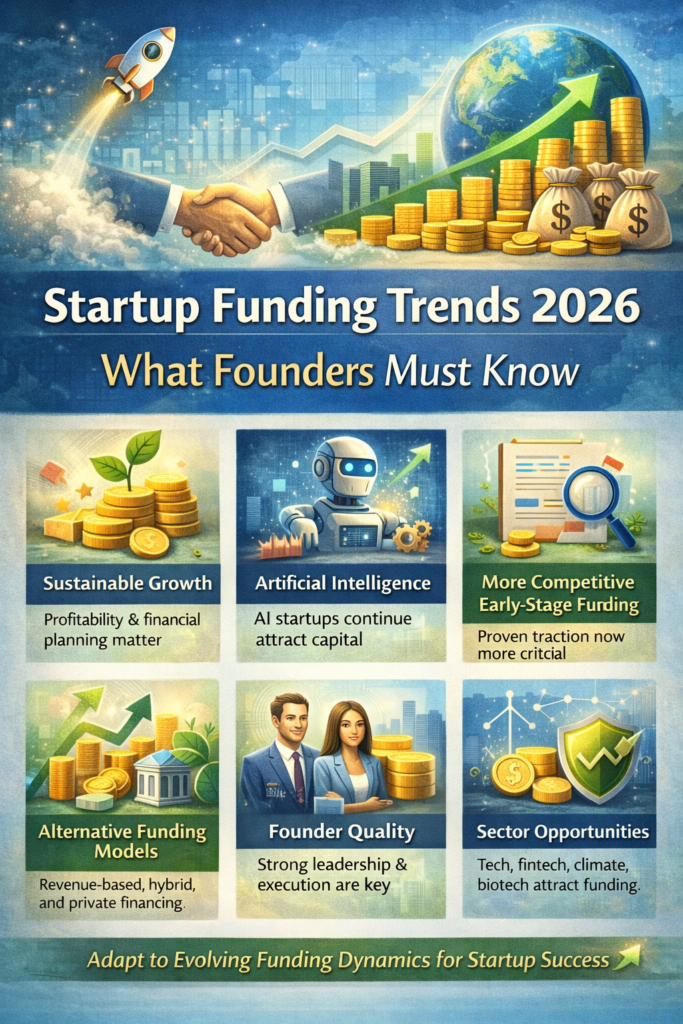
Startup funding is evolving rapidly, and 2026 is set to redefine how founders raise capital. After years of aggressive growth funding and valuation surges, investors are now more selective, strategic, and value-driven. Founders who understand these shifts will be better positioned to attract funding and build sustainable businesses.
This article explores the most important startup funding trends in 2026 and what founders must know to stay competitive in a changing investment landscape.
Shift From Growth at All Costs to Sustainable Growth
One of the biggest funding changes in 2026 is the clear move toward sustainability.
Investors are no longer impressed by rapid user growth alone. They want startups that demonstrate strong unit economics, clear revenue models, and a realistic path to profitability. Burn rates are under scrutiny, and founders are expected to show disciplined financial planning.
Startups that balance growth with cost efficiency are far more likely to secure funding in this environment.
Artificial Intelligence Startups Continue to Attract Capital
AI remains one of the strongest funding magnets in 2026.
However, investors are becoming more selective within the AI space. Rather than funding generic AI ideas, they are backing startups with real-world applications, industry-specific solutions, and defensible technology.
AI startups that improve productivity, automate complex workflows, enhance decision-making, or reduce operational costs are particularly attractive to investors.
Early-Stage Funding Becomes More Competitive
Raising seed and early-stage funding in 2026 requires stronger fundamentals.
Founders are expected to show traction earlier, whether through revenue, partnerships, or validated customer demand. The era of idea-only funding is largely over, except for highly experienced founding teams.
Strong storytelling combined with data-backed validation has become essential for early-stage fundraising success.
Rise of Alternative Funding Models
Traditional venture capital is no longer the only path to growth.
In 2026, more founders are exploring alternative funding options such as revenue-based financing, strategic partnerships, grants, and private credit. These models allow startups to scale without excessive equity dilution.
Bootstrapped and hybrid funding approaches are also gaining respect, especially among founders who prioritize long-term control over rapid expansion.
Increased Focus on Founder Quality and Leadership
Investors in 2026 are placing greater emphasis on the people behind the business.
Founder resilience, adaptability, and execution capability matter more than ever. Investors are looking for leaders who can navigate uncertainty, manage teams effectively, and make data-driven decisions.
A strong founding team with complementary skills often outweighs a perfect idea with weak leadership.
Sector-Specific Funding Opportunities
While funding overall is more selective, certain sectors continue to attract strong investor interest.
Industries such as climate technology, fintech infrastructure, healthcare innovation, cybersecurity, and enterprise software remain high on investor priority lists. Startups addressing regulatory challenges, sustainability goals, or efficiency gaps within these sectors stand out.
Founders operating in these areas should clearly communicate how their solution solves a real and urgent problem.
Valuations Become More Realistic
Inflated valuations are giving way to more grounded expectations.
In 2026, investors prefer fair pricing over hype. Startups with reasonable valuations and strong fundamentals are more likely to close funding rounds than those pushing aggressive numbers without support.
Founders who approach valuation discussions with flexibility and realism build stronger long-term investor relationships.
Globalization of Startup Funding
Startup funding is becoming increasingly global.
Investors are looking beyond traditional hubs to discover talent and innovation in emerging markets. Remote teams, cross-border funding, and global customer bases are now standard rather than exceptional.
Founders who think globally and design scalable solutions have a broader funding landscape to tap into.
Conclusion: How Founders Can Prepare for 2026
Startup funding in 2026 rewards clarity, discipline, and execution.
Founders who understand investor expectations, focus on sustainable growth, and adapt to new funding models will have a significant advantage. Success is no longer about raising the most capital, but about raising the right capital under the right terms.
By building strong fundamentals, telling a compelling story, and staying flexible, founders can navigate the evolving funding landscape and position their startups for long-term success.