
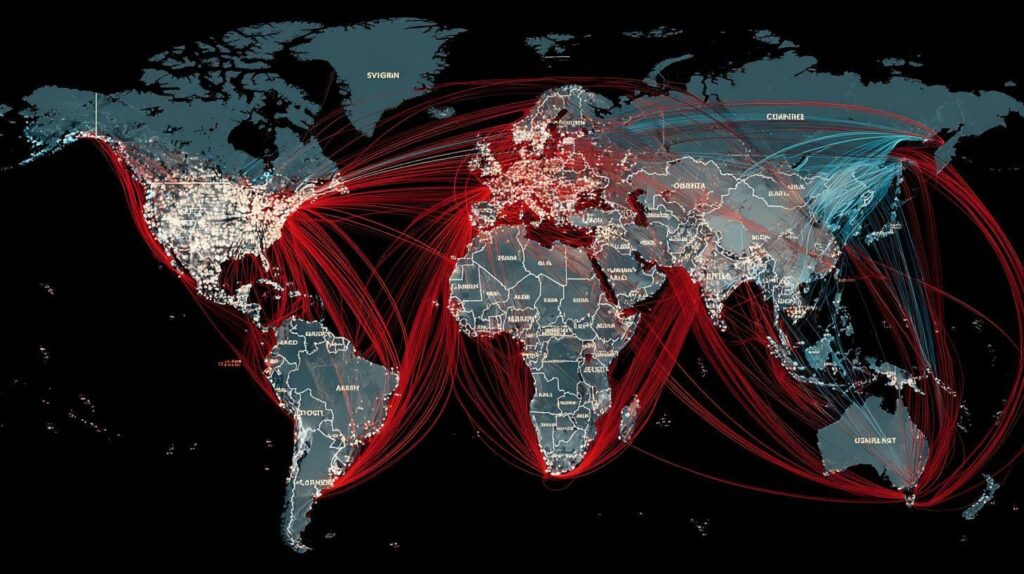
In an era of escalating US-China rivalry, Houthi attacks on the Red Sea, and Arctic ice melt unlocking northern passages, global trade routes are being forcibly redrawn. These geopolitical flashpoints-from the Suez Canal blockades to emerging corridors like IMEC and China’s BRI-threaten supply chains and shift economic power. Discover how businesses can navigate this turbulent landscape.
Defining Key Tensions: US-China Rivalry and Beyond
The US-China rivalry escalated with 25% average tariffs on $360B goods since 2018, per USTR data, triggering global supply chain fragmentation. These measures have pushed companies to rethink friendshoring and nearshoring strategies. Businesses now face higher costs from rerouting ships away from traditional paths.
Key geopolitical tensions are redrawing trade routes worldwide. Here are four major ones reshaping global trade:
- US-China trade war: Affects $600B in trade, forcing diversification of semiconductor supply chains and rare earth imports.
- Russia sanctions from the Ukraine conflict: Led to 40% cut in Europe’s gas supplies, spurring LNG rerouting and Arctic shipping trials.
- Red Sea crisis with Houthi attacks: Diverted 30% of Suez Canal traffic, increasing logistics costs for container shipping and bulk carriers.
- Taiwan risk: Threatens $2.5T semiconductor market, prompting stockpiling and shifts to alternative critical minerals trade sources.
WTO dispute data shows a surge in cases tied to these tensions, with over 50 active filings on tariffs and sanctions. Companies can build supply chain resilience by mapping chokepoints like the Strait of Malacca and Bab el-Mandeb Strait. Experts recommend scenario planning for shipping delays and port congestion.
To adapt, firms should explore alternative trade paths such as the Middle Corridor or India-Middle East-Europe corridor (IMEC). This reduces exposure to maritime security risks and supports deglobalization trends. Practical steps include using AIS data for real-time trade flow visualization.
Historical Context: From Silk Road to Modern Supply Chains
The ancient Silk Road facilitated 20% of global trade volume. Today’s $28T global trade flows through 12 maritime chokepoints controlling 60% of flows. These paths have long shaped geopolitical tensions and economic power.
In 130 BCE, the Silk Road linked China to Europe overland. It carried silk, spices, and ideas amid rival empires’ control. Disruptions from wars forced traders to seek alternative trade paths.
By 1498, Vasco da Gama opened the India route around Africa. This sea path bypassed Ottoman land tolls. It marked Europe’s push for direct maritime security in Asia trade.
The 1869 Suez Canal created a vital Europe-Asia shortcut. Carrying most oil and container shipping, it became a prime target. The 1956 Suez Crisis triggered the first oil crisis through blockades and invasions.
Fast-forward to the 2021 Suez Canal blockage, where a grounded ship halted traffic for days. Losses piled up from shipping delays and supply chain disruptions. This timeline reveals a pattern: geopolitical tensions consistently redraw trade routes via control of chokepoints like the Strait of Malacca and Bab el-Mandeb Strait.
- Silk Road era showed overland vulnerabilities to empire conflicts.
- Da Gama’s route highlighted naval power in evading land barriers.
- Suez events exposed chokepoints to crises, embargoes, and economic sanctions.
- Modern blockages underscore needs for supply chain resilience through diversification.
Core Thesis: Trade Routes as Battlegrounds of Power
Control of 12 global chokepoints gives 10 nations veto power over $14T annual trade flows, making routes ultimate strategic weapons. Imagine a map visualization highlighting these narrow passages, from the Suez Canal to the Strait of Malacca. Each pin marks a vulnerability where geopolitical tensions can trigger supply chain disruptions.
The Bab el-Mandeb Strait handles $1T in trade, while the Strait of Malacca sees $3.4T flow through annually. Other critical points include the Taiwan Strait, Panama Canal, and Turkish Straits. Ships carrying container shipping, bulk carriers, and LNG tankers must navigate these, exposing global trade to blockades or attacks.
He who controls chokepoints controls commerce sums up this dynamic. The Thucydides Trap applies here, as rising powers like China challenge established ones like the US over routes such as the South China Sea. Recent events, including Houthi attacks in the Red Sea crisis and the Suez Canal blockage, show how tensions redraw trade routes.
Businesses face rerouting ships, higher logistics costs, and shipping delays. Experts recommend supply chain resilience through diversification strategies like nearshoring or friendshoring. Monitoring AIS data and geopolitical forecasting helps firms plan for alternative trade paths, such as the Northern Sea Route.
Major Geopolitical Flashpoints Driving Change
Four flashpoints have disrupted trillions in annual global trade flows since 2022, forcing average shipping cost increases worldwide. These include the US-China trade war affecting electronics and semiconductors, Russia’s conflict impacting energy and grain, Middle East instability hitting oil and LNG, and Indo-Pacific tensions reshaping manufacturing supply chains.
Such geopolitical tensions are redrawing trade routes, with combined disruptions posing major risks to economic output. Companies now prioritize supply chain resilience through diversification and nearshoring strategies.
Under each flashpoint below, explore specific impacts like sanctions, tariffs, and rerouting, which experts link to broader deglobalization trends. Practical steps include inventory stockpiling and exploring alternative paths like the Middle Corridor.
US-China Trade War and Decoupling Efforts
US tariffs now cover hundreds of billions in Chinese goods with high average rates, reducing bilateral trade from its peak. This US-China trade war sparks decoupling efforts, pushing firms to rethink dependencies on Chinese manufacturing.
Early phases hit agriculture hard, with major losses in soybean exports to China. The Entity List targeted firms like Huawei, causing sharp revenue drops and accelerating semiconductor supply chain shifts. The CHIPS Act funds reshoring to boost domestic production.
Trade diversion surges, with imports from Vietnam and Mexico rising sharply as alternatives. Experts call this a “supply chain cold war”, urging friendshoring to allies. Businesses assess risks via geopolitical forecasting and hedge with multimodal transport options.
Firms build supply chain resilience by diversifying suppliers across ASEAN trade blocs. This reduces exposure to tariffs and supports regional trade blocs amid ongoing tensions.
Russia-Ukraine Conflict and Energy Route Disruptions
EU imported vast volumes of Russian gas in 2021; now volumes plummet post-sanctions, with LNG imports rising sharply to fill the gap. The Russia-Ukraine conflict disrupts energy route flows, forcing rerouting ships and LNG tankers.
Sanctions slash gas, coal, and grain exports, while fertilizer prices climb globally. Nord Stream sabotage and temporary grain corridor deals highlight chokepoints in commodity flows. Ukraine’s grain exports face ongoing hurdles despite deals moving millions of tons.
| Commodity | Impact |
| Gas | Major volume drop |
| Coal | Sharp export decline |
| Grain | Ukraine exports reduced |
| Fertilizer | Global price surge |
Companies counter with energy security measures like LNG rerouting and overland routes. Inventory stockpiling and rail freight help manage shipping delays and port congestion.
Middle East Instability: Red Sea and Strait of Hormuz Risks
Houthi attacks since late 2023 divert substantial Suez traffic, adding thousands of nautical miles per voyage. This Red Sea crisis amplifies risks at Bab el-Mandeb Strait and Strait of Hormuz, key for oil and LNG.
Hormuz handles massive daily oil flows and a large share of global LNG, while Bab el-Mandeb sees significant oil transit. Suez carries a big portion of world trade, now hit by Houthi attacks and threats from regional forces. Insurance premiums for these routes have spiked dramatically.
- Strait of Hormuz: Critical oil and LNG chokepoint.
- Bab el-Mandeb: Vital for Suez-bound shipments.
- Suez Canal: Faces blockages and diversions.
Firms adopt maritime security like naval escorts and satellite tracking. Rerouting via Cape of Good Hope raises logistics costs, prompting contingency planning and alliance shifts for safer paths.
Indo-Pacific Tensions: Taiwan and South China Sea Disputes
Taiwan Strait handles trillions in annual trade; most advanced semiconductors pass through here amid rising risks. Indo-Pacific tensions center on China’s sea claims covering vast areas of the South China Sea, a hub for major trade volumes.
Disputes involve Philippines EEZ clashes and the 9-dash line, threatening maritime domain awareness. Responses include QUAD alliance and AUKUS pact to counter South China Sea tensions. A Taiwan blockade scenario could severely impact global output.
Businesses use AIS data and big data analytics for trade flow visualization. Diversification via nearshoring and India-Middle East-Europe corridor (IMEC) builds resilience against Strait of Malacca risks.
Geopolitical risk assessment guides hedging strategies and scenario planning. This shifts focus to alternative trade paths like Arctic shipping routes for long-term security.
Disrupted Traditional Trade Arteries
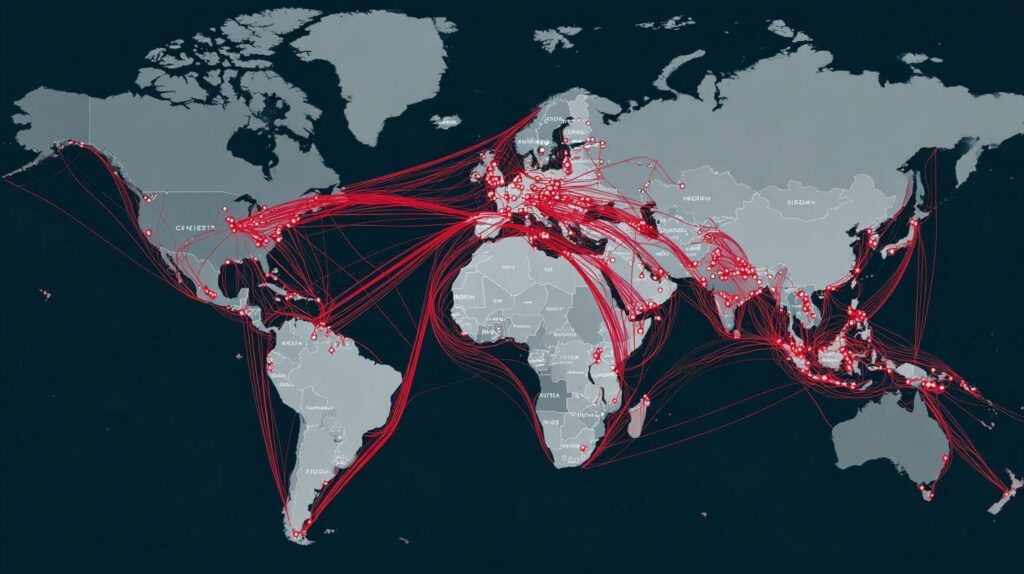
Two arteries handle 25% global trade; both now face existential risks costing $150B annually in detours. The Suez Canal and Black Sea routes serve as critical chokepoints for container shipping, bulk carriers, and LNG tankers. Geopolitical tensions have turned these paths into hotspots for disruption.
The 2021 Ever Given blockage in the Suez Canal halted 12% of traffic for days, exposing vulnerabilities. Recent Red Sea crisis from Houthi attacks prompted 50% of ships to divert in 2024, adding weeks to voyages. Meanwhile, the 2022 Black Sea blockade trapped 25Mt of grain, reshaping commodity flows.
These events preview economic cascading effects like soaring freight rates, port congestion, and supply chain disruptions. Businesses face higher logistics costs and shipping delays, pushing firms toward diversification strategies. Rerouting ships via longer paths increases fuel use and emissions, straining vessel capacity worldwide.
Experts recommend scenario planning to build supply chain resilience. Companies can explore multimodal transport, such as rail freight combined with sea routes, to mitigate risks from these disrupted traditional trade arteries.
Suez Canal Vulnerabilities and Houthi Attacks
Suez Canal revenues dropped 50% in early 2024 from Houthi attacks; 4,740 transits vs 7,000+ monthly average per SCA. The canal remains a vital link for oil trade routes and container shipping from Asia to Europe. Geopolitical tensions in the Bab el-Mandeb Strait have intensified maritime security concerns.
In 2021, the Ever Given blockage lasted 6 days, costing $9.6B per day in stalled trade. Houthi forces launched 90+ attacks in 2023, forcing vessels to take the Cape of Good Hope route. This adds 10-14 days to trips, with freight rates from Shanghai to Rotterdam surging 300%.
Such Suez Canal blockages trigger global ripple effects, including inventory stockpiling and air cargo surges for urgent goods. Firms dealing in semiconductors or critical minerals face heightened import dependencies. Naval escorts and satellite tracking via AIS data help monitor risks in real time.
To counter this Red Sea crisis, businesses adopt hedging strategies against currency fluctuations and rising insurance premiums. Diversifying to alternative trade paths, like the Northern Sea Route, builds resilience amid ongoing trade diversion.
Black Sea Blockades and Grain Corridor Impacts
Ukraine grain exports fell from 48Mt to 24Mt in 2022; Black Sea Grain Initiative exported 33Mt before Russia exit per UN. The Russia-Ukraine conflict created a naval blockade, halting wheat trade and fertilizer supply. This chokepoint disruption hit global food security hard.
Global wheat prices rose sharply, while fertilizer costs climbed amid the blockade. Romania’s exports jumped via alternative routes, with rail to Poland seeing heavy use. The July 2023 withdrawal ended safe passage, forcing overland options like the Middle Corridor.
These Black Sea blockades expose vulnerabilities in commodity flows and export routes. Energy security suffers as LNG rerouting adds to crude oil bypass needs. Companies turn to friendshoring and nearshoring to reduce exposure to such sanctions and embargoes.
Practical steps include geopolitical forecasting and risk assessment for grain exports. Multimodal transport via the Trans-Caspian route or India-Middle East-Europe corridor offers viable alternatives. This shift supports supply chain diversification against future conflicts.
Emerging Alternative Trade Routes
New routes cutting 40% transit times are gaining traction, with Arctic shipping up significantly since 2016 per NSR Administration. These paths respond to geopolitical tensions like the Russia-Ukraine conflict and Red Sea crisis. Options include the Northern Sea Route, which shortens distances by 40%, the India-Middle East-Europe Corridor saving 10 days from China to Europe, BRI rail reaching Moscow in 15 days, and the Trans-Caspian bypassing Russia.
Combined investments exceed $50 billion, fueling infrastructure for supply chain resilience. Companies diversify beyond chokepoints such as the Suez Canal and Strait of Malacca. This shift aids friendshoring and reduces reliance on vulnerable sea lanes amid sanctions and tariffs.
Multimodal transport combines rail, ship, and overland options for faster delivery. Firms use scenario planning to hedge against disruptions like Houthi attacks. These routes promote deglobalization trends and regional trade blocs.
Practical steps include monitoring AIS data for real-time rerouting and building inventory stockpiles. Experts recommend geopolitical forecasting to assess risks in Bab el-Mandeb Strait or Taiwan Strait. Such strategies lower logistics costs and shipping delays.
Northern Sea Route: Arctic Melting Opens New Paths
NSR cargo volume hit 36.2Mt in 2023 with icebreaker escorts, up 17% year-over-year. The route from Shanghai to Rotterdam saves 30% time compared to Suez. Arctic melting enables this path amid geopolitical tensions pushing LNG tankers northward.
Capacity targets reach 80Mt by 2030, but challenges persist with only 10% of the fleet as ice class ships. Icebreaker fees add significant costs around $1 million per use. Gazprom shipped 4.5Mt of LNG via NSR in 2023 despite EU sanctions limiting Western firms.
Shippers turn to this for energy security, bypassing Russian sanctions. Diversification strategies include chartering specialized vessels. Maritime security improves with satellite tracking for safer navigation.
Businesses assess freight rates and port congestion before committing. Overland backups via Eurasia trade corridors provide contingency options. This route exemplifies redrawing trade routes for resilience.
India-Middle East-Europe Corridor (IMEC)
IMEC cuts China-Europe shipping time by 10 days and costs by 30%. Key nodes are UAE and Saudi ports, highlighted at the G20 2023 summit. The route runs India to UAE, Saudi Arabia, Jordan, Israel, then Greece via rail and ship.
With $20 billion in investments, it counters China’s Belt and Road Initiative. Yet, Israel-Hamas conflict and Red Sea security pose risks from Houthi attacks. Companies explore this for supply chain disruption avoidance.
IMEC supports diversification from Strait of Malacca dependencies. Multimodal links reduce container shipping delays. Firms hedge with insurance premiums tailored to regional tensions.
Practical advice focuses on risk assessment for Middle Corridor viability. Alliances like QUAD enhance maritime domain awareness. This corridor aids EU trade policy shifts amid global realignments.
China’s Belt and Road Initiative (BRI) Rail Networks
China-Europe rail freight rose 30% to 1.7M TEU in 2023 via BRI. The Xi’an-Duisburg line takes 15 days versus 45 by sea. Six corridors include New Eurasian Landbridge and China-Mongolia-Russia paths.
Poland’s Mauserk terminal manages 700k TEU annually. Rail costs about $2k per container versus $1.5k sea pre-crisis. BRI rail thrives amid US-China trade war and Suez blockages.
This network boosts overland routes and Silk Road revival. It eases Panama Canal issues for Eurasian flows. Businesses prioritize rail freight for critical minerals and semiconductors.
Strategies involve big data analytics for trade flow visualization. Trans-Caspian extensions bypass Russia effectively. BRI fosters BRICS expansion and commodity flows resilience.
Pan-American Highway and Latin American Realignments
Mexico-China imports surged 60% since the 2018 trade war. US-Mexico trade hits $900B as nearshoring accelerates. Tesla’s $10B Monterrey factory and Foxconn in Mexico drive this shift.
Panama Canal issues push Pacific routes and overland options. Chile-Lithuania battery trade grows significantly. The Pan-American Highway links supply chains amid deglobalization.
Nearshoring reduces import dependencies on Asia. It counters tariffs and semiconductor shortages. Regional blocs like USMCA enhance trade balance stability.
Experts advise contingency planning for vessel capacity limits. Air cargo surges complement highway use. This realignment mitigates inflation from shipping delays.
Technological and Logistical Adaptations
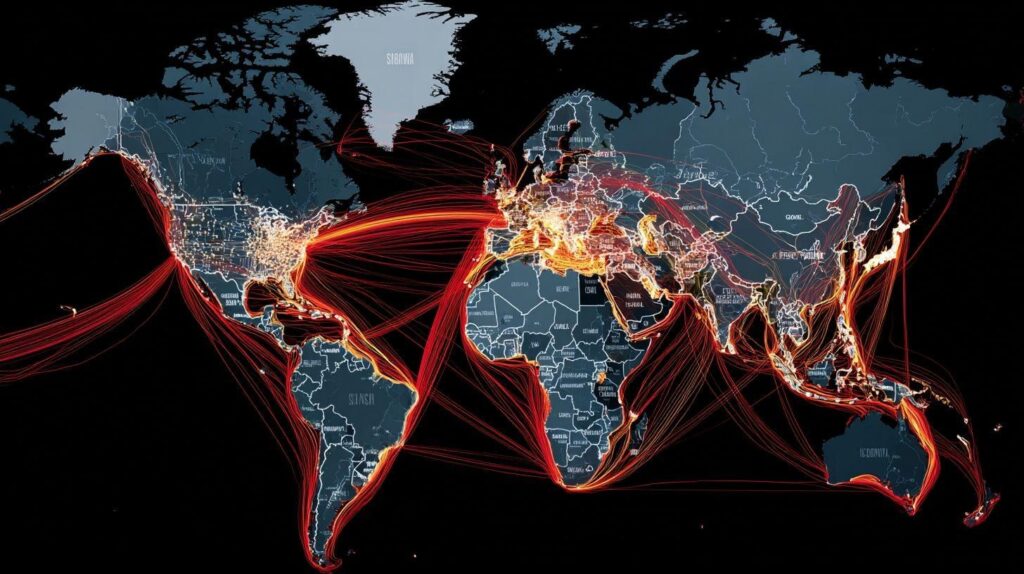
Companies diversified 37% of China supply chains since 2020 according to McKinsey reports. Air freight volumes rose 12% year over year amid geopolitical tensions. These shifts respond to disruptions like the Red Sea crisis and US-China trade war.
Nearshoring strategies cut logistics costs by moving production closer to markets. Firms now use air cargo more for high-value goods such as electronics and pharmaceuticals. This adaptation helps bypass chokepoints like the Suez Canal blockage and Bab el-Mandeb Strait issues.
Technology plays a key role with blockchain tracking for real-time visibility and AI forecasting for demand planning. Tools like satellite tracking and AIS data improve maritime security awareness. Companies build supply chain resilience through these innovations.
Practical steps include adopting multimodal transport with rail and air options. Experts recommend scenario planning for rerouting ships around Houthi attacks. These changes redraw trade routes for greater reliability.
Nearshoring and Friendshoring Strategies
Apple shifted 30% of iPhone production to India and Vietnam. Intel’s $20B Ohio fab exemplifies friendshoring to allies. These moves counter supply chain disruptions from sanctions and tariffs.
Nike boosted production in Vietnam while Intel expanded in Costa Rica. Tesla invested heavily in Mexico for vehicle assembly. Such nearshoring reduces exposure to distant risks like the Russia-Ukraine conflict.
Research suggests many firms accelerate diversification to regional trade blocs. Mexico sees rising manufacturing investments amid USMCA ties. This approach strengthens ties with trusted partners and cuts shipping delays.
Actionable advice includes assessing import dependencies and prioritizing allies. Firms stockpile critical minerals through friendshoring. These strategies enhance resilience against deglobalization trends.
Supply Chain Diversification via Air and Rail
Air cargo rates hit $12/kg peak in 2021 amid container shortages. Rail links from China to Europe grew as sea routes faced failures from the Red Sea crisis. These shifts highlight multimodal transport gains.
Air freight surges for electronics and pharma due to urgent needs. Rail boosts consumer goods flows via the Middle Corridor and Trans-Caspian route. Overland paths revive Silk Road options amid Panama Canal issues.
Platforms like Flexport offer visibility across modes. Maersk combines rail and sea for efficiency. Global inventory days increase to buffer port congestion and freight rate spikes.
Companies should explore Arctic shipping routes and India-Middle East-Europe corridor for alternatives. Hedging strategies manage currency fluctuations from trade diversion. This diversification builds robustness against ongoing geopolitical risks.
Economic and Strategic Implications
Global freight rates are up 160% since 2021 lows. IMF estimates show 0.7% global inflation contribution from shipping. These rises stem from geopolitical tensions like the Red Sea crisis and Houthi attacks, forcing rerouting ships around Africa.
Annual costs hit $1.5T with a 1% GDP drag worldwide. Companies face supply chain disruption from Suez Canal blockage and Panama Canal issues. Businesses adapt via nearshoring and friendshoring to cut logistics costs.
Strategically, trade alliances now outweigh military pacts. BRICS holds 40% GDP share by 2030, pushing deglobalization. Expect shifts in the sections below on costs, inflation, and BRICS trade blocs.
Firms use hedging strategies against currency fluctuations from sanctions. Experts recommend scenario planning for chokepoints like Bab el-Mandeb Strait. Diversification builds supply chain resilience.
Cost Increases and Inflationary Pressures
Container freight Shanghai-Europe hit $10,000/FEU in January 2024 versus $1,500 pre-crisis. This adds 1.4% to EU CPI per ECB. Geopolitical tensions from Russia-Ukraine conflict drive these spikes in container shipping.
Costs break down with containers up 300%, bulk carriers 80% higher, and air cargo 50% more. Insurance premiums surge 500% due to Houthi attacks and piracy risks. Walmart spent an extra $1B on shipping in 2022 alone.
- Rerouting via Cape of Good Hope adds weeks and fuel costs to bulk carriers.
- Port congestion worsens from vessel capacity shortages.
- Multimodal transport like rail freight rises as alternatives.
IMF links this to 0.7% global inflation. Companies counter with inventory stockpiling and freight rate hedging. Track AIS data for real-time maritime security insights.
Power Shifts: Rise of BRICS Trade Blocs
BRICS+ now claims 37% global GDP PPP. Intra-BRICS trade rose 56% since 2018 to $500B per IMF. Expansion includes Egypt, UAE, Iran, and Saudi Arabia in 2024, redrawing trade routes.
De-dollarization grows with 28% Russia-China trade in RMB. RCEP covers 30% GDP, outpacing CPTPP amid US-China trade war. Putin noted a “new world order” as blocs form.
- Belt and Road Initiative boosts Eurasia trade corridor.
- Middle Corridor and Trans-Caspian route bypass sanctions.
- India-Middle East-Europe corridor, or IMEC, links new paths.
These shifts promote regional trade blocs over global chains. Firms eye Northern Sea Route for Arctic shipping. Use geopolitical forecasting to assess alliance shifts like QUAD and AUKUS.
Future Outlook and Policy Recommendations
WEF forecasts 25% trade route reconfiguration by 2030 as Arctic opens and BRI rail matures. Geopolitical tensions continue to reshape global trade, pushing companies toward diversified paths amid risks like Suez Canal blockages and Red Sea crises.
Three key scenarios emerge: status quo with gradual shifts, hot war sparking severe supply chain disruptions, or a new cold war favoring friendshoring. Tools like AIS data analytics and scenario planning help businesses forecast rerouting needs.
Policy priorities include building maritime security through alliances and investing in alternative routes such as the Northern Sea Route. Leaders must prioritize resilience against chokepoints like the Strait of Malacca and Taiwan Strait.
Forward-thinking strategies focus on deglobalization trends, regional trade blocs, and multimodal transport to counter sanctions and tariffs from conflicts like the US-China trade war.
Potential Escalations and Route Forecasts
CSIS Taiwan wargame shows a blockade could cut much Asian trade, while Arctic NSR manages notable Asia-Europe volume by 2035 per DNV. Such scenarios highlight geopolitical risk in chokepoints like Bab el-Mandeb Strait and Houthi attacks.
In a contained escalation, IMEC sees increased traffic as firms bypass Red Sea issues via India-Middle East-Europe corridor. AIS data from MarineTraffic and ExactEarth tracks these shifts in real time for bulk carriers and LNG tankers.
Hot conflict risks massive global trade drops from naval escorts and port congestion. Meanwhile, a new cold war accelerates Arctic shipping routes and Middle Corridor for overland options.
Experts recommend scenario planning to model trade diversion, logistics costs, and vessel capacity strains from Russia-Ukraine conflict or South China Sea tensions.
Strategies for Resilience in a Fragmented World
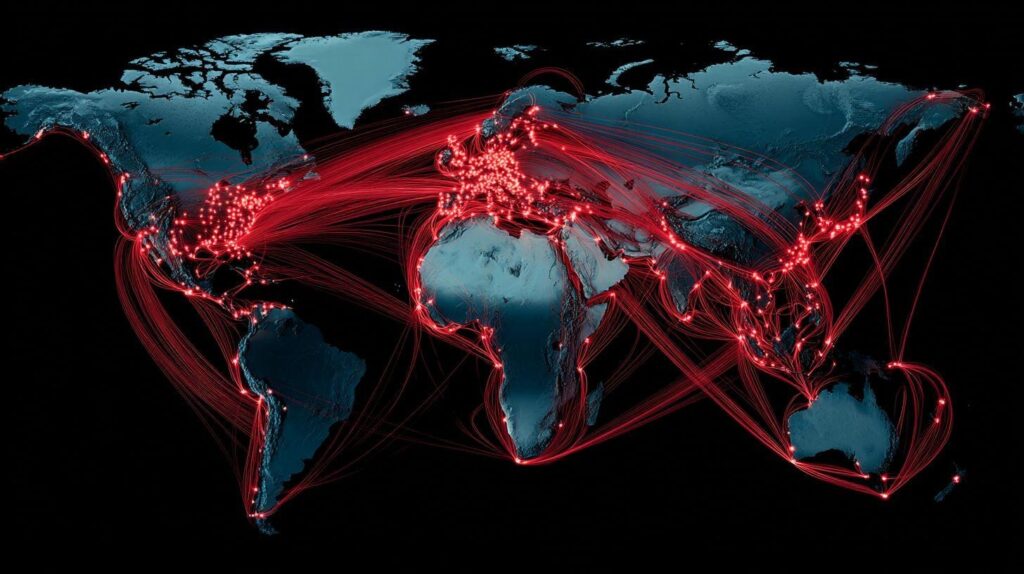
McKinsey recommends ‘China+1’ strategies like shifting to Vietnam or India, paired with 3PL partnerships and higher inventory buffers. These steps counter supply chain disruption from tariffs and economic sanctions.
Businesses build strength through targeted actions. Key recommendations include:
- Dual-source critical minerals to reduce import dependencies on rare earths and semiconductors.
- Deploy AI supply chain twins, as seen in IBM models, for real-time risk assessment.
- Form friendshoring alliances within QUAD or AUKUS to secure export routes.
- Enhance maritime domain awareness using SpaceX Starlink for satellite tracking amid piracy risks.
- Pursue regional trade pacts like ASEAN or BRICS to foster nearshoring and energy security.
These steps promote supply chain resilience, hedging against freight rates spikes and currency fluctuations from Indo-Pacific strategy shifts.
Frequently Asked Questions
How are geopolitical tensions redrawing trade routes in the context of the Red Sea crisis?
Geopolitical tensions, particularly Houthi attacks in the Red Sea amid the Israel-Hamas conflict, have forced shipping companies to reroute vessels around Africa’s Cape of Good Hope, adding weeks to transit times and increasing costs. This is a prime example of how geopolitical tensions are redrawing trade routes, shifting reliance from the Suez Canal to longer maritime paths.
What role does the Russia-Ukraine war play in how geopolitical tensions are redrawing trade routes?
The Russia-Ukraine war has disrupted Black Sea grain exports and prompted sanctions on Russian energy, leading Europe to seek alternative LNG supplies from the US and Qatar via expanded Atlantic routes. This illustrates how geopolitical tensions are redrawing trade routes by accelerating diversification away from traditional Eurasian corridors.
How are US-China tensions influencing how geopolitical tensions are redrawing trade routes?
Escalating US-China trade wars and tech restrictions have spurred ‘friendshoring’ and nearshoring, with companies relocating supply chains to Mexico, Vietnam, and India. Consequently, how geopolitical tensions are redrawing trade routes involves a pivot from direct transpacific shipping to multi-hub networks in Southeast Asia and Latin America.
In what ways is the Belt and Road Initiative countering how geopolitical tensions are redrawing trade routes?
China’s Belt and Road Initiative (BRI) is building alternative land and sea routes through Central Asia and Pakistan to bypass chokepoints like the Malacca Strait. This strategic response shows how geopolitical tensions are redrawing trade routes, fostering new silk roads amid Indo-Pacific rivalries.
How do sanctions on Iran affect how geopolitical tensions are redrawing trade routes?
Sanctions limiting Iranian oil exports have boosted tanker traffic through the Strait of Hormuz alternatives and shadow fleets, while encouraging India and others to source from Russia via Arctic routes. This demonstrates how geopolitical tensions are redrawing trade routes toward riskier, less monitored paths.
What future trends emerge from how geopolitical tensions are redrawing trade routes?
Emerging trends include Arctic shipping growth due to melting ice, increased air freight for high-value goods, and digital trade platforms reducing physical route dependency. Overall, how geopolitical tensions are redrawing trade routes signals a more resilient, multipolar global trade architecture resilient to conflicts.