
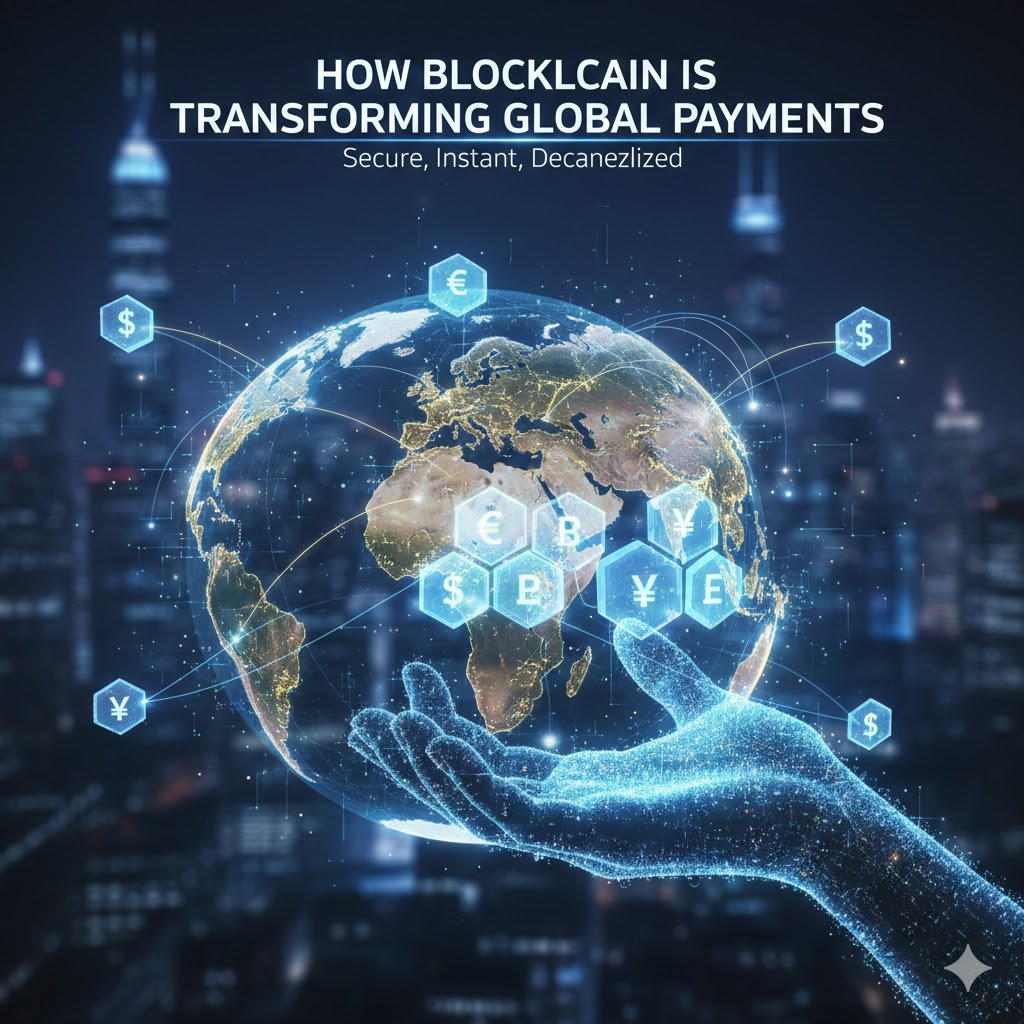
Global payments have long been slow, expensive, and dependent on layers of intermediaries. Sending money across borders often involves multiple banks, clearing networks, currency conversions, and settlement delays that can stretch from hours to several days. Fees can be high, transparency is limited, and tracking a payment in real time is rarely simple.
Blockchain technology is changing this landscape. By enabling direct value transfer on shared digital networks, blockchain based payment systems are making international transactions faster, cheaper, and more transparent. What began as the underlying technology for cryptocurrencies is now being adopted by financial institutions, fintech firms, and payment providers around the world.
The Problems With Traditional Cross Border Payments
Before understanding the transformation, it helps to see the challenges of the existing system.
Multiple intermediaries
A typical international payment passes through correspondent banks before reaching the final recipient. Each intermediary adds processing time and takes a fee.
Slow settlement
Even when a payment is sent instantly by the sender, the actual settlement between banks can take days because systems operate in batches and across different time zones.
High and unclear costs
Fees include transfer charges, foreign exchange spreads, and receiving fees. Often the sender does not know the full cost until the recipient gets less than expected.
Limited transparency
Tracking a cross border payment is difficult. Both sender and receiver may not know exactly where the money is during transit.
How Blockchain Changes the Payment Process
Blockchain replaces fragmented, institution specific ledgers with a shared and synchronised ledger.
Direct peer to peer transfer
Instead of passing through several banks, value can move directly from sender to receiver over a blockchain network. This reduces the number of parties involved.
Near instant settlement
Transactions on many blockchain networks settle in minutes or even seconds. Once confirmed, they are final and do not require further reconciliation.
Lower transaction costs
With fewer intermediaries and automated processing, fees can drop significantly compared to traditional wire transfers.
Built in transparency
Every transaction is recorded on a shared ledger that can be viewed and verified. Participants can track payments in real time.
The Role of Stablecoins in Global Payments
Volatility has been one barrier to using traditional cryptocurrencies for payments. Stablecoins address this issue.
Price stability
Stablecoins are digital tokens designed to maintain a stable value, often pegged to a major currency like the US dollar or euro. This makes them suitable for everyday transactions.
Faster cross border transfers
A company can send stablecoins across the world within minutes, and the recipient can convert them into local currency or reuse them for further payments.
Always on infrastructure
Blockchain networks operate twenty four hours a day, including weekends and holidays. This removes the delays caused by banking cut off times.
Real World Use Cases
Blockchain payments are moving from pilots to real operations in several areas.
Remittances
Migrant workers sending money home can use blockchain based services to reduce fees and deliver funds to families almost instantly.
Business to business payments
Companies paying overseas suppliers can settle invoices quickly, improving cash flow and reducing working capital needs.
E commerce and digital services
Online businesses can accept global payments without relying on expensive card networks or facing long settlement delays.
Treasury and liquidity management
Multinational firms can move funds between subsidiaries in different countries rapidly, improving control over global cash positions.
Integration With Traditional Finance
Blockchain is not replacing banks. Instead, it is becoming a new payment rail that banks and payment companies can use.
Bank issued digital money
Some institutions are experimenting with tokenised deposits and digital versions of traditional currencies that move on blockchain networks.
Payment network upgrades
Established payment providers are connecting to blockchain infrastructure to offer faster cross border settlement to their customers.
Compliance and regulation
Modern blockchain payment platforms include identity checks and transaction monitoring to meet anti money laundering and regulatory standards.
Key Benefits for the Global Economy
Financial inclusion
People without access to traditional banking can receive and send digital payments using only a mobile phone and an internet connection.
Greater competition
Lower barriers to entry allow new payment providers to compete, which can drive down costs for consumers and businesses.
Reduced friction in trade
Faster and more predictable payments support smoother international trade and supply chains.
Challenges That Still Exist
Blockchain payments are promising, but not without hurdles.
Regulatory differences
Rules for digital assets vary by country, which can complicate truly global adoption.
Technical scalability
Public blockchains must continue improving speed and capacity to handle very large payment volumes.
User experience
Managing digital wallets and keys can be confusing for everyday users without simplified interfaces.
Interoperability
Different blockchain networks need better ways to connect so value can move seamlessly across them.
The Future of Global Payments
The most likely future is a hybrid model where traditional banking systems and blockchain networks work together.
Banks may hold customer funds while blockchain networks handle the movement and settlement. Stablecoins and tokenised bank money could act as digital cash for the internet age. Cross border transfers that once took days may become as quick as sending a message.
As standards mature and regulation becomes clearer, blockchain based payments could become an invisible but powerful layer beneath everyday financial apps.
Conclusion
Blockchain is transforming global payments by reducing intermediaries, accelerating settlement, lowering costs, and increasing transparency. From remittances to corporate treasury operations, real world use cases are expanding rapidly.
While challenges remain around regulation, scalability, and usability, the direction is clear. Global payments are moving toward a future where money travels across borders as easily and instantly as information.
FAQ
What is a blockchain payment
A blockchain payment is a transfer of value recorded on a distributed digital ledger, allowing money to move directly between parties without multiple intermediaries.
How fast are blockchain cross border payments
Many settle within seconds to minutes, compared to traditional international wires that can take one to three business days.
Are blockchain payments cheaper
In many cases yes, because there are fewer middlemen and automated processing reduces operational costs.
What is a stablecoin
A stablecoin is a digital token designed to hold a stable value, usually linked to a traditional currency, making it suitable for everyday payments.
Do blockchain payments replace banks
No. Banks can use blockchain as a new infrastructure layer while still providing custody, compliance, and customer services.
Are these payments secure
Blockchain transactions are protected by strong cryptography and network consensus, making records very difficult to alter.
Can businesses use blockchain for international invoices
Yes. Companies can pay suppliers across borders quickly and often at lower cost using blockchain based payment platforms.
What are the main barriers to adoption
Regulatory uncertainty, technical scaling, and the need for simpler user experiences are the biggest current challenges.
Do blockchain networks work all the time
Yes. Most operate continuously without weekends or holidays, enabling round the clock payments.
Will blockchain become the standard for global payments
It is likely to become a major component of future payment systems, especially for cross border and digital native transactions.