
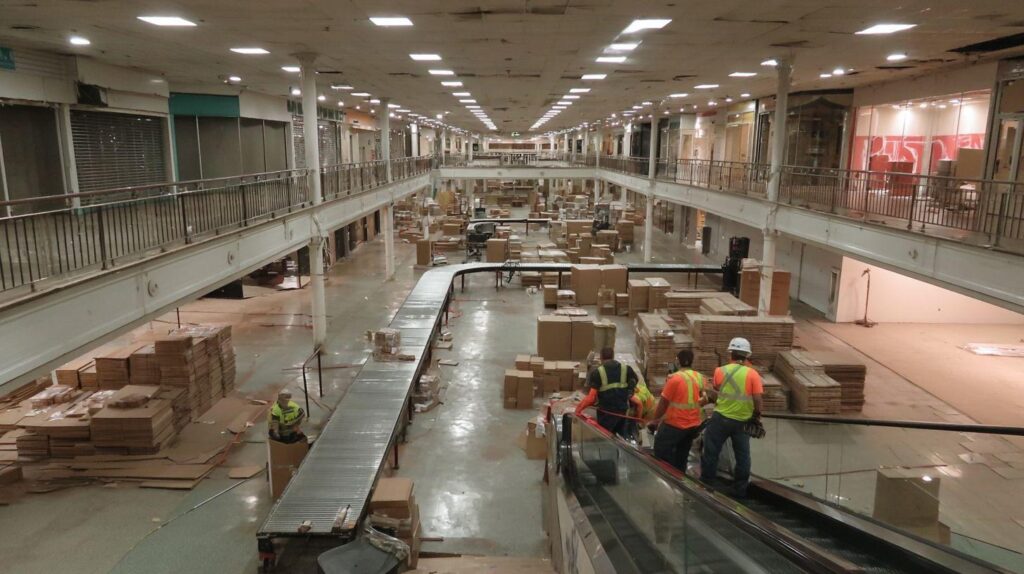
Once bustling hubs of American consumerism, today’s malls stand eerily vacant, with vacancy rates exceeding 10% nationwide per CoStar Group data. This decline, fueled by e-commerce giants and shifting behaviors, signals a seismic retail shift. Discover how repurposing these spaces into fulfillment centers offers economic revival-exploring case studies, benefits, challenges, and future trends that could redefine urban logistics.
The Rise and Fall of Malls
1956’s Southdale Center launched 2,500+ U.S. malls by 1990, peaking at 1.8 billion sq ft before 50% value loss by 2022. This Minnesota mall set the template for enclosed shopping centers with climate control and anchor tenants. It sparked a boom in traditional retail space across suburbs.
By the 1970s, around 1,400 malls dotted the landscape, drawing families for one-stop shopping. Big box stores like Sears anchored these hubs, fueling brick-and-mortar stores growth. Foot traffic surged as malls became social destinations.
The sector hit its high in 2007, with peak square footage and retail sales. Yet, e-commerce growth soon eroded dominance, leading to Sears bankruptcy and JCPenney decline. By 2023, CoStar noted about 1,100 dead malls, plagued by vacant storefronts.
Key milestones trace this arc:1956: Southdale opens, pioneering the mall model.1970s: Rapid expansion to 1,400 locations.2007: Peak occupancy and revenue.2023: Widespread closures amid retail apocalypse. Owners now eye mall conversion to fulfillment centers for survival.
- 1956: Southdale opens, pioneering the mall model.
- 1970s: Rapid expansion to 1,400 locations.
- 2007: Peak occupancy and revenue.
- 2023: Widespread closures amid retail apocalypse.
E-Commerce Revolution Overview
E-commerce captured 23% of U.S. retail ($1.1T) in 2023, up from 8% in 2015, driving demand for 500M+ sq ft of logistics space. This shift fueled the decline of traditional retail space, as consumers embraced online shopping over brick-and-mortar stores. Companies like Amazon built vast networks to meet rising expectations for fast delivery.
Amazon’s 350M sq ft fulfillment network exemplifies how e-commerce growth outpaced physical retail. Traditional malls faced vacant storefronts and anchor tenant exits, such as Sears bankruptcy and JCPenney decline. The retail apocalypse accelerated with store closures and foot traffic drops.
Supply chain demands prompted conversions of shopping centers into fulfillment centers. Suburban malls, once bustling, now serve as last-mile delivery hubs with inventory storage. This adaptive reuse addresses leasing challenges and ROI decline in retail real estate.
Examples include big box stores turning into distribution centers, supporting click-and-collect and BOPIS models. The pandemic impact and consumer behavior shift toward omnichannel retail further boosted warehouse conversion. Real estate investors, including REITs like Simon Property Group, explore mall conversions to revive dead malls.
Thesis: Repurposing as the Path Forward
Converting 20% of dead mall space (360M sq ft) could meet 40% of e-commerce logistics demand through 2030. This approach tackles the decline of malls by transforming vacant storefronts into fulfillment centers. Adaptive reuse offers a practical solution amid the retail apocalypse.
ROI for mall conversion stands at $15-25 per sq ft, far below the $50+ for new builds. Property owners avoid high construction costs while repurposing existing structures. Simon Property Group’s pilot programs demonstrate success in turning shopping centers into logistics hubs.
These conversions support e-commerce growth by providing space for inventory storage and last-mile delivery. Suburban malls, once reliant on anchor tenants like Sears, now host distribution operations. This shift addresses store closures and falling foot traffic.
Real estate investors and REITs benefit from warehouse conversion, boosting property values in declining areas. Examples include integrating click-and-collect points with fulfillment roles. Such retail transformation aligns with consumer behavior shifts toward online shopping.
Historical Context of Retail Malls
Malls symbolized post-war prosperity but structural decline began with department store failures. These retail cathedrals evolved from open-air shopping centers into enclosed havens, drawing families with air-conditioned comfort and one-stop convenience. Over decades, they shifted from booming hubs to distressed assets amid the retail apocalypse.
The transition accelerated as e-commerce growth eroded foot traffic in brick-and-mortar stores. Anchor tenants like Sears faced bankruptcy, leaving vacant storefronts and leasing challenges. Today, mall conversion to fulfillment centers offers adaptive reuse for commercial property owners.
Suburban malls once defined physical retail, but consumer behavior shifts toward online shopping reshaped retail real estate. Experts recommend exploring warehouse conversion to combat ROI decline. This evolution highlights the decline of traditional retail space into potential logistics hubs.
From peak dominance to dead malls, the story involves store closures and big box store struggles. Property redevelopment now focuses on mixed-use plans, turning shopping centers into distribution centers for last-mile delivery.
Golden Age of Malls (1950s-1990s)
By 1985, malls generated half of U.S. retail sales with Victor Gruen’s enclosed design attracting hundreds of millions of annual visitors per major center. The 1956 opening of Southdale Center in Minnesota marked the first fully enclosed mall, featuring climate control and multi-level parking. This innovation sparked a wave of shopping centers across suburbs.
In 1962, Randhurst Mall near Chicago introduced the circular layout, boosting pedestrian flow and tenant variety. The 1970s saw a regional mall boom, with architects adding atriums, fountains, and food courts to mimic community gathering spots. These designs turned malls into social destinations beyond mere shopping.
Peak metrics showed thriving anchor tenants driving traffic, while architectural trivia like skylights and sculptures enhanced appeal. Malls embodied omnichannel retail precursors with in-mall events. Yet, early signs of e-commerce hinted at future foot traffic drops.
Landlords invested in expansions, creating vast square footage for big box stores. Today, this legacy informs mall conversion strategies, repurposing vast spaces for inventory storage and supply chain needs in the era of Amazon warehouses.
Peak Retail Dominance
2007 marked retail peak with over 10 billion square feet of commercial space before the Great Recession triggered widespread permanent closures. Malls hit stride with anchor tenants like Sears and JCPenney dominating revenue through apparel and appliances. NRF insights highlighted malls as employment engines for retail workers nationwide.
Department stores anchored vast properties, pulling in crowds for experiential retail like holiday displays and sales events. This era saw malls as retail real estate crown jewels, with high occupancy and steady leasing. Big box stores amplified draw, filling square footage with home goods and electronics.
Consumer visits peaked amid low online shopping penetration, supporting brick-and-mortar stores. Employment stats reflected bustling food courts and specialty shops. However, cracks appeared with early store closures, foreshadowing the retail transformation.
The recession accelerated Sears bankruptcy and JCPenney decline, leaving dead malls behind. Now, owners eye fulfillment centers for vacant spaces, adapting to e-commerce with click-and-collect and BOPIS models. This shift aids logistics hubs amid pandemic impact and remote work influences.
Drivers of Traditional Retail Decline
Multiple structural forces converged to reduce mall foot traffic since the 2016 peak. These drivers include the rise of online shopping giants, shifting consumer behaviors, the pandemic’s lasting effects, and economic pressures on brick-and-mortar stores. Each contributed to the decline of malls and the growth of fulfillment centers.
The retail apocalypse left vacant storefronts and dead malls in its wake. Retailers faced store closures as e-commerce growth outpaced physical sales. This shift prompted mall conversion into logistics hubs for last-mile delivery.
Anchor tenants like big box stores struggled with foot traffic drop. Brands such as Sears bankruptcy and JCPenney decline highlighted leasing challenges. Property owners now explore adaptive reuse for commercial property viability.
Real estate investors and REITs like Simon Property Group adapted through warehouse conversion. Suburban malls became distribution centers, while urban spaces eyed mixed-use development. This retail transformation reflects broader supply chain demands.
Rise of Online Shopping Giants
Amazon’s dominant position in U.S. e-commerce eliminated thousands of retail jobs while building vast fulfillment centers. This e-commerce growth fueled the need for Amazon warehouses and pressured traditional retail space. Online shopping now drives inventory storage and distribution needs.
CompanyMarket ShareAmazon38%Walmart7%Target3%
| Company | Market Share |
| Amazon | 38% |
| Walmart | 7% |
| Target | 3% |
Shopify’s expansion to over 2 million merchant stores enableed direct-to-consumer brands. These platforms accelerated marketplace dominance, reducing reliance on shopping centers. Retailers pivoted to dark stores for click-and-collect services.
Practical examples include Walmart fulfillment centers handling grocery delivery hubs. Target distribution networks support BOPIS options. This trend underscores retail real estate shifts toward logistics and pallet storage.
Changing Consumer Behaviors
Gen Z and millennials show clear preferences for digital channels over physical stores. Research suggests many young shoppers opt for online weekly, favoring omnichannel retail. This consumer behavior shift cut time spent in brick-and-mortar locations.
Experts recommend blending channels, as most consumers use multiple touchpoints. Buy online pickup in store (BOPIS) appeals to those seeking convenience. Brands like pop-up shops and experiential retail try to draw crowds back.
- Millennials prioritize subscription boxes and loyalty programs.
- Gen Z embraces sustainability in retail and direct-to-consumer models.
- Omnichannel stats highlight demand for seamless experiences.
High streets and pedestrian zones survive by integrating smart city features like IoT sensors. Thrift stores and flea markets thrive amid discount retailer growth. Malls must adapt to these habits for revitalization.
Impact of the COVID-19 Pandemic
The pandemic triggered widespread disruptions, with lockdowns leading to thousands of temporary store closures. Mall foot traffic plummeted, speeding the pandemic impact on physical retail. This compressed years of digital shift into months.
Urban logistics faced steeper declines than suburban malls, which later housed urban decay recovery efforts. Remote work influence kept shoppers away from city centers. Revitalization projects now focus on community malls and lifestyle centers.
- March 2020: Widespread lockdowns begin.
- 2020-2021: Temporary closures mount.
- By 2022: Many turn permanent.
Public-private partnerships aid property redevelopment. Examples include gym conversions and entertainment venues in vacant spaces. This acceleration boosted demand for micro-fulfillment and drone hubs.
Economic Pressures on Brick-and-Mortar
Retail rents dropped sharply while operating costs climbed, squeezing cash flow for many shopping centers. This created challenges for Class B and C malls, worsening the ROI decline. Brick-and-mortar stores grappled with rising expenses and falling property values.
Mortgage defaults and foreclosure auctions hit REITs hard, prompting dividend adjustments. Groups like Brookfield Properties navigated leasing challenges amid REIT struggles. Investors turned to zoning changes for mixed-use potential.
- Cap rates increased, raising financing costs.
- Labor shortages compounded operational woes.
- Property values dropped, spurring adaptive strategies.
Solutions include residential conversion, office space, or vertical farming. Tax incentives support green retrofits and EV charging stations. This pressures owners toward fulfillment centers for stable income.
Current State of Mall Vacancies
The 25% national vacancy rate masks regional devastation with Midwest and Southeast malls at 40%+ empty. This decline of traditional retail space stems from e-commerce growth and shifting consumer behavior. Vacant storefronts now dominate many shopping centers.
Empty malls offer prime opportunities for mall conversion into fulfillment centers. Property owners face leasing challenges amid the retail apocalypse. Adaptive reuse can transform dead malls into logistics hubs.
Regional breakdowns reveal stark differences in retail real estate performance. Rust Belt areas suffer higher vacancies due to population shifts. Sun Belt locations show more resilience with mixed-use potential.
Experts recommend assessing local foot traffic drop and anchor tenant status. Converting to last-mile delivery sites addresses supply chain needs. This shift supports omnichannel retail strategies for brick-and-mortar stores.
Statistics on Empty Retail Spaces
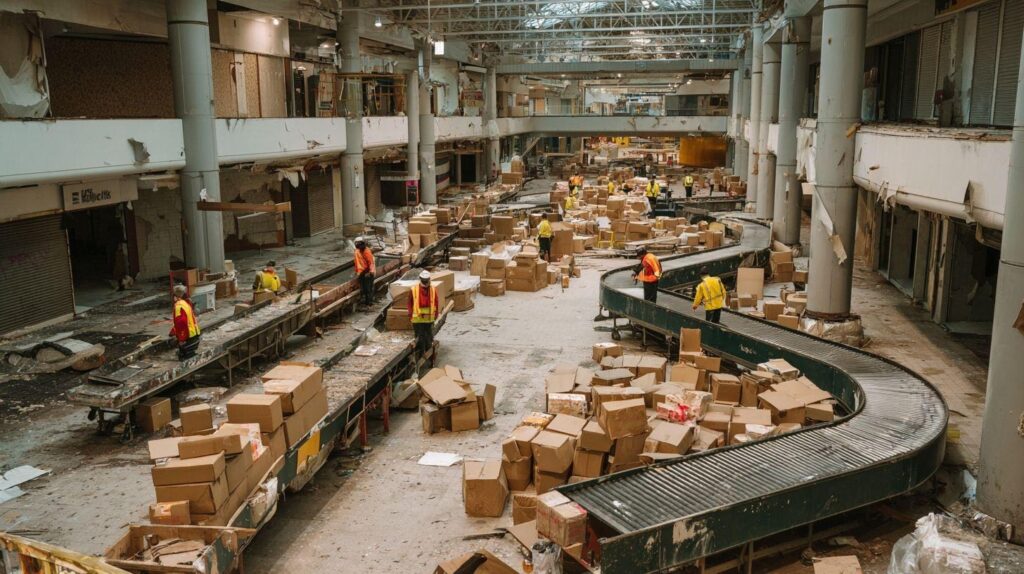
CoStar reports 1,211 dead malls with 30% national vacancy equating to 540M sq ft available. This vast square footage highlights the scale of the retail transformation. Developers eye these spaces for warehouse conversion.
Physical retail struggles as online shopping rises. Vacant spaces suit inventory storage and distribution centers. Regional data shows varied impacts across the U.S.
| Region | Vacancy Rate | Total Sq Ft Available |
| Northeast | 22% | 120M |
| Midwest | 38% | 180M |
| South | 29% | 150M |
| West | 21% | 90M |
Midwest leads in vacant storefronts, ideal for Amazon warehouses. South regions balance retail with logistics potential. West benefits from urban logistics demand.
Anchor Store Departures
Sears (2018 bankruptcy), JCPenney (2020), and Macy’s (100+ closures) vacated 50M sq ft of anchor space. These store closures triggered 20-30% traffic drops per departure. Big box store exits accelerated mall decline.
Sears bankruptcy left massive voids in suburban malls. JCPenney decline worsened leasing challenges. Macy’s downsizing fueled the retail apocalypse.
| Retailer | Stores Closed | Year |
| Sears | 687 | 2018 |
| JCPenney | 156 | 2020 |
| Macy’s | 125 | Ongoing |
Anchor tenant losses create opportunities for fulfillment centers. Pop-up shops or experiential retail fill gaps temporarily. Long-term, logistics hubs boost ROI.
Regional Variations in Decline
Rust Belt states average 42% vacancy vs Sun Belt’s 24%, creating arbitrage opportunities for logistics conversion. This population density correlation drives uneven decline. High-density areas resist better.
Ohio and Illinois face severe dead malls issues from manufacturing losses. Texas and Florida show recovery via diverse tenants. Correlation with density guides investment.
| State | Vacancy Rate |
| Ohio | 47% |
| Illinois | 43% |
| Texas | 19% |
| Florida | 25% |
Sun Belt malls adapt with buy online pickup in store models. Rust Belt conversions to dark stores or micro-fulfillment thrive. Zoning changes enable property redevelopment.
The Fulfillment Center Model
Modern centers optimize e-commerce via automation and efficient layouts, often averaging 200K sq ft with 24-48hr delivery guarantees. This model addresses the decline of traditional retail space by repurposing vacant malls into logistics hubs. Companies convert empty anchor tenant spots to handle surging online shopping demand.
These facilities support last-mile delivery and inventory storage, turning dead malls into vital supply chain nodes. For instance, suburban malls with ample parking lots become ideal for truck access and expansion. This shift helps combat the retail apocalypse through adaptive reuse of commercial property.
Operations focus on speed and scalability, integrating with omnichannel retail like buy online pickup in store options. Experts recommend prioritizing locations near urban centers for micro-fulfillment. Such conversions boost property values and attract real estate investors seeking stable REIT returns.
Mall owners like Simon Property Group explore these models amid store closures from chains like Sears bankruptcy and JCPenney decline. The pandemic impact accelerated foot traffic drops, making fulfillment a practical path for revitalization. This approach aligns with consumer behavior shifts toward e-commerce growth.
What Are Modern Fulfillment Centers?
Facilities averaging 200K-500K sq ft with 30+ dock doors serve a 100-mile radius for same-day delivery. These centers transform vacant storefronts in declining shopping centers into efficient distribution centers. They handle high-volume throughput for platforms driving the retail transformation.
Space breaks down with inbound areas at about 20% for receiving goods, storage claiming 50% for pallet storage, picking and packing using 20%, and shipping at 10%. This layout maximizes flow in former big box stores. Conveyor systems and high-bay racking fit well in mall conversions.
Throughput metrics emphasize quick turnover, supporting just-in-time delivery and click-and-collect services. Research suggests optimizing dock doors reduces bottlenecks in urban logistics. Examples include dark stores in strip malls processing grocery delivery hubs for Instacart facilities.
These setups address leasing challenges in physical retail by offering steady rental income. Property redevelopment turns suburban malls into mixed-use sites with fulfillment as the core. This model supports reverse logistics and returns processing in the era of rising e-commerce penetration.
Key Operations and Technologies
Kiva robots process 4x picks per hour while AI optimizes 95% slotting accuracy across 100M+ SKUs per month. Core operations rely on a tech stack that boosts efficiency in warehouse conversion projects. Automation tackles labor shortages common in fulfillment centers.
WMS systems like those from Manhattan Associates manage inventory in real time. RFID and Zebra scanners track items from inbound to outbound. These tools enable predictive analytics for demand forecasting in omnichannel setups.
| Technology | Vendor Example | Key Benefit |
| WMS | Manhattan Associates | Real-time inventory control |
| Automation | GreyOrange robots | Faster picking and packing |
| Inventory Tracking | RFID/Zebra | Accurate slotting and traceability |
ROI comes from reduced errors and speed gains, vital for last-mile delivery in mall retrofits. AI inventory management cuts waste, aligning with sustainability in retail. Practical examples show conveyor systems speeding cross-docking in former department stores.
Major Players (Amazon, Others)
Amazon operates 350M sq ft across 185+ centers while Walmart added 210M sq ft since 2018. These giants lead mall conversion efforts, leasing space from owners facing ROI decline. Their networks power Amazon warehouses and Walmart fulfillment amid brick-and-mortar struggles.
Target runs about 100M sq ft, UPS around 85M, focusing on strategic retail real estate buys. Leasing dominates for flexibility, with ownership in prime logistics hubs. This mix supports BOPIS and same-day services from repurposed properties.
| Player | Square Footage | Approach |
| Amazon | 350M sq ft | Mostly owned, rapid expansion |
| Walmart | 210M sq ft | Leased + owned since 2018 |
| Target | 100M sq ft | Hybrid leasing for omnichannel |
| UPS | 85M sq ft | Leased hubs near urban areas |
Players like FedEx ground stations and DHL centers follow suit, eyeing dead malls for drone hubs or EV charging integration. Public-private partnerships aid zoning changes for these shifts. This landscape reflects the retail transformation driven by COVID-19 acceleration and Gen Z preferences.
Case Studies: Successful Conversions
Real-world examples show 25-40% ROI improvement versus continued retail operation in mall conversions to fulfillment centers. These cases highlight adaptive reuse of declining retail space amid the retail apocalypse. Property owners turned vacant storefronts into logistics hubs, boosting revenue through e-commerce growth.
Success often stems from partnering with firms like Wayfair or Fanatics, which need space for last-mile delivery. Before conversion, many malls faced foot traffic drop and anchor tenant exits like Sears bankruptcy. After, they supported supply chain needs with inventory storage and distribution.
Key factors include zoning changes and infrastructure upgrades for warehouse conversion. These projects address leasing challenges in dead malls by attracting Amazon warehouses or similar. Experts recommend assessing square footage for pallet storage and automation robotics early.
Challenges like labor shortages persist, but conversions offer stability over ROI decline in physical retail. Suburban malls benefit most from urban logistics shifts. Overall, these cases guide retail real estate toward retail transformation.
Successful Mall-to-Warehouse Examples
Ontario Mills (CA): 50% space to Wayfair DC, occupancy rose from 65% to 94%, NOI +28%. This mall conversion repurposed big box stores into a fulfillment center. Wayfair used the space for conveyor systems and packaging, aiding e-commerce growth.
Rolling Acres (OH) shifted to logistics hubs, transforming a dead mall into multi-tenant warehouses. Before, high vacancy from store closures hurt revenue; after, new tenants like regional distributors filled the gap. The site now handles cross-docking and just-in-time delivery.
Chapel Hill Mall became a Fanatics distribution center, with before/after financials showing steadier cash flow. Fanatics leveraged existing loading docks for returns processing. Occupancy jumped, replacing JCPenney decline with reliable logistics income.
These examples demonstrate adaptive reuse success through tenant matching and retrofits like EV charging stations. REITs like Simon Property Group note similar gains in omnichannel retail setups. Plan for RFID tracking to maximize efficiency.
Lessons from Failed Attempts
Tamarack Mall (MN) conversion stalled by zoning fight despite 35% vacancy, losing $2.1M annual revenue. Local opposition blocked warehouse plans, prolonging dead malls status. Owners faced mounting costs from unused space.
Rolling Oaks (TX) failed due to infrastructure shortfalls, lacking power for automation robotics. Retrofitting proved too costly amid rising rents and property values drop. The project highlighted needs for site assessments before committing.
Eastridge (CA) encountered tenant resistance, with holdout stores opposing the shift to fulfillment. This delayed leasing, worsening financial strain from pandemic impact. Community pushback underscored communication importance.
Lessons include securing zoning changes early and evaluating infrastructure for micro-fulfillment. Experts recommend public-private partnerships to avoid revenue loss. Conduct feasibility studies covering labor shortages and supply chain fit to sidestep pitfalls.
Economic and Operational Benefits
Conversions of traditional retail space into fulfillment centers yield higher lease rates of $12-18 per square foot compared to $4-8 for retail, paired with 95% occupancy stability. This shift addresses the decline of malls by tapping into e-commerce growth. Property owners see improved cash flow from these stable tenants.
Logistics operators benefit from reduced last-mile delivery costs in repurposed sites. Examples include former shopping centers now serving as distribution hubs for online giants. This adaptive reuse boosts overall ROI in retail real estate.
Operational gains come from integrating fulfillment centers with omnichannel retail strategies. Vacant storefronts turn into inventory storage areas, supporting click-and-collect options. Real estate investors favor these projects amid store closures.
The synergy with supply chain demands creates long-term value. Suburban malls, once dead malls, now host logistics hubs. This transformation counters the retail apocalypse effectively.
Cost Advantages of Repurposing
$15-25 per square foot conversion costs for mall conversion projects compare favorably to $75+ for new builds, offering significant savings. Payback periods often fall within 18-24 months due to higher rents. This makes repurposing vacant storefronts a smart choice for commercial property owners.
Consider a typical ROI calculation for these conversions. Initial capex at $20 per square foot leads to a $16 NNN lease at a 9% cap rate, delivering a 28% levered IRR. Retail conversions, by contrast, hover around $6 per square foot with lower returns.
| Metric | Fulfillment Conversion | Traditional Retail |
| Capex per sq ft | $20 | $6 |
| Annual Lease (NNN) | $16 | $6 |
| Cap Rate | 9% | 8% |
| Levered IRR | 28% | 12% |
These figures highlight why REITs like Simon Property Group pursue warehouse conversion. Shorter build times reduce risk from leasing challenges. Owners achieve quicker stabilization in property values.
Logistics Efficiency Gains
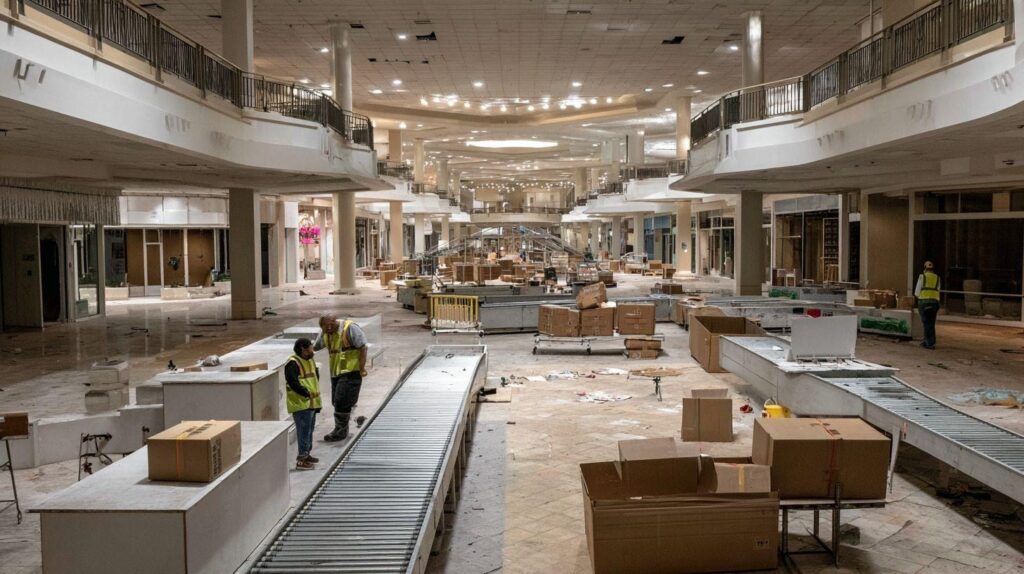
Suburban mall locations cut last-mile costs by 22% versus greenfield sites, according to a Prologis study from 2023. Their 15-mile average radius to customers beats the 25-mile norm for new warehouses. This positions dead malls as prime logistics hubs.
BOPIS synergy enhances efficiency, handling 30% of e-commerce orders through buy online pickup in store setups. Former anchor tenants like Sears bankruptcy sites now store pallets for same-day fulfillment. Operators integrate conveyor systems seamlessly.
Proximity reduces truck miles and fuel use in urban logistics. Micro-fulfillment centers in these spots support just-in-time delivery for grocery hubs. Automation robotics further cuts labor needs.
Examples include Walmart fulfillment networks using repurposed big box stores. This setup streamlines reverse logistics and returns processing. Owners gain from reliable, high-volume tenants.
Job Creation Shifts
Logistics roles create 2.5 jobs per 1,000 square feet versus retail’s 1.2, with wages averaging $22 per hour compared to $19. This shift from brick-and-mortar stores to distribution centers offers better pay amid the retail transformation. BLS data notes 210K new logistics jobs in 2022.
Distribution centers provide standard healthcare benefits, improving worker retention over traditional retail. Roles involve RFID tracking and AI inventory management, building valuable skills. Communities benefit from stable employment in revitalization projects.
- Pickers and packers earn premium wages with shift flexibility.
- Supervisors oversee automation, requiring less physical labor.
- Maintenance techs handle conveyor systems and robotics.
Higher job quality counters labor shortages in physical retail. Former mall workers transition to these positions easily. This supports local economies hit by foot traffic drops.
Challenges and Barriers
Regulatory, physical, and social hurdles delay many proposed mall conversions to fulfillment centers. These barriers stem from the decline of traditional retail space and the shift toward e-commerce growth. Developers must navigate complex processes to repurpose dead malls into logistics hubs.
Zoning restrictions often block industrial uses on former shopping centers. Physical retrofits demand significant investment in infrastructure like docks and electrical systems. Community pushback arises from fears of increased traffic and noise amid the retail apocalypse.
Actionable solutions include pursuing variance applications and tax incentives. Public-private partnerships can address stakeholder concerns effectively. Experts recommend early engagement to streamline adaptive reuse projects.
Overcoming these challenges enables retail transformation into viable distribution centers. Successful conversions boost local economies through jobs and tax revenue. The process requires patience and strategic planning for suburban malls.
Zoning and Regulatory Hurdles
Many mall sites face C-2 zoning that prohibits industrial activities, leading to an average rezoning process of several months. This regulatory barrier slows the shift from brick-and-mortar stores to fulfillment centers. Local codes designed for retail do not align with warehouse needs.
Developers can apply for zoning variances to permit logistics operations. Pursuing PILOT agreements, like those in New York, offer property tax relief in exchange for job creation. State enterprise zones provide additional incentives for mall conversion projects.
| Solution | Description | Typical Timeline |
| Variance applications | Request exceptions to existing zoning for industrial use | 6-12 months |
| PILOT agreements (NY model) | Payment in lieu of taxes for economic development | 9-18 months |
| State enterprise zones | Tax credits and streamlined approvals for logistics | 12-24 months |
Start variance processes early with detailed site plans showing minimal community impact. Engage local officials through town halls to build support. These steps accelerate approvals for adaptive reuse of vacant storefronts.
Infrastructure Retrofit Needs
Malls typically have few dock doors compared to the many required for efficient fulfillment operations, with HVAC repurposing adding substantial costs per square foot. These physical limitations hinder quick transitions from shopping centers to distribution centers. Engineering assessments reveal gaps in structural capacity and power supply.
Key retrofits focus on increasing floor load capacity for pallet storage and upgrading electrical systems for automation. Converting parking lots into loading areas demands careful planning. Costs vary by mall size but require upfront investment for long-term viability.
| Retrofit Area | Requirement | Estimated Cost |
| Structural | Floor load from retail to warehouse levels | High, per sq ft |
| Electrical | Amp service upgrade for conveyor systems | Significant panel expansion |
| Dock conversion | New doors and leveling platforms | Per door basis |
Conduct feasibility studies before purchase to quantify retrofit needs. Partner with engineering firms experienced in warehouse conversion. Phased implementations minimize disruption while enabling last-mile delivery setups.
Community and Stakeholder Resistance
Residents often oppose mall conversions due to concerns over traffic and noise, even as properties gain value after repurposing. This social barrier reflects shifts in consumer behavior from physical retail to online shopping. Anchor tenant departures leave emotional attachments to former gathering spots.
A strong messaging framework emphasizes jobs creation and preserved tax base. Highlight how fulfillment centers support local supply chains and e-commerce growth. Transparent communication builds trust amid the decline of malls.
- Host town halls to address fears directly.
- Share projections on employment and economic benefits.
- Partner with community leaders for endorsements.
The Lakeland, Florida case shows success through repeated town halls that secured buy-in. Focus on positive outcomes like reduced urban decay. This approach turns resistance into support for retail real estate redevelopment.
Implementation Strategies
A structured 12-18 month process maximizes ROI while minimizing execution risk in converting declining traditional retail space into fulfillment centers. This approach addresses the retail apocalypse by repurposing vacant malls for e-commerce growth. Owners start with clear milestones to navigate zoning changes and tenant needs.
Key phases include feasibility studies, entitlements, construction, and occupancy. Experts recommend early involvement of engineers and market analysts. This ensures smooth adaptation of dead malls into logistics hubs.
Funding models blend equity, debt, and incentives to cover costs. Technology integration follows, with warehouse management systems boosting efficiency. Successful conversions turn anchor tenant voids into revenue-generating distribution centers.
Real-world examples show mall owners partnering with REITs for adaptive reuse. These projects combat foot traffic drops and store closures. The result supports last-mile delivery demands from online shopping surges.
Step-by-Step Conversion Process
Step 1 involves feasibility studies over three months, including structural engineering and market analysis using CoStar comps. This assesses if a suburban mall suits warehouse conversion. Teams evaluate square footage for inventory storage.
Step 2 covers engineering assessments for load-bearing capacity. Step 3 handles zoning changes and permits during a six-month entitlements phase. Local approvals adapt commercial property for industrial use.
- Site selection: Review CoStar comps for vacant storefronts in declining shopping centers.
- Engineering assessment: Check roofs, floors for pallet storage and conveyor systems.
- Zoning and entitlements: Secure rezoning for logistics hubs amid retail transformation.
- Financing: Assemble capital stack with REIT partners.
- General contractor bid: Select GC experienced in big box store retrofits.
- Tenant LOI: Lock in e-commerce tenants like fulfillment operators.
- Construction: Six-month buildout with racking and automation.
- Certificate of occupancy and tenant move-in: Final inspections enable operations.
| Phase | Duration | Key Milestones |
| Feasibility | 3 months | Site selection, engineering report |
| Entitlements | 6 months | Zoning approval, permits |
| Financing & Bidding | 3 months | LOIs, GC contract |
| Construction | 6 months | Buildout, testing |
| Occupancy | 1 month | CO issuance, tenant ramp-up |
This Gantt-style timeline visualizes overlaps, reducing total time to 12-18 months. It minimizes risks from leasing challenges in the decline of malls.
Financing and Investment Models
Bridge loans at competitive rates with 65% LTV, plus mezzanine debt, fund 85% of mall conversions. REITs favor sale-leaseback deals for steady income from fulfillment centers. This model suits properties hit by JCPenney decline or Sears bankruptcy.
The typical capital stack includes 30% equity around $6M for a mid-sized project, 50% bank debt, and 20% mezzanine. Real estate investors tap tax incentives for adaptive reuse. Public-private partnerships aid revitalization of urban decay sites.
Examples include Prologis and Realty Income acquiring converted assets from Simon Property Group or Brookfield Properties. These deals counter ROI decline in physical retail. Pandemic impacts accelerated such shifts to e-commerce support.
Experts recommend starting with tenant LOIs to de-risk financing. Mezzanine funds target high-yield opportunities in warehouse conversion. This structure supports long-term leases for stable cash flow.
Technology Integration Essentials
Manhattan WMS paired with Zebra RFID stands as required for Grade A logistics spaces. Standard investments cover $2.5 per square foot in racking for micro-fulfillment. This setup handles returns processing and just-in-time delivery in former retail spaces.
A tech roadmap begins during feasibility, with full integration by occupancy. Warehouse management systems like SAP track inventory from click-and-collect to BOPIS. Automation from GreyOrange adds robotics for labor shortages.
Tenant requirements mandate IoT sensors for real-time monitoring. Conveyor systems and barcode scanning speed operations in ex-malls. AI inventory management predicts demand amid consumer behavior shifts.
Integration timeline aligns with construction: install during month 10, test in month 12. This supports omnichannel retail for brands like Walmart fulfillment or Target distribution. Green retrofits with EV charging enhance appeal to ESG-focused tenants.
Future Outlook and Trends
E-commerce logistics demand 1B sq ft by 2030, with 25% potentially from mall conversions. This shift reflects the ongoing decline of traditional retail space as online shopping surges. Developers eye dead malls for adaptive reuse into fulfillment centers.
Macro trends like the retail apocalypse accelerate this change. Store closures from chains such as Sears bankruptcy and JCPenney decline leave vast vacant storefronts. E-commerce growth demands quick access for last-mile delivery.
Suburban malls offer ideal locations near consumers. Converting them addresses supply chain needs for inventory storage and distribution. Real estate investors see value in this retail transformation.
Challenges include zoning changes and retrofits. Yet, public-private partnerships aid revitalization. Expect more logistics hubs in former shopping centers.
Projected Growth in E-Commerce Logistics
CBRE forecasts 1.1B sq ft needed by 2030; urban micro-fulfillment centers average 50K sq ft. This growth stems from rising demand for last-mile focus, where 70% cost concentration occurs. Malls provide ready square footage for such hubs.
| Year | Logistics Space (sq ft) |
| 2023 | 600M |
| 2030 | 1.1B |
Companies like Amazon warehouses prioritize urban sites. Former big box stores suit dark stores for click-and-collect or BOPIS. Automation robotics enhance efficiency in these spaces.
Experts recommend focusing on pallet storage and conveyor systems. Labor shortages push adoption of RFID tracking. This setup cuts delivery times for online orders.
Sustainability in Repurposed Spaces
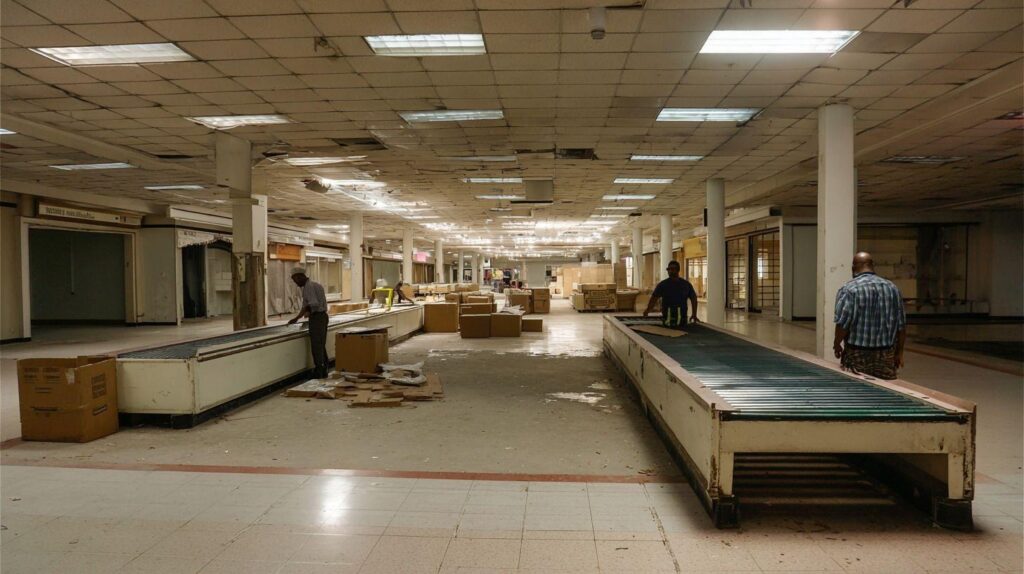
Conversions earn 25 LEED points via existing structure; solar + EV charging adds 15% lease premium. Repurposing traditional retail space beats new builds on ESG metrics with 60% energy savings. Tenants demand green features amid climate pledges.
Amazon’s Climate Pledge requires retrofits like EV charging stations. Adding solar panels to mall roofs supports renewable energy hubs. This appeals to sustainability-focused REITs.
Practical steps include LED lighting and insulation upgrades. Green retrofits reduce carbon footprints in logistics. Experts recommend circular economy practices for returns processing.
Benefits extend to lease appeal. Properties with these features attract omnichannel retail tenants. Long-term, they aid urban decay reversal.
Potential for Mixed-Use Hybrids
The Domain (TX): 40% logistics, 30% residential, 30% retail achieves 98% occupancy vs pure retail 65%. Hybrid models blend 50% DC + 25% residential + 25% entertainment. This counters foot traffic drop in dead malls.
- Logistics for daytime e-commerce fulfillment.
- Residential units fill evening hours.
- Entertainment draws weekend crowds.
Zoning evolution supports such mixed-use development. Cities offer tax incentives for property redevelopment. Examples include gym conversions and experiential retail pop-ups.
Simon Property Group explores these hybrids. They boost ROI over pure brick-and-mortar stores. Community malls thrive with this approach.
Policy Recommendations
Targeted incentives could accelerate 200M sq ft conversions, generating $15B tax revenue. As the decline of traditional retail space continues amid e-commerce growth, governments must support turning dead malls into fulfillment centers. This adaptive reuse addresses vacant storefronts and boosts local economies.
Policy measures should focus on mall conversion projects, easing zoning changes and providing financial relief. Municipalities gain from new logistics hubs that replace anchor tenants like Sears after bankruptcy. These steps counter the retail apocalypse and support supply chain needs.
Experts recommend combining tax incentives with streamlined approvals for warehouse conversion. Suburban malls, hit hard by foot traffic drop, can become last-mile delivery sites. Public-private partnerships drive property redevelopment and revitalization projects.
Such policies promote retail transformation, integrating omnichannel retail with physical spaces. Local governments see returns through job creation and sustained property values. This approach turns commercial property challenges into opportunities for urban logistics.
Government Incentives Needed
15-year PILOTs (50% taxes) + $5/sq ft grants modeled on NY’s 421-a program offer a strong start. These tools lower costs for converting shopping centers into Amazon warehouses or similar facilities. Municipalities benefit from long-term ROI as properties generate steady revenue.
Property tax abatements reduce initial burdens on real estate investors and REITs like Simon Property Group. Expedited permitting within 90 days speeds up projects facing leasing challenges. Both attract developers to brownfield sites in declining malls.
| Recommendation | Description | ROI to Municipalities |
| Property tax abatements | Reduce taxes for 10-15 years on converted spaces | Increased employment and future tax base growth |
| Expedited permitting (90 days) | Fast-track approvals for warehouse conversions | Quicker revenue from active sites, reduced vacancy |
| Infrastructure grants | Fund roads, utilities for logistics hubs | Enhanced property values and business attraction |
| Brownfield credits | Tax credits for cleaning contaminated mall sites | Revitalized land adds to tax rolls |
| Job creation subsidies | Per-job payments for new fulfillment roles | Local spending boost and population stability |
These incentives counter ROI decline from store closures like JCPenney and Macy’s downsizing. They support distribution centers amid pandemic impact and consumer behavior shift to online shopping. Governments secure sustainable income from former brick-and-mortar stores.
Best Practices for Local Governments
Columbus, OH model: 1-stop permitting cut conversion time 50%; $2.1M annual tax gain from first project. Local leaders can replicate this by preparing for retail real estate shifts. Pre-zoned districts streamline the process for fulfillment centers.
Implement pre-zoned industrial overlay districts near suburban malls to bypass lengthy rezoning. A unified permitting office handles all approvals in one place, cutting delays. These reduce barriers for developers eyeing big box store conversions.
- Pre-approved engineering templates speed design for conveyor systems and pallet storage.
- Community benefit agreements ensure local hiring and traffic mitigation.
- Performance-based incentives tie rebates to milestones like job numbers or completion dates.
Success metrics include reduced project timelines and rising tax yields, as seen in Columbus. These practices support micro-fulfillment and BOPIS models. They foster mixed-use development, blending warehouses with entertainment venues or EV charging stations.
Frequently Asked Questions
What is “The Decline of Traditional Retail Space: Turning Malls into Fulfillment Centers”?
The Decline of Traditional Retail Space: Turning Malls into Fulfillment Centers refers to the ongoing shift where declining foot traffic in physical malls due to e-commerce growth prompts owners to repurpose these large spaces into efficient fulfillment centers for online order processing, storage, and last-mile delivery.
Why is there a decline in traditional retail space like malls?
The Decline of Traditional Retail Space: Turning Malls into Fulfillment Centers is driven by the rise of online shopping, changing consumer preferences for convenience, high operational costs for retailers, and the impact of the COVID-19 pandemic, which accelerated the move to digital commerce and reduced mall visits by up to 50% in many areas.
How are malls being converted into fulfillment centers in “The Decline of Traditional Retail Space: Turning Malls into Fulfillment Centers”?
In The Decline of Traditional Retail Space: Turning Malls into Fulfillment Centers, vacant anchor stores and underused common areas are retrofitted with conveyor systems, robotic pickers, and loading docks to handle high-volume e-commerce logistics, often by companies like Amazon or third-party providers.
What are the economic benefits of turning malls into fulfillment centers?
The Decline of Traditional Retail Space: Turning Malls into Fulfillment Centers offers economic advantages such as job creation in logistics (often more stable than retail jobs), lower conversion costs compared to new builds, and revitalization of struggling properties, potentially preserving property values and local tax revenues.
What challenges exist in “The Decline of Traditional Retail Space: Turning Malls into Fulfillment Centers”?
Challenges in The Decline of Traditional Retail Space: Turning Malls into Fulfillment Centers include zoning restrictions for industrial use, community opposition to increased truck traffic and noise, high upfront retrofit expenses, and the need for skilled warehouse labor in suburban mall locations.
What is the future outlook for “The Decline of Traditional Retail Space: Turning Malls into Fulfillment Centers”?
The future of The Decline of Traditional Retail Space: Turning Malls into Fulfillment Centers looks promising as e-commerce is projected to grow to 25% of total retail by 2027, with more malls adapting into hybrid logistics hubs, omnichannel retail experiences, or even urban distribution nodes to meet rising delivery demands.