
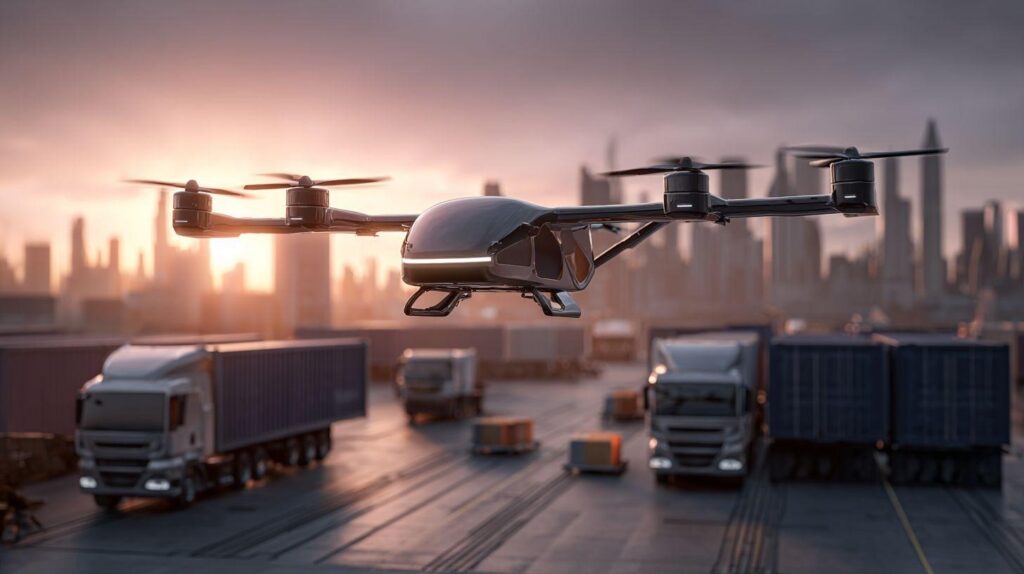
Imagine cargo drones silently lifting off from urban rooftops, slashing delivery times from days to hours. As global e-commerce surges, traditional air cargo strains under fuel costs and inefficiencies. This article explores eVTOL technology’s breakthroughs in batteries, autonomy, and operations; market projections to 2040; infrastructure needs; regulatory hurdles; and transformative impacts-unveiling a logistics revolution poised to redefine supply chains.
Defining eVTOL Technology
eVTOL (electric Vertical Take-Off and Landing) aircraft use multiple electric motors and high-capacity lithium-ion batteries to enable vertical takeoff, hover, and landing without traditional runways. These battery-powered aircraft rely on core components like 6-18 ducted fans or rotors for lift and propulsion. They also feature fly-by-wire controls for precise handling in urban environments.
Key elements include 200-500 kWh batteries that power distributed electric propulsion systems. Ducted fans reduce noise and improve safety compared to open rotors. Fly-by-wire systems use electronic signals to adjust flight paths automatically.
eVTOL designs fall into two main types: tilt-rotor and lift-plus-thrust. Tilt-rotor craft, like the Joby S4 with its 6 rotors, pivot rotors forward for efficient cruising. Lift-plus-thrust models, such as the Archer Midnight with 12 rotors, keep lift rotors vertical while separate thrusters handle forward flight.
Compared to helicopters, eVTOL offers 80% lower operating costs due to electric propulsion and fewer moving parts. This makes them ideal for air cargo tasks like drone delivery and last-mile logistics. Imagine a diagram showing tilt-rotor fans angling from vertical to horizontal, versus lift-plus-thrust with fixed upper rotors and rear tilt fans for clear visual contrast.
Current Air Cargo Challenges
Traditional air cargo faces high empty backhaul rates, elevated costs for short-haul routes, and delays in urban delivery. These issues strain supply chain efficiency and raise operational expenses for freight forwarders. Experts recommend exploring electric vertical takeoff solutions to address these pain points.
High fuel costs burden operators, with jet fuel often priced at elevated levels per gallon. This volatility impacts profitability, especially for frequent short-haul flights. Transitioning to electric propulsion in eVTOL logistics could reduce reliance on traditional fuels.
Airport congestion leads to long taxi times at busy hubs, delaying cargo movement. For instance, major airports experience significant ground delays that compound air freight timelines. Urban air mobility via VTOL cargo offers a path to bypass these bottlenecks with vertiports.
Last-mile bottlenecks and substantial carbon emissions further challenge the industry. Ground transport consumes much of the total delivery time, while emissions contribute to environmental concerns. Sustainable logistics through cargo drones and zero-emission transport promise greener alternatives.
| Distance (km) | Cost Breakdown ($/kg) | Fuel Share | Other Costs |
| 0-100 | High | 40% | 60% |
| 100-500 | Medium | 50% | 50% |
| 500+ | Low | 60% | 40% |
This chart illustrates how cost vs distance shifts in air cargo, with fuel dominating longer hauls. Short distances suffer from fixed overheads like airport fees. eVTOL logistics could flatten these curves through battery-powered aircraft and direct point-to-point delivery.
Why eVTOL Revolutionizes Logistics
eVTOL cuts door-to-door delivery from 48 hours to 90 minutes while reducing costs 60-70% through vertiport-to-vertiport routes bypassing airport infrastructure. Electric vertical takeoff aircraft enable urban air mobility for air cargo, transforming future logistics. Companies like Amazon Prime Air and UPS drone delivery already test these systems.
Lower operating costs drive one key transformation, with eVTOL at roughly $1.50 per km compared to $6 per km for traditional methods. This shift supports sustainable logistics and express shipping. Cargo drones cut expenses for high-volume low-weight goods.
A 250-mile range fits middle-mile needs perfectly, linking warehouses to distribution centers without long-haul delays. Operators achieve 24/7 operations thanks to electric propulsion and quiet flight. Noise drops to 80dB versus 110dB for helicopters, easing urban logistics.
Zero emissions from battery-powered aircraft align with green freight goals. Consider ROI: delivering a 100kg package costs $150 by eVTOL versus $600 traditionally. Examples include Zipline drones for medical supply delivery and DHL Parcelcopter for parcel delivery, showcasing supply chain disruption.
Technological Foundations
eVTOL cargo relies on 400Wh/kg batteries, AI navigation achieving high autonomy rates, and composite airframes much lighter than traditional materials. These elements form the core of electric vertical takeoff systems for air cargo. They support sustainable logistics and urban air mobility.
The three main pillars include advanced energy systems targeting high energy densities, autonomy through NASA’s UTM integration, and innovative airframes using carbon fiber with distributed electric propulsion. Energy systems power long-range flights for cargo drones. Autonomy handles complex airspace for BVLOS operations.
Airframes reduce weight and improve efficiency in VTOL cargo designs. Distributed electric propulsion offers redundancy and better hover performance. Experts recommend focusing on these for future air freight innovation.
Research from MIT highlights efficiency gains from distributed propulsion in eVTOL designs. This supports zero-emission transport and noise reduction in urban logistics. Practical examples include Beta Technologies’ cargo models for last-mile delivery.
Battery and Propulsion Advances
Solid-state batteries reaching higher energy densities than current lithium-ion enable 400+ mile ranges, with Beta Technologies’ ALIA achieving strong payload on efficient packs. These advances drive battery-powered aircraft for air cargo. They cut reliance on fossil fuels in green freight.
Key technologies include lithium-ion NMC for balanced performance, solid-state promising by Toyota’s timeline, LFP as cost leader for high-volume use, and hydrogen fuel cells for superior equivalent density. Each suits different eVTOL logistics needs. Operators choose based on route and payload.
| Technology | Energy Density | Cost | Charge Time | Cycle Life |
| Li-ion NMC | 250Wh/kg | $132/kWh | 1 hour | 1,000 cycles |
| Solid-state | 450Wh/kg | Higher | 30 min | 2,000 cycles |
| LFP | 180Wh/kg | Lowest | 45 min | 3,000 cycles |
| Hydrogen | 1,800Wh/kg equiv. | Premium | 5 min | 5,000 cycles |
Hybrid-electric systems combine these for resilient supply chains. Charging infrastructure at vertiports supports rapid turnaround in express shipping. This powers e-commerce fulfillment like Amazon Prime Air concepts.
Autonomous Flight Systems
NASA’s UTM system enables dense drone operations in shared airspace, with Wingcopter achieving high autonomous delivery success rates. These systems make autonomous flight reliable for cargo drones. They handle urban air mobility challenges.
Core components include computer vision like Intel RealSense for obstacle detection, LiDAR such as Velodyne Puck for precise mapping, UTM from NASA and AirMap for traffic management, and swarm AI as in Zipline for coordinated fleets. Each boosts flight autonomy. They meet BVLOS requirements for point-to-point delivery.
- Computer vision processes real-time images for safe navigation.
- LiDAR creates 3D models to avoid collisions in vertiports.
- UTM integrates with air traffic management for skyport networks.
- Swarm AI optimizes routes for multiple cargo pods.
FAA Part 135 certification paths guide aviation startups toward compliance. AI navigation with IoT sensors enables predictive maintenance. This supports medical supply delivery and disaster relief cargo.
Airframe Design Innovations
Distributed Electric Propulsion with multiple ducted fans provides strong redundancy and better hover efficiency than traditional helicopters. This powers DEP in eVTOL logistics. It suits high-volume low-weight cargo.
Designs compare as multirotor like DJI-inspired for simplicity, tilt-rotor from Joby for transition efficiency, lift+thrust as in Lilium for speed, and vectored thrust from Archer for maneuverability. Each fits cargo capacity needs. CFD simulations cut drag for longer payload range.
| Design | Payload | Capacity | Range |
| Multirotor | 500kg | Modular pods | 100 miles |
| Tilt-rotor | 1,000kg | Cold chain | 200 miles |
| Lift+thrust | 800kg | High-volume | 250 miles |
| Vectored thrust | 700kg | Urban freight | 150 miles |
Carbon fiber composites make airframes lighter for vertical landing. Modular payloads enable flexible freight forwarding. Examples like Volocopter cargo show gains in short-haul freight and hubless logistics.
Market Landscape and Projections
The eVTOL market is projected at $1T by 2040, with cargo comprising 35% driven by 28% CAGR through 2030. Urban air mobility offers a $9B total addressable market, while the cargo subset reaches $115B by 2030. Key drivers include e-commerce growth, cold chain needs, and deglobalization trends reshaping supply chains.
E-commerce expansion demands faster last-mile delivery, where Amazon Prime Air and similar services test electric vertical takeoff for parcels. Cold chain logistics benefits from zero-emission transport, ensuring medical supplies stay viable during flights. Deglobalization pushes resilient supply chains with regional air cargo networks.
Players like Beta Technologies and Joby Aviation preview the shift to VTOL cargo operations. Forecasts highlight venture capital trends fueling battery-powered aircraft and charging infrastructure. This landscape sets the stage for air cargo revolution through sustainable logistics.
Experts recommend focusing on payload range and flight autonomy for practical deployment. Urban logistics hubs, or vertiports, will support point-to-point delivery. Overall, eVTOL logistics promises hubless models for express shipping and freight forwarding.
Key Players and Startups
Beta Technologies leads cargo with its 5,000lb ALIA CTOL/VTOL hybrid, while Joby partners with UPS for 500kg middle-mile networks. These innovators drive electric aviation for air freight. Their designs emphasize cargo capacity and vertical landing efficiency.
Startups focus on autonomous flight and AI navigation for drone delivery. Partnerships with firms like FedEx enable real-world testing in urban areas. This competition accelerates FAA certification and beyond visual line of sight operations.
| Company | Stage | Payload | Range | Key Partners | Funding |
| Beta Technologies | Certified | 5,000 lb | 250 nm | UPS, FedEx | $800M |
| Archer Aviation | Prototype | 1,000 lb | 100 nm | Walmart | $1.5B |
| Eve Air Mobility | Development | 800 kg | 60 nm | Regional cargo | $500M |
| Joby Aviation | Testing | 500 kg | 150 nm | UPS | $1.2B |
| Lilium | Prototype | 2,000 lb | 155 nm | DHL | $900M |
| Volocopter | Demo | 400 kg | 25 nm | $600M | |
| Zipline | Operational | 1.8 kg | 100 nm | Medical | $700M |
| Wingcopter | Commercial | 5 kg | 65 nm | Humanitarian | $400M |
These players showcase modular payloads for high-volume low-weight cargo. Regional trends favor US dominance, with Europe advancing EASA approval.
Growth Forecasts to 2040
Cargo eVTOL fleet grows from 50 aircraft in 2025 to 45,000 units by 2040, capturing 15% of the $1T air cargo market. Forecasts outline three scenarios: base at 15% market share, optimistic at 28%, and pessimistic at 8%. Metrics track units, revenue, and payload-km amid FAA and expert projections.
- Base scenario: Steady adoption in short-haul freight via electric propulsion.
- Optimistic scenario: Rapid scaling with skyport networks and UTM systems.
- Pessimistic scenario: Delays from aviation regulations and battery limits.
Research suggests distributed electric propulsion boosts efficiency for regional air cargo. Examples include tilt-rotor designs for disaster relief cargo. Predictive maintenance and IoT sensors support fleet expansion.
McKinsey-like insights highlight cold chain logistics and e-commerce fulfillment. Growth hinges on vertiports and air traffic management for BVLOS operations.
Investment Trends
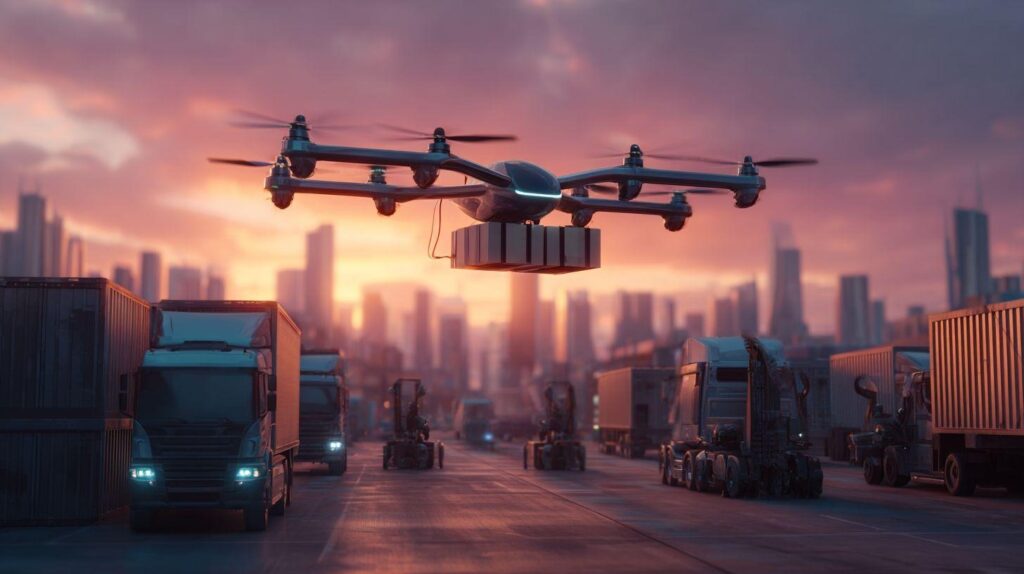
$12.5B has been invested in eVTOL since 2017, with 2024 seeing $2.1B across 15 cargo-focused startups. Funding breaks down by corporate VC at 35%, traditional VC at 25%, and strategic investors at 20%. US leads with 65%, followed by Europe at 25%.
| Top Deal | Company | Amount | Lead Investor |
| 1 | Joby Aviation | $750M | Toyota |
| 2 | Archer Aviation | $650M | United Airlines |
| 3 | Beta Technologies | $368M | Fidelity |
| 4 | Lilium | $300M | Baidu |
| 5 | Eve Air Mobility | $400M | Embraer |
| 6 | Volocopter | $182M | DB Schenker |
| 7 | Zipline | $250M | Sequoia |
| 8 | Wingcopter | $113M | Merian Ventures |
| 9 | Overair | $100M | Trinity Capital |
| 10 | Covariant | $80M |
Corporate backers like Boeing and Airbus prioritize hybrid-electric systems. Strategic players such as UPS focus on drone delivery for parcel networks.
Trends emphasize ESG compliance and carbon-neutral shipping. Venture capital supports rapid prototyping and distributed manufacturing for resilient supply chains.
Operational Models
Three models emerge: urban last-mile (Zipline: 2kg packages), middle-mile hubs (Beta: 1,700lb), long-haul feeders (400+ miles regional).
These eVTOL logistics models adapt electric vertical takeoff aircraft for air cargo needs. Urban last-mile focuses on small payloads over short distances. Middle-mile connects hubs to cities, while long-haul handles regional freight.
Real implementations show promise in sustainable logistics. Companies like Zipline deliver medical supplies via drone delivery. Beta Technologies partners with UPS for heavier loads. Economics favor eVTOL in time-sensitive routes.
Detailed models below highlight operations, case studies, and costs. They preview the air cargo revolution with vertiports and autonomous flight.
Urban Last-Mile Delivery
Wingcopter 198 delivers 6kg medical supplies within 55 minutes across 70km radius, 8x faster than ground in urban congestion.
This model suits last-mile delivery with 2-10kg payloads and 30-80km range. Operators run 100+ daily flights from rooftop vertiports. It excels in traffic-choked cities for e-commerce fulfillment and cold chain logistics.
Case studies include DHL Parcelcopter for express shipping and Zipline in Rwanda handling blood supply. These use BVLOS operations and AI navigation. Noise reduction from electric propulsion aids urban air mobility.
Economics show $2.50 per package versus $8 for ground transport. Battery-powered aircraft cut emissions for zero-emission transport. Experts recommend this for medical supply delivery in dense areas.
Middle-Mile Hub Networks
Beta-UPS network moves 1,700lb from airport vertiports to city centers in 45 minutes, cutting middle-mile from 4 hours to under 1.
The hub-spoke model links regional airports to urban vertiports. Aircraft shuttle cargo to distribution centers, enabling 50 tons per day per hub. Partners like FedEx and UPS Flight Forward build skyport networks.
A typical network map shows spokes from airports to city hubs. This supports urban logistics with modular payloads and cargo pod design. IoT sensors track shipments via 5G connectivity.
Benefits include resilient supply chains and supply chain disruption avoidance. Electric aviation reduces fuel costs in this range. FAA certification progresses for scaled operations.
Long-Haul Cargo Variants
Hybrid eVTOL like Natilus Kona-R carries 5,000lb over 900 miles at 480mph, targeting intra-regional cargo currently underserved.
These variants cover 400-1,000 mile ranges with blended-wing body designs and cargo pod swaps. They use hybrid-electric systems or magniX electrified Cessna Caravan conversions. Focus stays on short-haul freight and regional air cargo.
Operations involve point-to-point delivery from vertiports, bypassing traditional hubs. Tilt-rotor design and distributed electric propulsion boost efficiency. This aids disaster relief cargo and humanitarian aid drones.
Economics offer $1.20 per kg versus $3.50 per kg traditional. Lithium-ion batteries and charging infrastructure support flights. Research suggests growth in hubless logistics for deglobalization transport.
Infrastructure Requirements
By 2030, 1,500 vertiports will be needed, about 10 per major city, equipped with 500kW chargers that enable 30-minute recharges for 250-mile missions in eVTOL logistics.
These facilities demand around 5,000 square feet each for vertiports, megawatt-scale chargers, and seamless ground integration to support urban air mobility and cargo drones.
Vertiport specs include durable pads for vertical landing, while charging tech focuses on fast lithium-ion battery replenishment for battery-powered aircraft.
Logistics handoff areas use automated systems for quick cargo pod transfers, paving the way for zero-emission transport in air cargo revolutions and sustainable logistics.
Vertiport Development
Skyports is developing 65 vertiports globally with 30x30m pads that support 60 takeoffs per hour at the London Heathrow heliport conversion.
Each site requires 100x100ft pads built from reinforced concrete, plus 150ft obstacle clearance to ensure safe operations for electric vertical takeoff and VTOL cargo.
Automated tarmacs guide autonomous flight with AI navigation, reducing turnaround times for high-volume low-weight cargo in urban logistics.
Costs range from $5-15M per site, as seen in real projects like the $20M LAX vertiport and Paris rooftop conversions for eVTOL logistics and drone delivery.
Charging and Maintenance Hubs
ABB Terra 1 MW chargers recharge 400kWh packs in 25 minutes, while automated battery swapping cuts turnaround to 5 minutes for electric propulsion systems.
Key methods include fast DC charging at 500kW for 30-minute sessions, battery swap stations that refresh packs in under 5 minutes, and wireless options at 80kW for convenience.
- Fast DC suits short-haul freight with minimal downtime.
- Battery swaps, like Blade systems, boost efficiency for express shipping.
- Wireless charging integrates with vertiports for hands-free operations.
PG&E microgrid integrations power these hubs reliably, supporting predictive maintenance and flight autonomy in green freight networks.
Integration with Ground Logistics
Standardized 1.2m cargo pods enable conveyor-to-drone handoff in 90 seconds, matching Amazon robotic sortation speeds for last-mile delivery.
Roller conveyors and AGVs move pods smoothly from trucks to eVTOLs, with QR code tracking ensuring precise handoffs in supply chain disruptions.
IoT sensors and blockchain manifests provide real-time visibility, while 5G connectivity enables swarm intelligence for point-to-point delivery.
The UPS Flight Forward case study shows ground sync success, streamlining cold chain logistics and medical supply delivery in resilient supply chains.
Regulatory and Safety Frameworks
FAA Part 135 certification path completed by Beta Technologies in 2024 enables commercial BVLOS cargo ops under 14 CFR Part 91K. This milestone paves the way for eVTOL logistics in air cargo. Operators now pursue broader approvals for scalable operations.
FAA Type Certification typically spans 3-5 years, focusing on airworthiness and safety. EASA uses a Special Category approach for initial urban air mobility trials. Both connect with UTM systems for safe airspace use.
Certification steps include design reviews, flight testing, and conformity checks. Air traffic management evolves from traditional ATM to dynamic UTM integration. Noise regulations limit operations near communities, ensuring public acceptance.
These frameworks support sustainable logistics by enabling zero-emission VTOL cargo flights. Companies like Joby and Archer align with these paths for cargo pod delivery. Safe integration promises disruption in express shipping and last-mile freight.
Certification Pathways
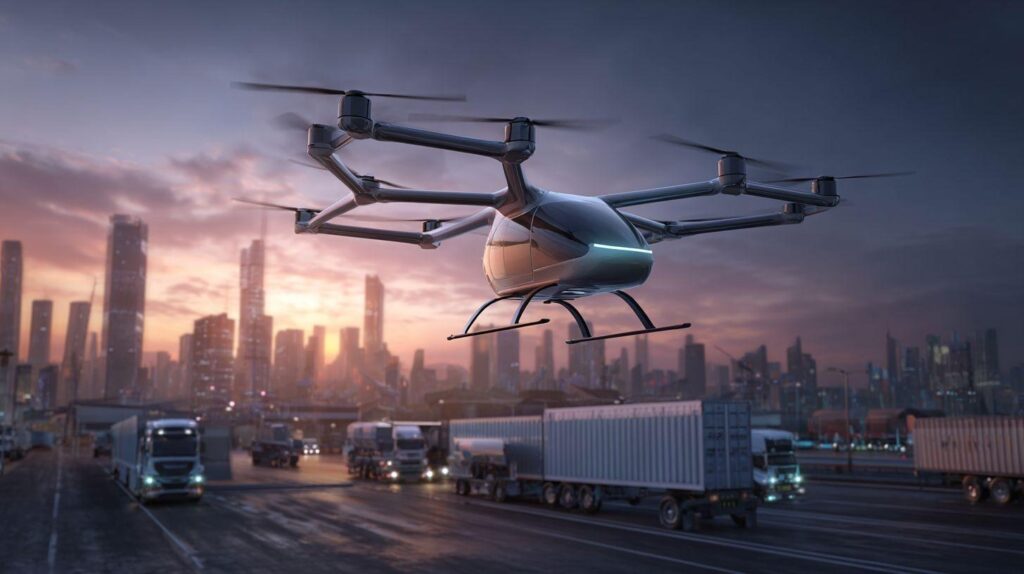
FAA 5-phase certification includes 18 months for Phase 1-2, which Beta completed, followed by 24 months for Type Inspection Authorization leading to 2026 commercial ops. Phase 1 covers concept definition and safety assessments. Phase 4 handles implementation and conformity inspections.
EASA processes mirror FAA with added G-1 issue papers addressing novel risks in electric propulsion. Joby Aviation progressed from 2021 concept to 2025 type certification goals. These timelines guide eVTOL cargo developers in planning.
Operators start with powered-lift category approvals for battery-powered aircraft. Testing validates payload range and flight autonomy. Successful paths enable BVLOS for drone delivery in urban logistics.
Practical steps involve early engagement with regulators for issue paper resolution. Beta’s path shows how modular payloads speed conformity. This supports air cargo revolution through certified autonomous flight.
Air Traffic Management
NASA UTM 2.0 manages high-density traffic in 2km corridors using 4D trajectory contracts with rapid conflict resolution. Unmanned Services (USS) provide real-time airspace data. Flight Services (DSS) coordinate with manned aviation.
Integrations like AirMap with Lockheed enhance BVLOS operations. Eurocontrol sandbox tests validate UTM for European vertiports. These systems enable swarm intelligence for cargo drones.
UTM levels scale from basic drone ops to advanced eVTOL logistics. AI navigation ensures safe point-to-point delivery. 5G connectivity supports IoT sensors for predictive maintenance.
Air cargo firms adopt UTM for hubless logistics and resilient supply chains. Examples include Volocopter cargo in trials. This evolution unlocks short-haul freight without traditional ATC limits.
Noise and Privacy Regulations
eVTOL limited to 65dB at 500m per FAA AC 36-3H, quieter than traffic noise and far below 95dB helicopters. ICAO Chapter 16 sets global noise standards for electric aviation. Acoustic modeling predicts community impact.
EU EASA PB2 addresses privacy concerns near vertiports. Regulations require flight path planning to minimize overflights of residences. Archer’s LA vertiports gained approval through noise studies and public input.
Designs with ducted fans and distributed electric propulsion reduce noise further. Operators use community engagement for skyport networks. This ensures acceptance for medical supply delivery and e-commerce fulfillment.
Compliance aids ESG goals in green freight. Cold chain logistics benefits from quiet overnight ops. Regulations foster noise reduction, balancing urban air mobility with resident privacy.
Economic and Environmental Impact
eVTOL cargo cuts operating costs 70% from $1.26/kg to $0.38/kg and CO2 95% versus jet fuel, per ICCT lifecycle analysis. This shift promises broad eVTOL logistics benefits, including lower expenses for operators and greener air cargo operations. Detailed metrics ahead show how these gains reshape future logistics.
Economically, eVTOL enables cost-efficient short-haul freight with electric propulsion and high utilization rates. Environmentally, it supports zero-emission transport through battery-powered aircraft, reducing reliance on fossil fuels. Labor markets see new roles in vertiport operations and autonomy engineering.
Companies like Amazon Prime Air and UPS drone delivery already test these systems for last-mile delivery. Vertiports and charging infrastructure cut urban logistics expenses. Overall, eVTOL drives sustainable logistics and supply chain disruption.
Experts recommend planning for vertiport networks to maximize gains. This includes AI navigation for efficient routes and modular payloads for cargo flexibility. The result fosters resilient supply chains in e-commerce fulfillment.
Cost Reduction Projections
Per-km costs drop from $1.86 in 2025 to $0.28 by 2040 through scale, batteries as the 60% cost driver, and 90% utilization versus 60% in traditional methods. eVTOL outperforms trucks and planes on high-volume low-weight cargo routes. Afry Economics study highlights these trends.
Electric vertical takeoff aircraft lower fuel and maintenance expenses with lithium-ion batteries and distributed electric propulsion. Operators achieve savings via predictive maintenance and high payload range. Compare this to diesel trucks facing rising fuel prices.
Practical steps include investing in DEP designs like ducted fans for efficiency. Firms can shift to point-to-point delivery, bypassing congested highways. This supports express shipping and parcel delivery in urban areas.
- Scale production reduces battery costs over time.
- Autonomous flight boosts utilization rates.
- Charging infrastructure enables quick turnarounds at vertiports.
Carbon Emissions Savings
1kg cargo via eVTOL emits 15g CO2 versus 1,200g for jet or 450g for truck, enabling 98% reduction across 500B ton-km annually. Lifecycle analysis covers well-to-wheel emissions from production to flight. ICCT and MIT studies underline these advantages.
Electric aviation uses renewable energy for charging, slashing green freight impacts. Noise reduction benefits urban air mobility, while vertical landing suits tight spaces. This aids cold chain logistics and medical supply delivery.
| Transport Mode | CO2 per kg-km (g) |
| eVTOL | 15 |
| Jet | 1,200 |
| Truck | 450 |
Adopt IoT sensors for tracking emissions in real time. Pair with blockchain for carbon-neutral shipping compliance. Examples include Zipline drones in humanitarian aid.
Job Market Transformations
Creates 92,000 new jobs by 2030 with vertiport ops at 45%, manufacturing at 30%, and software at 15%, while displacing 18,000 pilots per Oliver Wyman. Roles include vertiport technicians earning around $85K and autonomy engineers at $140K. Cargo loaders see 70% automation.
Aerospace engineering demand grows for tilt-rotor designs and flight autonomy. Upskilling from trucking involves training in UTM systems and BVLOS operations. Aviation regulations like FAA certification open paths.
Practical advice: Pursue certifications in electric propulsion and AI navigation. Programs target trucking workers for vertiport roles. This builds skills for skyport networks and air traffic management.
- Vertiport ops: Maintenance and scheduling.
- Manufacturing: Battery assembly and cargo pod design.
- Software: Swarm intelligence and 5G connectivity.
Challenges and Risk Mitigation
Lithium demand surges create price risks for eVTOL logistics; weather limits curb operations compared to trucks. Operators face supply chain vulnerabilities from concentrated refining, strict wind thresholds, and concerns over public acceptance in urban areas.
Key challenges include reliance on imported materials, operational downtime from weather, and building trust for air cargo revolution. These issues threaten the scalability of electric vertical takeoff for future logistics.
Mitigations focus on diversifying batteries, enhancing aircraft designs, and community outreach. Advances in hybrid-electric systems and regulatory approvals promise to address these hurdles for reliable VTOL cargo.
Experts recommend investing in domestic manufacturing and weather-resilient tech. Such steps ensure sustainable logistics and pave the way for widespread drone delivery adoption.
Battery Supply Chain Issues
Global lithium production must grow substantially by 2030 to meet demands of electric aviation; current output falls short of needs for scaling battery-powered aircraft.
Major risks include heavy dependence on overseas refining dominance, potential shortages of critical minerals like cobalt, low recycling rates, and sharp price swings. These factors disrupt eVTOL manufacturing for air freight innovation.
- Shift to LFP batteries reduces reliance on scarce materials.
- Government incentives like US tax credits boost local production.
- Research into sodium-ion batteries offers alternatives for zero-emission transport.
Companies explore distributed manufacturing to build resilient chains. For instance, partnerships with regional suppliers support cargo drones for express shipping and e-commerce fulfillment.
Weather and Operational Limits
eVTOL aircraft operate less often than ground vehicles, limited by winds, icing, and low visibility based on flight studies. These constraints affect urban air mobility and last-mile delivery.
Specific limits include maximum winds around strong gusts, where ducted fans in designs like tilt-rotor improve stability. Icing demands heating systems, while fog requires advanced sensors.
- LiDAR and radar enable safe navigation in poor visibility.
- De-icing mats protect against frozen conditions.
- Hybrid redundancy provides backup power for critical flights.
Solutions like these extend usability for cargo pod designs in cold chain logistics. Operators plan vertiport networks with shelters to minimize downtime in regional air cargo.
Future Roadmap
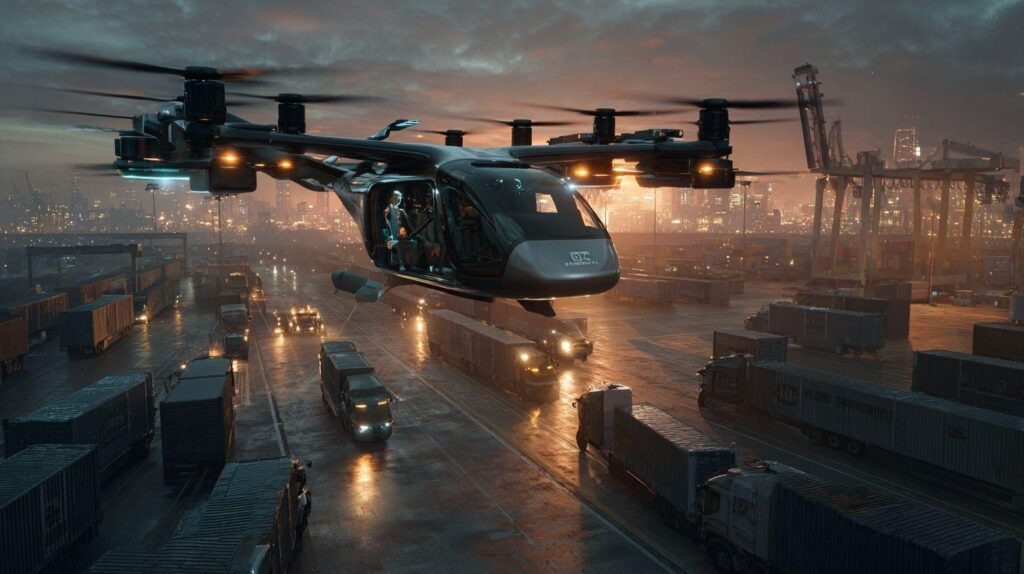
The future of air cargo begins in 2026 with first commercial cargo routes from Beta Technologies and UPS. By 2030, expect 2,500 aircraft serving 150 cities in eVTOL logistics. In 2040, supersonic cargo at Mach 1.4 will transform long-haul freight.
Near-term focus centers on FAA certification and early adopters like Joby Aviation for short-haul routes. These steps build toward scaled operations with vertiports and UTM systems. Early cargo drones will handle high-volume low-weight items such as medical supplies.
By 2030, urban air mobility networks expand to regional air cargo, supporting e-commerce fulfillment. Autonomous flight and AI navigation enable BVLOS operations. Skyport networks reduce reliance on traditional airports.
Long-term evolution introduces hydrogen-electric hybrids and blended-wing bodies. Supersonic eVTOL cuts delivery times for express shipping. This roadmap promises zero-emission transport and resilient supply chains.
2030 Commercial Milestones
2024 marks FAA Part 135 cargo certification complete for Beta Technologies. 2026 brings 50 aircraft into commercial operations with Joby and UPS routes. By 2030, 2,500 units generate significant revenue across 150 city networks.
BVLOS operations start in 2024, enabling drone delivery beyond visual line of sight. Europe gains EASA approval by 2028 for Volocopter cargo and Lilium Jet freight. These milestones support last-mile delivery in urban logistics.
| Year | Milestone |
| 2024 | Beta BVLOS certification |
| 2026 | Joby/UPS commercial routes |
| 2028 | Europe EASA approval |
| 2030 | 1% share of global cargo market |
Adoption curves accelerate with charging infrastructure and vertiports. Companies like Archer Aviation cargo and Wingcopter integrate modular payloads. Predictive maintenance and IoT sensors ensure reliable VTOL cargo flights.
Beyond 2040: Supersonic eVTOL
Hermes hydrogen-powered eVTOL reaches Mach 1.4 at 1,050mph with 5,000lb cargo over 2,500 miles, cutting US coast-to-coast to 2.5 hours. This advances supersonic cargo for time-sensitive freight. Hydrogen fuel cells power long-range missions.
Liquid hydrogen at high energy density enables hybrid-electric systems. Blended-wing bodies improve efficiency for high-volume low-weight cargo. NASA X-59 noise reduction tech supports urban integration.
Boom Supersonic cargo variants pair with ducted fans and tilt-rotor designs. Distributed electric propulsion enhances payload range. These innovations disrupt supply chains with point-to-point delivery.
- Hydrogen-electric hybrids for zero-emission transport
- Wingless aircraft with DEP for cold chain logistics
- Swarm intelligence for disaster relief cargo
- Blockchain tracking for humanitarian aid drones
Frequently Asked Questions
What is ‘The Future of Air Cargo: Electric Vertical Takeoff (eVTOL) Logistics’?
‘The Future of Air Cargo: Electric Vertical Takeoff (eVTOL) Logistics’ refers to the emerging paradigm in freight transportation where battery-powered eVTOL aircraft revolutionize cargo delivery by enabling rapid, emission-free vertical takeoffs and landings in urban and remote areas, bypassing traditional airport infrastructure for faster, greener logistics.
How will eVTOL transform the future of air cargo in ‘The Future of Air Cargo: Electric Vertical Takeoff (eVTOL) Logistics’?
In ‘The Future of Air Cargo: Electric Vertical Takeoff (eVTOL) Logistics’, eVTOLs will enable on-demand, point-to-point cargo transport, reducing delivery times from days to hours, cutting costs through automation, and integrating with drone swarms for last-mile efficiency, reshaping global supply chains.
What are the key benefits of adopting ‘The Future of Air Cargo: Electric Vertical Takeoff (eVTOL) Logistics’?
Key benefits of ‘The Future of Air Cargo: Electric Vertical Takeoff (eVTOL) Logistics’ include zero-emission flights for sustainability, reduced noise pollution, lower operational costs due to electric propulsion, enhanced safety via autonomous systems, and scalability for high-volume e-commerce demands.
What challenges must be overcome in ‘The Future of Air Cargo: Electric Vertical Takeoff (eVTOL) Logistics’?
Challenges in ‘The Future of Air Cargo: Electric Vertical Takeoff (eVTOL) Logistics’ encompass battery range limitations, regulatory hurdles for urban airspace integration, high initial infrastructure costs for vertiports, and the need for standardized certification to ensure reliable cargo operations.
Which companies are leading ‘The Future of Air Cargo: Electric Vertical Takeoff (eVTOL) Logistics’?
Leading innovators in ‘The Future of Air Cargo: Electric Vertical Takeoff (eVTOL) Logistics’ include Joby Aviation, Archer Aviation, and Volocopter, partnering with logistics giants like UPS and DHL to develop cargo-specific eVTOLs, with prototypes already tested for freight payloads.
When can we expect widespread implementation of ‘The Future of Air Cargo: Electric Vertical Takeoff (eVTOL) Logistics’?
Widespread implementation of ‘The Future of Air Cargo: Electric Vertical Takeoff (eVTOL) Logistics’ is projected by 2030, with initial commercial cargo trials starting in 2025-2027 in regions like the US, Europe, and Asia, driven by advancing battery tech and supportive air traffic regulations.