
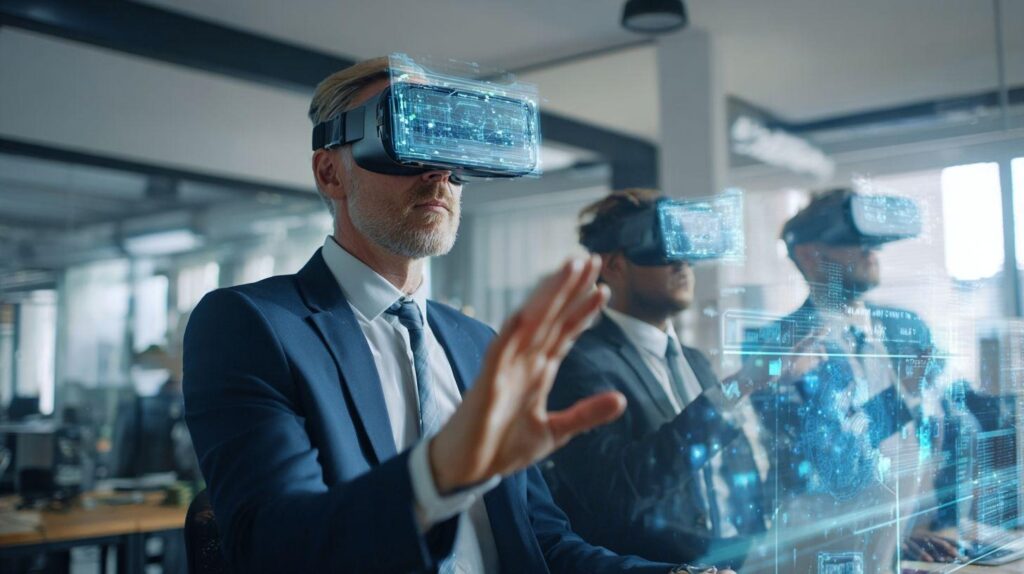
Imagine slashing training costs by 75% while boosting retention rates to 90%, as evidenced by PwC’s VR studies. Virtual reality is transforming corporate training from static sessions into dynamic, immersive experiences.
This article explores VR’s advantages-like enhanced engagement and scalability-core technologies, industry applications, case studies, implementation strategies, challenges, and future innovations, revealing how businesses can lead the revolution.
What is Virtual Reality Training?
VR training uses headsets like Oculus Rift and HTC Vive to create 360 degrees simulations where employees practice skills in risk-free virtual environments. This approach moves beyond traditional methods by offering immersive experiences that mimic real-world scenarios. Employees can interact with digital spaces as if they were physically present.
There are three main types of VR training. First, 360 degrees video provides passive viewing of pre-recorded scenes, ideal for orientation in remote locations. Second, interactive simulations powered by platforms like Unity allow users to make choices and see consequences in real time.
The third type involves full VR games with gamification elements, such as points and levels, to boost engagement in corporate training. Compared to standard e-learning like slide decks, VR fosters higher knowledge retention through hands-on practice. Experts recommend it for scenarios where real-world repetition would be costly or unsafe.
Hardware for effective VR training programs requires minimum specs like 6DOF tracking for natural movement and a 90Hz refresh rate to reduce motion sickness. Devices should support motion controllers and spatial audio for full immersion. These features enable scalable training across industries like manufacturing and healthcare.
Evolution from Traditional Methods
Training evolved from 1980s classroom lectures with low retention to 2010s e-learning modules with even lower retention, and now to VR simulations that boost engagement through hands-on practice. This shift draws from Dale’s Cone of Experience, which highlights how active involvement improves learning outcomes. Companies now prioritize immersive experiences over passive methods.
In the 1990s, slide decks dominated corporate training, relying on static presentations for employee education. These methods lacked interaction, leading to limited skill development. Trainers often repeated the same content without adapting to learner needs.
The 2000s brought learning management systems like Cornerstone, enabling digital training access. This allowed scalable delivery of courses, but retention remained a challenge due to screen-based delivery. Organizations began tracking progress through basic analytics.
Since 2015, VR pilots by Walmart and UPS have shown VR training’s potential in real-world scenarios, such as warehouse operations. These efforts use headset training for safe, repeatable practice. The result is a move toward scenario-based learning that builds confidence before live application.
- 1990s: Slide decks for basic instruction.
- 2000s: LMS platforms for online modules.
- 2015+: VR simulations for interactive training.
Current Market Adoption Statistics
96% of surveyed L&D leaders plan VR expansion within 2 years, according to Gartner 2023 data. The VR training market is growing at a 37.6% CAGR, reaching $13.8B by 2028. This surge reflects strong interest in immersive learning for corporate education.
Companies like Walmart train over 1 million employees with VR simulations for retail scenarios. Verizon uses VR to teach 5G technology, while BMW applies it in assembly line training. These examples show VR adoption across diverse industries.
| Industry | Adoption Rate | Leader |
| Retail | High | Walmart (1M+ trainees) |
| Telecom | Growing | Verizon (VR for 5G) |
| Automotive | Established | BMW (assembly) |
PwC highlights $162B in potential savings from VR in training programs. Deloitte’s VR survey points to improved knowledge retention and engagement. With a global workforce of 1.8B employees, scalable VR solutions offer vast potential for skill development.
Leaders in learning and development prioritize VR for its cost-effective training and real-time feedback. This data underscores how virtual reality is revolutionizing corporate training through practical, data-driven applications.
Key Advantages of VR Over Conventional Training
Research suggests VR training delivers four times faster skill acquisition than traditional methods with better retention. Unlike passive learning in classrooms or videos, VR creates a presence illusion that mimics real-world conditions. This aligns with experiential learning theory, where active participation drives deeper understanding.
Conventional training often relies on lectures and static materials, leading to low engagement. VR, however, offers immersive experiences through headset training and motion tracking. Companies report advantages in areas like safety training and hands-on skill development.
Four key benefits stand out: immersive learning, enhanced retention, cost savings, and scalability. These make VR a game-changer for corporate training programs. Experts recommend integrating VR simulations for manufacturing training, healthcare training, and leadership training.
Transitioning to VR revolutionizes training by enabling scenario-based learning in virtual environments. This supports employee upskilling and reskilling programs. Practical examples from Fortune 500 firms highlight its impact on productivity gains and error reduction.
Immersive Learning Experiences
VR’s 360 degrees immersion creates a strong sense of presence feeling compared to flat video training. Spatial audio and motion tracking combine to deliver emotional learning that sticks. Trainees feel as if they are truly in the scenario, boosting interactive training effectiveness.
For example, United Rentals uses VR for equipment training, achieving faster mastery of complex machinery. This approach excels in hazardous training like construction training or oil and gas training. Cybersickness mitigation involves short sessions and proper ventilation to keep learners comfortable.
Engagement levels rise with VR’s gamification elements, such as VR games and haptic feedback. Classroom sessions often feel passive, while VR headsets like Oculus Rift or HTC Vive provide hands-on training. This method supports diverse applications, from aviation training to customer service training.
Immersive technology fosters constructivist learning, where users build knowledge through exploration. Teams can practice in 3D modeling environments without real-world risks. This prepares workers for real challenges in corporate education.
Enhanced Retention and Engagement
VR boosts long-term knowledge retention through emotional memory activation in the brain. Spaced repetition within VR modules reinforces learning over time. This outperforms traditional classroom or e-learning methods for lasting skill development.
Consider Walmart’s use of VR, which cut training time per employee significantly. Emotional scenarios trigger stronger recall, ideal for compliance training and onboarding programs. Real-time feedback in training simulations helps correct errors instantly.
| Method | 1-week Retention | 3-month Retention |
| VR | High | Strong |
| Video | Moderate | Low |
| Classroom | Moderate | Low |
VR’s learner engagement drives behavioral change and accelerated learning. It suits soft skills training like empathy training or sales training. Data-driven training metrics show consistent gains in performance analytics.
Cost Savings Over Time
VR reduces long-term training costs through efficient digital training delivery. A forklift program might shift from expensive physical setups to affordable VR modules. This leads to substantial savings in corporate budgets.
UPS, for instance, achieved major annual savings with VR for driver training. The ROI comes from productivity gains and reduced downtime. Calculate it as skill improvements multiplied by output, minus VR costs, divided by those costs.
| Year | ROI Impact |
| 1 | Initial Investment |
| 2 | Break-even Point |
| 3 | Strong Returns |
Compared to travel-heavy training, VR breaks even within a few years. It optimizes training budget optimization for L&D teams. Scalable VR solutions support new hire training and regulatory training without ongoing travel expenses.
Scalability for Global Workforces
VR enables training thousands of employees at once, unlike limited classroom sizes. Cloud VR platforms scale infinitely for remote training across continents. No travel is needed for operations spanning many countries.
Accenture, for example, reached workers in numerous locations with VR onboarding. Physical training often covers just a small fraction yearly, while VR handles large groups. Multi-language auto-translation makes it accessible worldwide.
Collaborative VR supports virtual classrooms and team building VR. Features like AR integration enhance mixed reality training. This transforms workplace learning for global teams in retail training or hospitality training.
Enterprise VR platforms ensure device compatibility and easy deployment. Custom VR modules address field service training or crisis simulation. Overall, VR adoption drives industry transformation in learning and development.
Core Technologies Powering VR Training
Modern VR training combines Oculus Quest enterprise headsets with Unity/Unreal Engine development platforms. Hardware has evolved from tethered PC VR to standalone devices like Quest 2 Enterprise at around $1000 per unit. This shift enables immersive learning without cables for corporate settings.
Software progressed from basic 360-degree videos to AI-powered adaptive scenarios in training simulations. These tools create interactive environments for skill development in areas like safety training and leadership training. Companies now build custom VR modules for employee upskilling.
Three key tech pillars drive this revolution: robust hardware essentials with precise sensors, versatile software platforms for content creation, and AI integration for performance analytics. Together, they support scalable training solutions. Experts recommend starting with enterprise VR headsets for reliable deployment.
These technologies transform corporate education by offering hands-on training in virtual environments. From manufacturing training to sales training, VR boosts engagement and knowledge retention through experiential learning.
Hardware Essentials (Headsets and Sensors)
Enterprise VR headsets include Oculus Quest 2 Enterprise ($1000), HP Reverb G2 ($600), and Varjo XR-3 ($10K pro). These devices support corporate training with features like management zones for 100+ devices. Oculus Quest excels in standalone operation for remote training.
Sensors rely on 6DOF inside-out tracking for natural motion in VR simulations. This setup eliminates external base stations, simplifying headset training setups. Add haptic feedback gloves for realistic tactile experiences in hazardous training.
| Headset | Price | FOV | Refresh | Best For |
| Quest 2 Enterprise | $1000 | 100 degrees | 120Hz | Corporate |
| HP Reverb G2 | $600 | 98 degrees | 90Hz | Office sims |
| Varjo XR-3 | $10K pro | 115 degrees | 90Hz | High-end pro |
Choose based on needs, like wide FOV for aviation training. Motion tracking ensures presence illusion while mitigating cybersickness. Integrate spatial audio for immersive onboarding programs.
Software Platforms and Development Tools
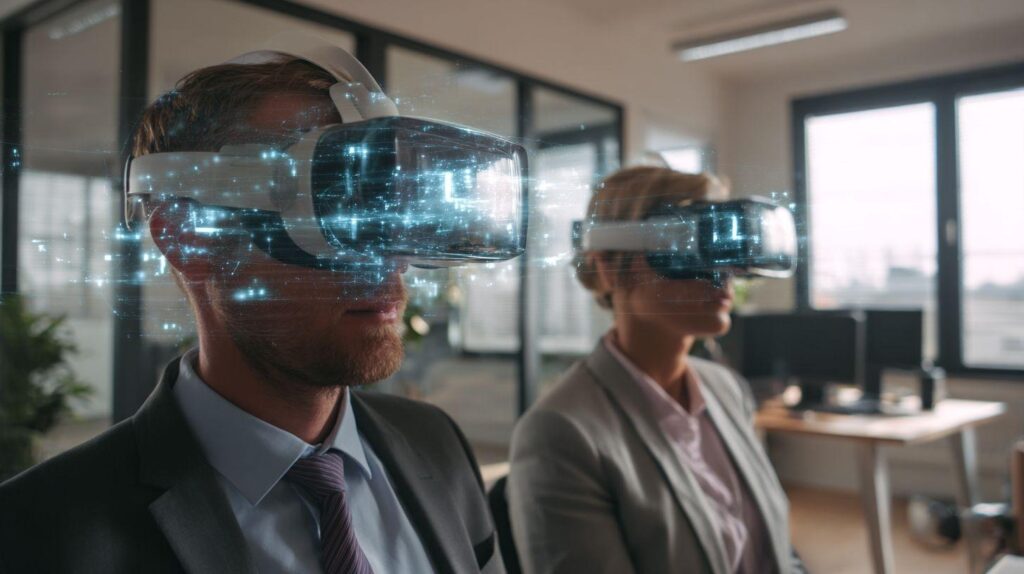
Unity versus Unreal Engine powers most corporate VR training modules. Unity offers a medium learning curve with free or $2000 pro options for interactive sims. Unreal suits photorealistic needs despite a harder curve and $1500 per seat costs.
| Platform | Learning Curve | Cost | Best Uses |
| Unity | Medium | Free/$2000 pro | Interactive sims |
| Unreal | Hard | Free/$1500 seats | Photorealistic |
Authoring tools like VRDirect ($500/mo) simplify VR content creation without coding. EON Reality provides $10K+ enterprise solutions for custom VR modules. Use these for scenario-based learning in compliance training.
For Unity setup, implement a basic VRController script to handle input. This enables gamification in soft skills training. Focus on 3D modeling for virtual classrooms and team building VR.
Integration with AI and Analytics
AI analyzes VR gaze and heatmaps for accurate skill proficiency prediction, as research suggests from Qualcomm VR efforts. Platforms like STRIVR offer AI branching scenarios that adapt to learner actions. Pixowork provides gaze analytics for data-driven training.
Integrate via Unity ML-Agents API to create dynamic training simulations. Track metrics like error rates and time-to-competency in dashboards. This supports real-time feedback for productivity gains in healthcare training.
- Branching paths for crisis simulation.
- Heatmap overlays for error reduction.
- GDPR-compliant anonymization for data privacy.
Apply in fields like oil and gas training or retail training. AI enhances learner engagement and behavioral change. Ensure VR standards for enterprise VR deployment and training ROI.
Major Applications Across Industries
VR cuts safety incident rates significantly in manufacturing and boosts sales close rates in retail. Virtual reality excels in areas where hands-on practice risks injury or costs thousands. It provides immersive learning without real-world dangers.
Recent VR industry reports highlight rapid adoption growth in corporate training. Companies use VR for hands-on training in hazardous environments like oil rigs or construction sites. This approach supports cost-effective training and scalable solutions across sectors.
Industries leverage VR simulations for skill development and compliance. For example, manufacturing firms train workers on equipment operation safely. Retail teams practice customer interactions in virtual environments.
Key applications span safety training, soft skills, technical procedures, and sales. These uses drive productivity gains and better retention rates. VR revolutionizes corporate training programs by enabling repeated practice.
Safety and Compliance Training
Boeing reduced aircraft maintenance errors using VR hazard recognition. This training simulates dangers without real risks. Workers practice in immersive environments to build quick responses.
Oil and gas companies like Shell use VR rig training for offshore scenarios. Construction firms such as Lendlease focus on fall protection simulations. Manufacturing leaders like Tesla train on arc flash hazards.
VR supports OSHA compliance verification through digital badges. Teams verify skills in virtual setups before real tasks. This method reduces incidents through repeated scenario-based learning.
Experts recommend VR for hazardous training in high-risk fields. It offers real-time feedback and motion tracking. Companies achieve safer workplaces with interactive training.
Soft Skills Development
VR empathy training increased employee inclusion scores in diversity programs. Platforms create difficult conversation scenarios for practice. Users build confidence through repeated interactions.
Mursion provides simulations for leadership training and negotiations. Axon Park offers virtual team exercises. These tools help develop soft skills in safe settings.
TransfrVR delivers a library of soft skills modules. Serious Labs focuses on immersive role-playing. Participants receive feedback on body language and tone.
Research suggests VR boosts peer review outcomes in corporate education. It fosters empathy via 360-degree videos and spatial audio. Teams improve collaboration remotely.
Technical and Procedural Skills
Mayo Clinic reduced surgical training time using FundamentalVR simulator. Doctors practice procedures with haptic feedback. This integration mimics real sensations accurately.
Welding training from Lincoln Electric uses VR for precise techniques. CNC machining programs by DMG Mori simulate complex operations. Aviation maintenance for Boeing 737 MAX builds expertise safely.
VR improves first-time pass rates compared to traditional methods. Motion tracking and 3D modeling create realistic setups. Learners repeat tasks until mastery.
Experts highlight haptic feedback as essential for technical skills. It supports fields like healthcare and manufacturing training. Companies scale procedural training across teams.
Sales and Customer Service Simulations
T-Mobile VR sales training increased upsell rates through realistic practice. Customer personas react emotionally in branching scenarios. Sales teams handle objections dynamically.
Precog offers retail simulations with diverse customer types. Virtiual focuses on hospitality interactions. These platforms emphasize emotional realism at high levels.
VR reduces handle times and lifts satisfaction scores. Trainees navigate objection handling paths repeatedly. Real-time feedback refines approaches.
Platforms enable customer service training anytime, anywhere. They support onboarding and upskilling. Businesses gain from data-driven training insights.
Real-World Case Studies
Walmart trained 1M+ associates via VR, saving 350K hours for a $50M productivity gain. This effort used VR simulations for employee training in retail scenarios. Company reports highlight how such programs cut costs in corporate training.
VR ARA studies show immersive learning boosts knowledge retention in large-scale deployments. Walmart’s approach involved headset training with Oculus devices for hands-on practice. Results included faster onboarding and better safety training outcomes.
Other industries adopted similar VR training models. Manufacturing firms used VR simulations for skill development, while healthcare relied on interactive training. Lessons learned emphasize scalable training and real-time feedback for ROI.
Implementation details often include pilot phases before enterprise rollout. These case studies demonstrate VR revolutionizing training across sectors. Companies report gains in engagement and error reduction from VR platforms like Unity.
Manufacturing and Heavy Industry Examples
BMW reduced assembly training 40% from 75 to 45 hours across 8 factories, saving $4.2M. They used Unity and Quest Enterprise for VR simulations in iX assembly. This manufacturing training focused on hazardous tasks with motion tracking.
| Metric | Before VR | After VR |
| Errors | Baseline | -67% |
| Scrap | Baseline | -30% |
| Training time | Baseline | -40% |
The rollout started with a 6-month pilot using 200 headsets, then expanded enterprise-wide. Workers practiced in virtual environments mimicking factory lines. This cut costs for automotive training and improved safety.
Lessons include integrating haptic feedback for realism and tracking performance analytics. BMW’s success shows VR for heavy industry enables cost-effective training. Experts recommend scenario-based learning for reskilling programs.
Healthcare Training Success Stories
Cleveland Clinic VR anatomy training delivered 230% knowledge gain versus traditional methods, saving $800K. Osso VR platform covers 10K+ procedures with FDA clearance for certification. Surgeons achieved 97th percentile performance through immersive experiences.
Pass rates improved 186%, and procedure time dropped 20%. VR simulations offer hands-on training without patient risk, using spatial audio and 3D modeling. This supports regulatory training in high-stakes settings.
Implementation involved custom VR modules on enterprise headsets like HTC Vive. Clinics used data-driven training to measure retention rates. Lessons highlight VR for accelerated learning and behavioral change in healthcare.
Research suggests such platforms enhance experiential learning for complex skills. Cleveland Clinic’s model aids remote training and upskilling. It sets a standard for VR adoption in medical education.
Retail and Hospitality Implementations
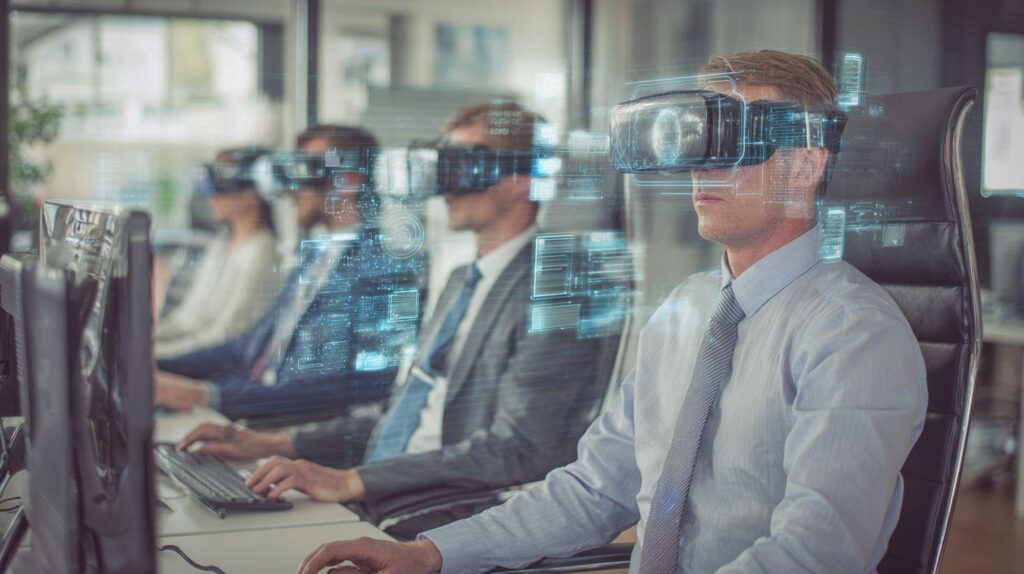
Lowes trained 20K associates via Oculus-powered VR, reducing shrinkage 20% for $60M savings. STRIVR’s VR forklift simulations cut accident rates 70% and trainer time 80%. This retail training focused on safety and operations.
Marriott used VR property tours, boosting conversion 25%. Seasonal hiring benefited from 2-hour VR onboarding with 360-degree videos. Hospitality training improved customer service via immersive scenarios.
Deployment included VR headsets for interactive training and gamification. Companies tracked metrics like engagement and retention rates. Lessons stress scalable VR solutions for new hire training.
These cases show cost-effective training in dynamic environments. Retail and hospitality gain from VR simulations for soft skills and compliance. Experts recommend pilots to optimize training ROI.
Implementation Strategies for Corporations
Successful VR deployment follows a 6-month pilot to enterprise rollout framework. Corporations use this phased approach to avoid common pitfalls in corporate training. It builds confidence before full-scale adoption.
Start with a budget allocation for a pilot program serving initial users. Secure executive sponsorship and assign ownership to learning and development teams. This ensures alignment across departments like IT and safety.
Focus on stakeholder buy-in early to drive VR training success. Conduct needs assessments for areas like safety training or onboarding programs. Tailor immersive learning to specific goals such as skill development in manufacturing or healthcare.
Monitor progress with clear milestones for scalable training. Integrate VR headsets like Oculus Rift or HTC Vive into existing workflows. This strategy supports employee upskilling and long-term training ROI.
Step-by-Step Deployment Guide
Form a cross-functional team including L&D, IT, and safety experts in Week 1, dedicating about 8 hours. This step aligns stakeholders for VR deployment in corporate training programs. It sets the foundation for smooth rollout.
- Complete stakeholder alignment through workshops to define objectives.
- Perform needs assessment covering Kirkpatrick Levels 1-4 for training effectiveness.
- Select vendors like STRIVR or EON for VR platforms and custom modules.
- Launch a 50-user pilot with focused budget to test immersive experiences.
- Deploy MDM solutions for device management and security.
- Handle content localization for global teams in sales or customer service training.
- Integrate with LMS like Cornerstone for seamless data-driven training.
- Scale to 1,000 users, refining based on pilot feedback for enterprise VR.
The entire process spans 4-6 months. Use a checklist to track progress in VR simulations and scenario-based learning. This guide supports immersive onboarding and compliance training.
Overcoming Common Technical Challenges
Many VR projects struggle with connectivity and hardware issues in corporate education; enterprise MDM addresses most compatibility problems. Focus on WiFi optimization and battery management for reliable headset training. Proactive solutions keep immersive technology running smoothly.
| Challenge | Impact | Solution |
| WiFi under 50Mbps | High session dropouts | Cisco Meraki or 6GHz WiFi 6E upgrades |
| Battery life under 2 hours | Incomplete training modules | Quest Link charging docks for continuous use |
| Mixed reality passthrough fails | Navigation and orientation issues | Oculus Insight v2 calibration routines |
Address cybersickness mitigation by testing in real environments. Ensure device compatibility for VR headsets in manufacturing training or aviation training. Regular updates to Unity VR or Unreal Engine content prevent disruptions.
Test solutions in pilots for remote training scenarios. Train IT teams on motion tracking and spatial audio setup. These steps enhance engagement and knowledge retention in virtual environments.
Measuring ROI and Success Metrics
Calculate VR ROI with this formula: (productivity gains plus error reduction plus time saved minus VR costs) divided by VR costs. Track progress across Kirkpatrick’s four levels for training effectiveness. This approach proves value in corporate training programs.
Build a dashboard for Level 1 completion rates, Level 2 knowledge gains, Level 3 behavior changes, and Level 4 business impacts. Use tools like STRIVR Analytics or Qualtrics for performance analytics. Set 90-day benchmarks to guide digital transformation.
Monitor metrics in areas like safety training or leadership training. Experts recommend focusing on real-time feedback from VR simulations. Adjust based on data for accelerated learning and behavioral change.
Aim for clear productivity gains in reskilling programs. Compare pre- and post-training performance in immersive experiences. This data-driven method supports scalable VR solutions and justifies ongoing investment.
Challenges and Limitations
While powerful, VR adoption faces hurdles without proper mitigation strategies. Corporate training programs must address these to ensure immersive learning delivers lasting value.
Common issues include high initial costs and user discomfort like motion sickness. Experts recommend phased investments and best practices for cybersickness mitigation to build sustainable VR training programs.
Solutions focus on cost-effective training options such as leasing hardware and using pre-built content. This approach supports scalable training across departments like sales training and safety training.
Regular evaluation of training metrics helps overcome barriers. Companies achieve better knowledge retention by combining VR simulations with traditional methods in onboarding programs.
High Initial Costs and Barriers
VR pilot costs for corporate training often start high compared to traditional setups, but smart planning reduces this gap. Hardware, content development, and IT integration form the main expenses.
Break down costs with leasing options to spread expenses over time. This makes VR headsets accessible for employee training in areas like manufacturing training and healthcare training.
| Cost Component | Typical Share | Strategy |
| Hardware | Largest portion | Lease models |
| Content Creation | Significant share | Off-the-shelf libraries |
| IT Setup | Smaller portion | Cloud-based deployment |
Compare vendors like STRIVR with in-house development for training ROI. Over time, total ownership costs drop, enabling digital transformation in learning and development.
Motion Sickness and User Comfort
A notable portion of users experience cybersickness in VR training, but targeted techniques greatly reduce it. Best practices include limiting acceleration and using comfort features.
Opt for seated options and high refresh rates like 120Hz to enhance comfort. Teleport locomotion minimizes disorientation during VR simulations for safety training or crisis simulation.
- Apply vignette borders to narrow the field of view gradually.
- Use pre-screening questionnaires to identify sensitive users.
- Start with 2-minute acclimation sessions in virtual environments.
Premium headsets offer better results than budget models. This supports immersive experiences in leadership training and remote training without frequent breaks.
Content Creation and Customization Hurdles
Custom VR modules demand more investment than standard videos, yet they drive superior engagement in corporate education. Timelines and tools make production manageable.
Choose from off-the-shelf packages, custom Unity builds, or AR integration based on needs. Asset libraries speed up 3D modeling for scenario-based learning.
| Option | Cost Range | Timeline |
| Off-the-shelf (e.g., STRIVR) | Lower entry | Faster deployment |
| Custom Unity | Higher investment | 8-12 weeks |
| AR Integration | Added expense | Extended process |
Focus on ROI justification through performance analytics. Tailored content boosts retention in compliance training and soft skills training.
Future Trends and Innovations
Eye-tracking VR headsets launching in 2025 enable precise attention analytics. Virtual reality is maturing beyond novelty into an enterprise standard for corporate training programs. Learning and development leaders prioritize immersive learning for its impact on skill development.
Over the next five years, expect standalone glasses under $200 and metaverse campuses for remote training. These advancements support scalable training in manufacturing, healthcare, and aviation. Companies can create virtual environments for hands-on training without physical risks.
Integration of AI-driven personalization and AR overlays will enhance employee training. Platforms enable scenario-based learning with real-time feedback. This shift promises higher engagement and knowledge retention in corporate education.
Experts recommend piloting VR simulations for compliance training and leadership development. Future innovations like haptic feedback and spatial audio will deepen immersive experiences. Organizations adopting these trends gain productivity through error reduction and accelerated learning.
Advancements in VR Hardware
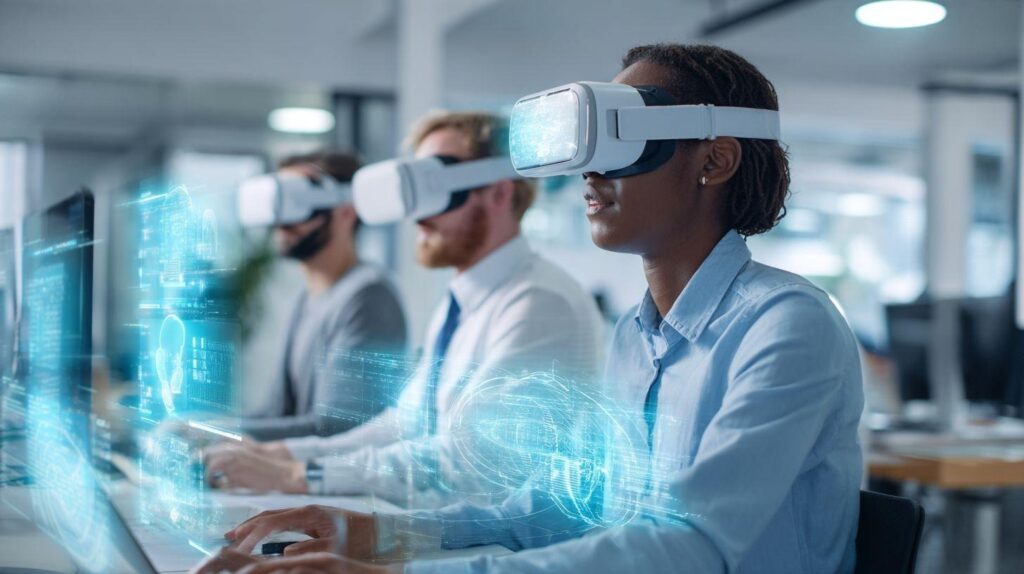
Apple Vision Pro successor in 2026 offers 4K per eye, under 300g weight, and all-day battery. These specs make enterprise VR practical for extended headset training sessions. Lighter designs reduce cybersickness in prolonged immersive learning.
By 2024, devices like Pimax Crystal deliver high-resolution displays per eye. In 2025, eye-tracking becomes standard for performance analytics in training simulations. This roadmap supports VR adoption across industries like oil and gas and construction.
Expect enterprise glasses under $300 by 2027, enabling cost-effective training. Brain-computer interface pilots, such as those from Neuralink, hint at thought-controlled VR training. Teams can deploy these for safety training in hazardous environments.
Practical advice includes selecting hardware with motion tracking and haptic feedback. Test compatibility for custom VR modules in onboarding programs. These upgrades transform digital training into interactive, effective experiences.
Integration with AR and Metaverse
Microsoft Mesh enables large-scale virtual campuses for collaborative VR. Hybrid AR/VR integration supports global team building and digital twins in corporate training. This cuts costs for field service and automotive training.
Platforms like Horizon Workrooms and Spatial.io host virtual classrooms for soft skills training. Passthrough AR overlays blend real-world and virtual elements seamlessly. Employees prefer this for sales training and customer service simulations.
Use cases include crisis simulation with mixed reality for emergency response. Remote teams practice in metaverse spaces, fostering empathy training and diversity exercises. AR enhances retail and hospitality training with overlaid instructions.
Organizations should explore MR training for scalable solutions. Combine Unity VR with AR for 3D modeling in engineering. This integration boosts training ROI through better retention and behavioral change.
Personalized Adaptive Learning Paths
AI in VR adapts difficulty real-time, giving targeted reps for skill gaps like welding. Platforms such as Dreamscape Learn and Taqtile use gaze and motion data for machine learning models. This personalizes corporate training effectively.
Algorithms track user interactions to build adaptive learning paths in immersive environments. Weak performers receive extra practice in VR simulations, aiding manufacturing and healthcare training. Micro-credentialing with blockchain verifies achievements securely.
Examples include virtual welders repeating tasks until mastery in scenario-based learning. This approach excels in new hire training and reskilling programs. Data-driven insights improve learner engagement and presence illusion.
Experts recommend platforms with real-time feedback for leadership and compliance training. Integrate gamification for higher completion in employee upskilling. These paths accelerate experiential learning and memory retention across L&D initiatives.
Frequently Asked Questions
How is Virtual Reality Revolutionizing Corporate Training Programs?
Virtual Reality (VR) is revolutionizing corporate training programs by providing immersive, interactive simulations that replicate real-world scenarios, allowing employees to practice skills in a risk-free environment. This leads to higher retention rates, up to 75% better than traditional methods, and reduces training costs by minimizing the need for physical resources or travel.
What are the key benefits of using Virtual Reality in Corporate Training Programs?
The key benefits include enhanced engagement through immersive experiences, improved skill retention via hands-on practice, scalability for large teams, and measurable performance tracking. VR revolutionizing corporate training programs also cuts down on safety risks in high-stakes industries like manufacturing or healthcare.
How does Virtual Reality improve safety in Corporate Training Programs?
Virtual Reality revolutionizing corporate training programs excels in safety by enabling trainees to experience hazardous situations, such as operating heavy machinery or handling chemicals, without real-world dangers. This approach has been shown to reduce workplace accidents by up to 40% in adopting companies.
Which industries are most impacted by Virtual Reality Revolutionizing Corporate Training Programs?
Industries like healthcare, aviation, oil and gas, and retail are most impacted. For instance, surgeons practice complex procedures, pilots simulate flights, and sales teams rehearse pitches, all thanks to how Virtual Reality is revolutionizing corporate training programs with tailored, realistic simulations.
What is the cost-effectiveness of Virtual Reality in Corporate Training Programs?
Initially, VR setups require investment, but they offer long-term savings by reducing material costs, travel expenses, and downtime. Studies show ROI within 6-12 months, making Virtual Reality revolutionizing corporate training programs a financially smart choice for forward-thinking businesses.
How can companies get started with Virtual Reality Revolutionizing Corporate Training Programs?
Companies can start by assessing training needs, partnering with VR developers for custom modules, and investing in accessible hardware like Oculus Quest. Pilot programs help scale successfully, demonstrating how Virtual Reality is revolutionizing corporate training programs step by step.