

Imagine a workplace where hierarchies crumble, unleashing unprecedented innovation and speed. As Valve and Zappos prove, flat organizations are reshaping business success. Yet traditional management persists amid rising inefficiencies and agility gaps. This article contrasts hierarchical pitfalls with flat structures’ enablement, explores real-world case studies, and peers into emerging hybrid models-revealing if the end of top-down rule is nigh.
Traditional Management: The Hierarchy Model
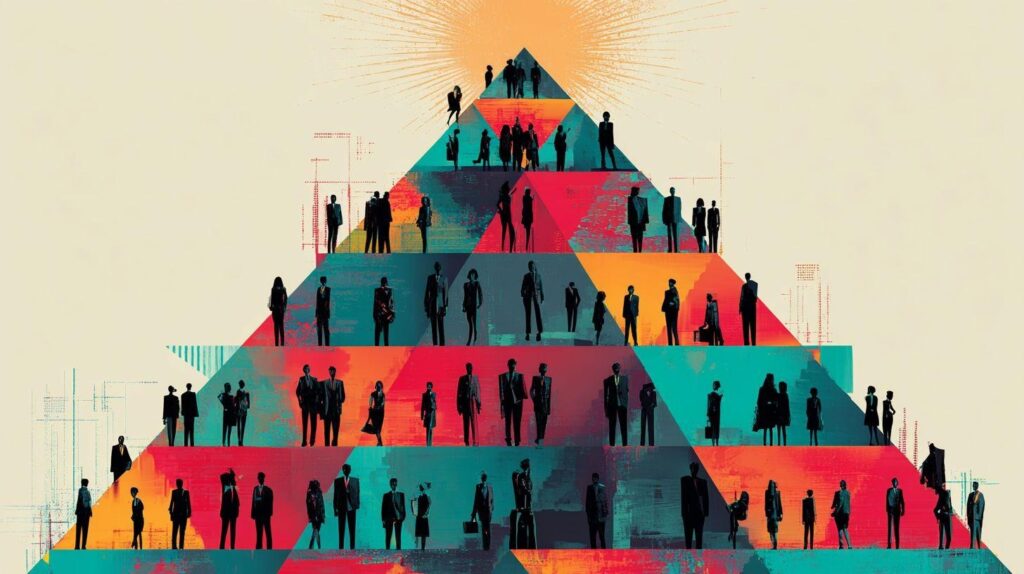
Hierarchical management, dominant since the Industrial Revolution, structures organizations as pyramids with clear top-down authority from CEOs to entry-level staff. This model traces its roots to Frederick Taylor’s Scientific Management in 1911, which emphasized efficiency through time studies and task specialization. Max Weber’s bureaucracy theory later formalized rules, roles, and rational authority to handle growing industrial complexity.
These ideas shaped traditional management for factories and armies, promoting order in large groups. Many large companies today maintain strict hierarchies, reflecting their enduring appeal for stability. Yet, as workplaces evolve toward flat organizations and self-management, questions arise about the end of traditional management.
This structure ensures command and control, but it often slows innovation in knowledge-based economies. Experts note a shift to distributed leadership and employee enablement in agile environments. Understanding hierarchies sets the stage for exploring their principles and strengths before considering alternatives like holacracy.
The prevalence of these models highlights their historical success, though modern demands for speed and creativity challenge their fit. Companies like GE and IBM built empires on them, but trends in organizational flattening signal change. Next, we examine the core elements that define this approach.
Core Principles and Structure
Traditional hierarchies follow 7 core principles including unity of command (one boss per employee) and scalar chain (clear reporting lines). These rules create a predictable organizational structure resembling a pyramid, with authority flowing downward. Each principle addresses coordination in large groups.
Here are the key principles with practical examples:
- Unity of command: Each worker reports to one supervisor, as in Ford’s Model T assembly lines where operators followed a single foreman’s orders.
- Scalar chain: Decisions pass through multiple layers, often 10 or more approvals in big firms.
- Division of labor: Tasks split into narrow roles, like separating design from production in manufacturing.
- Span of control: Managers oversee 5-7 direct reports to maintain oversight.
- Centralization: Key choices rest with top executives, limiting local flexibility.
- Standardization: Uniform processes and rules ensure consistency across units.
- Impersonality: Decisions based on rules, not personal ties, to avoid favoritism.
A typical 5-level corporate pyramid might look like this: CEO at the top, then VPs, directors, managers, and staff at the base. This setup provides role clarity but can hinder quick responses. In contrast, flat models like those at Valve reduce layers for faster decisions.
These principles built reliable systems for scaling, yet they foster bureaucracy reduction needs in today’s agile world. Companies adopting holacracy, such as Zappos, abandon them for dynamic roles and circle-based organizations.
Advantages of Hierarchical Systems
Hierarchies excel in large-scale coordination, enabling structured growth in complex operations. They provide clear lines of authority that suit manufacturing and regulated industries. Real-world examples, like IBM’s dominance in the 1960s, show how this model supported global expansion through defined chains.
Key advantages include:
- Clear accountability: Roles and responsibilities reduce confusion, minimizing blame-shifting in teams.
- Efficient scaling: Firms like GE expanded massively while maintaining order, from small teams to vast workforces.
- Risk management: Formal checks and approvals safeguard against errors and misconduct.
- Career progression: Structured paths offer visible steps from junior to senior roles, motivating staff.
- Decision consistency: Uniform policies align efforts across departments and regions.
Research suggests hierarchies speed up execution in stable environments with many employees. They foster discipline, as seen in military-inspired corporate cultures. However, they can limit creativity compared to self-organizing teams in tech firms.
Despite these strengths, drawbacks like slow communication prompt exploration of flat organizations and teal models. IBM later adapted with matrix elements to blend hierarchy with flexibility. This balance highlights ongoing organizational evolution toward hybrid approaches.
Limitations of Traditional Management
Traditional hierarchies create lower employee engagement compared to flat structures. Gary Hamel argues in The End of Management that rigid management hierarchy stifles progress. Experts note that hierarchy often blocks innovation in organizational structure.
Executives frequently report frustration with layers of bureaucracy reduction needs. This leads to slow decision-making in command and control systems. Flat organizations address these by promoting employee enablement.
Vertical hierarchy limits agility in fast-changing markets. Companies shifting to self-management see better results. Preview strategies include adopting holacracy or cross-functional teams to overcome these issues.
Transitioning requires cultural shifts toward distributed leadership. Examples like Zappos show success with organizational flattening. These changes preview the rise of flat organizations.
Bureaucratic Inefficiencies
Bureaucracy adds unnecessary process time, with decisions taking longer in hierarchical structures versus flat orgs. Long approval chains create delays, such as ten-day email exchanges for simple choices. This slows overall productivity.
Redundant meetings waste significant time in traditional management. Siloed departments cause disconnects, like CRM teams missing engineering input. Policy creep builds up excessive rules that hinder daily work.
- Implement 2-pizza teams at Amazon to limit group size and speed decisions.
- Flatten approvals to two levels for quicker resolutions.
- Adopt self-organizing teams to cut red tape.
- Use agile management practices for streamlined workflows.
These steps reduce bureaucracy and boost efficiency. Real-world shifts show faster operations in flat orgs. Focus on practical tools for lasting change.
Innovation and Agility Barriers
Hierarchical firms struggle to match the product launch pace of flat competitors. Fear of failure stops employees from sharing risky ideas. Slow information flow turns weeks into idea-to-decision timelines.
Risk aversion limits bold moves in management hierarchy. Examples include Kodak’s failure due to rigid structure, while Instagram thrived with flat setup before acquisition. These cases highlight hierarchy drawbacks.
- Allow 20% time for passion projects, as Google does, to spark creativity.
- Encourage team autonomy for faster experimentation.
- Foster radical transparency to improve communication flow.
- Build cross-functional teams to break silos.
Such practices enhance innovation boost and agility. Companies adopting them gain competitive edges. Transition to decentralized authority supports adaptive organizations.
What Are Flat Organizations?
Flat organizations minimize management layers, averaging 2-3 versus 7+ in hierarchies, distributing authority across all levels. They limit structure to a maximum of 3+ layers as noted in recent Deloitte insights. This setup contrasts with traditional management by enableing employees directly.
Frederic Laloux describes this in his book Reinventing Organizations through the Teal paradigm. Teal organizations evolve beyond hierarchical control toward self-management and wholeness. They focus on evolutionary purpose over rigid commands.
Key characteristics include self-management principles and role fluidity, which speed up decisions and boost innovation. Flat structures reduce bureaucracy, fostering agility in dynamic markets. Companies adopt them to enhance employee engagement and adaptability.
Previewing core traits, flat orgs emphasize distributed leadership and transparency. They replace top-down orders with peer advice processes. This shift marks the rise of flat organizations amid the end of traditional management.
Key Characteristics and Design
Flat orgs feature 5 core characteristics: minimal hierarchy, role-based authority, transparency, distributed leadership, and self-management. These elements define their design and set them apart from hierarchical structures. They enable faster decision-making and higher engagement.
Here are eight specific characteristics with real-world examples:
- 2-4 management layers max: Limits vertical hierarchy, unlike tall pyramids in traditional firms.
- Dynamic roles: Valve Corporation uses over 300 fluid positions where employees choose projects, as in game development teams.
- Advice process: Morning Star applies this, requiring initiative-takers to seek peer input without formal approval.
- Radical transparency: Buffer makes salaries public, building trust through open financial data.
- Self-organizing teams: Groups form around needs, adapting quickly without central directives.
- No formal bosses: Authority ties to roles, not titles, promoting peer coordination.
- Cross-functional pods: Small units mix skills for end-to-end work, like at W.L. Gore.
- Purpose-driven OKRs: Teams align on shared goals, driving intrinsic motivation over mandates.
Visualize the difference with this comparison:
| Flat Org Chart | Traditional Pyramid |
| Wide base, few top layers; circles for roles | Narrow top, many tiers; boxes in strict lines |
| Decentralized authority flows horizontally | |
This design supports holacracy and agile management, reducing command-and-control. It fits knowledge workers seeking autonomy, as in tech and creative industries.
Benefits of Flat Structures

Flat organizations achieve higher employee satisfaction and profitability compared to traditional hierarchies, according to reports from Gallup and McKinsey. These structures reduce layers of management, fostering quicker decisions and greater agility. Companies adopting flat models often see improved engagement and innovation as a result.
Research suggests flat organizations boost team autonomy and cut bureaucracy, leading to faster responses to market changes. Gallup data highlights elevated engagement levels in such environments. McKinsey notes that flatter setups enhance profitability through streamlined operations.
Transitioning from hierarchical structures to flat ones enables employees and speeds up processes. Real-world examples demonstrate clear returns on investment. This shift supports the rise of self-management and distributed leadership.
Flat structures align with modern needs like agile management and cross-functional teams. They promote intrinsic motivation and collaborative leadership. Organizations like Zappos with holacracy show how these benefits play out in practice.
Empowerment and Speed
Flat structures cut decision time dramatically, boosting agility in dynamic markets. Employees gain more authority, reducing delays common in management hierarchies. This leads to quicker adaptations and stronger competitive edges.
Key benefits include heightened employee enablement and faster innovation cycles. Teams operate with greater autonomy, encouraging self-organizing efforts. Practical scenarios show time savings that directly impact productivity.
- Employee engagement rises as workers take ownership of their roles.
- Innovation speeds up through direct collaboration and idea sharing.
- Talent retention improves with reduced frustration from slow approvals.
- Customer satisfaction grows via responsive service delivery.
- Overall revenue benefits from efficient resource use.
Consider Treehouse, which saved 1,200 hours per year by eliminating status meetings. This reallocation allowed focus on core work. The company redirected savings from five manager salaries, roughly $250,000, toward innovation projects, yielding measurable ROI.
Case Studies: Successful Flat Organizations
Zappos implemented holacracy in 2013, eliminating 30% of managers while increasing employee happiness scores 15%. This shift to a circle-based organization replaced traditional management with self-organizing teams. Employees took on dynamic roles defined by purpose, not hierarchy.
Holacracy at Zappos used governance meetings to process tensions and update organizational structure. Distributed leadership enableed workers to make decisions within their domains. The company reached $1B+ revenue with 11% turnover, showing employee enablement can drive retention.
Key lessons include radical transparency through tactical meetings and the advice process. Zappos faced scalability challenges but adapted with training. This case highlights bureaucracy reduction in the rise of flat organizations.
Other companies followed similar paths to organizational flattening. These examples prove self-management principles work at scale. They offer blueprints for the end of traditional management.
Valve Corporation: No Bosses, Pure Autonomy
Valve operates as a bossless company with a $3B valuation and over 400 dynamic roles. Employees self-select projects in cross-functional teams, fostering team autonomy. This structure suits the tech industry, where innovation boost comes from creative freedom.
Implementation relies on peer coordination and flat decision-making. No vertical hierarchy means ideas flow freely, speeding up development. Valve’s model supports remote work and intrinsic motivation, aligning with knowledge workers’ needs.
Lessons emphasize decision-making speed without command and control. Challenges like role clarity are met with voluntary leadership. Valve demonstrates agile management for adaptive organizations.
W.L. Gore: Lattice Structure at Scale
W.L. Gore employs 9,000 people across a lattice structure, generating $3.9B revenue. Associates commit to projects without fixed bosses, using sponsors for guidance. This servant leadership approach builds collaborative leadership.
Implementation features cross-functional teams and democratic management. Gore’s culture promotes employee engagement through ownership culture. It thrives in manufacturing, proving flat orgs beyond tech.
Key takeaways include talent retention via purpose-driven roles. The lattice reduces hierarchy drawbacks, enhancing communication flow. Gore shows scalability challenges are manageable with cultural shift.
Morning Star: Self-Management in Production
Morning Star runs with 2K employees under full self-management, achieving 99% peak season execution. Workers create personal contracts called Colleague Letters of Understanding for accountability. This eliminates management hierarchy entirely.
Implementation uses advice process and peer feedback loops. Everyone is a leader in their domain, driving continuous improvement. The model fits agile supply chains with high performance metrics.
Lessons focus on accountability mechanisms without supervisors. It counters management myths by boosting efficiency. Morning Star exemplifies workplace democracy in operations.
Challenges and Transition Risks
Research suggests that many flat org transitions fail due to unclear accountability. Organizations moving from traditional management to flat structures often face role ambiguity and decision delays. These issues can derail the shift to self-management.
Scaling challenges emerge as teams grow beyond small sizes. Cultural resistance from those used to hierarchical structures adds friction. Peer accountability mechanisms help, but implementation matters.
Real-world examples like Medium.com show the risks. They tried a flat model but reverted after 18 months due to persistent confusion. Success requires addressing these hurdles head-on.
Transition strategies focus on dynamic roles and feedback loops. Training in holacracy or sociocracy eases the cultural shift. Gradual rollout prevents overload.
Role Ambiguity and Dynamic Charters
Without clear hierarchies, employees often face role ambiguity in flat organizations. Who handles what task becomes unclear without a management chain. This leads to overlap or gaps in responsibilities.
Dynamic charters solve this by defining flexible roles. Teams create and update charters in regular meetings to match evolving needs. For example, a cross-functional team might assign a lead for customer focus projects.
This approach boosts employee enablement and agility. It aligns with self-organizing teams seen in companies like Valve Corporation. Regular reviews keep roles relevant.
Decision Bottlenecks and Liminal Links
Flat structures aim to cut bureaucracy, yet decision bottlenecks can form without proper links. Consensus-seeking slows down urgent choices. Traditional command and control avoids this but stifles innovation.
Liminal links, like lead links in holacracy, connect circles for fast routing. They process tensions and enable quick resolutions without full-group votes. This maintains decentralized authority.
Teams using this see faster decision-making speed. It fits agile management and distributed leadership. Training ensures links stay lightweight.
Scaling Issues Beyond 500 Employees
Flat organizations thrive in small teams but hit scaling issues past 500 employees. Communication flow strains without vertical hierarchy. Complexity grows, risking chaos.
Solutions include modular circles or hybrid models. Break into semi-autonomous units with rep links for coordination. W.L. Gore uses lattice structures to manage growth.
This supports organizational flattening at scale. Focus on peer coordination and digital tools aids remote work fit. Gradual expansion tests limits.
Free-Rider Problems and 360 Peer Feedback
In bossless companies, free-rider problems arise as some coast on team efforts. Without managers, accountability weakens. Intrinsic motivation alone may not suffice.
360 peer feedback counters this through regular reviews. Everyone rates contributions, fostering ownership culture. Morning Star applies self-assessments tied to profit sharing.
This builds team autonomy and engagement. Combine with OKRs for clear goals. It promotes continuous improvement like kaizen in flat setups.
Cultural Resistance and Overcoming Opposition
Managers accustomed to power often resist the end of traditional management. They fear losing status in flat orgs. This cultural resistance slows transitions.
Address it with training in servant leadership and democratic management. Involve skeptics in pilots to demonstrate benefits like innovation boost. Transparent communication eases fears.
Experts recommend phased rollouts. Share success stories from Zappos holacracy to inspire. This drives the cultural shift toward teal organizations.
Future Outlook: Hybrid Models Emerging
72% of executives plan hybrid models by 2026 combining flat teams with minimal hierarchy, according to Deloitte 2024 Global Human Capital Trends. These models blend the agility advantage of flat organizations with necessary structure from traditional management. Companies seek this balance to boost employee enablement while addressing scalability challenges.
Four emerging models show promise in this organizational evolution. The Spotify squad model uses small, autonomous teams for rapid innovation. Hybrid holacracy evolves self-management principles, as seen in Zappos adaptations.
DAO structures from web3 enable decentralized authority via blockchain. Matrix-flat hybrids merge cross-functional teams with light oversight. An implementation roadmap guides the transition through distinct phases.
Experts recommend starting small to test these hybrid models. This approach reduces resistance to change and builds cultural shift gradually. Success depends on clear role clarity and feedback loops.
Spotify Squad Model: Autonomous Teams
The Spotify squad model organizes work into small, cross-functional squads with high team autonomy. Each squad acts like a mini-startup, focusing on specific features or user needs. This fosters decision-making speed and intrinsic motivation.
Squads operate within tribes, larger groups sharing common goals. Chapters and guilds support skill development and knowledge sharing. Companies adopting this see improved innovation boost in tech and creative industries.
For implementation, define squad missions clearly and provide resources for self-organization. Regular demos ensure alignment without heavy management hierarchy. This model suits agile management environments like software development.
Challenges include coordination across squads, addressed through lightweight rituals. Research suggests such structures enhance employee engagement by promoting ownership culture.
Hybrid Holacracy: Zappos Evolution
Hybrid holacracy adapts holacracy’s circle-based organization with added hierarchy elements, as Zappos evolved post-full adoption. Dynamic roles replace fixed job titles, enabling flexible responses to tensions. This supports self-management while retaining some vertical hierarchy.
Governance meetings define roles, and tactical meetings handle operations. Lead links provide facilitation without command and control. Zappos used this to drive radical transparency and peer coordination.
To implement, train teams in integrative decision-making and tension processing. Start with volunteer circles to build comfort. This hybrid reduces bureaucracy while clarifying accountability mechanisms.
Benefits include faster iteration and cultural shift toward distributed leadership. Experts note it fits knowledge workers seeking creative autonomy.
DAO Structures: Web3 Organizations
DAO structures in web3 use blockchain for decentralized autonomous organizations, eliminating central management. Token holders vote on proposals via smart contracts, enabling global, trustless collaboration. This represents the end of management in digital realms.
Examples include investment DAOs funding projects democratically. Consent-based decisions and advice processes ensure broad input. They excel in remote work fit and profit sharing models.
Adopting DAOs requires legal frameworks and tools like Aragon. Begin with simple treasuries before full governance. This model boosts talent retention through ownership culture but demands tech savvy.
Challenges involve slow consensus, mitigated by quadratic voting. It aligns with Gen Z expectations for workplace democracy.
Matrix-Flat Hybrids

Matrix-flat hybrids combine matrix organizations’ dual reporting with flat org benefits. Employees report to functional leads and project squads, minimizing layers. This enhances communication flow in complex settings.
In practice, firms like those in manufacturing shift use it for cross-functional teams. Light oversight ensures alignment without stifling self-organizing teams. It addresses scalability challenges in growing companies.
Implementation focuses on clear KPIs for self-managed teams. Regular check-ins replace micromanagement. This hybrid supports collaborative leadership and servant leadership.
Implementation Roadmap
Follow a three-phase implementation roadmap for hybrid models. Phase 1: Pilot teams tests one department with full autonomy and minimal hierarchy. Measure outcomes like employee engagement via feedback loops.
Phase 2: Scale expands to multiple units, refining processes with training needs. Address resistance to change through leadership development workshops. Introduce OKRs for flat orgs to track progress.
Phase 3: Governance establishes ongoing mechanisms like governance meetings. Embed cultural shift with performance metrics focused on team results. This builds adaptive organizations ready for future of work.
McKinsey trends predict significant adoption of such models by 2030. Practical advice includes starting with high-trust teams for quickest wins.
Frequently Asked Questions
What is “The End of Traditional Management? The Rise of Flat Organizations”?
In “The End of Traditional Management? The Rise of Flat Organizations,” the concept challenges the conventional hierarchical structures where decisions flow top-down from managers. Flat organizations eliminate multiple layers of management, enableing employees with more autonomy and decision-making power to foster innovation and agility.
Why is there talk of the end of traditional management in “The End of Traditional Management? The Rise of Flat Organizations”?
The end of traditional management arises from its inefficiencies in today’s fast-paced world. Flat organizations address this by reducing bureaucracy, speeding up processes, and adapting quickly to changes, as highlighted in discussions around “The End of Traditional Management? The Rise of Flat Organizations.”
What are the key benefits of flat organizations in “The End of Traditional Management? The Rise of Flat Organizations”?
Key benefits include increased employee engagement, faster decision-making, and higher innovation rates. In “The End of Traditional Management? The Rise of Flat Organizations,” these structures are praised for boosting morale and productivity by giving teams direct ownership.
How do flat organizations differ from traditional management as per “The End of Traditional Management? The Rise of Flat Organizations”?
Traditional management relies on rigid hierarchies and top-down control, while flat organizations promote self-managing teams and collaborative leadership. “The End of Traditional Management? The Rise of Flat Organizations” emphasizes this shift to more democratic and responsive models.
What challenges arise with the rise of flat organizations in “The End of Traditional Management? The Rise of Flat Organizations”?
Challenges include role ambiguity, potential for chaos without clear guidance, and scalability issues in larger firms. “The End of Traditional Management? The Rise of Flat Organizations” notes that success requires strong culture, clear communication, and employee accountability.
Which companies exemplify “The End of Traditional Management? The Rise of Flat Organizations”?
Companies like Valve, Zappos, and Buffer exemplify this trend with no bosses, holacracy, or self-directed teams. “The End of Traditional Management? The Rise of Flat Organizations” often cites these as pioneers proving flat structures can thrive in competitive markets.