
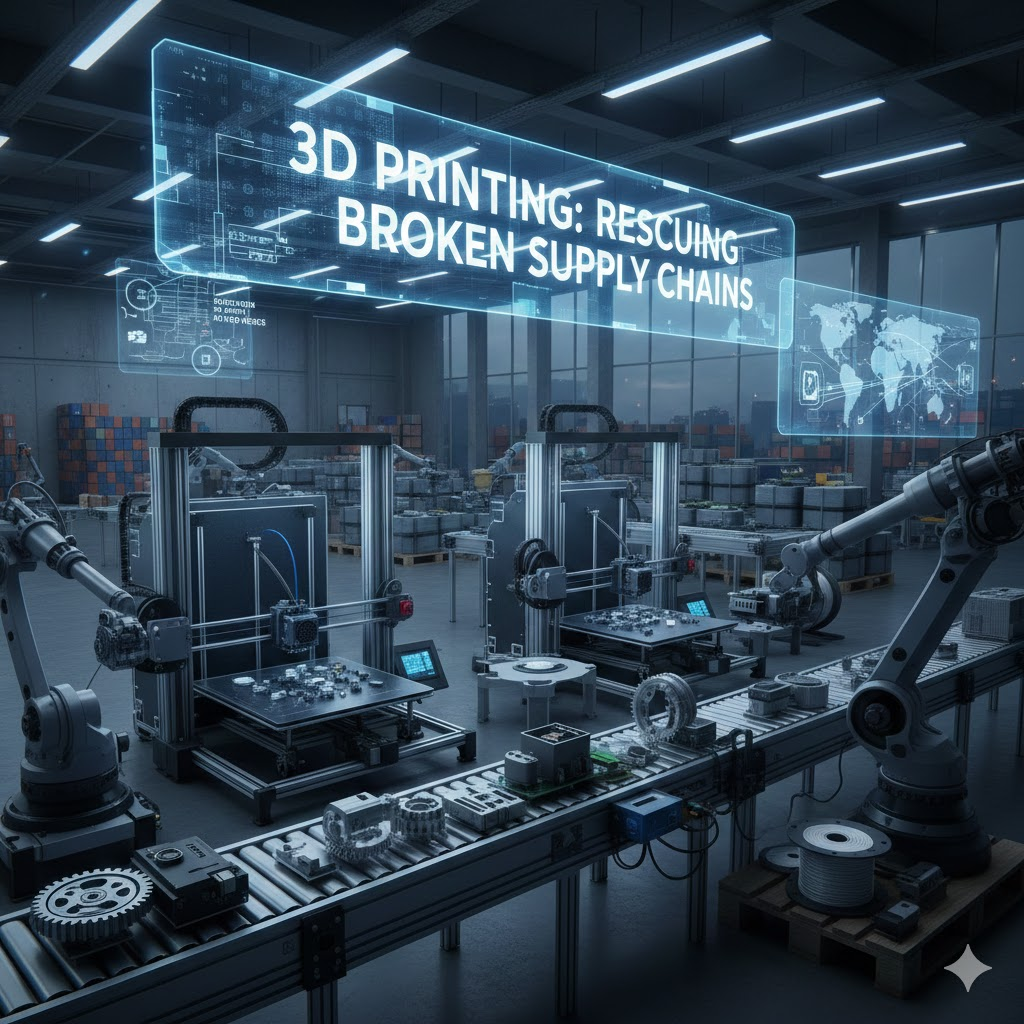
Global supply chains shattered by pandemics and wars have left industries scrambling for solutions. Enter 3D printing, revolutionizing resilience through decentralized production and slashed lead times. This article explores vulnerabilities exposed, core advantages like on-demand manufacturing, real-world triumphs-from COVID-19 medical supplies to automotive crisis parts-plus technological enablers, strategies, and future horizons. Discover how it’s rebuilding broken links.
Supply Chain Vulnerabilities Exposed
The 2021 Suez Canal blockage stranded $9.6 billion in goods daily while COVID-19 caused 1.5 million shipping containers to pile up at U.S. ports. These events revealed deep cracks in global supply chains. Companies faced halted production and massive delays from such disruptions.
Pandemics, wars, and logistics failures amplify these risks. Traditional manufacturing worsens the problem with long lead times and reliance on distant suppliers. Businesses struggle to respond quickly when crises hit.
Supply chain disruptions like port congestion force firms to rethink strategies. Events such as the Red Sea attacks reroute shipping, adding weeks to delivery. This exposes the need for more flexible approaches like on-demand manufacturing.
Transitioning to decentralized production through 3D printing offers a path forward. Local fabrication cuts dependence on fragile global networks. Firms can produce parts on-site during shortages.
Global Disruptions from Pandemics and Wars
COVID-19 exposed supply chain fragility when ventilator parts shortages delayed critical care in overwhelmed hospitals. Factories shut down worldwide, halting shipments of essential components. Patients waited weeks for supplies from overseas.
The Suez Canal blockage in 2021 trapped ships for days, delaying goods worth billions. Trade routes clogged, affecting everything from consumer electronics to medical supplies. Such bottlenecks show how one chokepoint can paralyze global trade.
Russia’s war in Ukraine disrupted neon gas flows, key for semiconductor production. Chip makers faced shortages, slowing automotive and tech manufacturing. Attacks in the Red Sea later forced half of shipping to reroute around Africa.
These events underline the push for supply chain resilience. Companies now explore 3D printing for rapid response. Printing spare parts locally bypasses disrupted routes and speeds up recovery.
Traditional Bottlenecks in Manufacturing
Traditional manufacturing requires 12-16 week lead times for automotive parts, as seen when shortages crippled production lines. Factories demand high upfront tooling costs and large minimum orders. This rigidity leaves businesses vulnerable during crises.
Key bottlenecks include high tooling expenses, often tens of thousands per part design. Minimum order quantities force overproduction of thousands of units. Shipping from overseas adds 45 days or more to delivery times.
- Inventory carrying costs tie up capital in stored goods.
- Dependence on one or two critical suppliers creates single points of failure.
- Long setup times prevent quick adjustments to demand shifts.
These issues fuel the rise of additive manufacturing. 3D printing slashes lead times to days, enabling just-in-time production. Firms gain flexibility with custom parts and reduced waste.
Core Advantages of 3D Printing
3D printing cuts production lead times from 12 weeks to 48 hours while eliminating much of traditional inventory costs. This technology transforms broken supply chains through decentralization and speed. It enables on-demand production that bypasses global logistics delays from events like port congestion or semiconductor shortages.
The Wohlers Report notes a growing market for additive manufacturing, highlighting its role in supply chain rescue. Unlike traditional methods reliant on overseas factories and long shipping routes, 3D printing supports just-in-time production. Companies achieve flexibility with local print farms producing custom parts on site.
NASA has used this approach for rocket parts, showing significant cost savings in aerospace components. Traditional supply chains face disruptions from trucking delays or air freight issues, but decentralized production keeps operations running. This shift reduces stockout risks during pandemics or geopolitical events.
On-demand manufacturing eliminates warehouses full of spare parts, freeing capital for innovation. Experts recommend integrating CAD models with platforms for instant quoting. Overall, 3D printing builds supply chain resilience through rapid prototyping and component fabrication.
Decentralized On-Demand Production
Xometry’s network of printers delivers parts in 24-72 hours anywhere globally, bypassing shipping delays. This decentralized production uses local print farms within 50 miles of users. It contrasts with traditional methods needing weeks for overseas manufacturing and FedEx transit of 3-5 days.
Platforms like Xometry and Protolabs provide quotes in one hour after CAD file upload. Users send STL files for instant pricing on FDM technology or metal 3D printing. Print farms with Markforged hubs scale to thousands of parts per day, supporting industries from automotive to medical supplies.
- Upload CAD models to cloud platforms for rapid quoting.
- Select local printers using filament materials or resin printing.
- Monitor progress with supply chain visibility tools for same-day delivery.
- Scale via distributed manufacturing networks during shortages.
A network map of these hubs shows coverage across regions, enabling nearshoring benefits. For example, during the Suez Canal blockage, firms printed drone components locally. This model supports reshoring and agile manufacturing for sustained supply chain resilience.
Reduced Lead Times and Inventory Needs
GE Aviation reduced spare part lead times from 6 months to 5 days using HP Multi Jet Fusion printers. This inventory reduction frees up space and capital tied in warehouses. Traditional stockouts from global disruptions drop sharply with on-demand printing.
Companies shift from bulky inventories to just-in-time production, cutting holding costs. Boeing examples show teams redirecting staff from storage to design work. Print farms handle custom parts like ventilator components during pandemic shortages.
| Traditional Supply Chain | 3D Printing Approach |
| 12 weeks lead time | 2 days production |
| High inventory storage | On-demand fabrication |
| Global shipping risks | Local print farms |
Practical ROI comes from lower costs per part via material efficiency and waste reduction. Use slicing software like Cura to optimize print speed and layer height. This approach mitigates shortages in aerospace components or consumer goods, enhancing overall supply chain resilience.
Real-World Case Studies
Real implementations prove 3D printing’s crisis response capability in broken supply chains. A Formlabs study highlighted 10x faster medical part production during emergencies. These examples show on-demand manufacturing rescuing pandemic shortages and geopolitical disruptions.
During COVID-19, 3D printing produced 15 million face shields in 2 weeks across 1,600+ makerspaces. This effort used FDM technology and desktop printers for rapid PPE production. Decentralized production networks enabled quick scaling without global logistics crisis delays.
In automotive sectors, additive manufacturing delivered spare parts printing during chip shortages and wars. Cases from Ford and Volkswagen demonstrate supply chain resilience through local manufacturing. Printers like Markforged Metal X handled metal components with tight tolerances.
These stories highlight just-in-time production and inventory reduction benefits. Companies shifted to digital manufacturing for agile responses. Experts recommend hybrid approaches combining 3D printing with traditional methods for future disruptions.
Medical Supplies During COVID-19
Italian doctors 3D printed 10,000 ventilator valves in 72 hours using desktop printers when supply chains collapsed. The Lancet documented this effort with Formlabs Form 3 resin printing. Teams shared STL files openly for community driven production.
In the US, America Makes coordinated 15 million face shields in two weeks. Makerspaces used Prusa i3 printers with filament materials for PPE production. FDA emergency use approvals sped deployment to hospitals facing shortages.
The UK ventilator challenge produced 15,000 parts via Formlabs and Conway collaboration. SLA printing ensured biocompatibility and precision for critical components. This showcased print farms scaling custom parts production rapidly.
These cases underline medical supply printing flexibility. Regulatory compliance came through quick FDA nods. On-demand manufacturing cut lead times from weeks to hours, proving value in disaster response printing.
Automotive Parts in Geopolitical Crises
Ford 3D printed 10,000+ bracket assemblies in Ohio during 2022 chip shortage, avoiding production halts. Using Markforged Metal X, they achieved metal 3D printing with Nylon12 materials. Tolerances of +-0.1mm met automotive specs.
Volkswagen in Ukraine turned to EOS M290 for metal parts during the invasion. SLS printing created durable components onsite, bypassing shipping delays. This local manufacturing mitigated geopolitical disruptions effectively.
BMW adopted Stratasys F770 to cut lead times by 50% in reshoring efforts. Cost per part dropped to $2.50 from $15 via injection molding. Polymer printing supported topology optimization for lightweight structures.
These examples show automotive parts fabrication building supply chain resilience. Post-processing like annealing improved mechanical properties. Companies gained production flexibility for spare parts printing in crises.
Technological Enablers
Material breakthroughs now make industrial 3D printing viable for production-grade parts. These advances replace traditional injection molding in disrupted supply chains. IDTechEx notes the multi-material market growing at 28% CAGR to $4.8B by 2032.
HP’s Multi Jet Fusion prints 6x faster than SLS using TPU, nylon, and polypropylene simultaneously. This speed supports on-demand manufacturing during global logistics crises. Companies produce custom parts locally, bypassing shipping delays.
New polymers and metals enable supply chain resilience. Firms print spare parts for automotive and aerospace on-site. This cuts lead times from weeks to hours, aiding shortage mitigation.
Experts recommend combining additive manufacturing with CAD models for rapid prototyping. Digital files allow decentralized production anywhere. Such flexibility proved vital during pandemic shortages for PPE and ventilator parts.
Material Advancements and Multi-Material Printing
BASF’s Ultrasint PA11 achieves 55 MPa tensile strength, matching injection-molded nylon for automotive brackets. This material supports component fabrication in broken supply chains. It offers flexibility for brackets in trucks facing part delays.
Multi-material printing expands options for complex geometries. Stratasys J850 combines rubber and plastic in one build for seals and grips. This enables production of hybrid parts impossible with single-material methods.
| Material | Printer | Tensile Strength | Heat Deflection | Cost/kg | Applications |
| HP PA12 | Multi Jet Fusion | 55MPa | 175°C | $85 | Consumer goods, brackets |
| BASF PA11 | SLS | 48MPa | 180°C | $110 | Automotive parts, hoses |
| EOS Aluminum AlSi10Mg | Metal SLS | 350MPa | 230°C | $250 | Aerospace components, engines |
| Carbon DLS Silicone | DLS | 2.2MPa | 200°C | $400 | Seals, medical devices |
Choose materials based on needs like heat deflection for engine parts or low cost for prototypes. Metal 3D printing suits high-strength aerospace uses during port congestion. Polymer options fit rapid consumer goods printing.
Implementation Strategies
Successful implementation strategies for 3D printing in broken supply chains rely on hybrid approaches. These models blend additive manufacturing with traditional methods to boost supply chain resilience. Experts note many manufacturers plan hybrid adoption for better ROI.
GE’s hybrid model combines 3D printing for prototypes and spares with CNC for high-volume runs. This cuts total lead time significantly. It shows how on-demand manufacturing fits into existing operations.
Hybrid setups enable rapid prototyping and custom parts production alongside mass production. Companies reduce inventory and tackle disruptions like port congestion. Start by assessing needs for lead time and volume.
Preview key tactics like print farms and micro-factories. These integrate CAD models and STL files into workflows. They support just-in-time production during global logistics crises.
Hybrid Manufacturing Models
Protolabs hybrid model uses 3D printing for prototypes under 10 parts in 1-2 days, then shifts to CNC for over 100 parts in 5-10 days. This saves development time for clients facing supply chain disruptions. It balances speed and scale effectively.
GE pairs additive manufacturing for quick spares and prototypes with CNC machining for volume. This approach aids aerospace components and aviation printing. It minimizes downtime from shortages.
- Print farms deploy over 100 Ultimaker S5 printers for decentralized production, handling pandemic shortages like PPE and ventilator parts.
- Micro-factories, as in Local Motors’ 9-hour car build, enable local manufacturing and reshoring to avoid tariffs and geopolitical issues.
- Cloud platforms like Xometry let users upload STL files for on-demand manufacturing at nearby facilities, cutting shipping delays.
| Volume | Lead Time | Cost | Hybrid Method |
| Low (<10 parts) | 1-2 days | Medium | 3D printing prototypes |
| Medium (10-100) | 3-5 days | Medium-High | 3D + CNC transition |
| High (>100) | 5-10+ days | Low per unit | CNC high-volume |
Use this decision matrix to pick methods based on needs. It supports agile manufacturing for automotive parts or medical supplies. Test with FDM technology or resin printing for best fit.
Future Outlook and Challenges
By 2030, Wohlers predicts 3D printing will capture 5% of $12T global manufacturing, focused on spares and customization. This growth promises to reshape broken supply chains through on-demand manufacturing and decentralized production. Experts see it as a key tool for supply chain resilience amid disruptions like port congestion and geopolitical issues.
The market for additive manufacturing shows strong potential, with projections pointing to $51B by 2026 according to Wohlers. Companies can adopt it for rapid prototyping and custom parts production, reducing reliance on global logistics. Real-world cases, such as Adidas 4D shoes, highlight mass customization in footwear.
Challenges remain, but solutions are emerging. Certification hurdles slow adoption, yet FAA approvals for thousands of aerospace components demonstrate progress. Scaling via print farms and targeting low costs per part will drive wider use in industries facing shortages.
A clear implementation roadmap guides businesses: pilot programs in 2024, 10% of spares via 3D printing by 2026, and micro-factories by 2030. This path supports just-in-time production and inventory reduction. Firms should start with CAD models and STL files for spare parts printing.
Market Growth
3D printing market growth accelerates as companies seek alternatives to pandemic shortages and Suez Canal blockages. It enables local manufacturing and reshoring production, cutting air freight costs and trucking delays. Industries like automotive parts and consumer goods printing benefit most.
Projections from sources like Wohlers underscore expansion to $51B by 2026. Businesses can leverage FDM technology and metal 3D printing for component fabrication. Examples include GE aviation printing and Boeing 3D parts, proving viability in high-stakes sectors.
To capitalize, integrate print farms for higher volumes. Start with desktop 3D printers like Ultimaker FDM, then scale to industrial systems from Stratasys or EOS. This supports agile manufacturing and lead time reduction from weeks to hours.
Mass Customization
Mass customization thrives with 3D printing, allowing unique products without tooling costs. Adidas 4D shoes exemplify this, using digital manufacturing for personalized footwear. It fits Industry 4.0 by enabling production flexibility and design iteration speed.
Fashion prototyping and custom medical supply printing show broad applications. Use software like Fusion 360 for topology optimization and complex geometries. Consumers gain from honeycomb infill for lightweight structures impossible in traditional methods.
Overcome hurdles by refining slicing software like Cura slicer. Pair with post-processing such as annealing for better mechanical properties. This approach boosts supply chain visibility and customer satisfaction through on-demand options.
Key Challenges
Certification poses a major challenge for 3D printing in regulated fields. FAA approvals for thousands of parts signal progress in aerospace components. Companies must ensure tolerances, surface finish, and tensile strength meet standards.
Scaling production requires print farms capable of high daily output. Optimize print speed, layer height, and nozzle size for efficiency. Material choices like filament materials or resin printing affect cost per part targets around $0.50.
Address costs through material efficiency and waste reduction. Use recycled filaments for sustainability in supply chains. Automation in printing and CNC integration help achieve these goals while maintaining quality control.
Implementation Roadmap
Begin in 2024 with pilot programs, testing 3D printing for critical spares. Focus on rapid prototyping in makerspaces or fab labs. This builds experience with support structures and bed adhesion.
By 2026, aim for 10% of spares via on-demand manufacturing. Deploy cloud printing platforms for distributed manufacturing. Integrate IoT monitoring for predictive maintenance.
Reach micro-factories by 2030, enabling full supply chain rescue. Emphasize hybrid manufacturing and blockchain tracking. This creates resilient networks for disaster response printing and beyond.
Frequently Asked Questions
How is 3D printing rescuing broken supply chains?
3D printing is rescuing broken supply chains by enabling on-demand, localized production of parts and products, bypassing delays from global shipping disruptions, inventory shortages, and factory shutdowns. This additive manufacturing technology allows businesses to produce items exactly when and where they’re needed, reducing lead times from weeks to days or even hours.
What specific supply chain disruptions has 3D printing helped overcome?
During events like the COVID-19 pandemic, port congestions, and geopolitical tensions, 3D printing has rescued broken supply chains by quickly fabricating critical components such as medical PPE, ventilator parts, and automotive spares, ensuring continuity when traditional manufacturing and logistics failed.
How does 3D printing reduce dependency on international suppliers?
3D printing rescues broken supply chains by decentralizing production; companies can print parts locally using digital files, minimizing reliance on distant suppliers vulnerable to tariffs, strikes, or natural disasters, thus enhancing supply chain resilience and agility.
Can 3D printing handle high-volume production in broken supply chains?
While traditionally for prototypes, advancements in 3D printing speed and scalability are rescuing broken supply chains by supporting bridge production for high-volume needs, such as producing thousands of drone parts or consumer goods during shortages, until full-scale manufacturing recovers.
What industries are benefiting most from 3D printing in supply chain recovery?
Industries like aerospace, healthcare, automotive, and consumer electronics are seeing 3D printing rescue broken supply chains, with examples including GE Aviation printing fuel nozzles on-site and hospitals producing custom implants, avoiding months-long delays from disrupted global logistics.
What is the future role of 3D printing in preventing supply chain breaks?
Looking ahead, 3D printing will continue rescuing broken supply chains through integration with AI, digital twins, and distributed manufacturing networks, enabling predictive production and just-in-time inventory, making supply chains more robust against future disruptions.