
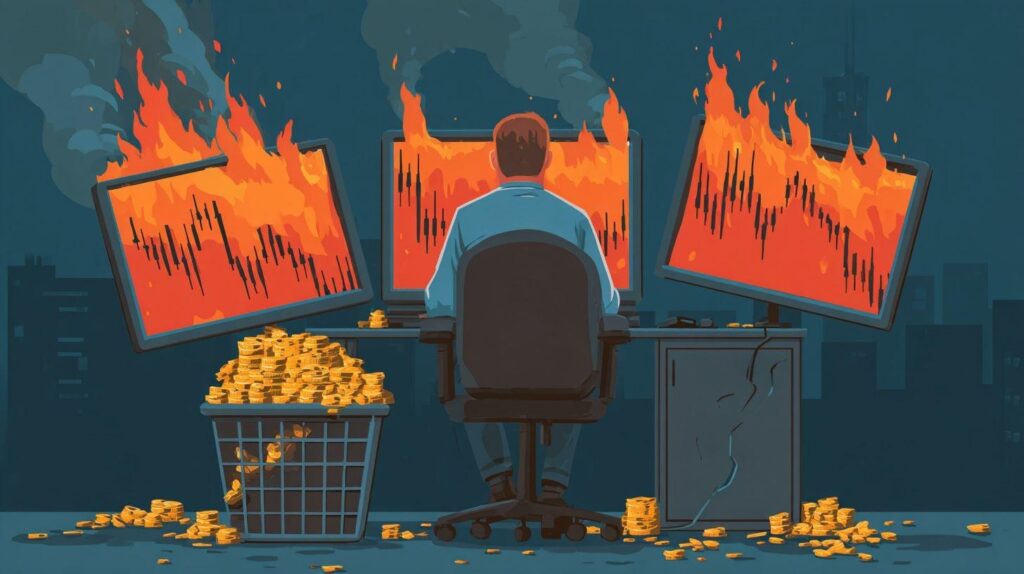
Imagine watching a 20% loss balloon into a career-ending catastrophe-all because you doubled down. Averaging down on losing trades tempts countless investors with its promise of quick recovery, yet it devastates portfolios.
This article exposes the psychological traps, mathematical pitfalls, and real-world disasters of this strategy. Discover superior alternatives like scaling in on strength and building unbreakable discipline to safeguard your capital.
What Is Averaging Down? (1)
Averaging down occurs when traders buy additional shares of a declining stock to lower their average entry price, often leading to amplified losses as seen in the 2021 GameStop meme stock frenzy where retail investors piled into falling positions. This investment strategy aims to reduce the cost basis on a losing trade. Traders hope the price rebounds to make the position profitable sooner.
Consider buying 100 shares at $50, costing $5,000. If the price drops to $40, adding another 100 shares costs $4,000 more. The new average price becomes $45, calculated as total cost divided by total shares.
This approach appears in stocks, forex, and crypto trading but gets little attention in risk management training. Many retail investors use it instinctively during market dips. Yet it often ignores trend following and proper position sizing.
Experts recommend focusing on capital preservation over lowering averages. Averaging down can trap capital in drawdowns, increasing exposure to further declines and margin calls.
Definition and Basic Mechanics (2)
Averaging down means purchasing more of a losing position to reduce the average cost basis, mathematically calculated as: Total Cost / Total Shares. The formula is Avg Price = (Shares1*Price1 + Shares2*Price2) / (Shares1+Shares2). This lowers the breakeven point compared to the original entry.
| Scenario | Shares | Price | Total Cost | Avg Price |
| Initial Buy | 100 | $100 | $10,000 | $100 |
| Average Down | +100 | $80 | $18,000 | $90 |
In this table, the position needs an 11% recovery from $90 to break even, versus a 25% rise from $100. This seems helpful but doubles exposure during bear markets. Poor timing leads to larger unrealized losses.
Traders must consider risk per trade and stop losses instead. Without an exit strategy, averaging down fuels the sunk cost fallacy. Track this in a trade journal to spot the pattern.
Common Examples in Trading (3)
In 2021, Robinhood users averaged down on AMC stock from $60 to $12, turning $10k positions into $2k losses when it dropped to $6. This meme stock frenzy showed how buying the dip trap destroys accounts. Charts displayed sharp declines below support levels with high volume.
- Tesla (TSLA) in 2022 fell from $300 to $100; averaging traders held through volatility, facing extended recovery time.
- Bitcoin dropped from $69k to $16k in 2022; crypto dip buyers saw compounding losses amid bear market pressure.
- EUR/USD forex pairs during economic indicators shifts; forex traders added positions, hitting margin calls on leverage.
- Penny stocks like SNDL lured with low prices; small caps led to overtrading and total wipes on thin liquidity.
These cases highlight trader psychology issues like FOMO and greed. Price action often broke moving averages and RSI oversold signals. Use technical analysis to avoid such traps.
Professional traders cut losses short, focusing on risk reward ratio. Retail investors repeat these mistakes without backtesting.
Why It Feels Intuitive (4)
“Buy the dip” slogans from CNBC and Reddit reinforce averaging down as many retail traders admit doing it. This stems from dollar-cost averaging success in bull markets, where regular buys smooth costs over time. People confuse long-term investing with short-term trading fixes.
A second reason is the “stocks always recover” bias, tied to S&P 500 history. Yet individual names fail, and timing matters in swing trading or day trading. Emotional trading ignores maximum drawdown risks.
- Dollar-cost averaging works for index funds but fails on single losing trades.
- Social proof from Warren Buffett quotes, often taken out of context, promotes value investing over speculation.
- Contrast with trend following: pyramiding winners and using stop losses preserves capital.
Behavioral finance explains loss aversion and confirmation bias here. Discipline via a trading plan counters this intuition. Prioritize portfolio management and diversification over doubling down.
The Psychological Trap of Averaging Down
Behavioral finance research shows averaging down triggers loss aversion. Traders often hold losing positions longer than winners due to emotional attachment. This stems from prospect theory, where losses feel more painful than equivalent gains.
Prospect theory highlights how people overweight losses, creating a strong urge to double down on bad trades. This leads to emotional trading and poor risk management. Traders quote, “I can’t sell now, I’ve put too much in,” ignoring capital preservation.
Three key cognitive biases fuel this trap: the sunk cost fallacy, where past losses demand more commitment, as one trader said, “It’s not a loss until I sell.” Overconfidence leads to denial of market reversals. The gambler’s fallacy tricks traders into expecting bounces after streaks of red candlesticks.
Understanding these biases helps build discipline. Use a trading plan with strict stop loss orders to avoid the buying the dip trap. Focus on position sizing and cutting losses short for better portfolio management.
Sunk Cost Fallacy in Action
Sunk cost fallacy makes traders treat initial losses as “investments” requiring more capital. They add to a losing trade hoping to recover, turning a small financial loss into total destruction. For example, after a $10k loss on a stock, adding another $10k at lower prices aims to “get even,” but often deepens the drawdown.
This bias ignores that past costs are irrelevant to future decisions. Research suggests people continue bad bets to justify prior commitments. In trading, this leads to ignoring technical analysis signals like broken support levels.
Consider a trader in a bear market holding a meme stock through declining prices. Instead of cutting losses short, they average down, facing margin calls and unrealized losses ballooning. The original loss hurts less than the compounded damage from poor position sizing.
To counter this, maintain a trade journal reviewing each bad trade. Set exit strategies before entry. Prioritize risk reward ratio over recovery hopes for sustainable equity curves.
Overconfidence and Denial
Overconfident traders ignore stop losses more often after initial losses. They double down on predictions like “Tesla will bounce from $110.” This denial stems from believing personal analysis trumps market reality.
Three common signs include ignoring RSI indicator above 70 signaling overbought conditions. Traders cherry-pick analyst upgrades while dismissing downgrades, a form of confirmation bias. They often claim “This time it’s different,” overriding trend following rules.
Research suggests overconfident traders underperform due to excessive trading and poor timing. In swing trading, this means holding through resistance levels instead of exiting. Emotional trading erodes performance metrics like Sharpe ratio.
Combat this with backtesting strategies and fixed risk per trade. Use moving averages or MACD for objective entry signals. Discipline through a trading plan prevents FOMO-driven mistakes.
Gambler’s Fallacy Connection
After 5 red candlesticks, traders believe “it’s due for green.” This mirrors roulette players expecting red after black streaks despite equal odds. Each trade remains statistically independent, like coin flips.
Gambler’s fallacy assumes past results influence future independent events. In forex trading, a 7-day losing streak on EUR/USD prompts averaging down at worst levels. This ignores volatility and true support levels.
Research suggests people expect reversals after streaks, leading to the buying the dip trap. Cryptocurrency dips or penny stocks amplify this, as traders chase market reversals without evidence. It results in compounding losses and longer recovery times.
Avoid it by focusing on chart patterns, volume analysis, and Bollinger Bands. Practice diversification and asset allocation. Let profits run on winners while using stop losses to protect capital.
Mathematical Realities That Make It Dangerous
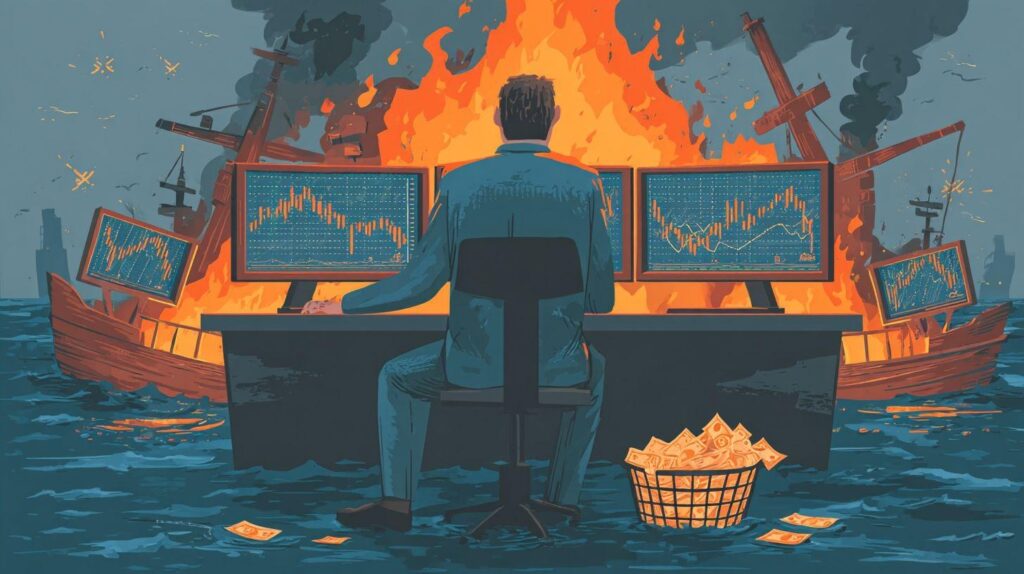
Mathematically, averaging down requires exponentially larger recoveries: a 50% loss needs a 100% gain to break even, a 66% loss needs 200%, per compounding loss calculations. This creates an asymmetric risk-reward imbalance where downside risk explodes geometrically. Small losses demand outsized gains just to recover.
Consider a simple table teaser: a 33% loss requires a 50% recovery to break even. Averaging down amplifies this, ballooning position size and recovery needs. The subsections below break it down with examples from stock market scenarios.
Traders fall into the buying the dip trap, ignoring how position sizing explosion violates risk management rules like the Kelly criterion. Break-even illusions further fuel emotional trading and the sunk cost fallacy. Understanding these math realities supports better portfolio management.
Focus on cutting losses short instead of doubling down on a losing trade. This preserves capital and avoids deep drawdowns. Practical advice: always set a stop loss before entry.
| Loss % | Recovery Needed | Preview Example |
| 33% | 50% | Averaging down pushes it higher |
| 50% | 100% | Position size doubles risk |
| 66% | 200% | Break-even moves against you |
Asymmetric Risk-Reward Imbalance
A 33% portfolio drop requires 50% recovery; averaging down at bottoms turns this into 75%+ required gains as position size balloons. This asymmetric risk-reward imbalance favors losses over wins in losing trades. Recovery becomes harder with each added share.
Take a stock at $100 dropping to $80, a 20% loss needing 25% up to recover. Buy more at $80, now your average cost rises slightly, but total shares increase. A further drop to $60 demands over 50% from the new low just to break even.
Experts recommend sticking to fixed fractional sizing, like 1-2% risk per trade. Averaging down disrupts this, leading to overtrading and larger unrealized losses. Use a trade journal to track how this imbalance hits your equity curve.
| Loss % | Recovery Needed | With 2x Average Down |
| -20% | +25% | +40% from new low |
| -50% | +100% | +150% from averaged low |
| -66% | +200% | +300% needed overall |
Calculator formula: Recovery % = (Loss % / (100% – Loss %)) * 100. Test in Excel with columns for entry price, loss levels, shares added, and weighted average. This reveals the danger before real money enters a bad trade.
Position Sizing Explosion
Starting with 2% risk ($2k on $100k account), averaging down twice uses 6% total risk, violating Kelly criterion’s 1-2% max per trade rule. Each layer adds to exposure without confirmation of reversal. This position sizing explosion risks maximum drawdown.
Progression example: Trade 1 risks 1% on a swing trade entry. It hits stop but you average down, adding another 1% at support level. Third buy at lower RSI pushes total to 3%, now a margin call looms in volatile markets.
Van Tharp advises never exceeding 6% portfolio risk across ideas. Pyramiding winners fits trend following, but doubling down invites revenge trading. Maintain discipline with a trading plan limiting risk per trade.
- Trade 1: 1% risk, stock drops 10%.
- Trade 2: Add 1%, total 2% risk.
- Trade 3: Add 1%, now 3% total, recovery time extends.
Break-Even Price Illusion
$50 stock drops to $40 (buy more) new $45 break-even, but needs 25% rally vs original 20%-illusion of progress. This break-even price illusion traps traders in the sunk cost fallacy. Further drops make exit harder amid loss aversion.
Example with TSLA: Buy at $300, drops to $200 (33% loss), average down to $175 average cost. Break-even now at $233, just 17% up from $175 but 50% from original $200 low. Market reversal rarely obliges quickly.
| Scenario | Original Entry | Avg Down | New Break-Even | % Up Needed |
| TSLA $300 $200 | $300 | $175 avg | $233 | 33% from $175 |
| $50 $40 | $50 | $45 avg | $45 | 25% from $40 |
| $100 $70 $60 | $100 | $65 avg | $75 | 25% from $60 |
Opportunity cost mounts as capital ties up in drawdown. Better: use technical analysis like moving averages for entry signals, not FOMO buys. Cut losses short to free funds for high risk-reward setups.
Real-World Case Studies of Disaster
LTCM’s 1998 collapse with a $4.6 billion loss, Archegos in 2021 with $20 billion in damage, and thousands of retail GameStop averagers show averaging down’s catastrophic potential. These cases span hedge funds and everyday traders. Both institutions and retail investors faced similar traps from emotional trading and ignoring stop losses.
Institutional blowups like LTCM highlight how even Nobel-winning quants fell into the sunk cost fallacy. Retail parallels appear in meme stock frenzies. Doubling down on losing trades led to margin calls across all levels.
GameStop traders bought dips from $483 peaks, mirroring hedge fund leverage misuse. These stories stress capital preservation over hoping for market reversals. Proper position sizing could have limited the fallout.
Reviewing these disasters teaches risk management basics. Track your equity curve and avoid the buying the dip trap. Focus on cutting losses short to protect your portfolio.
Famous Trading Blowups
Long-Term Capital Management lost 92% in 1998 averaging down on bond convergence trades, requiring a $3.6 billion Fed bailout. Nobel laureates bet on spreads narrowing after the Russian default. Leverage amplified their positions into disaster.
Archegos Capital in 2021 imploded with $20 billion losses from concentrated ViacomCBS bets. Bill Hwang used total return swaps to hide massive exposure. Averaging down triggered a margin call cascade as shares plunged.
Amaranth Advisors erased $6 billion in 2006 on natural gas futures. They doubled down expecting a winter rally that never came. Poor risk per trade and ignoring volatility crushed the fund.
| Fund | Year | Key Bet | Loss | Outcome |
| LTCM | 1998 | Bond convergence | 92% | Fed bailout |
| Archegos | 2021 | ViacomCBS swaps | $20B | Liquidation |
| Amaranth | 2006 | Nat gas futures | $6B | Fund collapse |
These cases warn against doubling down in leveraged bets. Use fixed fractional sizing and set exit strategies upfront.
Retail Trader Horror Stories
A u/WSB user turned $50k into $2.3k averaging GME from $483 in January 2021 down to $88, posting full account statements. They ignored support levels and chased the meme stock dip. FOMO drove repeated buys into a bear market trap.
Another trader dropped $100k to $8k on AMC, adding shares at every drop hoping for a squeeze. Reddit screenshots showed unrealized losses ballooning without a stop loss. The sunk cost fallacy kept them in too long.
In forex, a GBP/JPY account hit zero after averaging down through volatility spikes. Crypto holders watched ETH fall from $4k to $900, pyramidng a losing trade. These posts reveal common trading mistakes like overtrading.
- Lesson one: Journal every entry signal and stick to your trading plan.
- Lesson two: Use technical analysis like RSI or moving averages for exits.
- Lesson three: Practice position trading with diversification, not all-in bets.
Avoid revenge trading after losses. Retail investors mirror pros by preserving capital first.
Long-Term Account Destruction
Five consecutive 20% position losses in averaging style create 67% total drawdown requiring 203% recovery. Proper 1% risk per trade limits pain, while 3% bets compound into ruin. This shows why drawdown kills accounts over time.
Averaging down ignores risk reward ratio. Emotional traders double positions on bad trades, chasing recovery. Trader psychology fuels this, but discipline with stop losses prevents it.
Equity curves diverge sharply: safe sizing builds steady gains, averaging erodes capital. Backtest strategies to see maximum drawdown effects. Experts recommend Kelly criterion for sizing.
| Loss Sequence | 1% Risk | 3% Risk (Averaging) |
| 1 loss | -1% | -3% |
| 3 losses | -3% | -9.3% |
| 5 losses | -5% | -14.9% |
Pyramid winners instead, letting profits run. Track performance metrics like expectancy to stay disciplined. Capital preservation ensures long-term wealth building.
Capital Preservation: The Core Principle

Paul Tudor Jones warns, “Losers average losers. Preserve capital at all costs.” Trading legends like Warren Buffett and George Soros echo this by stressing capital preservation over chasing gains. The math reveals stark survival odds: risking 1% per trade lets you endure 100 losses before ruin, while averaging down at 5% wipes out your account in just five bad trades.
Averaging down on a losing trade tempts traders with the buying the dip trap, but it amplifies financial loss. Instead, focus on risk management through strict position sizing and stop loss orders. This protects your brokerage account from margin call disasters.
Preserving capital maintains your equity curve and enables compounding over time. Traders who cut losses short avoid the sunk cost fallacy and trader psychology pitfalls like emotional trading. Simple discipline in portfolio management builds long-term wealth.
Preview the sections ahead: small losses sustain long streaks, while drawdowns from doubling down extend recovery time. Experts recommend fixed fractional sizing over risky strategies like pyramiding losers.
Why Small Losses Matter Most
1% loss per trade under the 1% risk rule survives 68 consecutive losses before halving a 50% account; 5% averaging down needs only 13 losses for that same ruin. The formula, losses to ruin equals 1 divided by risk percent times 0.01, shows why averaging down accelerates disaster. This table illustrates the impact:
| Risk % | Losses to Ruin (50% Account) |
| 1% | 68 |
| 2% | 34 |
| 5% | 13 |
Picture a blue chip stock dropping past your entry: adding shares via averaging down hikes your risk per trade. A stop loss caps the damage at 1%, preserving capital for better setups. This avoids compounding losses in volatile markets.
Position sizing keeps risks small, supporting high win rate or not. Track via a trade journal to spot trading mistakes like doubling down. Discipline trumps hope in stock market swings.
Compounding’s Double-Edged Sword
$100k at 20% drawdown needs $25k profit to recover; 50% drawdown needs $100k profit, same trades but vastly different math. At 2% monthly returns, a 20% drawdown takes 11 months to recover, 40% takes 37 months, and 60% stretches even longer. Averaging down deepens these holes, turning temporary dips into prolonged pain.
Consider a meme stock plunge: initial 20% loss feels manageable, but averaging down pushes it to 50%, demanding heroic gains to break even. Cutting losses short and letting profits run aligns with trend following. This investment strategy favors risk reward ratio over FOMO.
Recovery time kills opportunity cost, sidelining you from fresh entry signals like chart patterns or RSI indicator bounces. Use technical analysis for support levels, not excuses to average down. Trader psychology drives the greed to double down, but a solid trading plan enforces exit strategy.
Backtest ideas to see maximum drawdown effects on your equity curve. Prioritize diversification and asset allocation over leverage in options trading or cryptocurrency dips.
Superior Alternatives to Averaging Down
Professional traders use fixed risk of 1-2% per trade, scale into winners through pyramiding, and cut losses at predefined levels. These strategies offer better risk management than averaging down on a losing trade. They preserve capital and build steady equity curves.
Averaging down often leads to larger drawdowns and emotional trading. In contrast, fixed risk limits exposure from the start. Pyramiding adds to strength, avoiding the sunk cost fallacy.
Cutting losses short keeps traders disciplined. These methods support capital preservation in volatile markets. Professional traders prioritize them over chasing bad trades.
Experts recommend these for long-term wealth building. They reduce opportunity cost from tied-up capital. Use them to avoid financial loss in stock market swings.
Proper Position Sizing from the Start
Risk 1% max per trade: $100k account, 5% stop = $2k position size ($100k * 0.01 / 0.05). This fixed fractional sizing protects your brokerage account. It prevents one bad trade from causing major damage.
Follow these steps for position sizing:
- Define risk % at 1% of account value.
- Set stop distance based on technical analysis, like below support level.
- Calculate position = (Account * Risk%) / Stop%.
For a $50k account and 2% stop, position size is $25k max. This approach uses Kelly criterion principles for safety. Track it in your trade journal.
Excel templates simplify calculations. Input account size, risk per trade, and stop loss distance. Proper sizing beats emotional decisions in day trading or swing trading.
Scaling In on Strength, Not Weakness
Add to winners above moving averages: Enter NVDA at $150, add at $170, $190 as it breaks resistance. This pyramiding winners builds positions in uptrends. It avoids the buying the dip trap on losers.
Paul Tudor Jones said, “Losers average losers, professionals pyramid winners.” Scale in on pullbacks to the 20EMA in a bull market. Keep total risk at 1% across entries.
Example: First entry risks 1%, second on strength confirms trend following. Use RSI indicator or MACD for confirmation. This cuts unrealized losses early.
Averaging up preserves risk reward ratio. It lets profits run while managing volatility. Professional traders use it for stocks, forex trading, or cryptocurrency dips.
Cut Losses and Move On Strategy
Set hard stops at 1-2% account risk: SPY $450 entry, stop $445 (1% risk), target $465 (2.5:1 reward). Predefine exits before entry to avoid greed. This enforces discipline in your trading plan.
Rules for cutting losses short:
- Predefine stops using chart patterns or Bollinger Bands.
- Never move stops wider, even on market reversal signals.
- Exit at 1R loss to free capital for better setups.
Expectancy improves with 40% win rate and 2.5:1 risk reward ratio, staying profitable. Track performance metrics like Sharpe ratio in session recaps. It counters loss aversion from behavioral finance.
Move on after exits to prevent revenge trading. This builds positive equity curves over time. Use it in any market, from bear market corrections to recovery rallies.
Building a Bulletproof Trading Mindset
Trader psychology plays a central role in stock market success. Research suggests that emotional trading often leads to mistakes like averaging down on a losing trade. Building discipline helps traders avoid the sunk cost fallacy and focus on capital preservation.
Experts recommend following a structured trading plan to counter impulses such as FOMO or greed. This section previews a discipline checklist with ironclad rules. These steps promote risk management and long-term wealth building.
A key insight from trader studies shows profitable traders stick to plans rigorously. They review performance metrics like Sharpe ratio regularly. This mindset shifts focus from short-term losses to consistent equity curve growth.
In practice, treat trading like a business with clear entry signal and exit strategy rules. Avoid doubling down on bad trades to prevent drawdown. Consistent application builds resilience against market volatility.
Rules to Enforce Discipline
Discipline separates professional traders from retail investors chasing quick wins. Follow these eight ironclad rules to protect your brokerage account from emotional decisions. They emphasize position sizing and cutting losses short.
- Never risk more than 2% of capital per trade to limit financial loss from any single position.
- After 3 losing trades in a row, stop trading for the day to avoid revenge trading.
- Conduct a daily P&L review at session end to spot patterns in unrealized losses.
- Maintain a weekly trade journal logging entry signals, chart patterns, and lessons learned.
- Backtest all strategies using tools like TradingView before live deployment in swing trading or day trading.
- Ban revenge trading after a bad trade to prevent compounding losses from overtrading.
- Use position size by volatility with ATR to adjust for stocks with high swings.
- Perform an annual performance audit targeting Sharpe ratio above 1 for sustainable returns.
Implement these rules in your trading plan to counter loss aversion from prospect theory. For example, size positions with fixed fractional sizing instead of averaging down on a penny stock dip. This approach ensures risk reward ratio stays favorable.
Track metrics like maximum drawdown and win rate in your journal. Combine with technical analysis tools such as RSI indicator or moving averages for better decisions. Over time, this builds a smooth equity curve and reduces recovery time from losses.
Frequently Asked Questions
What is “Averaging Down” on a Losing Trade?
“Averaging Down” on a Losing Trade refers to the strategy of buying more shares of a declining asset to lower the average cost per share. While it might seem like a way to recover losses, this is why you should never “averaging down” on a losing trade, as it often amplifies risks rather than mitigating them.
Why You Should Never “Averaging Down” on a Losing Trade: The Core Reason
The primary reason why you should never “averaging down” on a losing trade is that it doubles down on a flawed thesis. If your initial trade idea was wrong, adding more capital to a sinking ship increases potential losses without addressing the underlying problem, turning a small mistake into a catastrophe.
What Are the Main Risks of “Averaging Down” on a Losing Trade?
Key risks include capital depletion, emotional bias reinforcement, and opportunity cost. Why you should never “averaging down” on a losing trade becomes clear when you consider how it ties up funds that could be used elsewhere, while ignoring stop-loss discipline and market signals indicating further downside.
How Does “Averaging Down” Affect Your Risk Management?
“Averaging Down” undermines proper risk management by escalating exposure to a single position. This is why you should never “averaging down” on a losing trade- it violates the golden rule of risking only a small percentage of your portfolio per trade, potentially leading to account blowups.
Can “Averaging Down” Ever Work in Trading?
While occasional successes occur, statistically, why you should never “averaging down” on a losing trade holds true because it relies on hope rather than evidence. Professional traders avoid it, favoring cut-loss strategies that preserve capital for high-probability setups.
What Should You Do Instead of “Averaging Down” on a Losing Trade?
Instead, exit the trade promptly using predefined stop-losses and re-evaluate your analysis. Understanding why you should never “averaging down” on a losing trade enables you to focus on position sizing, diversification, and waiting for confirmed bullish signals before re-entering.