
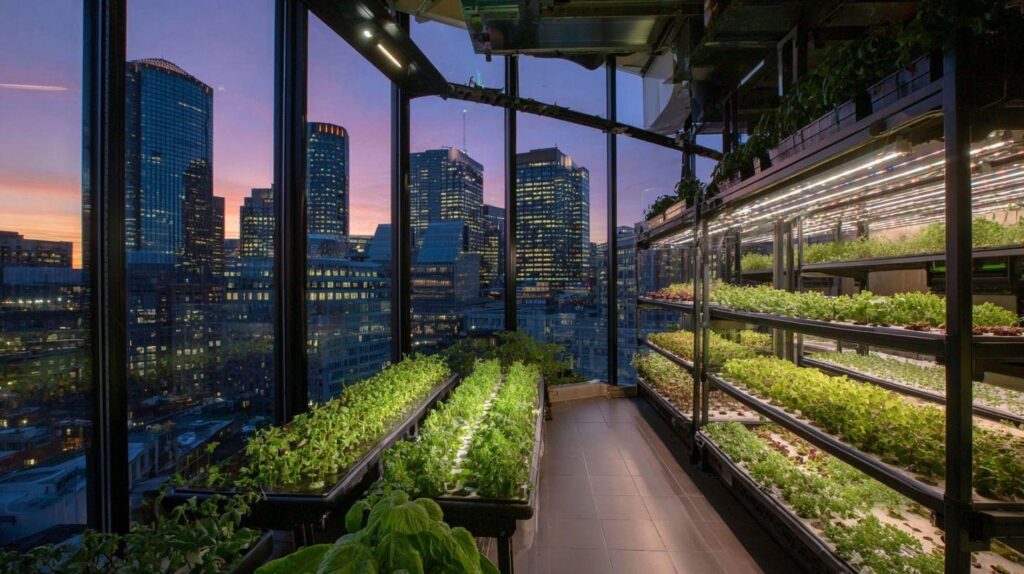
Imagine skyscrapers yielding bountiful harvests where concrete once reigned supreme. As urban populations surge-projected by the UN to reach 68% globally by 2050-high-tech agriculture emerges as a vital solution to food security and climate pressures.
This article explores driving forces like vertical farming and AI automation, showcases pioneers such as Singapore’s Sky Greens, and analyzes economic, sustainability, and policy impacts. Discover how cities are redefining farming’s future.
Definition and Scope
Urban high-tech agriculture encompasses controlled environment agriculture (CEA) systems like hydroponics, aeroponics, and vertical farms producing 10-20x more yield per square foot than soil farming. These methods grow crops in stacked layers or soilless setups inside buildings or greenhouses in urban centers. They address limited space and year-round production needs.
Vertical farming uses multi-layer racks to stack crops vertically, maximizing output in high-rise structures. Hydroponics delivers nutrients via water, with systems like nutrient film technique (NFT) flowing thin films over roots and deep water culture (DWC) suspending roots in oxygenated solutions. These approaches cut water use and eliminate soil-borne diseases.
Five core components drive these systems. They include climate control for stable temperatures, LED lighting tuned to plant needs, IoT sensors tracking conditions, automation for tasks like planting, and data analytics for decisions.
- Climate control maintains ideal humidity and air flow.
- LED lighting provides energy-efficient spectra for growth.
- IoT sensors monitor pH, nutrients, and light levels.
- Automation handles watering and harvesting precisely.
- Data analytics predict yields and optimize resources.
The market reached $14.1B in 2023 according to Grand View Research, showing rapid growth in agritech for city farming.
Historical Evolution
Vertical farming traces to 1915 when Gilbert Ellis Bailey coined ‘vertical farm’, evolving to modern systems like Japan’s Plant Lab in 2003 growing lettuces daily in shipping containers.
In the 1950s, hydroponics experiments began on Wake Island, marking early steps in soil-less farming. These efforts laid groundwork for controlled environment agriculture in limited spaces. Growers tested nutrient solutions without soil, proving viability for remote or urban settings.
By the 2000s, AeroFarms ran pilots, shifting from traditional glasshouses to LED lighting. Dickson Despommier’s The Vertical Farm in 2010 popularized stackable farms in cities. This book highlighted potential for urban centers to produce food locally.
The 2010s saw Sky Greens launch in Singapore in 2012, using towers for greens. In the 2020s, AI integration advanced precision farming with sensors and automation. Examples include hydroponics, aeroponics, and IoT agriculture optimizing yields in vertical setups.
Driving Forces Behind Urban AgTech Adoption
Urbanization drives AgTech as cities grow rapidly, creating demand for local food production. High population density, food insecurity, and climate volatility push urban centers toward high-tech agriculture. Each city dweller needs vast farmland, which dense areas cannot provide, making solutions like vertical farming and hydroponics essential.
These forces necessitate innovative urban farming to meet needs without relying on distant supplies. Technologies such as controlled environment agriculture (CEA) and IoT sensors enable production in limited spaces. Cities now turn to smart agriculture for sustainable, resilient food systems.
Population pressures highlight the shift to indoor and rooftop systems. Food security risks from global disruptions favor local sources. Climate challenges make weather-independent methods like aeroponics and LED lighting critical for year-round yields.
Urban AgTech adoption grows through precision farming and automation. Examples include stackable farms in warehouses and rooftop gardens with climate control. These approaches support zero-mile diets and reduce transport emissions effectively.
Urban Population Growth
By 2050, billions will crowd into cities, with megacities demanding massive daily produce. Dense urban centers like those in Asia and Africa face land shortages for traditional farming. Vertical farms and rooftop gardens emerge as practical solutions to produce food locally.
Cities often import most food from hundreds of kilometers away, straining logistics. Shortening distances to farm-to-table cuts emissions significantly. Technologies like modular farms fit into shipping containers or unused buildings.
Singapore leads with vertical farms boosting local vegetable output through hydroponics and LED systems. These setups use stackable layers to multiply growing space. Urban planners integrate green walls and indoor farming into high-rises for efficiency.
Population growth accelerates container farming and precision systems. Sensors monitor conditions, while automation handles planting and harvesting. This model supports dense cities by enabling scalable, space-saving agriculture.
Food Security Challenges
COVID-19 exposed vulnerabilities in global supply chains, disrupting imports and raising prices. Urban farms offer resilient local supply through CEA and soil-less methods like nutrient film technique. These systems reduce dependency on distant sources.
Key risks include supply chain breaks from conflicts, port congestion, and trade issues. Urban agriculture counters these with on-site production using hydroponics and aquaponics. Cities build food security via rooftop and indoor setups.
- Conflicts disrupt grain flows from key regions.
- Port delays cause widespread shortages.
- Weather events halt transport routes.
- Pandemics close borders and processing plants.
Solutions like urban greenhouses and fertigation ensure steady output. Experts recommend community-supported models and co-ops for distribution. This approach strengthens city resilience against future shocks.
Climate Change Pressures
Climate change threatens crop yields through extreme weather, yet urban CEA remains unaffected. Systems with climate control and hydroponics produce year-round regardless of external conditions. Cities adopt these to secure consistent food supplies.
Floods and droughts devastate traditional fields, but indoor farms use minimal water via deep water culture. LED lighting and CO2 enrichment optimize growth in controlled settings. Precision tools like sensors track pH and nutrients precisely.
Hydroponics achieves high water efficiency compared to open fields. Vertical systems with automation handle pests through IPM and UV sterilization. Examples include strawberries in aeroponics and lettuce under dynamic lights.
Urban centers mitigate risks with drought-tolerant crops in CEA and renewable energy setups. Solar-powered farms and greywater recycling enhance sustainability. These technologies build resilient agriculture amid volatility.
Core Technologies Transforming Urban Farming
Six technologies-hydroponics with notable water savings, LEDs offering energy efficiency, AI for yield boosts-enable urban farms to outperform traditional agriculture. These form a stackable tech stack including vertical systems, automation, and sensors. The AgTech sensors market reaches $15B by 2028 according to Statista.
Urban farmers combine hydroponics, aeroponics, and aquaponics for soil-less growth. LED lighting and climate control optimize conditions in tight city spaces. AI-driven platforms integrate data for precision decisions.
This stack supports controlled environment agriculture (CEA) in rooftops and warehouses. Modular designs allow scalability for city farming. Experts recommend starting with core sensors before adding robotics.
Practical setups use IoT networks for real-time monitoring. Renewable integrations like solar power enhance sustainability. These tools drive local food production in urban centers.
Vertical Farming Systems
Vertical farms stack crops in 10-20 layers using racks, delivering 350x greater productivity per square foot than field farming according to Cornell University. Systems like Sky Greens tower farms and AeroFarms tray systems maximize space. Capital expenses range from $100-300 per square foot.
Hydroponics circulates nutrients in nutrient film technique (NFT) or deep water culture (DWC). Aeroponics mists roots for oxygen-rich growth, ideal for lettuce and herbs. Aquaponics pairs fish waste with plant uptake in closed loops.
Stackable farms fit shipping containers or rooftops. Modular farms allow easy expansion for microgreens and strawberries. Operators adjust layers for crops like tomatoes or basil.
Climate control maintains optimal conditions. Precision farming reduces waste through automated stacking. Cities benefit from year-round yields near consumers.
LED Lighting Innovations
Full-spectrum LEDs deliver 2.5mol/J efficiency versus HPS 1.8, cutting energy use while boosting photosynthesis with red:blue 4:1 ratios according to Philips Lighting. Philips GreenPower offers savings around $0.30 per kWh compared to Fluence SPYDR at 2.7mol/J. Spectra target 660nm red and 450nm blue for optimal lettuce growth.
Dynamic schedules follow 16/8 light cycles for vegetative and flowering phases. Far-red and UV supplementation enhance morphology. Farmers program lights for specific crops like peppers or kale.
ROI achieves payback in about 18 months with energy savings. Energy-efficient lighting suits indoor urban setups. Pair with sensors for AI-optimized adjustments.
Examples include vertical farms using custom spectra for herbs. PAR lighting ensures even coverage across layers. This tech supports sustainable agriculture in power-limited cities.
AI and Automation
AI platforms like FarmWise predict yields within 2% accuracy, optimizing irrigation to save water via computer vision crop analysis. Growtronics FMS manages full operations, while Blue River Tech, acquired by John Deere for $305M, powers robotics. These tools enable smart agriculture in dense urban centers.
Robots handle planting, scouting, and harvesting. Autonomous harvesters use AI vision for selective picking of ripe strawberries or tomatoes. Drones monitor via hyperspectral imaging for early pest detection.
Data analytics process inputs from sensors. Machine learning refines nutrient delivery in hydroponics. Platforms integrate for predictive maintenance on LED systems.
Practical advice: Start with basic AI for irrigation control. Scale to robotics for labor savings in large vertical farms. This boosts efficiency for city farm-to-table produce.
IoT Sensor Networks
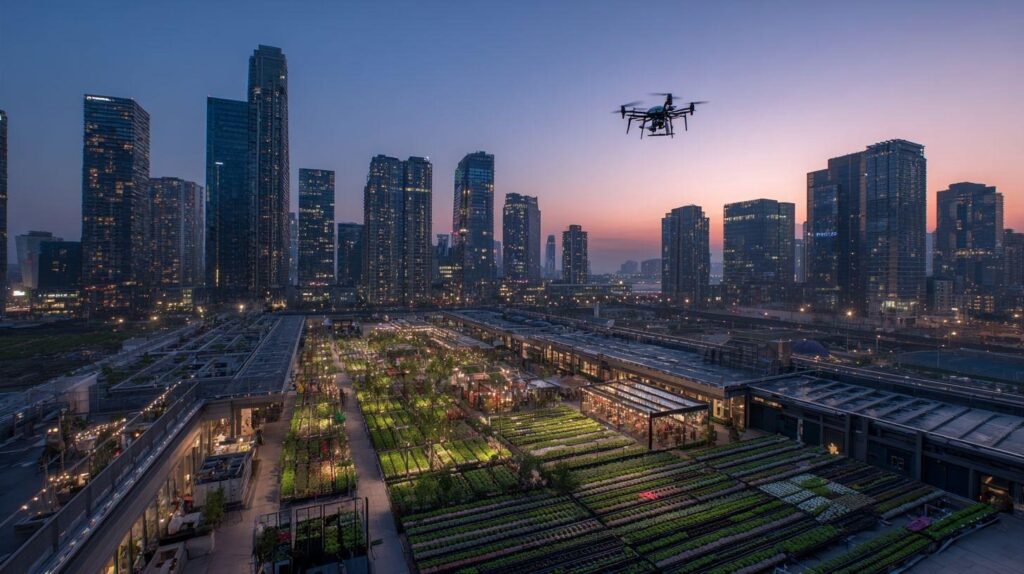
IoT networks with 50+ sensors per farm monitor VPD at 0.8-1.2kPa optimal, CO2 at 800-1200ppm, preventing yield loss according to Argus Controls data. Suites include Apogee PAR at $350, Decagon EC/pH at $600, and Onset HOBO temp/RH at $150. Platforms like FarmBeats from Microsoft and CropX enable integration.
Sensors track pH, EC, and humidity in real time. 5G edge computing and MQTT protocol ensure low-latency data flow. This supports precision fertigation in aeroponics.
Farmers use dashboards for alerts on deviations. IoT agriculture prevents issues like root rot in DWC systems. Combine with AI for automated adjustments.
Examples feature networks in rooftop gardens for basil or microgreens. Sensor data analytics optimize for urban heat islands. Reliable monitoring drives reliable urban food security.
Case Studies of Leading Urban Farms
Leading farms demonstrate viability: AeroFarms produces 390x more yield/sqft than field farming using aeroponics and AI. These pioneers in high-tech agriculture operate in dense urban centers, combining vertical farming with precision technologies. Together, they generate over $500M in combined revenue, proving scalability.
Sky Greens in Singapore, AeroFarms in New York, and Badia Farms in Dubai lead the way. They use hydroponics, aeroponics, and AI climate control to maximize output on minimal land. Leafy greens and herbs thrive in stacked systems with LED lighting and sensors.
These farms integrate IoT agriculture for real-time monitoring of pH, nutrients, and humidity. Automation reduces labor while boosting water efficiency. Urban planners can learn from their rooftop gardens and container setups for city food security.
Practical steps include adopting nutrient film technique (NFT) for continuous flow or drip systems for precision. Experts recommend starting with modular farms to test yield optimization. These cases show urban agriculture supports local production and zero-mile diets.
Singapore’s Sky Greens
Sky Greens’ 9m A-Go-Gro towers produce 1.5Mkg leafy greens/year on 1 hectare, 10x field productivity using rainwater (80% less water). With 608 towers and $8.8M revenue in 2022, just 10 staff manage output equivalent to 100 farmers. Rotating racks ensure even light exposure in vertical setups.
Solar-powered systems drive the smart agriculture model, cutting energy costs. Rainwater collection feeds hydroponics, promoting sustainable practices. Over 20 farms now operate, expanding urban farming across the city-state.
Key tech includes automation for harvesting and sensors tracking vapor pressure deficit (VPD). Growers can replicate this with vertical towers for basil or lettuce. It supports food security urban in land-scarce areas.
Expansion relies on data analytics for crop cycles. Start small with stackable racks powered by renewables. This approach yields high returns through B2B supply to local markets.
New York’s AeroFarms
AeroFarms’ Newark farm (70K sqft) grows 2M plants/cycle without soil/sunlight, yielding 390x more than field farming via aeroponics. It uses 95% less water and 75% less energy than traditional methods. A $40M Series D funding supports growth, with 200+ employees serving clients like Whole Foods.
Baby greens complete 10-day cycles under LED lighting and AI-optimized climate control. Precision farming with machine learning predicts yields and adjusts nutrients. This indoor farming model fits tight urban spaces.
Robotics handle planting and harvesting, minimizing labor. Operators monitor via IoT sensors for EC and CO2 levels. Replicate with aeroponic towers for microgreens or herbs in warehouses.
The farm emphasizes controlled environment agriculture (CEA) for year-round production. Integrate predictive analytics to cut waste. It sets a benchmark for city farming scalability and farm-to-table supply.
Dubai’s Badia Farms
Badia Farms’ 450sqm containers produce 500K meals/year in desert climate, using hydroponics and 95% water recycling. It achieves 1.2kg/sqft/month across 300+ crop varieties. Named World’s Largest Vertical Farm in 2018, it supplies B2B restaurants and hotels.
Stacked containers feature AI climate control and automation for optimal growth. Deep water culture (DWC) systems recycle nutrients efficiently. This combats urban heat with energy-efficient lighting.
Crops like strawberries and peppers thrive in modular setups. Use sensors for pH monitoring and fertigation. Ideal for container farming in arid zones, promoting water efficiency.
Awards highlight its vertical farming innovation. Scale with shipping containers and solar integration. It drives local food production and circular economy practices in urban centers.
Economic Impacts and Business Models
$12.8B invested in 400+ AgTech startups 2018-2023; vertical farms achieve 25-35% IRR after 3 years (AgFunder). The global market for high-tech agriculture in urban centers now exceeds $25B. This growth reflects demand for local food production in cities.
Business models vary to suit urban constraints. B2B sales target restaurants needing fresh greens daily. Direct-to-consumer (DTC) approaches deliver to homes via apps.
Franchise models allow rapid scaling with modular farms. Startups use hydroponics and LED lighting to cut costs. These strategies boost profitability in dense urban centers.
Investors focus on sustainable agriculture with quick returns. Examples include rooftop gardens supplying nearby markets. Such models support food security and reduce transport emissions.
Startup Ecosystem
Bowery Farming raised $370M valuation $2.3B; Plenty $400M Series B, building 100-acre facilities. Top-funded players lead the vertical farming space. Bowery totals $700M, while AeroFarms secured $238M before challenges.
Kalera raised $130M but filed for bankruptcy in 2023. These cases highlight risks in scaling indoor farming. VC firms like Finistere Ventures and AgFunder, with $1.2B AUM, back promising ventures.
Accelerators such as The Shed at Dartmouth nurture early-stage ideas. Startups integrate AI farming and sensors for precision. Examples include microgreens and herbs grown in stackable systems.
This ecosystem drives innovation in urban agriculture. Firms explore aeroponics and automation to compete. Partnerships with cities expand access to rooftops and warehouses.
Cost-Benefit Analysis
1,000sqft vertical farm CAPEX $300K-1M generates $250K revenue/year at $5/kg premium pricing. Break-even occurs in 18-36 months for efficient operations. This beats traditional field farming timelines in urban settings.
Energy costs dominate, but LED lighting and climate control optimize use. Compare to field crops: vertical farms save on land and water via hydroponics. Revenue from premium lettuce or strawberries covers upfront investments.
Opex includes labor, reduced by robotics and IoT. Field farming faces weather risks and transport fees. Urban models offer year-round yields with yield optimization.
Experts recommend tracking metrics like energy per kg produced. Modular designs lower entry barriers. Long-term, CEA proves resilient against supply chain disruptions.
Sustainability and Environmental Benefits
High-tech agriculture in urban centers supports the triple bottom line of people, planet, and profit. Urban farms save 2,000L water per ton of produce, a 95% reduction, and eliminate 1,000km transport emissions per IPCC guidelines. These practices enhance food security while minimizing environmental harm.
Controlled environment agriculture (CEA) like vertical farming reduces land use in crowded cities. Rooftop gardens and indoor farms produce fresh greens with precision farming tools such as LED lighting and sensors. This approach cuts reliance on rural fields prone to weather risks.
Life cycle assessment (LCA) shows urban tomatoes have 10x lower impact than field-grown ones. IoT agriculture and automation optimize resources, from water to energy. Cities benefit from local food production that supports the zero-mile diet.
Experts recommend integrating renewable energy agriculture like solar-powered farms. These systems lower operational costs and build resilient urban agriculture. Practical examples include stackable farms in shipping containers for scalable city farming.
Water Conservation
Hydroponics uses 20L per kg of tomatoes versus 200L for field-grown; closed-loop systems recycle 95% according to WUR Netherlands. Aeroponics needs just 5L per kg compared to 150L in soil. These soil-less methods transform urban farming water efficiency.
Technologies like reverse osmosis and fogponics purify and mist nutrients directly to roots. Badia Farms delivers 1L per plant per day, showcasing real-world precision. Sensors monitor pH and EC for optimal uptake in CEA setups.
Urban greenhouses with automated irrigation and drip systems prevent waste. Greywater recycling and stormwater harvesting further boost sustainability. Vertical farms stack crops to maximize output per drop.
Practical advice includes starting with nutrient film technique (NFT) for herbs like basil. These systems suit rooftop gardens and container farming in cities. Long-term, they support food security amid urban water scarcity.
Reduced Carbon Footprint
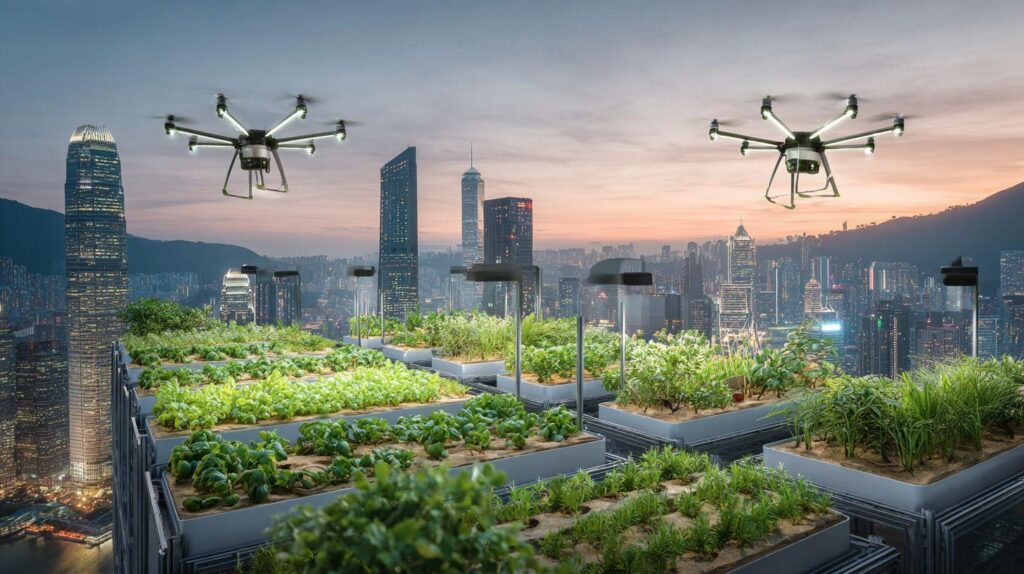
Local microgreens produce 0.2kg CO2e per kg versus 2.5kg for imported ones; vertical farms achieve carbon-neutral status with solar power. LCA comparisons show rooftop strawberries with 85% lower emissions per University of Michigan insights. Transport savings alone cut 90% of related emissions.
Certifications from groups like Carbon Trust validate these gains in smart agriculture. Energy-efficient lighting such as LEDs and climate control minimize power use. Solar integration powers entire indoor farms in urban centers.
Precision farming with AI farming and data analytics predicts yields, reducing excess energy. Drone monitoring and hyperspectral imaging optimize growth without waste. Cities lower their overall carbon footprint through local production.
Examples include vertical farms supplying farm-to-table urban restaurants. Experts recommend modular farms for scalability. This shift supports resilient agriculture against climate change.
Circular Economy Integration
Urban high-tech agriculture achieves 95% waste recycling: fish effluent fertilizes crops in aquaponics, while food waste powers biodigesters yielding 1.5MWh per ton. Black soldier fly (BSF) larvae convert organics to protein feed. Anaerobic digestion produces biogas for energy.
Infarm demonstrates 100% circular nutrients in vertical setups. Closed loops recover resources in shipping container farms and green walls. Waste-to-fertilizer systems like vermicomposting enrich hydroponic solutions.
Aquaponics pairs fish like tilapia with leafy greens, creating symbiotic cycles. Insect farming for crickets or mealworms provides alternative proteins. These models fit urban co-ops and community supported agriculture (CSA).
Practical steps involve biogas production from kitchen scraps for greenhouse heating. Blockchain traceability ensures circular claims reach consumers. This integration advances sustainable urban agriculture and resource recovery.
Regulatory and Policy Frameworks
Cities offer $50M+ incentives; NYC zoning allows rooftop farms, Singapore mandates green roofs. These measures support high-tech agriculture in crowded urban centers. They encourage vertical farming and rooftop gardens to boost local food production.
The policy landscape shapes urban farming growth. Governments update rules for controlled environment agriculture (CEA) like hydroponics and aeroponics. This creates space for indoor farming amid limited land.
Over 200 cities now have dedicated urban ag policies, reflecting a global trend. These frameworks address zoning, safety, and sustainability. They help integrate smart agriculture into city planning.
Challenges include adapting old laws to new tech like LED lighting and automation. Solutions involve collaboration between regulators and agritech firms. This fosters scalable urban greenhouses and stackable farms.
Zoning and Building Codes
NYC Zoning Resolution 102 allows ag buildings; Dubai free zones waive 50% restrictions for vertical farms. These changes enable rooftop farms and high-rises dedicated to CEA. They reduce barriers for modular farms in dense areas.
Toronto’s Bill 197 promotes rooftop agriculture. It sets standards for structural loads from soil-less systems like nutrient film technique (NFT). EU’s Farm2Fork strategy pushes green building norms across cities.
Fire codes pose challenges for multi-layer racks in vertical setups. Multi-story hydroponic towers need extra ventilation and access paths. Experts recommend early code reviews during farm design.
NFPA 318 standards offer solutions for safety in assembly spaces. They guide fire suppression in aeroponics and aquaponics facilities. Cities adapt these for urban greenhouses with climate control.
Government Incentives
USDA Urban Ag Grants: $14.2M 2023; Singapore SFA $32M R&D fund supporting 20+ farms. These programs fund precision farming tools like IoT sensors and robotics. They target startups in container farming and stackable systems.
EU Horizon 2020 provides funding for agritech innovation. Australia’s Export Market Dev Grants aid market entry for urban produce. Tax credits, such as 30% for solar in US CEA, lower setup costs.
Incentives cover water-efficient systems like drip irrigation and fogponics. Cities offer rebates for energy-efficient LED lighting and geothermal heating. This supports zero-mile diet initiatives with local herbs and microgreens.
Practical steps include applying for grants early in projects. Pair them with zoning variances for rooftop or indoor farms. These boost ROI for AI-driven yield optimization in urban centers.
Future Trends and Innovations
CRISPR crops paired with AI lighting promise to boost yields significantly, while blockchain ensures full traceability by 2030 according to GART report predictions.
These technologies drive high-tech agriculture in urban centers, combining biotech for resilient plants with data systems for transparent supply chains. Experts recommend integrating them for scalable urban farming.
Horizon scanning points to megacity expansion, where vertical farming and precision tools address food security. Innovations like IoT sensors and automation will shape sustainable city food production.
Practical steps include adopting controlled environment agriculture (CEA) with LED lighting and robotics. Cities can pilot modular farms to test these trends before full rollout.
Biotechnology Advances
CRISPR-edited indoor tomatoes yield more in urban settings, and cellular agriculture reduces land needs dramatically. These methods support soil-less farming in tight spaces.
Pipeline developments include Pairwise’s CRISPR berries backed by major investments and BioHarvest’s plant cell tech. USDA often grants non-GMO status to such edits, easing market entry.
Genetic engineering crops like drought-tolerant varieties thrive in hydroponics or aeroponics. Growers pair them with climate control for consistent results in rooftop gardens.
Experts recommend starting with CRISPR crops urban such as berries or tomatoes in container farms. This approach enhances nutrition-dense produce for local markets.
Blockchain for Supply Chains
IBM Food Trust tracks produce from farm to fork quickly compared to manual methods, cutting waste in pilots like Walmart’s. Blockchain platforms ensure reliable records.
Systems like TE-FOOD handle high volumes daily, while Agriledger integrates QR codes and RFID tags. Cases such as Carbify show carbon credit tracking in action.
In urban farming, blockchain traceability verifies freshness for farm-to-table urban sales. Consumers scan codes to see origins, building trust.
Implement RFID tracking produce in vertical farms for real-time monitoring. Pair with apps for direct-to-consumer sales to minimize food loss.
Expansion to Megacities
Shanghai plans numerous vertical farms by 2030, and Mumbai pilots container farms to serve many meals yearly. These models target dense populations.
Cities like Delhi, Lagos, and Dhaka eye franchise farms or city-owned facilities. Significant investments will scale urban agriculture to meet demand.
Megacity scale relies on stackable and modular farms using aquaponics or NFT systems. They work together with green walls for multi-use spaces.
Policy support through zoning incentives aids growth. Start with pilots in shipping container farms to prove viability before wider adoption.
Challenges and Barriers to Scale
High initial capital expenses around $1,000 per square foot and 25% energy costs block scaling in urban farming. Despite significant investments in high-tech agriculture, these operations contribute less than 1% to global production. The bankruptcy of Kalera highlights how many startups struggle to survive.
Vertical farms and indoor farming face steep upfront costs for LED lighting, climate control, and automation. Energy demands from HVAC systems and lighting add ongoing expenses in city centers. Operators must balance these against yields from hydroponics or aeroponics.
Solutions include modular container farms and renewable energy sources like solar-powered setups. Impact funds and REITs provide financing for controlled environment agriculture (CEA). Still, achieving profitability requires innovative cost reductions and efficient designs.
Experts recommend starting small with shipping container farms to test markets. Precision farming tools, such as IoT sensors, help optimize resource use. These steps address core barriers in scaling urban agriculture.
High Initial Capital
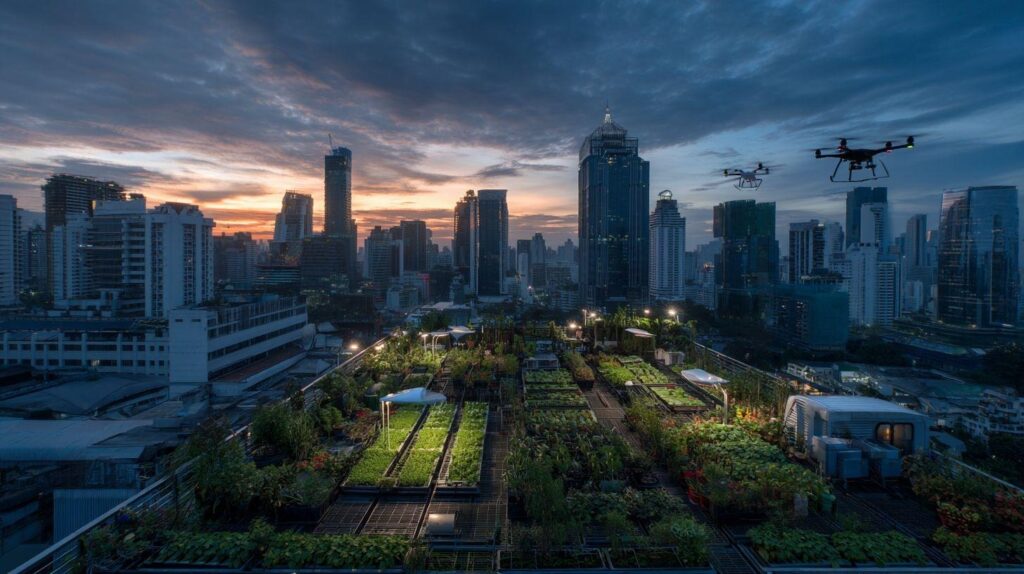
1-acre vertical farm costs $50-100M versus $1M for a field; ROI requires $4-6/kg pricing, about 2x conventional produce. LEDs account for 30% of expenses, HVAC 25%, and automation 20%. These figures make entry tough for new agritech ventures.
Financing options include impact funds focused on sustainable agriculture and REITs targeting urban greenhouses. Modular containers cut costs by up to 50% compared to custom builds. Soil-less farming systems like nutrient film technique reduce land needs in dense cities.
Cost reduction strategies involve energy-efficient lighting and AI-driven automation. Rooftop gardens with polycarbonate greenhouses lower structural expenses. Operators can explore geothermal heating for long-term savings in CEA setups.
Practical advice centers on phased expansion, starting with stackable farms. Examples include microgreens or herbs, which offer quick turns. This approach improves ROI in high-tech urban agriculture.
Skilled Labor Shortages
CEA requires agronomists earning around $90K per year plus data scientists; a significant worker gap is projected for the US by 2030. High-tech agriculture demands expertise in robotics, AI farming, and sensors. Many urban farms report hiring difficulties.
Solutions include VR training programs and university initiatives in controlled environment agriculture. Tools like VRnext simulate hydroponics and aeroponics management. Cornell offers specialized MS programs to build talent pipelines.
Automation with drones and predictive analytics eases labor needs. Pollination robots and autonomous harvesters handle repetitive tasks. Training focuses on data analytics for yield optimization in vertical farms.
Community programs and co-ops foster local skills. Examples feature basil or strawberry cultivation with IoT monitoring. These efforts bridge gaps in smart agriculture for city farming.
Consumer Acceptance
Many consumers distrust ‘lab-grown’ produce despite potential nutritional benefits; surveys indicate skepticism persists. The ‘tasteless’ myth and transparency fears hinder adoption. Urban buyers question hydroponic or aeroponic methods.
Solutions involve farm tours and traceability apps from leaders like AeroFarms. Premium direct-to-consumer sales, such as $8 per pound for microgreens, build trust. Blockchain traceability verifies freshness in farm-to-table urban supply chains.
Educating on benefits like water efficiency and local production counters doubts. Zero-mile diet appeals highlight sustainability. Tastings of lettuce or tomatoes from indoor farms demonstrate quality.
Marketing through apps and community supported agriculture strengthens acceptance. Certifications for food safety reassure buyers. These steps promote high-tech produce in urban centers.
Frequently Asked Questions
What is ‘The Rise of High-Tech Agriculture in Urban Centers’?
The Rise of High-Tech Agriculture in Urban Centers refers to the growing integration of advanced technologies like vertical farming, hydroponics, AI-driven monitoring, and automated systems into city-based food production. This trend addresses urban food security by transforming rooftops, warehouses, and abandoned buildings into efficient farms, reducing reliance on rural imports and minimizing transportation emissions.
Why is ‘The Rise of High-Tech Agriculture in Urban Centers’ important for cities?
The Rise of High-Tech Agriculture in Urban Centers is crucial because it tackles challenges like limited land space, population density, and climate change impacts. It enables year-round local food production, cuts carbon footprints from long-distance shipping, and enhances food resilience against supply chain disruptions, ultimately promoting sustainable urban living.
What technologies drive ‘The Rise of High-Tech Agriculture in Urban Centers’?
Key technologies fueling The Rise of High-Tech Agriculture in Urban Centers include LED lighting for optimized growth, precision irrigation via sensors, robotics for planting and harvesting, and data analytics powered by AI and IoT. These innovations allow for controlled environments that boost yields by up to 10 times compared to traditional farming.
How does ‘The Rise of High-Tech Agriculture in Urban Centers’ benefit the environment?
The Rise of High-Tech Agriculture in Urban Centers significantly reduces water usage by up to 90% through recirculating systems, eliminates pesticides in many cases, and lowers greenhouse gas emissions by localizing production. It also repurposes urban waste like food scraps for composting, contributing to a circular economy in cities.
What are the challenges in ‘The Rise of High-Tech Agriculture in Urban Centers’?
Despite its promise, The Rise of High-Tech Agriculture in Urban Centers faces hurdles such as high initial setup costs, energy demands for climate control, regulatory barriers for zoning, and the need for skilled technicians. Scalability remains an issue, though falling tech prices are making it more accessible.
What is the future outlook for ‘The Rise of High-Tech Agriculture in Urban Centers’?
The future of The Rise of High-Tech Agriculture in Urban Centers looks bright, with projections indicating it could supply 10-20% of urban food needs by 2030. Advancements in affordable automation, renewable energy integration, and policy support will accelerate adoption, potentially revolutionizing global food systems in megacities.