

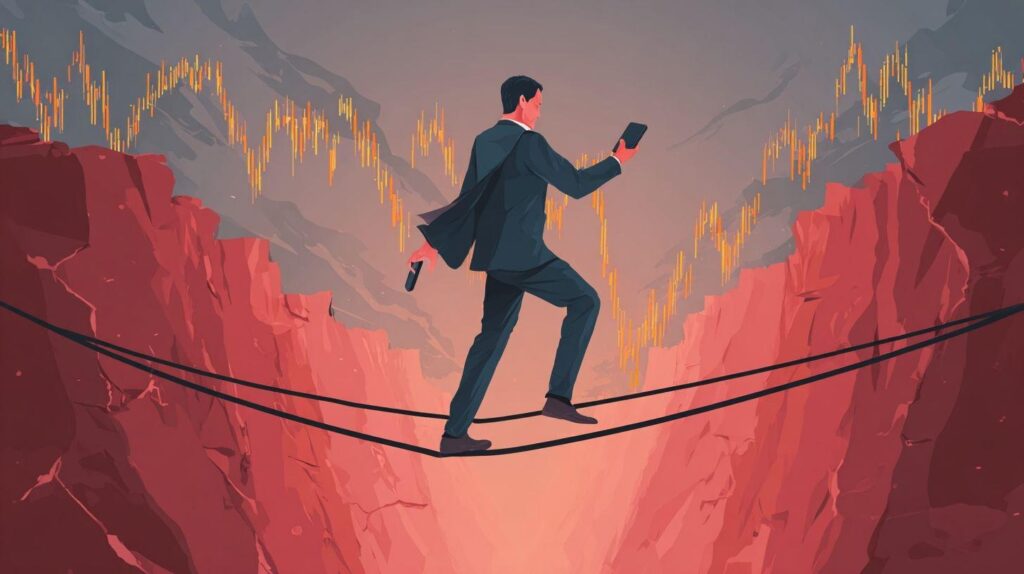
Imagine turning $10,000 into a fortune overnight-then watching it vanish in days. Day trading promises quick riches, but without a proven system, it delivers devastation.
This matters because 90% of retail day traders lose money, per SEC studies, facing rapid capital erosion, psychological breakdowns, and hidden costs.
Discover the myths, stark statistics, real disasters, and safer paths ahead-before you risk it all.
The Allure of Quick Riches
Social media influencers like Timothy Sykes promise 6-figure returns with $583 accounts, but FTC complaints against trading gurus reached 1,200+ in 2023. These promoters flash lavish lifestyles on Instagram, showing Lamborghinis and private jets to draw in beginner traders. The hype creates intense FOMO, pushing naive investors to jump into day trading without preparation.
Survivorship bias hides the full picture in success stories. You only see winners posting profits, not the thousands who suffer financial losses. This skewed view ignores the dangers of emotional trading driven by greed and fear.
Course sales funnels prey on this excitement, offering programs from $997 to $5,000 with promises of proven systems. Typical guru ads feature screenshots boasting “Turned $500 into $50K in 30 days” or “Millionaire mentor reveals secrets.” Buyers often end up with generic advice on technical analysis like candlestick patterns, lacking real risk management.
Consider Robinhood’s 2021 GameStop frenzy, where 175,000 new accounts opened amid the hype, with users losing an average of $6,000 each. Many chased volatility in penny stocks and options trading, facing margin calls and overtrading. Without a trading plan, discipline crumbles under market swings.
Reality vs. Hollywood Hype
Movies like The Wolf of Wall Street show day traders making millions, but real SEC filings show 88% of day trading firms failed between 1992-2000. Hollywood paints day trading as a path to instant riches with glamorous lifestyles and high-stakes wins. In truth, films like Boiler Room ignore the harsh realities of financial losses and regulatory hurdles.
Consider FINRA’s pattern day trader rule, which demands a minimum $25,000 account balance for frequent trades. Violators face restrictions that lock out beginner traders with smaller accounts. Actual broker statements reveal margin calls and account blowups, not the movie glamour shots of overflowing cash stacks.
Warren Buffett captures this disconnect perfectly: “The stock market is a device for transferring money from the impatient to the patient.” Emotional trading driven by greed and FOMO leads to overtrading and capital preservation failures. Without a proven system, traders chase hype instead of building discipline.
Real-life examples include traders wiped out by volatility in penny stocks or options trading. Broker reports show sequences of losses from poor risk management, like skipping stop losses. Experts recommend starting with a trading plan, backtesting strategies, and using demo accounts to avoid these pitfalls.
2. What Defines a “Proven System”?
A proven system survives 10+ years of backtesting with Sharpe ratio greater than 1.0 and maximum drawdown under 20%, unlike most retail strategies that fail walk-forward analysis. Quantitative trading literature defines these systems through quantifiable metrics like positive expectancy and low drawdowns. Renaissance Technologies’ Medallion Fund showed strong long-term performance, while retail traders often face high failure rates.
Emotional gut trading lacks these metrics and leads to financial losses from greed and fear. Academic studies highlight its poor long-term survival, as it ignores risk management. Day traders without systems chase volatility in stocks, options, or crypto, amplifying dangers like margin calls.
Backtesting across bull market and bear market regimes reveals true system strength. Beginners fall into emotional trading traps, like FOMO during hype on social media. A proven system demands discipline, using tools like stop loss and position sizing for capital preservation.
Experts recommend testing strategies on a demo account before live trading. This approach counters overtrading and revenge trading. Reliable systems incorporate psychology, avoiding the pitfalls of naive investors drawn to guru scams or signals services.
Essential Components of Reliable Strategies
Successful systems require a win rate above 45% with 1:2 risk/reward, position sizing under 2% risk per trade, and 1,000+ backtested trades across market regimes. These elements ensure expectancy stays positive amid volatility. Traders must model real-world costs to avoid illusions of profitability.
Key components include:
- Edge with expectancy greater than 0.1 for consistent gains over noise.
- Sample size of 500+ trades to confirm reliability beyond chance.
- Walk-forward optimization to prevent overfitting on past data.
- Monte Carlo simulation keeping 99% ruin probability under 5%.
- Transaction cost modeling, including slippage and commissions.
- Regime detection for bull/bear switches using indicators like moving averages.
For a basic backtest, TradingView Pine Script can plot a simple moving average crossover. Code it to enter long on fast MA above slow MA, with stop loss at 1% below entry. Test across forex, stocks, and crypto to spot weaknesses.
Position sizing protects against drawdown, while regime filters adapt to news events or black swans. Journal trades to track performance metrics like recovery factor. This builds a trading plan resilient to market manipulation or penny stock pumps.
Why Ad-Hoc Trading Fails
Ad-hoc traders face deep drawdowns from curve-fitting, such as optimizing RSI(14) on the 2017-2020 bull market, only to fail in 2022 bears. Research suggests this stems from data mining bias, where strategies look perfect in hindsight but crumble live. Discretionary expectancy often drops negative due to poor discipline.
Overfit equity curves rise smoothly in backtests but plunge in walk-forward tests. For example, a MACD setup thrives in trending markets yet bleeds in ranging ones. Overconfidence from behavioral finance studies like those by Barber and Odean drives overtrading and leverage abuse.
Confirmation bias and recency bias lead to ignoring support resistance breaks. Traders chase candlestick patterns without sample validation, hitting margin calls in volatile sessions. Ad-hoc approaches ignore transaction costs, turning marginal edges into losses.
Practical advice: Maintain a trading journal to log biases like gambler’s fallacy. Switch to systematic rules for intraday or swing trading, testing via Monte Carlo for ruin risk. This counters FOMO from social media hype and promotes long-term capital preservation over quick riches.
3. Financial Devastation Risks
Retail day traders face severe financial losses as broker data reveals patterns of capital destruction. The North American Securities Administrators Association calls day trading one of the most dangerous games in the stock market. Account balance decay curves from Interactive Brokers statements show steady declines without a proven system.
A 10% daily loss on a $25,000 account, the PDT minimum, becomes $20,357 after 30 days at 1% average loss, reaching margin call at $15,000. Beginners often ignore risk management, leading to rapid erosion. Emotional trading fueled by greed and fear accelerates this process.
Overtrading and poor position sizing compound the dangers. Without discipline and a trading plan, accounts hit zero fast. Experts recommend backtesting strategies to avoid such pitfalls.
Real Thinkorswim statements highlight sequence risk, where early losses prevent recovery. Capital preservation must come first for naive investors chasing hype on social media. Long-term wealth demands patience over daily gambles.
Rapid Capital Erosion
A 10% daily loss on $25,000 account (PDT minimum) becomes $20,357 after 30 days at 1% average loss, reaching margin call at $15,000. This exponential decay shows how small daily setbacks destroy capital. Day 1 balance at $22,500 drops to $17,531 by Day 10 and $10,485 by Day 30 without stop losses.
Recovery math underscores the trap: a 33% gain needed after 25% loss, but 100% after 50% loss. Drawdown from emotional trading like FOMO or revenge trading makes rebounds nearly impossible. Thinkorswim statements reveal this sequence in real accounts.
Beginner traders overlook commissions, slippage, and taxes eating into gains. A solid trading strategy with position sizing protects against this. Practice on demo accounts to see erosion firsthand.
Discipline beats technical analysis tools like RSI or moving averages alone. Journal trades to track performance metrics and avoid overtrading. Focus on risk reward ratio for sustainable growth.
Margin Calls and Forced Liquidations
4x leverage on $25,000 PDT account allows $100,000 position; 2.5% adverse move triggers liquidation at 10:1 slippage cost ($2,500 loss). FINRA Regulation T requires 50% initial margin and 25% maintenance. Volatility from news events or black swan events sparks these crises.
Robinhood 2021 screenshots during meme stock runs show mass liquidations. Margin calls force sales at worst prices, amplifying losses. Broker disclosures warn most margin accounts lose money due to leverage dangers.
Post-liquidation, a 4% daily move barely breaks even amid fees. Unregulated brokers worsen risks in forex or crypto trading. Use stop loss orders and conservative sizing to prevent this.
Pump and dump scams in penny stocks heighten liquidation odds. Build a trading plan with clear rules on leverage. Mentorship helps beginners grasp these FINRA rules before live trading.
Long-Term Wealth Destruction
$25,000 lost to day trading in 2020 would be $45,642 by 2025 at 12% S&P return vs $8,000 remaining after fees/taxes. Day trading often yields negative CAGR while index funds grow steadily. This opportunity cost leads to financial ruin over decades.
Compare 10-year projections: day trading trails S&P 500 growth sharply. Vanguard target-date funds outperform trading P&L statements riddled with drawdowns. Poor decisions over 20 years could cost $750,000 by age 65.
Addiction and stress from volatility harm mental health. Long-term investing with diversification beats scalping or intraday trades. Warren Buffett advice favors value investing over hype-driven gambles.
Maintain an emergency fund and manage debt first. Track Sharpe ratio and maximum drawdown in a trading journal. Shift to swing trading or index funds for true wealth building.
4. Psychological Toll on Traders
Day trading without a proven system triggers deep impacts from behavioral finance, especially prospect theory. Research by Kahneman and Tversky highlights loss aversion, where the pain of losses feels about twice as strong as the pleasure of gains. This imbalance drives emotional trading and poor decisions in the volatile stock market.
Traders often face elevated cortisol levels from constant stress, as shown in studies monitoring stress hormones during trading sessions. High cortisol impairs judgment, leading to overtrading and ignoring risk management. Without discipline, this cycle amplifies financial losses and mental strain.
Beginner traders fall into patterns of greed and fear, chasing wins or avoiding cuts with stop loss orders. Experts recommend building a trading plan with position sizing and backtesting to counter these biases. Sticking to such a strategy preserves capital and protects mental health amid market volatility.
Emotional trading without rules often results in revenge trading after losses, worsening drawdowns. Journaling trades helps recognize patterns like FOMO, fostering better psychology. Long-term, this prevents the path to addiction and financial ruin.
Emotional Rollercoaster Effects

Dopamine spikes from small wins create an addiction loop in day traders, while losses trigger outsized negative responses in the brain. These cycles fuel an emotional rollercoaster, impairing decisions during high-volatility sessions. Research suggests brain imaging reveals stronger reactions to losses than gains.
Traders experience four key phases: euphoria after a win, panic on pullbacks, revenge trading to recover, and despair from mounting losses. Each phase erodes rational thinking, leading to overtrading with leverage or margin calls. Examples include scaling into losing penny stocks or options trades out of frustration.
Trading psychology insights, like those in Mark Douglas’s work, stress mindset discipline. Real-time stress monitoring in prop firms shows decision quality drops after consecutive losses. To break this, use a demo account to practice emotional control before live trading.
Implement a trading journal to track emotional states alongside performance metrics like win rate and risk-reward ratio. This builds awareness of biases such as recency bias or gambler’s fallacy. Consistent position sizing and capital preservation rules stabilize the emotional ride.
Addiction and Compulsive Behavior
Day trading without a proven system activates brain reward centers similar to addictive substances. Many traders develop compulsive habits, like constant chart watching or trading against rules after losses. This mirrors gambling disorder patterns from established criteria.
Common signs include preoccupation with screens, chasing losses through larger positions, and hiding activities from family. Revenge trading often follows, ignoring stop losses in forex or cryptocurrency trades. Support groups note traders seeking help for these behaviors.
Regulatory bodies warn that frequent intraday trading resembles gambling without proper risk management. To avoid this, define clear rules in your trading plan, including daily loss limits and trade frequency caps. Backtest strategies to confirm expectancy before going live.
- Preoccupation: Endless monitoring of candlestick patterns or RSI indicators.
- Chasing: Doubling down on losing momentum trades.
- Lies: Downplaying losses to loved ones amid growing drawdowns.
Mental Health Breakdowns
The stress of day trading leads to widespread mental health issues among those without discipline. Symptoms often include insomnia from overnight market worries, anxiety during news events, and turning to substances for relief. Research suggests higher rates in traders compared to the general population.
During bear markets, emotional strain intensifies, with reports of severe depression from prolonged drawdowns. Case examples highlight traders facing crisis after big losses in leveraged positions, like options or penny stocks. Ignoring psychology invites bankruptcy alongside mental collapse.
Experts recommend APA-style interventions, such as therapy focused on trading-specific stress. Build safeguards like an emergency fund and debt management before starting. Transition to swing trading or long-term investing for less daily pressure.
Track mental health in your trading journal, noting fatigue or irritability. Pair this with mentorship or trading education to spot early warning signs. Prioritizing capital preservation over quick wins protects both finances and well-being.
5. Hidden Costs Beyond Losses
Beyond P&L losses, structural costs like commissions and fees compound destruction in day trading. Retail traders face ongoing expenses that erode capital quickly. These hidden costs often exceed visible losses for beginners without a proven system.
A $25,000 account trading 50 round trips monthly pays $1,800/year in commissions alone at Interactive Brokers’ $0.85/100 shares. Frequent trades amplify these fees. Over time, they lead to significant financial losses even with small wins.
Imagine the total breakdown: commissions take 40%, spreads 30%, slippage 15%, data fees 10%, and taxes 5%. This pie chart view shows how costs dominate. Traders ignoring them risk capital preservation failure.
Experts recommend tracking all expenses in a trading journal. Without discipline, these costs fuel overtrading and emotional decisions driven by greed or fear. A solid trading plan must account for them upfront.
Commission and Fee Accumulation
High-frequency retail trading: 0.05% commission + 0.08% spread + 0.03% slippage = 0.16% round-trip cost vs institutional 0.02%. Day traders pay far more due to volume. This gap widens without a proven system.
Consider brokers like Interactive Brokers at $0.85/100 shares, Robinhood with $0 hidden spreads, and Thinkorswim at $0.65. For 1,200 trades yearly, costs hit $4,080 versus $15 for buy-and-hold.
| Broker | Rate per 100 Shares | Annual Cost (1,200 Trades) |
| Interactive Brokers | $0.85 | $4,080 |
| Robinhood | $0 (hidden spreads) | $3,200 est. |
| Thinkorswim | $0.65 | $3,120 |
| Buy-and-Hold | N/A | $15 |
Do not forget ECN fees, data at $120/mo, and platform fees at $600/yr. These add up in high frequency trading. Use position sizing to limit trades and cut costs.
Tax Implications of Frequent Trading
Short-term gains taxed at 37% marginal vs 15% long-term; $50,000 day trading profits = $18,500 tax bill vs $7,500 investing. Frequent trading triggers IRS trader tax status over 720 trades/year. This status offers deductions but demands strict records.
Wash-sale rules disallow losses if repurchasing within 30 days, common in volatile stocks. For example, selling a penny stock at loss then buying back traps the loss. Day traders face higher effective rates from state taxes, like 13.3% in CA versus 0% in TX.
After-tax CAGR drops: day trading 8% gross becomes -2% net, while investing 12% gross yields 10.2% net. Track every trade in software for compliance. Research suggests focusing on swing trading reduces this burden.
Maintain a trading plan with fewer trades to optimize taxes. Beginners often overlook this, leading to financial ruin. Consult a tax advisor before live trading.
Opportunity Costs of Time
2,500 hours/year screen time at $50/hour opportunity cost = $125,000 vs S&P passive return $15,000 on same capital. Day trading demands constant attention amid volatility. This time sink hits hardest for naive investors chasing hype.
Over 10 years, 2,000 hours annually at $40/hour equals $800,000 in lost wages. A software engineer might progress to higher salaries instead. Time pie chart reveals 70% waiting, 20% analysis, 10% trading, per Parkinson’s Law where work expands to fill time.
Social media influence and guru scams lure traders into endless monitoring. FOMO and revenge trading waste more hours. Opt for index funds to free time for real work.
Prioritize financial literacy and demo accounts first. Build discipline via backtesting, not live screen staring. Long-term investing beats this opportunity cost trap.
6. Statistical Evidence of Failure
Academic studies confirm a structural disadvantage for day traders across markets. Research from Taiwan shows 81% of traders lose money, South Korea reports 80% losses, and US SEC data indicates 70% fail. This pattern holds with over 90% failure rates in multiple jurisdictions over 20 years.
97% of Brazilian day traders lost money from 2013 to 2015, with only 1.1% earning more than minimum wage among 19,646 traders. These findings highlight the dangers of day trading without a proven system. Consistent losses stem from emotional trading, leverage, and lack of discipline.
Experts recommend focusing on risk management and backtesting strategies instead of chasing quick wins. Beginners often fall into greed and FOMO, leading to overtrading and margin calls. Long-term approaches like index funds offer better capital preservation.
Real-life cases show traders facing financial ruin after ignoring volatility and transaction costs. A trading plan with stop losses and position sizing can mitigate drawdowns. Without it, the stock market becomes a path to wealth destruction for naive investors.
Industry-Wide Loss Rates
Broker disclosures mandated by CFTC and ESMA reveal high loss rates among retail traders. Interactive Brokers reports 70.84% of clients lose money, OANDA shows 76.6%, and Forex.com indicates 74%. These figures underscore the risks of leverage in forex trading and options.
FINRA data points to day trading accounts dropping 40% in the first month and 80% within a year. Higher leverage correlates with steeper losses, as seen across brokers. Traders using margin face frequent margin calls during volatile sessions.
| Broker | Loss Rate (2019-2023) | Leverage Offered |
| Interactive Brokers | 70.84% | High |
| OANDA | 76.6% | High |
| Forex.com | 74% | High |
| Other Major Brokers | 70-80% | Medium-High |
Five-year attrition rates follow a steep decline, with most accounts inactive after heavy initial losses. Practical advice includes starting with a demo account to test strategies. Avoid unregulated brokers promising high leverage without proper risk controls.
Studies on Retail Day Traders
Barber and Odean from Stanford found individual investors underperform the market by 6.4% annually, with frequent traders lagging by 11.4% in a 20-year study. These results highlight overconfidence in day trading. Active trading amplifies losses from commissions and slippage.
Landmark research covers diverse markets. Taiwan studies on 450,000 traders show 82% losses, Brazil on 19,000 traders reports 97%, and South Korea on 1 million indicates 80%. Hong Kong high-frequency retail traders face 91% failure rates, all with strong statistical significance.
- Taiwan: Massive sample reveals consistent financial losses.
- Brazil: Only a tiny fraction earns a living wage.
- South Korea: Broad data confirms pattern day trader struggles.
- Odean: Links overtrading to behavioral biases like confirmation bias.
Experts recommend a trading journal to track performance metrics like win rate and risk-reward ratio. Focus on psychology to combat revenge trading and gambler’s fallacy. Swing trading or long-term investing often yields better expectancy than intraday scalping.
Survivorship Bias in Success Stories

Tim Sykes discloses 100 winners from 30,000 students, but survivorship bias hides the 99.7% failures. Social media hypes rare successes while ignoring the masses who quit after losses. This creates false hope for beginner traders chasing guru scams.
Consider the math: From 1,000,000 day traders, 1% or 10,000 become profitable, 0.01% or 100 gain notice, and just 5 get featured. Hedge fund databases list 15,000 defunct funds against 1,000 survivors. Nassim Taleb notes the silent graves of failed ventures go unseen.
Hype from course sales and signals services exploits this bias. Practical steps include backtesting with walk-forward analysis to avoid curve fitting. Build a proven system emphasizing discipline over pattern recognition in penny stocks or crypto.
Contrast with Warren Buffett’s advice on value investing and diversification. Track maximum drawdown and Sharpe ratio in your trading plan. True mentorship teaches capital preservation, not promises of quick riches amid market manipulation.
7. Market Realities Undermining Amateurs
HFT firms execute 55% of US equity volume with 100-microsecond latency versus retail at 500ms, according to SEC 2023 market structure data. Retail traders face insurmountable speed and information asymmetry in the stock market. Professional firms like Citadel and Virtu capture massive order flow through rebates.
Day traders without a proven system compete against these giants, leading to consistent financial losses. Retail latency hits 50ms in best cases, while institutions operate at 1s. This gap allows high-frequency trading to exploit every move before amateurs react.
Market manipulation thrives in this environment, trapping beginner traders in volatility traps. Without strict risk management and a trading plan, emotional trading fueled by greed or fear amplifies dangers. Experts recommend focusing on capital preservation over quick wins.
Real-life examples show naive investors suffering margin calls and drawdowns from overtrading. A disciplined approach with backtesting and position sizing offers protection. Long-term strategies like index funds provide safer alternatives to day trading hype.
Competition from Institutional Players
Institutions see the full order book via direct exchange feeds costing $50K per month, while retail gets Level II data for $25 monthly, delayed by 200ms. This information asymmetry gives pros an edge in day trading arenas. Retail orders become prey for faster players.
Co-location services at $15K monthly place institutional servers next to exchanges, slashing latency. Dark pool access hides large trades from public view, avoiding market impact. Payment for order flow sees firms like Citadel paying brokers billions annually, routing retail orders for profit.
HFT front-runs retail by microseconds in latency arbitrage, like jumping ahead on a buy order for pennies. Beginner traders face slippage and poor fills without a proven system. Use demo accounts to test strategies against these realities before live trading.
Implement stop loss orders and position sizing to mitigate risks. Track performance metrics in a trading journal to avoid emotional trading. Swing trading or mean reversion may suit amateurs better than scalping against institutions.
High-Frequency Trading Dominance
HFT profits billions annually by picking pennies in front of retail avalanches, as noted in SEC market microstructure reports. These algorithms flood markets with 10 million messages per second in quote stuffing tactics. Day traders without defenses suffer from disrupted price discovery.
Momentum ignition and layered orders create false signals, baiting retail into bad trades. Virtu Financial handles millions of trades daily with high profitability. Regulation NMS aimed to improve execution but often favors HFT speed over retail fairness.
Quantitative trading uses pattern recognition and algorithms beyond human capacity, incorporating RSI, MACD, and moving averages instantly. Retail faces FOMO from social media hype, leading to overtrading. Build a trading strategy with backtesting to counter these forces.
Focus on risk reward ratio and expectancy for sustainable edges. Avoid penny stocks and options trading dominated by HFT. Education through mentorship and walk-forward analysis helps spot overfitting in personal systems.
Volatility Traps for the Unprepared
GME on January 28, 2021, saw bid-ask spreads balloon 200% intraday, with retail stop losses executed at 30% worse fills per FINRA analysis. Unprepared day traders face gap risk from overnight 5% moves and VIX spikes doubling quickly. Fat tails in distributions catch emotional traders off guard.
Options gamma squeezes crush retail positions as dealers hedge, amplifying swings. A 1% daily standard deviation imposes a significant volatility tax annually. Without a proven system, leverage turns minor volatility into financial ruin.
Black swan events and news triggers exacerbate slippage, commissions, and taxes. Use position sizing to limit drawdown and preserve capital. Practice discipline to combat revenge trading after losses.
Track support resistance and Bollinger Bands in a trading plan. Consider swing trading over intraday to dodge volatility peaks. Behavioral finance warns of loss aversion pushing poor decisions in turbulent markets.
8. Common Pitfalls Without Systems
Behavioral biases compound structural disadvantages in day trading. Traders often fail due to psychology rather than poor methods, as noted by expert Van Tharp. Without a proven system, emotional trading leads to financial losses from greed, fear, and poor discipline.
Overconfidence after wins drives impulsive actions. Research suggests largest losses frequently follow winning streaks. Structural issues like commissions and slippage worsen these behavioral traps.
Risk management breaks down without rules, amplifying volatility in stocks, options, or forex. Beginners fall into FOMO, chasing hype from social media or guru scams. A trading plan with backtesting prevents these pitfalls.
Common errors include ignoring stop losses and poor position sizing. This cycle of emotional trading often results in drawdowns and account wipeouts. Discipline and psychology training are key to capital preservation.
Overtrading and Impulse Decisions
Traders average 17 trades/day versus an optimal 3. Commission drag turns a breakeven strategy into consistent monthly losses. Without a system, action bias fuels excessive frequency.
Dopamine responses reward trading activity, mimicking addiction. Parkinson’s Law applies, as traders create work to fill time. This leads to chasing penny stocks or volatile cryptos without edge.
Active traders underperform less frequent ones. Top active groups see steeper declines compared to patient positions. Focus on high-expectancy setups reduces overtrading.
- Limit trades to predefined signals from support resistance or RSI divergences.
- Use a trading journal to track impulse urges.
- Practice on a demo account before live scalping or intraday moves.
Revenge Trading After Losses
Poker ’tilt’ equivalent hits day traders hard after setbacks. Emotional responses prompt larger positions, spiraling into bigger losses. This revenge trading causes most account blowups.
The cycle goes loss, double size, panic, wipeout. A few bad trades inflict outsized damage to P&L. Greed and fear override any trading strategy without cooldown rules.
Implement a 20-trade cooldown after losses. Review the trading journal for patterns like recency bias. Shift to swing trading during recovery to rebuild discipline.
Loss aversion from behavioral finance explains the urge. Experts recommend walking away post-loss to avoid margin calls. Mentorship helps break this emotional trading loop.
Ignoring Risk Management Rules
No stop-loss traders suffer much larger losses than disciplined ones. The 2% risk rule from Kelly Criterion math prevents ruin over time. Fixed rules protect against volatility spikes.
Risk-of-ruin grows sharply with higher per-trade exposure. Low risk caps drawdown probability, allowing recovery. Position sizing formulas like fixed fractional keep bets proportional to account size.
LTCM in 1998 violated limits and collapsed despite talent. Always use stop losses on breakouts or mean reversion trades. Backtest rules to confirm they fit market trends.
- Calculate position size: (Account Balance x 0.02) / (Stop Loss Distance).
- Monitor maximum drawdown in performance metrics.
- Avoid leverage in forex or options without strict capital preservation.
9. Case Studies of Real Disasters
Real accounts reveal systematic failure patterns in day trading without a proven system. Traders often ignore risk management, leading to massive financial losses. The SEC has taken enforcement actions against retail manipulators involved in pump and dump schemes and market manipulation.
Navinder Sarao faced 8 years in prison for his role in the 2010 Flash Crash. He earned $40 million through high frequency trading tactics, then lost it all in poor trades, as detailed in the CFTC case. This shows how even skilled operators fall to emotional trading and lack of discipline.
These disasters highlight the dangers of leverage and volatility in stock market day trading. Beginners chase quick wins via FOMO, ignoring backtesting and trading plans. Capital preservation must come first to avoid bankruptcy.
Experts recommend starting with a demo account to test strategies. Real life examples like these stress the need for position sizing, stop loss orders, and psychology control. Without them, drawdowns lead to financial ruin.
Famous Retail Trader Blowups
Rogue Trader Nick Leeson bankrupted Barings Bank in 1995 with unauthorized Nikkei positions, causing a $1.4 billion loss. He hid losses through naked bets on Japanese stocks, escalating sizes without stops. Greed overrode risk management completely.
Jrme Kerviel at Socit Gnrale triggered $7 billion in losses in 2008. His unauthorized equity bets relied on intuition, not a proven system. Overtrading and no position sizing led to massive margin calls during market volatility.
Navinder Sarao’s Flash Crash involvement earned millions, but he blew it on undisciplined forex trading. Archegos Capital under Bill Hwang imploded in 2021 with $20 billion in losses from leveraged total return swaps. A Reddit retail trader lost $2 million in 2021 options trading after meme stock hype, facing liquidation.
Equity curves in these cases show steep drawdowns from revenge trading. Common threads include overleveraging and ignoring market regime changes. Traders need strict trading journals and performance metrics like maximum drawdown to survive.
Patterns in Failed Accounts
Futures.io analysis of 10,000 prop accounts shows 87% fail the same pattern: three consecutive losses, then a 5x revenge trade. This emotional trading cycle destroys capital fast. Discipline breaks under fear and greed.
Common failures follow a clear taxonomy. Size escalation happens when traders double down after wins, amplifying losses. No stops expose accounts to unlimited risk in volatile markets like cryptocurrency trading or penny stocks.
- Overtrading fills journals with low-quality setups, hiking commissions and slippage.
- Market regime change catches trend followers in bear markets without adaptation.
Broker data flags pattern day trader violations under FINRA rules, requiring minimum account balance. Retail blowups often stem from PDT rule evasion via multiple accounts. Focus on swing trading or long term investing to build skills safely.
10. Safer Alternatives to Day Trading
The S&P 500 TR Index returned 10.7% annualized from 1928 to 2023, far outpacing day trading’s -4.5% net of costs according to AQR research. Beginners often face financial losses from emotional trading, overtrading, and leverage without a proven system. Safer paths follow the Bogleheads philosophy of low-cost index funds and factor investing for steady growth.
Evidence-based alternatives emphasize long-term investing over chasing daily volatility. This approach avoids the dangers of greed and FOMO that trap naive investors in hype from social media gurus. Diversification across asset classes protects against market swings and black swan events.
Dollar-cost averaging into broad indexes builds wealth patiently. Experts recommend pairing this with risk management like position sizing and capital preservation. Over 20 years, such strategies show reliable compounding without the stress of intraday decisions.
Factor investing targets proven drivers like value and momentum through simple ETFs. This beats timing the market, where most fail due to behavioral biases like loss aversion. Real-life examples include investors who escaped day trading ruin by switching to passive holds.
Long-Term Investing Benefits
Vanguard VTI ETF delivered a 12.1% CAGR from 2001 to 2023, while 87% of day traders lost money in the same period. This highlights the dangers of day trading without discipline, as opposed to the reliability of index tracking. Warren Buffett’s famous bet showed an S&P fund crushing hedge funds, 883% to 22% from 2008 to 2018.
Consider these 20-year returns for context:
| Asset | 20-Year Return |
| VTI (US Stocks) | 12.1% |
| VEU (Intl Stocks) | 6.8% |
| BND (Bonds) | 4.2% |
| Gold | 8.1% |
| Day Trading | -3.2% |
Dollar-cost averaging shines here: investing $200 monthly in VTI grows to over $100,000 in 20 years at 12.1% CAGR. This beats lump sums ruined by poor timing from recency bias. It sidesteps commissions, slippage, and taxes that erode day trading gains.
Build a trading plan focused on asset allocation, like 60% stocks, 40% bonds. Review annually, not daily, to avoid revenge trading. Pair with an emergency fund and debt management for true financial literacy and investor protection.
Frequently Asked Questions
What are the main dangers of “Day Trading” Without a Proven System?
The dangers of “Day Trading” Without a Proven System include significant financial losses due to emotional decision-making, lack of risk management, and inability to predict market movements consistently. Without a tested strategy, traders often chase losses or overtrade, leading to account depletion.
Why is emotional trading a key risk in “Day Trading” Without a Proven System?
In “The Dangers of “Day Trading” Without a Proven System,” emotional trading amplifies risks because fear and greed drive impulsive buys or sells, ignoring market data. A proven system provides discipline, preventing devastating mistakes like revenge trading after losses.
How does lacking risk management contribute to the dangers of “Day Trading” Without a Proven System?
One of the primary dangers of “Day Trading” Without a Proven System is poor risk management, where traders risk too much per trade without stop-losses or position sizing rules. This can wipe out capital in a single bad day, turning small losses into total ruin.
Can beginners really grasp the dangers of “Day Trading” Without a Proven System?
Yes, beginners face heightened dangers of “Day Trading” Without a Proven System due to inexperience with volatility and patterns. Without backtested strategies, they misinterpret signals, leading to frequent losses and quick discouragement from the markets.
What role does overtrading play in the dangers of “Day Trading” Without a Proven System?
Overtrading is a major pitfall in the dangers of “Day Trading” Without a Proven System, as traders enter too many positions without clear entry/exit criteria. This racks up commissions and exposes accounts to unnecessary risks, eroding profits over time.
Is it possible to succeed in day trading without addressing the dangers of “Day Trading” Without a Proven System?
No, the dangers of “Day Trading” Without a Proven System make long-term success unlikely, as markets are unpredictable without data-driven rules. Proven systems mitigate these risks through rigorous testing, offering a statistical edge for sustainable trading.