
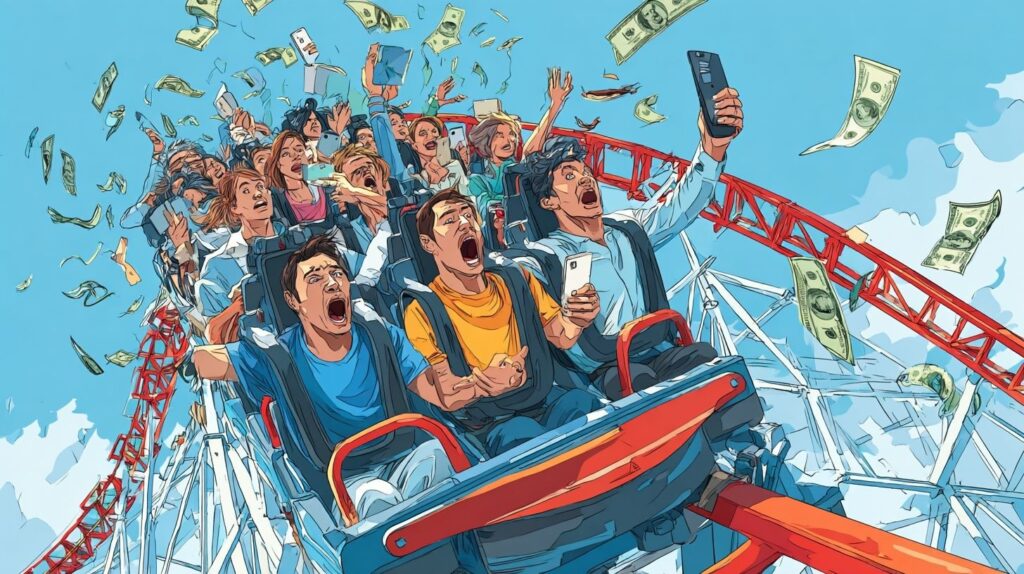
In January 2021, GameStop’s stock rocketed 1,625% in weeks, turning Reddit traders into overnight millionaires-or devastating losses for the unprepared.
This meme stock frenzy highlights a dangerous allure: hype-driven gains masking profound risks like extreme volatility, emotional traps, and regulatory pitfalls.
Explore the hype cycle, hidden vulnerabilities, and long-term consequences-arming you with strategies to invest wisely, not recklessly.
What Are Meme Stocks?
Meme stocks are publicly traded companies whose prices are propelled by social media hype rather than financial performance, exemplified by GameStop (GME) rising from $17.25 to $483 in two weeks. These stocks fit specific criteria: 100%+ weekly moves, trading volume exceeding 10 million shares per day, and social sentiment over 80% bullish based on StockTwits data. They thrive on platforms like Reddit’s WallStreetBets, where retail investors drive price swings through FOMO and herd mentality.
Experts define meme stocks by their detachment from fundamentals like P/E ratios or earnings reports. Instead, short squeezes and influencer impact, such as Roaring Kitty’s posts, fuel rapid gains. This creates high volatility, often leading to sudden losses for those without an investment strategy.
Five notable examples include GME with its $4.1B market cap spike, AMC surging 600% in May 2021, BB, a second GME wave labeled GME2, and KOSS. These cases highlight speculative trading fueled by TikTok stocks and Twitter hype, contrasting with blue chip stocks or index funds.
| Stock | Average Daily Volume (Peak Periods) | S&P 500 Comparison |
|---|---|---|
| GME | >100M shares | 10x higher |
| AMC | >50M shares | 8x higher |
| BB | >20M shares | 5x higher |
| KOSS | >15M shares | 4x higher |
| S&P 500 Avg | ~4M shares | Baseline |
This volume chart comparison shows meme stocks dwarfing S&P 500 norms, increasing liquidity risk and exposure to pump and dump schemes. Retail investors using apps like Robinhood often face IV crush in options trading during these spikes.
The GameStop Saga: A Case Study
GameStop’s January 2021 short squeeze saw shares rocket 26,000% from yearly lows, forcing hedge funds like Melvin Capital to lose $6.8B while retail investors faced 84% drawdowns by April. This event, driven by WallStreetBets on Reddit, highlighted the risks of meme stocks. Traders chased rapid gains fueled by social media hype.
The timeline began on January 13 when Ryan Cohen filed a 13D filing, signaling activist involvement. Shares peaked at $483 on January 27 amid a gamma squeeze, with short interest over 140%. By February, prices crashed 87%, exposing stock market volatility.
Keith Gill, known as Roaring Kitty or DFV with 325K Reddit followers, amplified the frenzy through posts and videos. His influence sparked FOMO among retail investors using apps like Robinhood. An SEC report later examined the role of social media in this market manipulation.
From 2021 to 2024, GameStop’s price chart shows a -70% drop from peak, with wild swings due to dilution and weak earnings. Metrics like high short interest and gamma squeeze mechanics illustrate speculative trading dangers. Investors without a strategy suffered sudden losses, underscoring the need for due diligence and risk management.
Why They Attract Retail Investors
Commission-free platforms like Robinhood saw explosive growth in new accounts during the meme stock frenzy, enabling retail investors to chase massive gains fueled by FOMO and YOLO trading mentality.
These apps democratized access to the stock market, drawing in beginners who previously felt locked out by high fees. Features like fractional shares let users buy into high-priced stocks such as GameStop or AMC Entertainment with small amounts of cash.
Gamification elements, including confetti animations for trades and leaderboard rankings, turn investing into a game. This appeals to younger crowds hooked on quick rewards, much like mobile apps or social media scrolls.
Social proof from communities like Reddit’s WallStreetBets amplifies the hype, with users sharing stories of rapid gains from short squeezes. Emotional investing thrives here, as herd mentality pushes traders to ape in without checking fundamentals.
Average holding periods for meme stocks are extremely short compared to traditional investments, heightening stock market volatility. Retail investors often jump in on social media hype from TikTok or Twitter, ignoring investment strategy and facing sudden losses when the pump fades.
Understanding the Hype Cycle
Meme stock hype follows predictable cycles amplified by social media algorithms, where Reddit mentions correlate with next-day price gains according to MIT research. These cycles typically unfold in four stages: discovery, where a stock gains initial attention from retail investors; hype, fueled by viral posts; peak, marked by extreme valuations; and crash, leading to sudden losses. StockTwits sentiment index spikes often precede major moves in GameStop and similar names.
Social drivers like WallStreetBets discussions accelerate this process, creating rapid price swings without regard for fundamentals. Investors chasing short squeezes ignore investment risks, amplifying stock market volatility. This leads to emotional investing and herd mentality.
Recognizing these stages helps with risk management. Set stop-loss orders during hype to protect against crashes. Focus on portfolio diversification over speculative trading in meme stocks.
Long-term investing in index funds or ETFs offers stability compared to these cycles. Always conduct due diligence using tools like stock screeners before joining the hype.
Social Media’s Role in Price Surges
A single WallStreetBets post mentioning $AMC generated massive impressions and a sharp price spike within 24 hours, demonstrating social media’s direct price impact. Platforms vary in how they drive meme stock surges, with speed and reach creating high volatility. Retail investors often face sudden losses from these manipulated moves.
| Platform | User Base | Impact Speed | Example |
|---|---|---|---|
| 10M WSB | 2-5 days | GME short squeeze | |
| 550M | Instant | #AMC hype | |
| TikTok | 1.5B | Viral | $BBBYQ trends |
| StockTwits | 5M | Real-time | Sentiment drives returns |
These platforms fuel pump and dump schemes. Use technical analysis like moving averages to spot artificial surges. Avoid day trading without an exit strategy.
Trading apps like Robinhood lower barriers, increasing FOMO entries. Prioritize fundamental analysis over social media hype for better decisions.
Influence of Influencers and Reddit Communities
Roaring Kitty (Keith Gill) returned May 2024 with a 1-hour YouTube stream viewed by over 1 million people, triggering GME’s massive single-day gain and huge market cap swing. Influencers like DFV act as catalysts for short squeezes, drawing retail investors into speculative trading. @Cheds boosted AMC calls, while Discord pump groups coordinate rapid buys.
Communities like WallStreetBets see high daily post volumes, with popular upvotes driving notable price moves. SEC investigations into WSB highlight market manipulation risks. These groups promote diamond hands mentality, discouraging profit taking.
- DFV’s posts sparked the original GameStop frenzy.
- @Cheds influenced AMC through targeted calls.
- Discord groups enable coordinated pumps.
Counter this with investor education. Track trading volume and RSI indicators for overbought signals. Consult a financial advisor to avoid emotional investing.
FOMO: Fear of Missing Out Dynamics
FOMO drove many retail investors into GME at peak prices, with behavioral finance studies showing loss aversion amplifies late-stage entries. Kahneman and Tversky’s prospect theory explains why investors buy high despite high odds of loss. This leads to price swings and financial losses in meme stocks.
Robinhood users saw explosive options volume growth in 2021, fueled by herd mentality. Late entries miss optimal buy points, increasing bankruptcy risk from leveraged positions. Fear of missing out ignores lack of fundamentals.
Combat FOMO with risk tolerance assessments and asset allocation. Use stop-loss orders and focus on long-term investing. Diversify into blue chip stocks or the S&P 500 to preserve capital.
Develop an investment strategy emphasizing capital preservation. Monitor market sentiment via the VIX fear gauge, and practice contrarian investing during hype peaks.
Volatility: The Core Risk
Meme stocks exhibit 10-20x the volatility of the S&P 500, with GameStop’s 30-day volatility hitting 420% versus Nasdaq’s 25% average. Volatility measures price fluctuations using standard deviation, where meme stocks often show 150% annualized levels compared to 15% for blue chip stocks. The VIX fear gauge spikes during social media hype on Reddit’s WallStreetBets, signaling retail investor frenzy.
These assets experience extreme price swings driven by short squeezes, FOMO, and herd mentality. Investors face rapid gains followed by sudden losses, as seen in GameStop and AMC Entertainment. Without an investment strategy, such volatility disrupts long-term goals.
Portfolio impact grows severe with heavy exposure, amplifying overall risk. High volatility leads to emotional investing and poor decisions during pump and dump cycles. Experts recommend diversification to counter these swings from social media hype.
Understanding stock market volatility helps retail investors avoid YOLO trades and apeing in. Tools like stop-loss orders aid risk management. Building financial literacy protects against meme stock pitfalls.
Extreme Price Swings Explained
AMC Entertainment swung +3,000% from January to May 2021, then -95% to $2.30 by 2023, demonstrating meme stocks’ characteristic 80-95% drawdowns after hype peaks. Such moves stem from gamma squeezes and IV crush in options trading. Retail investors on trading apps like Robinhood fuel these via calls and diamond hands mentality.
Options Greeks explain the mechanics: gamma amplifies price moves near expiration, while IV crush deflates premiums post-hype. Theta decay erodes option value over time. This creates explosive volatility for underlying stocks like GME.
| Stock | Peak Gain | Max Drawdown | Recovery Time |
|---|---|---|---|
| GME | 26,000% | -97% | Never |
| AMC | 3,000% | -95% | Never |
| BB | 1,800% | -92% | Never |
Review this table to grasp price swings. Meme stocks lack fundamentals, relying on Twitter hype and TikTok influencers. Use technical analysis like RSI and moving averages for swing trading signals.
Historical Examples of Crashes
GameStop crashed 87% in 3 weeks post-squeeze in February 2021, while AMC shed 92% from $72 to $5.50, mirroring dot-com bubble stock collapses. Roaring Kitty and Keith Gill sparked the GME frenzy, but reality hit with dilution and overvaluation. These events highlight pump and dump risks for retail investors.
Social media drives short squeeze euphoria, followed by bubble bursts. Earnings reports often reveal weak P/E ratios and shareholder dilution. Compare to past bubbles for perspective on recovery challenges.
| Event | Peak-to-Trough | Duration | Example |
|---|---|---|---|
| Meme 2021 | -95% | 3 months | GME |
| Dot-com 2000 | -92% | 2.5 years | Pets.com |
| Tulip Mania | -99% | 2 months | Contracts |
This table shows patterns of rapid gains and sudden losses. Over five years, many meme stocks lag index funds like the S&P 500. Prioritize due diligence with tools like Yahoo Finance for candlestick charts and support levels.
Impact on Portfolio Stability
A 20% portfolio allocation to meme stocks increases total volatility by 45%, per Morningstar backtesting, turning a balanced 8% return portfolio into a 22% standard deviation gamble. Meme-heavy portfolios suffer wild swings, like +150% one year and -80% the next. This erodes capital preservation and long-term wealth.
Consider a $10K investment: balanced portfolios yield steady growth via portfolio diversification, while meme exposure leads to negative CAGR over five years. Sharpe ratio drops sharply, signaling poor risk-adjusted returns. Avoid margin trading and leveraged positions to limit bankruptcy risk.
- Balanced: Focuses on blue chips, ETFs, and asset allocation matching risk tolerance.
- Meme-heavy: Prone to FOMO, pattern day trader rule violations, and wash sale tax issues.
- Diversified: Uses stop-loss orders and profit-taking for exit strategy.
Experts recommend risk management through fundamental analysis over speculative trading. Match investment horizon to volatility tolerance. Consult a financial advisor for personalized diversification strategy amid bear markets or corrections.
Lack of Fundamental Value
GameStop traded at 1,200x sales during the 2021 mania despite $6B revenue and negative $215M earnings, ignoring basic valuation metrics professional investors require. Fundamental analysis relies on tools like P/E ratio, P/S ratio, and DCF models to assess intrinsic value. Meme stocks often detach from these, driven by social media hype on Reddit’s WallStreetBets.
This creates a massive price vs intrinsic value gap. Retail investors chasing FOMO overlook earnings reports and debt levels. Professionals demand positive cash flow and reasonable multiples before buying.
Metrics ignorance leads to overvaluation bubbles. Compare to traditional stocks where P/E stays grounded in growth prospects. Without strategy, meme investing risks sudden losses from bubble bursts.
Experts recommend due diligence with stock screeners. Focus on long-term investing over speculative trading. This gap highlights why portfolio diversification beats chasing rapid gains.
Ignoring Financial Metrics
GME’s forward P/E hit 2,500x vs S&P 500 average 20x during peak, while AMC traded at negative earnings with $4.6B debt load ignored by social media hype. Retail investors on Robinhood skipped these red flags. Hype from short squeeze talk drowned out fundamental analysis.
Key metrics reveal the disconnect. Use Yahoo Finance screener to filter by P/E ratio, P/S, and debt ratios for safer picks.
| Metric | GME Peak | AMC Peak | S&P Avg |
|---|---|---|---|
| P/E | 2,500x | N/A | 22x |
| P/S | 120x | 45x | 2.8x |
| Debt/EBITDA | N/A | 18x | 2.1x |
Set screener filters for P/E under 25x and debt/EBITDA below 3x. This avoids high volatility traps in meme stocks like GameStop and AMC. Pair with risk management like stop-loss orders.
Overvaluation Beyond Earnings
AMC diluted shareholders 400% via $2B+ equity raises post-mania, dropping from $72 to $4 while burning $1.5B cash with no path to profitability. DCF analysis pegged fair value at $7.50, showing 150x overvaluation at peak. Social media pumps ignored this reality.
From 2021-2023, AMC issued 350M shares, crushing value like WeWork’s 99% dilution loss. GuruFocus scores highlight such overvaluation risks. Retail investors face shareholder dilution without exit strategies.
Track dilution in filings on trading apps. Compare to value investing where growth matches price. Use profit taking to preserve capital amid price swings.
Avoid emotional investing from influencers. Focus on financial literacy and research tools like Seeking Alpha for DCF insights. This prevents bankruptcy risk in speculative plays.
Comparison to Traditional Stocks
While Apple (AAPL) grew 800% over 5 years on 25% EPS CAGR, GameStop lost 90%+ despite 20,000% volatility, proving fundamentals > hype for wealth creation. Blue chips offer stability via dividends and steady gains. Meme stocks deliver sudden losses post-pump and dump.
Side-by-side metrics show the risks. Long-term investing in index funds beats day trading memes.
| Metric | Meme Stocks | Blue Chips | Index |
|---|---|---|---|
| 5Y Return | -70% | +120% | +90% |
| Volatility | 250% | 25% | 15% |
| Dividend | 0% | 2.1% | 1.6% |
Choose ETFs like VOO for S&P 500 exposure over meme ETFs. Assess risk tolerance and use diversification strategy. Traditional stocks weather bear markets better than high-volatility memes.
Emotional and Behavioral Traps
Behavioral finance shows that retail investors often underperform due to emotional biases. These issues get worse in meme stock environments fueled by social media hype. Research from Dalbar over 20 years highlights a significant lag for average investors compared to market returns.
Common traps include herd mentality, panic selling, and confirmation bias. University of California studies on irrational exuberance explain how excitement drives poor choices. Meme stocks like GameStop amplify these with rapid price swings and FOMO.
Without an investment strategy, investors chase short squeezes on Reddit and WallStreetBets. This leads to emotional investing over fundamental analysis. Experts recommend risk management to avoid financial losses from high volatility.
Building discipline helps counter stock market volatility. Focus on portfolio diversification and stop-loss orders. Long-term investing beats speculative trading in most cases.
Herd Mentality Pitfalls
“Diamond hands” WSB mantra kept many holders through GME’s steep drawdown as late entrants bought high versus the recovery price. Herd mentality drives retail investors to follow crowds on platforms like Reddit. This creates pump and dump cycles in meme stocks.
Social proof pulls people into FOMO trades, like aping into AMC during hype. Escalation of commitment makes them hold losing positions. Exit stampedes then cause sudden losses when sentiment shifts.
Research suggests following the crowd leads to poor timing in speculative trading. Prevention starts with position sizing rules, such as limiting any single stock to a small portfolio percentage. Set clear entry and exit strategies upfront.
- Assess your risk tolerance before joining trends.
- Use due diligence with tools like Yahoo Finance for trading volume and P/E ratios.
- Avoid YOLO trades promoted by influencers on Twitter or TikTok.
Panic Selling and Greed Buying
Robinhood users panic sold GME at deep bottoms while greed buying AMC calls at high premiums that later crushed post-earnings. The trading psychology cycle moves from greed to peak, then fear to panic. Meme stocks speed up this loop with extreme price swings.
Average holdings face sharp drawdowns during corrections. Emotional investing ignores fundamentals like shareholder dilution or bankruptcy risk. Greed leads to overvalued buys, panic to sales at lows.
Solutions include practical rules for risk management. Adopt stop-loss orders to cap losses. Limit positions and use cooling periods before big moves.
- Set an 8% stop-loss rule on entries.
- Cap any position at 25% of portfolio.
- Wait 72 hours after hype to decide on trades.
Confirmation Bias in Social Echo Chambers
WallStreetBets upvote algorithm shows only bullish AMC theses, filtering bearish analysis and causing users to ignore debt warning signs. Confirmation bias creates filter bubbles in social media hype. Reddit threads reinforce one-sided views on stocks like GameStop.
This bias blinds investors to overvaluation or lack of fundamentals. Sentiment stays bullish at peaks despite analyst sell calls. It fuels high volatility and eventual bubble bursts.
Combat it with balanced research tools. Use Seeking Alpha for contrarian views and Finviz for news balance. Combine technical analysis like RSI indicators with fundamental checks.
- Review earnings reports for dilution risks.
- Check market cap against real value.
- Practice contrarian investing to spot hype traps.
Liquidity and Market Manipulation Risks
Meme stocks face heightened manipulation risks from social media coordination on platforms like Reddit and Discord. Groups hype shares through WallStreetBets posts, driving rapid buying that strains liquidity mechanics. FINRA warns pattern day traders about account minimums and restrictions in volatile conditions.
Coordinated pumps often lead to extreme price swings, where low float stocks see massive volume spikes. Retail investors chasing FOMO pile in, but thin liquidity means sellers overwhelm buyers quickly. This setup invites market manipulation, as influencers signal buys without disclosing positions.
Experts recommend monitoring trading volume and using stop-loss orders to manage liquidity risk. Without an investment strategy, emotional investing amplifies losses during dumps. Diversification protects against herd mentality in these speculative trades.
Regulatory scrutiny from SEC investigations highlights ongoing issues. Pump groups exploit high volatility for gains, leaving others with sudden losses. Building financial literacy helps spot these traps before joining the hype.
Flash Crashes and Trading Halts
GameStop experienced 17 trading halts on January 28, 2021, with 40% intraday swings, while Robinhood restricted GME trading affecting significant volume. Exchanges use circuit breakers at 7%, 13%, and 20% drops to pause action. These halts aim to curb panic selling in meme stocks.
Here’s a table of historical halts in key examples:
| Stock | Halts | % Swings |
|---|---|---|
| GME | 17 | 74% |
| AMC | 12 | 58% |
Broker restrictions, like Robinhood’s case, stemmed from clearinghouse demands during the GameStop squeeze. Retail investors faced frozen trades, missing exit opportunities. This underscores counterparty risk in trading apps.
To navigate, set risk management with predefined exit strategies. Track support levels and RSI indicators for warning signs. Avoid margin trading to prevent forced liquidations in crashes.
Potential for Pump-and-Dump Schemes
SEC charged several pump groups from 2021 to 2023 for schemes promising big gains but dumping at peaks, leaving retail investors with heavy losses on high volume. The cycle starts with Telegram coordination building hype. Then comes a sharp pump, followed by insider dumps.
Red flags include:
- Volume spikes over normal levels with no news
- Zero fundamentals like earnings reports
- Sudden influencer endorsements on TikTok or Twitter
These schemes thrive on social media hype, targeting FOMO in retail crowds. Enforcement brings fines, but recovery for victims remains tough. Focus on due diligence with tools like Yahoo Finance for P/E ratios.
Practical advice: Wait for confirmation beyond hype. Use candlestick charts to spot exhaustion patterns. Prioritize portfolio diversification over YOLO trades in microcaps.
Short Squeeze Vulnerabilities
Beyond initial squeezes, meme stocks remain vulnerable as shorts rebuild positions, with GME short interest climbing again in mid-2024 to enable potential sharp moves. A short squeeze happens when short interest exceeds 20% alongside low float. Rising prices force shorts to cover, fueling rallies.
Key examples include:
| Stock | Max Short % | Squeeze Gain |
|---|---|---|
| GME | 140% | 26,000% |
| KOSS | 100% | 12,000% |
Monitor via platforms tracking short data for real-time insights. Gamma squeezes from options add fuel, but IV crush follows. Roaring Kitty’s posts showed how influencers reignite these.
Manage with stop-loss orders and profit-taking rules. Assess risk tolerance before apeing in. Long-term investing in ETFs beats chasing squeezes without strategy.
Opportunity Costs and Diversification Loss
A $10K investment in meme stocks from 2021 to 2024 would have resulted in a -$7,200 loss, while the same amount in an S&P 500 ETF like VOO gained +$42,000. This stark difference highlights the 49% missed opportunity cost beyond mere volatility. Investors chasing social media hype on Reddit’s WallStreetBets often overlook these real financial costs.
Meme stocks like GameStop and AMC Entertainment promise rapid gains from short squeezes, but they deliver sudden losses instead. Retail investors driven by FOMO face not just price swings, but the chance cost of missing steady growth in diversified assets. Portfolio diversification protects against such high volatility.
Calculate your own costs by comparing meme holdings to index funds over time. Tools like Yahoo Finance show how stock market volatility in speculative trading erodes wealth. Focus on long-term investing to avoid these traps.
Experts recommend assessing risk tolerance before allocating to meme stocks. Without an investment strategy, even small positions lead to outsized losses during bear markets or corrections. Prioritize capital preservation over YOLO trades.
Missing Safer Investment Opportunities
While meme traders lost heavily chasing 1,000% dreams, Nasdaq QQQ delivered 18.2% CAGR from 2021-2024 with one-tenth the stress. The table below compares performance, showing meme stocks’ devastating impact.
| Asset | 3Y Return | Max Drawdown |
|---|---|---|
| Meme Average | -68% | -97% |
| QQQ | +42% | -33% |
| VTI | +38% | -25% |
Adding just 15% meme allocation can destroy 8% of annual returns due to rebalancing needs amid extreme swings. Swing trading GameStop on hype leads to financial losses, while VTI offers broad exposure to tech stocks and growth stocks. Retail investors should compare these metrics before apeing in.
Use stock screeners to evaluate P/E ratio and trading volume in meme picks versus ETFs. Fundamental analysis reveals the lack of fundamentals in pump and dump schemes. Safer options like index funds build wealth without the fear gauge of VIX spikes.
Undermining Long-Term Portfolio Balance
Modern Portfolio Theory proves 60/40 stock/bond allocation beats 100% meme stocks by superior risk-adjusted returns over 10-year cycles. Heavy meme exposure disrupts asset allocation, amplifying stock market volatility. The table illustrates this clearly.
| Allocation | Return | Volatility | Sharpe |
|---|---|---|---|
| 60/40 | 8.2% | 11% | 0.75 |
| Meme Heavy | 2.1% | 65% | -0.04 |
Take a risk tolerance questionnaire to gauge your fit for high volatility. Meme-heavy portfolios suffer in black swan events, unlike balanced ones with blue chip stocks. Risk management via diversification strategy preserves gains from bull markets.
Avoid herd mentality from TikTok stocks or Twitter hype by sticking to ETFs like S&P 500. Rebalance quarterly to maintain balance, using stop-loss orders on speculative positions. Long-term investing trumps emotional investing every time.
Tax Implications of Short-Term Trading
Meme stock day trading triggers 37% short-term capital gains tax versus 15-20% long-term rates, plus wash sale rule traps averaging extra tax liability. For a $10K meme profit, expect $3,700 in taxes compared to $1,500 held over a year. Pattern Day Trader (PDT) rule demands $25K minimum or limits you to three trades in five days.
Wash sale example: Buy GME at $25, sell at $20 for $500 loss, then rebuy within 30 days disallows the deduction. This common mistake in averaging down on AMC Entertainment hikes your tax bill. Track trades carefully to avoid PDT flags on Robinhood or trading apps.
Capital preservation favors buy-and-hold over frequent trades fueled by influencers like Roaring Kitty. Use tax-advantaged accounts for meme plays to soften the blow. Consult a financial advisor on exit strategy amid dilution and overvaluation risks.
Regulatory and Legal Concerns
The meme stock frenzy, sparked by the GameStop short squeeze in 2021, has drawn intense regulatory scrutiny. Platforms like Reddit’s WallStreetBets fueled social media hype, leading to rapid price swings and market manipulation concerns. The SEC launched 50+ meme stock probes post-2021, fining influencers $1M+ and restricting coordinated trading across platforms.
Retail investors chasing FOMO through coordinated buys on Discord and Telegram face serious legal risks. Pump and dump schemes disguised as community efforts have triggered SEC investigations into insider trading and group manipulations. Experts recommend documenting all trades to prove independent decisions.
Regulatory bodies now monitor trading apps like Robinhood for enabling herd mentality. Recent cases highlight fines for influencers promoting TikTok stocks without disclosures. Retail investors should prioritize due diligence over hype to avoid penalties.
New rules aim to curb speculative trading in high-volatility names like AMC Entertainment. Understanding SEC Rule 10b-5 helps prevent unintentional violations. Always consult a financial advisor for compliance in volatile environments.
SEC Scrutiny on Coordinated Trading
SEC Rule 10b-5 violations charged 15 individuals for $GME pump coordination via Discord, with $18M fines and trading bans. This case underscores risks of pre-arranged group buys in meme stocks. Platforms like WallStreetBets amplified these efforts, leading to short squeeze chaos.
Legal precedents include the 2023 $DWAC pump, resulting in a $1.2M fine for orchestrated hype. WSB manipulation probes targeted pump groups using coded language like diamond hands. Violations occur when groups artificially inflate prices without fundamental analysis.
To stay compliant, follow this checklist:
- Avoid public calls for synchronized buying on social media.
- Document research using tools like Yahoo Finance or candlestick charts.
- Use stop-loss orders for individual risk management, not group signals.
- Report any influencer payments to avoid undisclosed promotions.
Retail investors should focus on investment strategy over community pressure. Pattern day trader rules add hurdles for frequent trades in these names.
Brokerage Restrictions and Margin Calls
Robinhood restricted $GME/AMC trading Jan 28, 2021 impacting 40% volume, while margin calls liquidated $2B+ retail positions during 80% drawdowns. These events exposed brokerage restrictions during peak volatility. Margin trading amplified losses for leveraged positions.
Under Reg T, brokers require 50% initial margin, with maintenance often at 25-30% triggering calls. Forced sales hit during price swings, as seen in AMC’s rapid declines. Retail investors faced sudden liquidations without exit strategies.
| Broker | Halt Frequency | Margin Rate |
|---|---|---|
| Robinhood | High | 12% |
| TD Ameritrade | Medium | 9.5% |
Risk management rules demand portfolio diversification beyond meme stocks. Set conservative position sizes and monitor VIX index for fear gauge spikes. Avoid YOLO trades in options trading like calls during gamma squeezes.
Evolving Rules for Retail Investors
FINRA’s PDT rule ($25K minimum) caught 68% of meme day traders, while T+1 settlement and ‘gamification’ rules target Robinhood-style platforms. These changes address speculative trading fueled by confetti rewards and push notifications. Retail investors must adapt to protect against financial losses.
New regulations aim to boost investor education amid social media hype. Stricter PDT enforcement limits accounts under $25K to three day trades per week. This curbs high-frequency trading in volatile microcaps.
| Rule | Impact | Date |
|---|---|---|
| PDT Enforcement | Limits <25K accounts | 2024 |
| Gamification Ban | No confetti/rewards | Proposed |
| Options Disclosure | Risk warnings | 2023 |
Broker compliance checklist: Enable risk warnings, track wash sales for tax implications, and use ETFs for safer exposure. Prioritize long-term investing over swing trading in overvalued names. Assess risk tolerance before engaging in these markets.
Long-Term Consequences
Meme stock losses extend far beyond numbers, often leading to deep psychological and financial devastation. Retail investors caught in social media hype face lasting harm from sudden losses. These impacts disrupt lives for years.
Research suggests meme stock trading heightens emotional investing and herd mentality. Many chase FOMO on platforms like Reddit’s WallStreetBets, ignoring stock market volatility. This leads to leveraged positions via apps like Robinhood.
Financial fallout includes bankruptcy risk and eroded savings. Households struggle with debt from margin calls during price swings. Long-term, this delays retirement and family goals.
Prevention starts with investment strategy and risk management. Experts recommend portfolio diversification over speculative trading. Building financial literacy helps avoid pump and dump schemes.
Psychological Toll of Losses
Research suggests meme stock traders face elevated mental health challenges compared to traditional investors. The thrill of rapid gains often masks the pain of sudden losses. This contributes to prolonged stress.
Loss aversion plays a key role, delaying recovery for months. Traders hold losing positions like GameStop shares, hoping for a short squeeze rebound. Emotional investing amplifies the toll.
To combat this, maintain a trading journal for every trade. Note reasons for entry and exit to spot patterns. Pair it with a 30-day detox rule after big losses to reset mindset.
Social media hype from TikTok influencers worsens FOMO and fear of missing out. Step back, review fundamentals like P/E ratio, and prioritize long-term investing over day trading swings.
Financial Ruin Case Studies
A 25-year-old trader known as ‘MemeLord’ lost heavily on GME options, facing margin calls that led to bankruptcy. His story, shared widely, highlights risks of YOLO trades. Many Reddit users confessed similar fates during the GameStop squeeze.
Consider a disciple of u/DeepFuckingValue who aped into calls expecting diamond hands to the moon. Initial gains turned to massive losses amid IV crush and theta decay. Net worth plunged from promise to peril.
| Scenario | Before Peak | After Crash |
|---|---|---|
| MemeLord (GME Options) | $50K portfolio | -$530K debt |
| DFV Disciple | $100K savings | -$450K loss |
| TikTok Group (AMC) | Collective $2M bets | $8M evaporated |
Lessons include setting stop-loss orders and avoiding margin trading. Diversify into index funds like S&P 500 ETFs instead of concentrating on high volatility memes.
Lessons for Future Investing
Adopt these five rules to protect against meme stock pitfalls: limit any single stock to under 5% of portfolio, set 20% trailing stops, demand strong free cash flow yields, allocate 80% to indexes, and journal every trade.
Use tools like TradingView for alerts on support levels and RSI indicators. Track positions in an Excel sheet with columns for entry price, size, and exit plan. This builds discipline over emotional trades.
Here’s a simple investment plan template:
- Assess risk tolerance and investment horizon.
- Allocate assets: 80% broad ETFs, 20% individual picks with due diligence.
- Monitor via moving averages and MACD for swing trading signals.
- Review quarterly, rebalance to maintain diversification.
Disciplined strategies often yield steady returns, while meme chasing leads to volatility whipsaws. Focus on capital preservation, profit taking, and avoiding herd mentality for sustainable growth.
Frequently Asked Questions
The Risks of Investing in “Meme Stocks” Without a Strategy: What Are They?
The risks of investing in “meme stocks” without a strategy include extreme volatility, potential for significant losses, hype-driven price swings unrelated to company fundamentals, and emotional decision-making leading to poor timing. Without a clear plan, investors often buy high on social media buzz and sell low in panic, amplifying losses from rapid price drops.
Why Do “Meme Stocks” Experience Such High Volatility?
Meme stocks, popularized on platforms like Reddit and Twitter, surge on viral hype rather than earnings or growth prospects. The risks of investing in “meme stocks” without a strategy heighten when retail traders coordinate squeezes, causing prices to skyrocket and then crash, as seen with GameStop in 2021, leaving unprepared investors with massive drawdowns.
How Can Lack of Strategy Lead to Emotional Trading in Meme Stocks?
Without a predefined strategy, investors fall prey to FOMO (fear of missing out) or panic selling amid “meme stocks'” wild swings. The risks of investing in “meme stocks” without a strategy include chasing trends based on social media sentiment, ignoring stop-losses, and holding through 80-90% drops, resulting in permanent capital loss.
What Role Does Social Media Play in the Risks of “Meme Stocks”?
Social media fuels meme stock frenzies with unverified tips and groupthink, detached from financial analysis. The risks of investing in “meme stocks” without a strategy intensify as investors follow influencers blindly, leading to overcrowded trades that reverse sharply when enthusiasm fades, often wiping out gains overnight.
Can Diversification Mitigate the Risks of Investing in “Meme Stocks” Without a Strategy?
Diversification helps, but without an overall strategy, even small meme stock allocations can devastate portfolios due to their asymmetry-unlimited downside with hype-fueled upside. The risks of investing in “meme stocks” without a strategy persist if positions aren’t sized properly or hedged against sudden collapses.
What Lessons from Past Meme Stock Events Highlight These Risks?
Events like the 2021 GameStop and AMC surges showed how “meme stocks” can rise 1,000%+ then plummet 90%, ruining traders without exit plans. The risks of investing in “meme stocks” without a strategy are evident in billions lost by late entrants, underscoring the need for research, risk limits, and avoiding speculation as core investing.