
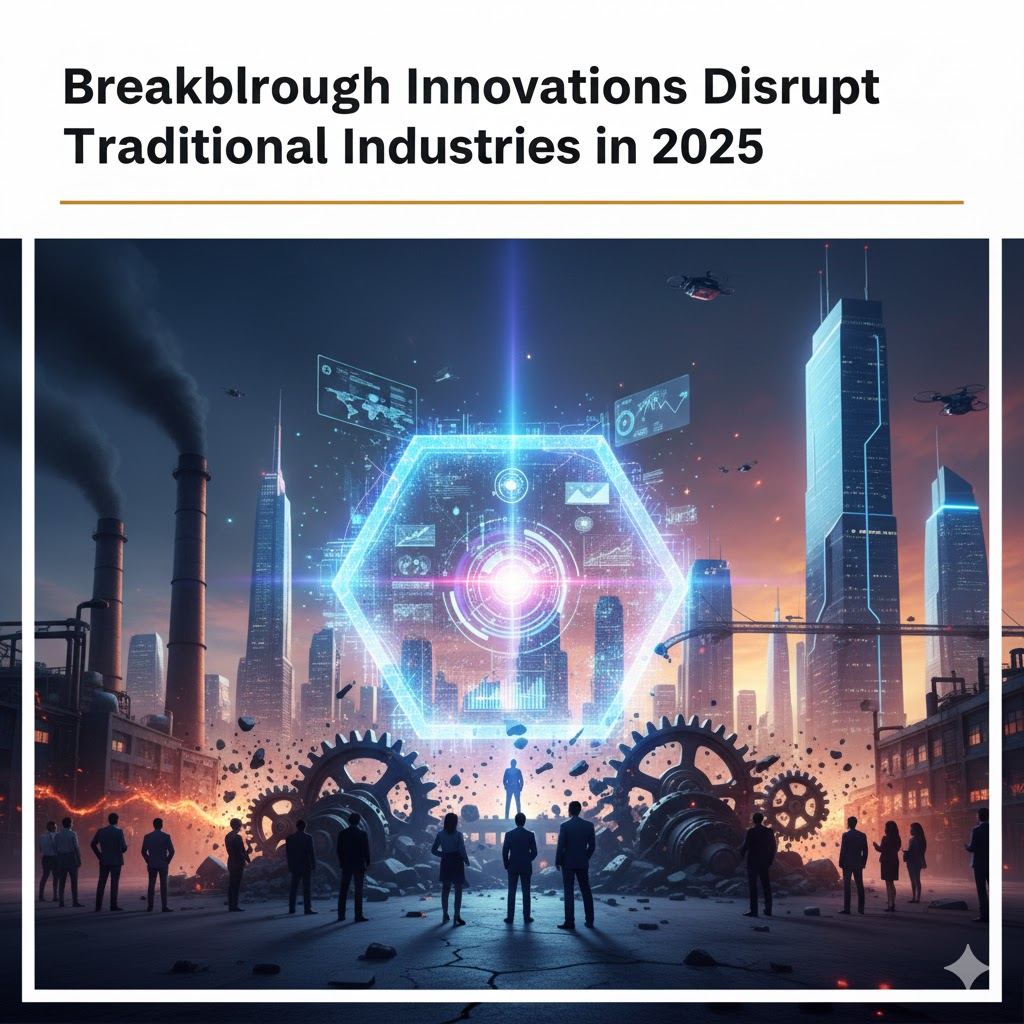
The year 2025 is shaping up to be a turning point for industries that once relied on stable, time-tested business models. Breakthrough innovations are no longer emerging at the edges of the economy. They are moving into the core of traditional industries, forcing companies to adapt faster than ever before. From manufacturing and healthcare to finance and retail, technology driven change is redefining how value is created and delivered.
Artificial Intelligence Moves From Support to Strategy
Artificial intelligence has evolved beyond a back office tool into a central driver of business strategy. In 2025, companies are using AI to make real time decisions, predict demand, optimize pricing, and manage complex operations with greater accuracy.
Traditional industries such as manufacturing and logistics are leveraging AI powered systems to reduce downtime, improve quality control, and streamline supply chains. In financial services, AI is reshaping risk assessment, fraud detection, and customer engagement. These capabilities are giving forward thinking companies a competitive edge while leaving slower adopters struggling to keep pace.
Automation Redefines the Nature of Work
Automation is transforming how work gets done across labor intensive industries. Advanced robotics and smart machines are taking on tasks that were once manual, repetitive, or error prone. In sectors such as construction, warehousing, and agriculture, automation is improving efficiency and safety while addressing labor shortages.
Rather than eliminating jobs entirely, this shift is changing skill requirements. Workers are increasingly expected to manage, maintain, and collaborate with automated systems. Businesses that invest in reskilling their workforce are finding it easier to integrate these technologies and sustain productivity gains.
Healthcare Innovation Accelerates Patient Centric Care
Healthcare is experiencing one of the most profound transformations. Breakthroughs in data analytics, wearable technology, and remote monitoring are enabling more personalized and preventive care models.
In 2025, digital health platforms are allowing providers to monitor patients beyond clinical settings, improving outcomes while reducing costs. Advances in biotechnology and precision medicine are also shortening drug development timelines and enabling targeted treatments.
These innovations are challenging traditional healthcare delivery models and pushing providers to rethink how services are designed and delivered.
Retail and Consumer Markets Go Fully Digital
Retail is continuing its shift toward digital first experiences. Innovations in data analytics, augmented reality, and supply chain technology are redefining how consumers discover and purchase products.
Physical stores are evolving into experience centers that integrate seamlessly with online platforms. Personalized recommendations, dynamic pricing, and faster fulfillment are becoming standard expectations rather than differentiators.
Traditional retailers that fail to modernize are losing ground to agile competitors who use technology to respond quickly to changing consumer preferences.
Energy and Manufacturing Embrace Smarter Systems
Energy and manufacturing industries are undergoing structural changes driven by innovation. Smart grids, advanced sensors, and predictive maintenance tools are improving efficiency and reliability in energy production and distribution.
Manufacturers are adopting digital twins and connected systems to simulate processes, reduce waste, and accelerate product development. These innovations are lowering costs and supporting sustainability goals while increasing operational resilience.
As a result, traditional production models are being replaced by more flexible and data driven approaches.
Financial Services Face New Competitive Pressures
In financial services, innovation is blurring the lines between banks, fintech firms, and technology companies. Digital payments, embedded finance, and decentralized platforms are reshaping how financial products are delivered.
Customers now expect faster, more transparent, and more personalized services. Traditional institutions are responding by partnering with technology providers or developing in house digital capabilities to stay relevant.
This transformation is creating a more competitive and inclusive financial ecosystem, while also raising new regulatory and security considerations.
The Broader Economic Impact
The disruptive power of innovation in 2025 extends beyond individual industries. Productivity gains, new business models, and changing workforce dynamics are influencing economic growth and competitiveness.
At the same time, disruption brings challenges. Companies must navigate cybersecurity risks, ethical considerations, and workforce transitions. Policymakers and industry leaders are under pressure to balance innovation with stability and inclusivity.
Conclusion
Breakthrough innovations in 2025 are redefining the foundations of traditional industries. What once took decades to change is now evolving in a matter of years. Companies that embrace innovation with clear strategy and adaptability are positioning themselves for long term success. Those that resist change risk becoming obsolete in an economy shaped by continuous disruption.